Back
When Should You Start Step 2 CK Tutoring? A Data-Backed Timeline (2026)
Discover exactly when to start Step 2 CK tutoring based on NBME scores, shelf performance, and rotation schedule. Data-backed decision points for optimal timing and results.
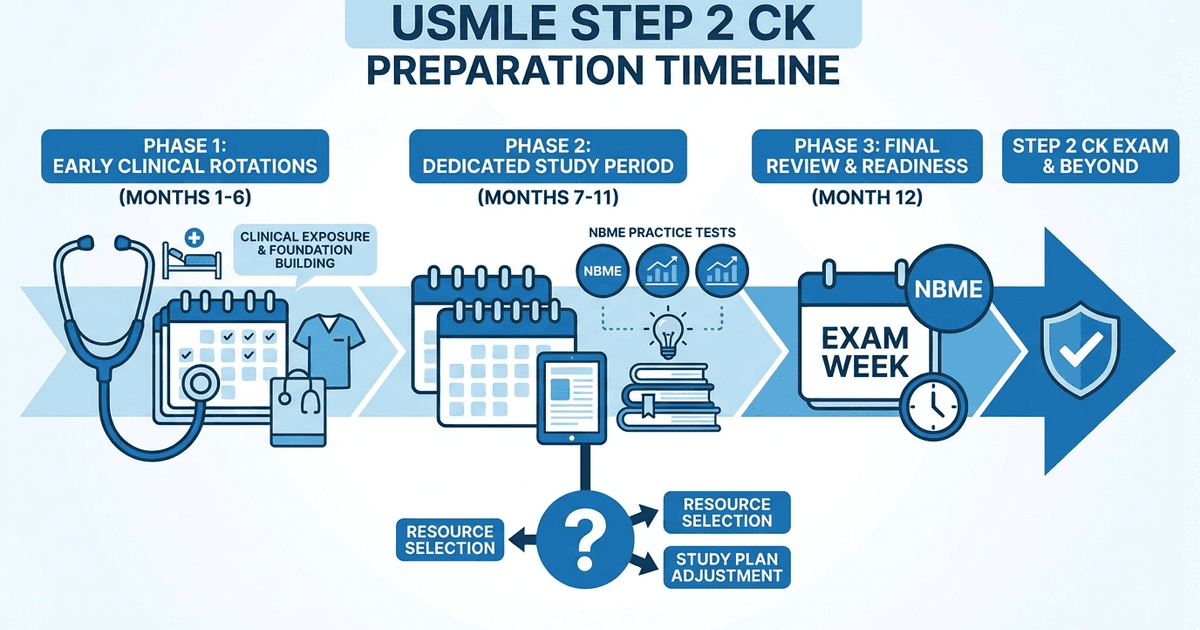
When Should You Start Step 2 CK Tutoring? A Data-Backed Timeline (2026)
You are probably staring at your clinical rotation schedule, wondering when the hell to start Step 2 CK prep. Your third-year friends all say different things. Some started tutoring the first week of rotations. Others waited until dedicated prep. Most have no idea what they are doing.
Here's what actually matters: Step 2 CK has a 52% first-time pass rate among US medical students in 2026. The students who pass don't just study harder — they start at specific trigger points based on their NBME scores, shelf performance, and rotation load. The students who fail wait too long or start too early and burn out.
This timeline gives you concrete decision points. No guesswork. No "it depends" answers. Just the data-backed moments when tutoring becomes worth your time and money.
Phase 1: Pre-Clinical Rotations (Months 1-2 Before Starting)
Start if: You scored below 70th percentile on COMSAE or equivalent baseline assessment. Dont start if: Your school hasnt given you a baseline assessment yet. Seriously — tutoring without knowing your starting point is like driving blindfolded.
Most students skip this phase entirely. Smart move. Your brain is about to get flooded with real patient cases for the first time. Adding tutoring on top creates cognitive overload.
What to do instead: Download question banks and do 10-15 questions daily during your last pre-clinical month. Track which systems feel foreign versus familiar. This becomes your roadmap once rotations start.
The exception: students who consistently scored in the bottom quartile on pre-clinical exams. These students need foundational knowledge before seeing patients, not concurrent with seeing patients.
Phase 2: Early Clinical Rotations (Months 1-4)
Start if: Your first shelf exam score falls below the 40th percentile at your school. Dont start if: You are hitting 60th percentile or higher on shelf exams. The rotations themselves are your tutoring right now.
Here's the pattern that separates high scorers from average ones: high scorers use their first 4 months of rotations to identify knowledge gaps, not to panic about them. They track which shelf questions they miss and why.
During IM rotation, maybe you realize you dont understand heart failure staging. During surgery, you discover you cant distinguish between appendicitis and diverticulitis presentations. These gaps become your tutoring focus later — not comprehensive content review.
Red flag trigger: If you fail any shelf exam in your first 4 rotations, start tutoring immediately. Failed shelf = guaranteed Step 2 CK struggle without intervention.
For students managing their study schedule during this phase, Oncourse's adaptive Daily Plan automatically adjusts your study activities based on weak areas and available time, replacing the need for complex spreadsheets that most students abandon after two weeks.
Phase 3: Mid-Clinical Rotations (Months 5-8)
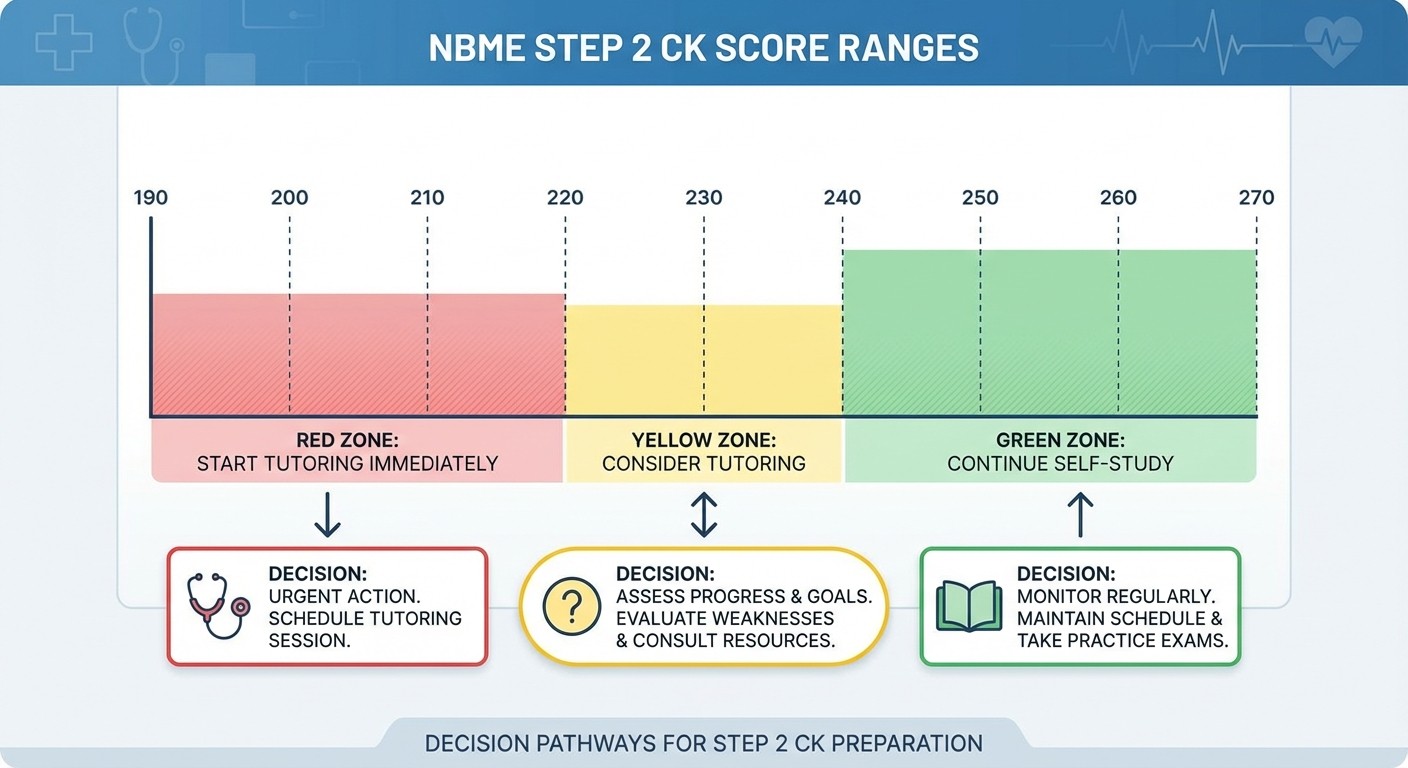
Decision point #1: Take your first NBME Step 2 CK practice test after completing IM, surgery, and at least one other core rotation. Start tutoring if:
NBME score below 210 (roughly 20th percentile)
Consistent shelf scores below 50th percentile
Missed more than 30% of questions in any single system
Continue self-study if:
NBME score above 230 (roughly 60th percentile)
Shelf scores consistently above 60th percentile
No single system with catastrophic knowledge gaps
This is where most students make their biggest mistake. They see a 220 NBME score and panic into tutoring. But 220 with 4-6 months of rotations left is actually on track for a passing score. The students who need tutoring at this point are the ones consistently underperforming across multiple metrics.
The rotation load factor: If you are doing sub-internships or research months during this phase, factor in your bandwidth. Sub-I months with 80-hour weeks dont pair well with intensive tutoring. Wait until you have a lighter rotation.
For targeted weak area practice, filtering Clinical Rounds by specialty (cardiology, nephrology, GI) lets you drill the specific systems where your NBME scores are lowest, directly mirroring the Step 2 CK exam format.
Phase 4: Late Clinical Rotations (Months 9-12)
Decision point #2: Take your second NBME after completing all core rotations. Start tutoring if:
Second NBME score hasnt improved by at least 15 points from first attempt
Still scoring below 220 with less than 6 months until test date
Planning to take Step 2 CK within 3-4 months
The 6-month rule: Students who start tutoring more than 6 months before their test date burn out. Students who start less than 2 months before their test date dont have enough time to address fundamental gaps. The sweet spot is 3-5 months out. Shelf score plateau pattern: If your last 3 shelf scores show no improvement despite consistent studying, that's a tutoring trigger regardless of absolute scores. Plateaus indicate you need a different approach, not more of the same approach. Rotation-specific consideration: If you are doing your OB/Gyn, Peds, or Psych rotations in this phase, those shelf exams serve as mini-Step 2 CK prep. Strong performance (70th percentile+) in these areas means you can delay tutoring. Weak performance means start immediately.
During this phase, students benefit from Synapses flashcards for rapid knowledge consolidation, particularly for high-yield mnemonics that stick better than re-reading textbook chapters.
Phase 5: Dedicated Study Period (8-12 weeks before exam)
Everyone should have tutoring or structured prep by this point.
If you reach dedicated study period without any tutoring or structured program, you are flying blind. Even high-performing students benefit from guidance during dedicated prep because the volume of material requires prioritization.
The 8-week minimum: Most successful students dedicate 8-12 weeks to focused Step 2 CK prep. Less than 8 weeks only works if you are already scoring 240+ on NBMEs. Weekly NBME schedule: Take practice tests every 2 weeks during dedicated prep. Your scores should improve by 10-15 points every 2-3 weeks. If they dont, your study approach needs immediate adjustment. Content versus practice ratio: Weeks 1-4 should be 70% content review, 30% practice questions. Weeks 5-8 should be 30% content review, 70% practice questions. Students who maintain 70% content review throughout dedicated prep typically underperform. System-specific tutoring: Even students who dont need comprehensive tutoring often benefit from targeted help in 1-2 systems. If nephrology consistently tanks your practice scores, 4-6 sessions of nephrology-focused tutoring beats 12 weeks of general prep.
For closing knowledge gaps quickly in the final weeks, Explanation Chat provides step-by-step breakdowns of why each answer choice is right or wrong, eliminating the need to re-read entire textbook chapters.
The Financial Reality Check
Tutoring costs: Individual tutoring ranges from $50-200 per hour. Structured programs cost $500-3000 total. The decision isnt just when to start — its whether tutoring provides better ROI than self-study. ROI calculation: If tutoring improves your score by 20 points, that's roughly 15-20 percentile points. For competitive residencies, that score improvement often determines match success. For most students, $1500 in tutoring beats a gap year and reapplication costs. Free alternatives first: Before paying for tutoring, max out free resources. Most students waste money on tutoring when they havent fully used available question banks, practice tests, and structured self-study plans. The diminishing returns point: Once you are consistently scoring above 250 on NBMEs, tutoring provides minimal benefit. Your time is better spent on interview prep and clinical performance.
Red Flags: When to Start Immediately
Regardless of timeline, start tutoring immediately if:
You failed Step 1 (Step 2 CK becomes make-or-break)
You failed any shelf exam twice
Your practice test scores are decreasing over time
You are an IMG with limited clinical experience in the US system
You have documented test anxiety that affects performance
The anxiety exception: Students with severe test anxiety benefit from tutoring earlier in the process. The structure and accountability help manage stress before it becomes paralyzing.
Data-Backed Benchmarks
Based on 2026 NBME performance data:
Timeline | Target NBME Score | Action |
|---|---|---|
6+ months out | 200+ | Continue self-study |
4-6 months out | 210+ | Continue self-study |
2-4 months out | 220+ | Consider tutoring for weak areas |
2-4 months out | <220 | Start comprehensive tutoring |
<2 months out | <240 | Intensive tutoring required |
Pass rates by preparation type:
Self-study only: 47% first-time pass rate
Self-study + question banks: 61% first-time pass rate
Structured program/tutoring: 73% first-time pass rate
Comprehensive tutoring (started early): 84% first-time pass rate
Common Timing Mistakes
Starting too early: Beginning comprehensive tutoring during your first clinical rotations creates competing priorities. You are trying to learn bedside manner, medical decision-making, and test strategy simultaneously. Pick one focus. The course syllabus trap: Many students start tutoring because a prep course "recommends" starting 9-12 months early. These recommendations prioritize course revenue over student outcomes. Start based on your performance data, not their marketing timeline. Waiting for motivation: Motivation follows action, not the reverse. If your scores indicate you need tutoring, start regardless of how motivated you feel. Waiting until you "feel ready" typically means waiting too long. All-or-nothing thinking: You dont need 6 months of comprehensive tutoring. Many students benefit from 4-6 targeted sessions addressing specific weak areas. Match your tutoring intensity to your score gaps.
Building Your Personal Timeline
Step 1: Track your baseline with a diagnostic NBME after completing 2-3 core rotations. Step 2: Set score milestones every 2 months based on your target exam date. Step 3: Monitor shelf exam trends. Three consecutive below-average scores = tutoring trigger. Step 4: Factor in your rotation schedule. Heavy months (sub-I, ICU) are not ideal for starting intensive tutoring. Step 5: Set a final decision point 4 months before your exam date. If you are not on track to pass by then, comprehensive tutoring becomes mandatory.
Frequently Asked Questions
How long before Step 2 CK should I start tutoring?
Most students benefit from starting tutoring 3-5 months before their exam date. Starting earlier than 6 months often leads to burnout, while starting later than 2 months doesnt leave enough time to address fundamental knowledge gaps.
What NBME score indicates I need tutoring?
If you score below 220 on practice NBMEs taken 2-4 months before your exam, consider tutoring. Scores below 210 make tutoring essential, while scores above 230 typically indicate self-study is sufficient.
Should I start tutoring if Im doing well on shelf exams?
If you are consistently scoring above the 60th percentile on shelf exams, focus on self-study initially. Start tutoring only if your NBME practice scores plateau or if you have specific weak areas despite good shelf performance.
Is tutoring worth it for high-scoring students?
Students already scoring 240+ on NBMEs typically see minimal benefit from comprehensive tutoring. However, targeted tutoring for 1-2 weak systems can be valuable even for high performers.
Can I start tutoring during dedicated study period?
Yes, but 8-12 weeks of dedicated prep is the minimum timeframe where tutoring remains effective. Starting tutoring with less than 8 weeks before your exam requires intensive daily sessions to be worthwhile.
How do I know if my shelf scores predict Step 2 CK performance?
Shelf scores correlate moderately with Step 2 CK performance, but NBME practice tests are more predictive. Use shelf scores as early warning indicators, but make tutoring decisions based on NBME results.
The bottom line: start tutoring when your data indicates you need it, not when anxiety tells you to. Track your scores, set clear benchmarks, and make decisions based on performance trends rather than fear.
Prepare smarter with Oncourse AI — adaptive MCQs, spaced repetition, and AI explanations built for USMLE Step 2 CK. Download free on Android and iOS.