Back
USMLE Step 2 CK Score 2026: What's Good, Average, and Competitive
Understand USMLE Step 2 CK scores in 2026: what's passing vs competitive, specialty-specific targets, and how to interpret your score for residency matching success.
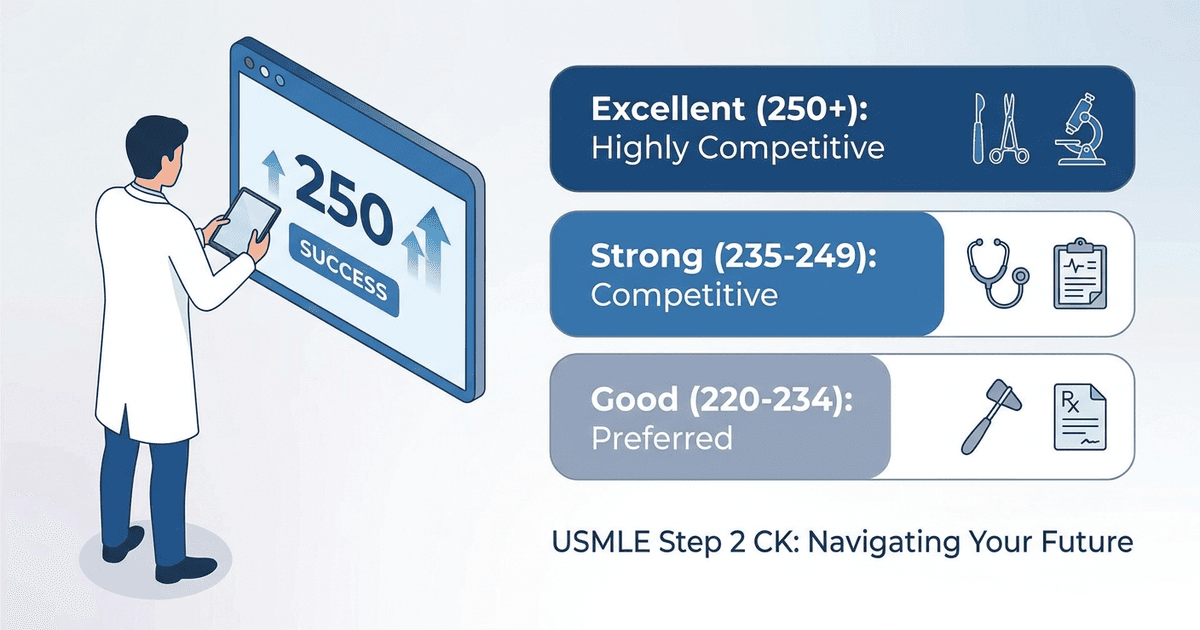
USMLE Step 2 CK Score 2026: What's Good, Average, and Competitive
You just got your Step 2 CK score back. Your heart rate spikes as you see the three-digit number staring back at you. Is 247 good? What about 255? Does 238 kill your chances at internal medicine?
Here's the truth nobody tells you upfront: there's no universal "good" Step 2 CK score. Your 250 might be phenomenal for family medicine but barely competitive for dermatology. The game changed when Step 1 went pass/fail — Step 2 CK is now carrying all the weight.
This guide breaks down exactly what Step 2 CK scores mean in 2026, backed by current USMLE data and NRMP match statistics. No fluff, no false hope. Just the numbers you need to plan your next move.
Understanding USMLE Step 2 CK Scoring in 2026
The Scoring Scale and Minimum Requirements
USMLE Step 2 CK uses a three-digit scoring scale ranging from 1–300. Starting July 1, 2025, the minimum passing score increased from 214 to 218, affecting all examinees testing on or after that date.
This four-point increase came from the USMLE Management Committee's scheduled review, which occurs every 3–4 years. The committee used recommendations from physician panels, surveys of residency program directors, performance trends, and score precision analysis to determine this adjustment.
Key point: 218 is the absolute minimum to continue toward residency. It doesn't guarantee matching anywhere — it just keeps your door open.
Score Distribution: Where Does Everyone Actually Land?
According to the USMLE sample Step 2 CK score report for 2026, first-time examinees from LCME-accredited US and Canadian medical schools have a mean score of 250 with a standard deviation of 15.
This distribution tells us:
68% of students score between 235–265 (within 1 standard deviation)
95% score between 220–280 (within 2 standard deviations)
The median hovers around 250
But here's what matters more: where matched residents actually scored by specialty.
What "Good" Actually Means: Specialty-Specific Breakdowns
The Reality Check: NRMP Match Data
The 2024 NRMP Charting Outcomes shows that US MD seniors who matched to their preferred specialty had a mean Step 2 CK score of 250.4 (SD 13.2). But this number hides massive specialty variations.
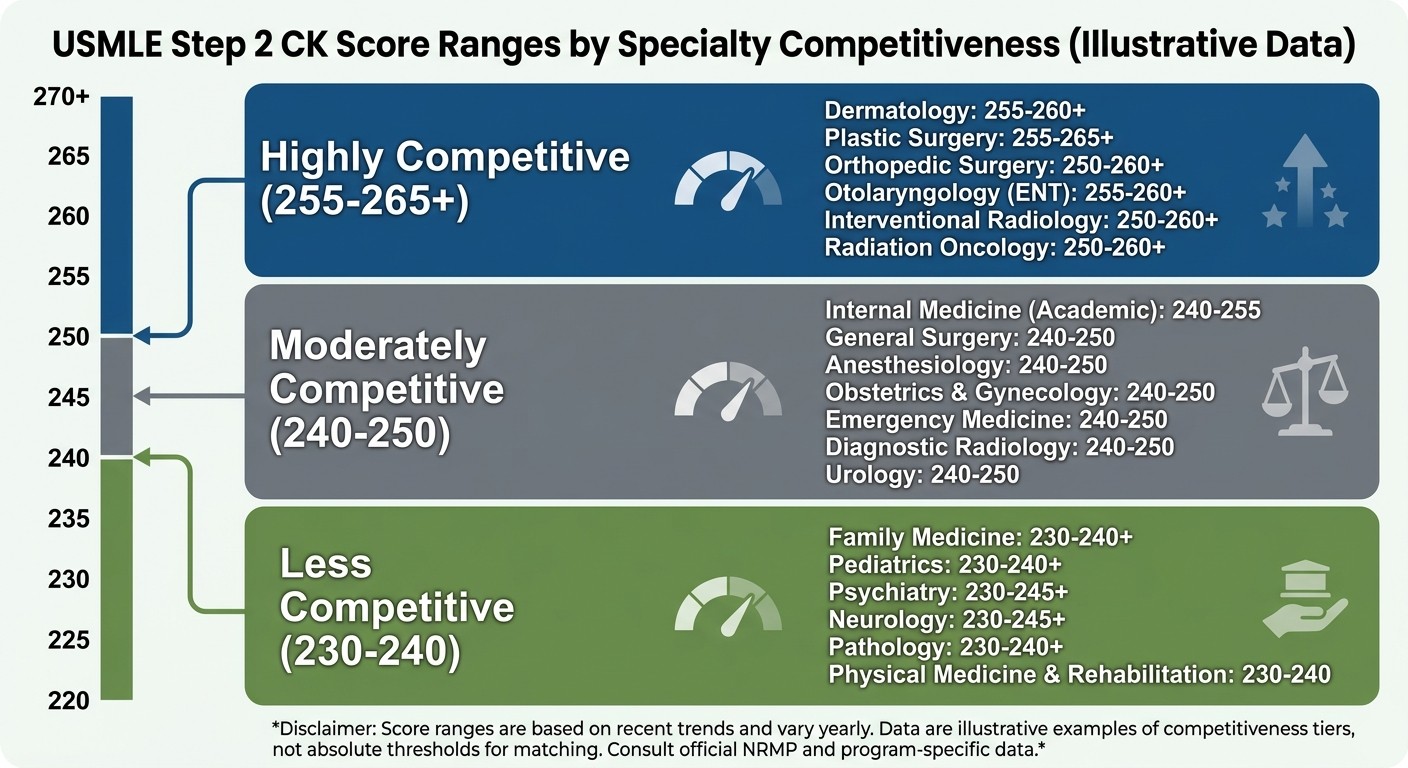
When you break it down by specialty competitiveness, the picture gets clearer:
Highly Competitive Specialties (Mean 255-265+)
Dermatology: ~263
Plastic Surgery: ~261
Orthopedic Surgery: ~258
Ophthalmology: ~257
Radiation Oncology: ~256
Neurosurgery: ~254
Anesthesiology: ~252
Moderately Competitive Specialties (Mean 240-250)
Diagnostic Radiology: ~249
Emergency Medicine: ~247
Neurology: ~245
Psychiatry: ~243
Internal Medicine: ~242
Pediatrics: ~241
Less Competitive Specialties (Mean 230-240)
Family Medicine: ~238
Internal Medicine-Pediatrics: ~236
Pathology: ~235
Physical Medicine & Rehabilitation: ~234
What This Means for Your Target Score
If you're aiming for internal medicine, a 250 puts you above the matched mean. For dermatology, that same 250 sits well below average. The NRMP data shows significant overlap between specialties, but the trends are clear.
After completing a practice block on Oncourse, your predicted score gives you a reality check against these benchmarks — but only after you've attempted more than 35 questions. Before that, the algorithm doesnt have enough data to generate a meaningful prediction.
Score Interpretation: Average vs Good vs Competitive
Passing But Not Competitive (218-235)
Scores in this range meet the minimum requirement but severely limit your options. You're looking at:
Family medicine programs with geographic ties
Less competitive pathology or psychiatry positions
Preliminary year programs
Significant research/connections needed for most specialties
Around Average (235-250)
This range represents the national average for matched applicants. You're competitive for:
Family medicine (very competitive)
Psychiatry (competitive)
Pediatrics (competitive)
Internal medicine (competitive with strong application)
Pathology (very competitive)
The key insight: when Oncourse's topic breakdown shows consistent weak areas below 60% accuracy, those specific deficits can tank your score even if you're solid elsewhere. The clinical knowledge tested spans Medicine (55-65%), Pediatrics (17-27%), OB-GYN (10-20%), Psychiatry (10-15%), and Surgery (5-15%) according to USMLE content specifications.
Good Scores (250-260)
Now you're above the national matched mean. This opens doors to:
Internal medicine at competitive programs
Emergency medicine (competitive)
Neurology (competitive)
General surgery (competitive with strong clinical grades)
Most psychiatry programs
Anesthesiology (competitive)
Highly Competitive (260+)
Scores above 260 put you in the running for the most competitive specialties:
Dermatology (still need near-perfect everything else)
Orthopedic surgery
Ophthalmology
Diagnostic radiology
Radiation oncology
Plastic surgery
The IMG Reality: Different Standards Apply
International Medical Graduates face a persistent 15-20 point gap compared to US MDs across most specialties. For internal medicine, matched IMGs average around 232 compared to US MD's 247.
This means:
IMG target for internal medicine: 250+ to be competitive
IMG target for family medicine: 240+ for reasonable chances
IMG target for competitive specialties: Often need 270+ when US MDs match with 255+
The gap isn't fair, but it's consistent across the data. Plan accordingly.
Converting Your Score Into Action
If You Haven't Taken Step 2 CK Yet
Set your target based on your specialty list:
Aiming for primary care: Target 245+ for comfort
Aiming for internal medicine: Target 250+
Aiming for competitive specialties: Target 265+
IMG applying broadly: Add 15-20 points to any target
Oncourse's daily plan adjusts based on your performance gaps, cycling between new content (momentum subject), low-accuracy remediation (topics below 60%), and spaced revision of older material. This systematic approach addresses the breadth needed for Step 2 CK's clinical focus.
If You Already Have Your Score
Score below target: Focus on strengthening your overall application. Research, clinical grades, away rotations, and geographic ties become crucial. Consider applying broadly within and below your target competitiveness level. Score at target: You're in the game. Now execution on other application components determines your success. Score above target: You have flexibility. Use your strong Step 2 CK to aim higher or to offset weaknesses elsewhere in your application.
The Percentile Game: Understanding Your Position
USMLE doesnt publish exact percentiles anymore, but we can estimate based on the normal distribution:
Score | Approximate Percentile |
|---|---|
218 | ~2nd percentile |
235 | ~16th percentile |
250 | ~50th percentile |
|---|---|
265 | ~84th percentile |
280 | ~98th percentile |
Remember: these percentiles are among all test-takers, not just matched applicants. Among matched residents, a 250 might be 30th percentile for dermatology but 70th percentile for family medicine.
Beyond the Score: What Programs Actually Value
While Step 2 CK carries enormous weight post-Step 1 pass/fail, programs evaluate holistically:
Clinical Performance: Your shelf exam scores and clinical grades matter enormously. A 240 Step 2 CK with honors in relevant rotations beats a 255 with average clinical grades. Research: Competitive specialties expect meaningful research. One quality publication trumps ten abstracts. Away Rotations: For competitive specialties, away rotations remain crucial for demonstrating fit and securing strong letters. Geography: State ties matter more for some specialties (family medicine) and less for others (dermatology).
Red Flags and Score Interpretation
Multiple Attempts
If you took Step 2 CK more than once, programs see all attempts. A 235 → 255 jump shows improvement but raises questions about your baseline knowledge. A 255 → 245 decline is concerning and needs explanation.
Step 1 Pass/Fail Context
Programs can no longer use Step 1 scores to differentiate, making Step 2 CK disproportionately important. A strong Step 2 CK can overcome uncertainty about your Step 1 performance.
Timing Matters
Taking Step 2 CK late in MS4 (after applications) limits its impact. Early MS4 or late MS3 timing maximizes your score's application value.
Study Strategy Based on Target Score
For Scores 240-250 (Solid Foundation)
Focus on high-yield topics across all major subjects
Emphasize pattern recognition over rare pathology
Target 75-80% accuracy on practice questions
Allow 8-12 weeks of dedicated study
for Scores 250-265 (Competitive Range)
Master both common presentations and atypical cases
Include subspecialty medicine topics
Target 80-85% accuracy on practice questions
Plan 10-14 weeks of dedicated study
Consider additional question banks beyond UWorld
For Scores 265+ (Top Tier)
Know rare presentations and zebra diagnoses
Master complex management algorithms
Target 85%+ accuracy consistently
Plan 12-16 weeks with multiple resources
Include research-grade understanding of pathophysiology
When your practice scores plateau, Oncourse's spaced repetition system helps consolidate weak areas through targeted review rather than random repetition.
Specialty-Specific Score Guidance
Internal Medicine
Competitive score: 250+ Safety score: 240+ Red flag: <235
Internal medicine programs increasingly screen by Step 2 CK. Geographic ties and research help, but the score threshold is rising. IMGs typically need 250+ for serious consideration.
Emergency Medicine
Competitive score: 255+ Safety score: 245+ Red flag: <240
EM has become more competitive post-COVID. Away rotations matter enormously, but they won't overcome a significantly low Step 2 CK.
Family Medicine
Competitive score: 245+ Safety score: 235+ Red flag: <225
Family medicine remains accessible with lower scores, especially with strong geographic ties or underserved commitment. But top programs still expect competitive scores.
Surgery Specialties
Competitive score: 255+ (general surgery), 265+ (competitive surgical subspecialties) Safety score: 245+ (general surgery) Red flag: <240
Surgical specialties weigh clinical performance heavily, but Step 2 CK provides the initial screen. Research productivity and away rotations become crucial at the competitive level.
Score Release and Next Steps
Immediate Post-Score Actions
If you passed: Celebrate briefly, then analyze where you stand relative to your specialty targets. Update your application strategy accordingly. If you didnt pass: You have time to remediate and retake before applications, but this adds significant stress to your timeline. Consider adjusting your specialty targets to allow more time for improvement.
Timeline Considerations
Score received early MS4: Maximum flexibility for application strategy
Score received mid-application season: Limited ability to adjust, but still valuable for interviews
Score received late in season: Minimal impact on current cycle, plan for next year if needed
Frequently Asked Questions
What's considered a "good" USMLE Step 2 CK score in 2026?
There's no universal "good" score — it depends entirely on your target specialty. For family medicine, 245+ is competitive. For internal medicine, aim for 250+. For highly competitive specialties like dermatology or orthopedic surgery, you'll typically need 265+. The national mean for matched US MD seniors is 250.4 according to NRMP data.
Is 250 competitive for USMLE Step 2 CK?
A 250 is exactly at the national average for matched US MD seniors and is competitive for many specialties including internal medicine, pediatrics, and psychiatry. It's above average for family medicine and pathology, but below average for competitive specialties like dermatology (mean ~263) or orthopedic surgery (mean ~258). Context matters.
What's the minimum passing score for Step 2 CK in 2026?
The minimum passing score is 218 for exams taken on or after July 1, 2025. This represents a 4-point increase from the previous minimum of 214. However, passing doesn't guarantee matching — most specialties require scores well above the minimum for competitive applications.
How much higher do IMG scores need to be compared to US MD scores?
IMGs typically need scores 15-20 points higher than US MDs for the same specialty competitiveness. For example, while US MDs match to internal medicine with an average of ~247, matched IMGs average around 232 — but competitive IMG applicants often need 250+ to have reasonable chances at quality programs.
Can a high Step 2 CK score make up for a low Step 1 pass?
Since Step 1 is pass/fail, programs can't see your actual Step 1 score — only that you passed. This makes Step 2 CK disproportionately important. A strong Step 2 CK (260+) can definitely overcome concerns about your Step 1 performance, especially when combined with strong clinical grades and research.
How long should I study to achieve a competitive Step 2 CK score?
Study duration depends on your target score and baseline knowledge. For scores in the 240-250 range, plan 8-12 weeks of dedicated study. For competitive scores (250-265), allow 10-14 weeks. For top-tier scores (265+), budget 12-16 weeks. Quality of study matters more than raw time — focus on active learning and spaced repetition rather than passive review.
---
Prepare smarter with Oncourse AI — adaptive MCQs, spaced repetition, and AI explanations built for USMLE Step 2 CK. Download free on Android and iOS.