USMLE Step 1 Immunology: High-Yield Topics, Practice Strategy and Weak-Area Review
Master USMLE Step 1 immunology with high-yield topics, question-first study loops, and systematic weak-area review. Target hypersensitivity, immunodeficiencies, and cytokines effectively.
USMLE Step 1 Immunology: High-Yield Topics, Practice Strategy and Weak-Area Review
You probably opened another immunology resource hoping this one will finally make the cytokines stick. The truth is, most students treat USMLE Step 1 immunology like a memorization marathon — drilling isolated facts about IL-12 and complement pathways without understanding why these concepts matter for your actual exam performance.
Here's what actually happens on Step 1: immunology doesn't live in its own bubble. Those 10-15% of immunology questions show up wrapped in cardiology stems (think myocarditis), pharmacology questions (monoclonal antibody mechanisms), and infectious disease scenarios (opportunistic infections in specific immunodeficiencies). Success comes from recognizing patterns and mechanisms, not from memorizing every cytokine's molecular weight.
This guide focuses on the three elements that separate high performers from those who struggle: targeting genuinely high-yield topics, building question-first study loops, and converting missed questions into systematic weak-area practice.
What Makes Immunology High-Yield for Step 1
Step 1 immunology questions test pattern recognition in clinical contexts. The NBME doesn't ask you to list cytokine functions — instead, you get a 45-year-old with recurrent Neisseria infections, and you need to recognize late complement deficiency (C5-C9).
High-yield immunology falls into three tiers: Tier 1 (Core — 60-70% of questions):
Hypersensitivity reactions Types I-IV with clinical examples
Basic immune cell functions and interactions
Antibody classes and their roles
Complement system pathways and deficiencies
Antigen presentation (MHC I vs II)
Tier 2 (High-frequency — 20-25% of questions):
Primary immunodeficiencies (Bruton, SCID, DiGeorge, CVID, CGD)
Autoimmune disease mechanisms (SLE, RA, MS patterns)
Key cytokines and their clinical implications
Vaccine mechanisms and contraindications
Tier 3 (Targeted — 10-15% of questions):
Transplant rejection types and timing
Tumor immunology and immune evasion
Advanced immunodeficiencies and syndromes
The mistake most students make is spending equal time on all three tiers. Tier 1 concepts appear in multiple question formats across different systems, while Tier 3 topics typically show up once per exam, if at all.
Core High-Yield Immunology Topics
Hypersensitivity Reactions
These show up constantly because they explain drug reactions, autoimmune diseases, and allergic responses across multiple systems.
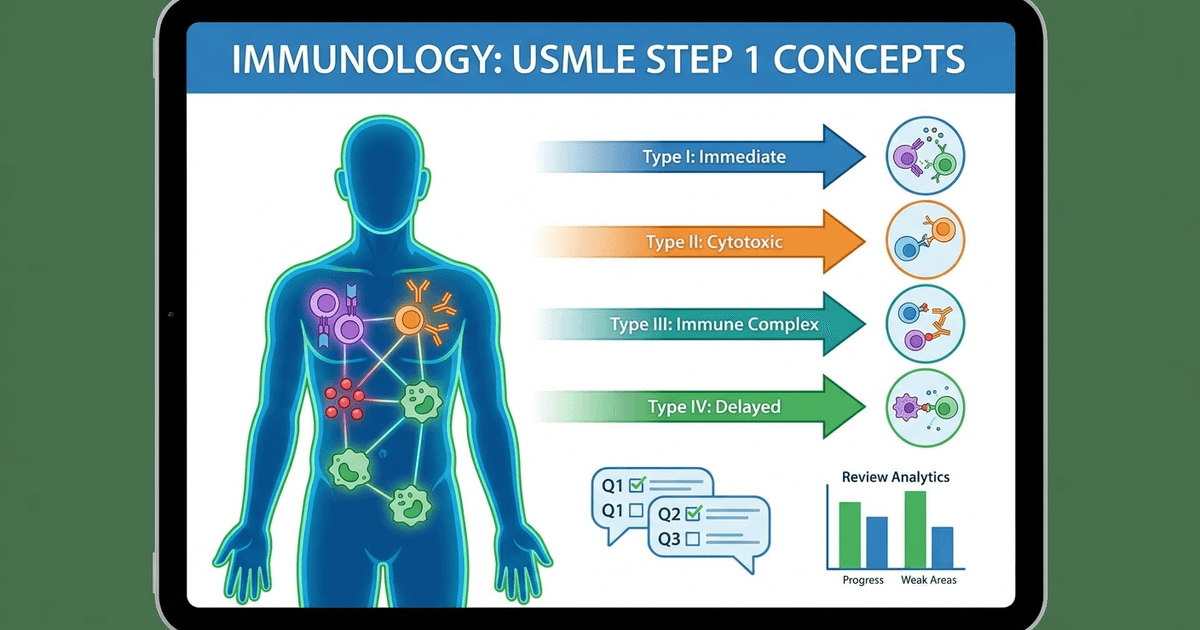
Type I (IgE-mediated): Immediate reaction within minutes. Think anaphylaxis, allergic rhinitis, atopic dermatitis. Mediators include histamine, leukotrienes, and prostaglandins. Clinical clue: onset within 30 minutes, responds to epinephrine and antihistamines. Type II (Antibody-mediated): Direct cell destruction by IgG/IgM. Examples include autoimmune hemolytic anemia, Goodpasture syndrome (anti-GBM), and myasthenia gravis (anti-AChR). Timeline: hours to days. Type III (Immune complex-mediated): Antigen-antibody complexes deposit in tissues. Classic examples: SLE nephritis, post-streptococcal GN, serum sickness. Timeline: days to weeks. Look for complement consumption (low C3, C4). Type IV (T-cell mediated): Delayed reaction taking 48-72 hours. Examples include contact dermatitis, tuberculin skin test, and organ transplant rejection. No antibodies involved — pure T-cell response.
Essential Cytokines and Their Clinical Context
Rather than memorizing every cytokine, focus on the ones that frequently appear in Step 1 stems:
IL-1: Fever and acute-phase response. Think sepsis scenarios. IL-2: T-cell growth factor. Deficiency leads to severe immunodeficiency. IL-4: Drives IgE class switching. High in allergic diseases. IL-5: Eosinophil recruitment. Look for parasitic infections or allergic responses. IL-6: Acute-phase protein synthesis. Elevated in inflammatory conditions. IL-12: Drives Th1 response. Deficiency causes mycobacterial susceptibility. IFN-γ: Macrophage activation. Critical for intracellular pathogen defense. TNF-α: Granuloma formation and cachexia. Target of biologics in RA and IBD.
The key insight: these cytokines don't exist in isolation. IL-12 and IFN-γ work together in Th1 responses against intracellular pathogens, while IL-4 and IL-5 coordinate Th2 responses against parasites and allergens.
Primary Immunodeficiencies with High Clinical Yield
X-linked Agammaglobulinemia (Bruton): No mature B cells, recurrent bacterial infections after maternal antibodies wane (around 6 months). Low/absent immunoglobulins. SCID (Severe Combined Immunodeficiency): Defective T and B cells. Infections from birth, failure to thrive, absent thymic shadow on X-ray. DiGeorge Syndrome: Thymic aplasia, hypocalcemia, cardiac defects. Remember "CATCH-22" — cardiac defects, abnormal facies, thymic aplasia, cleft palate, hypocalcemia, chromosome 22 deletion. Common Variable Immunodeficiency (CVID): Late-onset hypogammaglobulinemia. Adults with recurrent respiratory infections and increased malignancy risk. Chronic Granulomatous Disease (CGD): NADPH oxidase defect. Infections with catalase-positive organisms (Staphylococcus, Aspergillus, Serratia, Nocardia).
When reviewing these, ask: "What's the pattern of infections?" This helps you recognize the deficiency type in clinical vignettes.
Autoimmune Disease Mechanisms
SLE: Type III hypersensitivity with immune complex deposition. Anti-dsDNA and anti-Smith antibodies are specific. Complement levels (C3, C4) often low due to consumption. Rheumatoid Arthritis: Synovial inflammation with pannus formation. Anti-CCP antibodies more specific than rheumatoid factor. TNF-α plays a central role (hence TNF inhibitor therapy). Multiple Sclerosis: Th1-mediated attack on myelin. Oligoclonal bands in CSF, demyelinating plaques on MRI. Myasthenia Gravis: Anti-acetylcholine receptor antibodies cause neuromuscular junction dysfunction. Thymic abnormalities common.
Building a Question-First Study Loop
Most students read about immunology, then attempt questions. This backwards approach leads to passive recognition without active recall. Instead, use questions as your primary learning tool.
The Five-Step Question Loop:
1. Predict before reading answer choices. After reading the stem, pause and think: "What immunologic mechanism explains this presentation?"
2. Eliminate systematically. Don't just pick the right answer — understand why each wrong option is incorrect.
3. Extract the underlying principle. Every question tests a core concept. What's the takeaway that applies to similar scenarios?
4. Connect to related concepts. How does this mechanism relate to other immunologic processes you've studied?
5. Create a mental model. Visualize the pathway or mechanism. This helps with recall under exam pressure.
For example, if you miss a question about recurrent Neisseria infections, don't just note "late complement deficiency." Think through the complement cascade, understand why C5-C9 deficiency specifically predisposes to Neisseria, and connect this to the membrane attack complex function.
Using tools like Oncourse's Rezzy AI tutor can help when you're stuck on complex explanations — it can walk you through the reasoning step by step, helping you understand not just what the answer is, but why the other options don't fit the clinical picture.
Systematic Missed Question Review
Every missed immunology question falls into one of five categories. Identifying the gap type helps you target your review appropriately.
Knowledge Gap
You simply didn't know the fact being tested.
Example: Not knowing that IL-12 deficiency causes mycobacterial susceptibility. Fix: Create a focused flashcard with the key association. Use spaced repetition with Synapses to reinforce recall over time.
Mechanism Gap
You knew isolated facts but didn't understand how they connect.
Example: Knowing that complement deficiency causes infections, but not understanding why C5-C9 deficiency specifically affects Neisseria. Fix: Draw out the pathway or mechanism. Understand the "why" behind the association. When you encounter confusing explanations, tools like Explanation Chat can help clarify the underlying mechanisms through follow-up questions.
Stem-Reading Gap
You misread a key detail in the question stem.
Example: Missing that the patient is immunocompromised, changing your differential entirely. Fix: Practice highlighting key clinical details before looking at answer choices. Time pressure causes most stem-reading errors.
Differential Diagnosis Gap
You recognized the general category but couldn't distinguish between similar conditions.
Example: Knowing it's an immunodeficiency but unable to distinguish between CVID and X-linked agammaglobulinemia. Fix: Create comparison tables. Focus on distinguishing features: age of onset, specific infections, laboratory findings.
Spaced-Review Gap
You knew this concept previously but forgot it due to inadequate review.
Fix: This is where systematic spaced repetition becomes crucial. The concepts you "knew but forgot" need more frequent review cycles.
Converting Repeated Misses into Daily Weak-Area Sessions
When you consistently miss questions from the same immunology subtopics, it signals a systematic weakness that needs targeted intervention.
Step 1: Track your misses by subtopic. Keep a simple log:
Hypersensitivity mechanisms: 4 misses
Primary immunodeficiencies: 6 misses
Cytokine functions: 3 misses
Complement pathways: 5 misses
Step 2: Prioritize based on frequency and impact. Topics with both high miss rates and high clinical importance get priority. Primary immunodeficiencies appearing in 6 missed questions need immediate attention. Step 3: Create focused practice sessions. Instead of random question blocks, target your weak areas. Spend 30-45 minutes on immunodeficiency questions only, then review every explanation thoroughly. Step 4: Use adaptive targeting. Tools like Oncourse's Daily Plan can automatically identify your weak topics from practice performance and route targeted questions into your daily study sessions. Step 5: Monitor improvement. Track your accuracy in weak areas over time. Once you're consistently scoring >70% in a subtopic, you can reduce focused practice frequency.
The goal isn't perfection — it's consistent competence. A weak area becomes manageable when you can reliably recognize the pattern and eliminate wrong answers, even if you occasionally miss subtle distinctions.
Combining Flashcards with Practice Questions
Most students either do pure question practice or pure flashcard review. The most effective approach combines both strategically.
Use flashcards for factual recall:
Cytokine sources and functions
Immunodeficiency key features
Antibody class characteristics
Complement pathway components
Use questions for application and integration:
Recognizing clinical presentations
Distinguishing between similar conditions
Understanding mechanisms in context
Practicing under time pressure
The critical principle: never rely on passive rereading. Whether you're reviewing flashcards or question explanations, force yourself to actively recall information before checking the answer.
For efficient spaced repetition, focus your flashcard reviews on concepts you miss in practice questions. This creates a feedback loop — questions identify gaps, flashcards fill them, and subsequent questions test retention.
When you encounter a cytokine you've never heard of in a question explanation, immediately create a flashcard. But don't create flashcards for every minor detail — focus on information that's likely to recur in different question contexts.
Final-Sprint Strategy: 90/60/30/14/7 Days Out
Your immunology review strategy should intensify as you approach Step 1, but the focus shifts from learning new material to reinforcing and integrating existing knowledge.
90 Days Out: Foundation Building
Complete first pass of high-yield immunology topics
Begin systematic question practice (20-30 immunology questions daily)
Create initial flashcard deck for core concepts
Identify major weak areas through practice performance
60 Days Out: Integration Phase
Focus on mixed question blocks that include immunology
Emphasize connections between immunology and other systems
Target persistent weak areas with focused practice sessions
Begin timed practice to simulate exam conditions
30 Days Out: Pattern Recognition
Primarily mixed blocks with occasional targeted review
Focus on rapid pattern recognition in question stems
Review only your most persistent weak areas
Maintain daily flashcard review for core facts
14 Days Out: Maintenance Mode
Mixed blocks only — no new targeted practice
Quick daily review of core immunology facts (15-20 minutes)
Focus on confidence building and stress management
Address only glaring gaps discovered in practice tests
7 Days Out: Final Reinforcement
Light question review focusing on high-yield topics only
Quick flashcard review of most-missed concepts
No new material — trust your preparation
Maintain routine but reduce intensity
The key principle throughout: trust your systematic preparation. Students who panic and cram new immunology material in the final week often perform worse than those who maintain consistent review of well-practiced concepts.
Common Immunology Study Mistakes
Mistake 1: Memorizing lists without understanding mechanisms.
Students create flashcards like "IL-4 → IgE class switching" without understanding how IL-4 signals B cells or why this matters clinically. Focus on the "why" behind every association.
Mistake 2: Skipping incorrect answer choices.
Every wrong answer in immunology questions represents a potential trap on exam day. Understanding why complement deficiency doesn't explain recurrent viral infections reinforces your understanding of complement's role against bacteria.
Mistake 3: Not tagging weak topics systematically.
Many students notice they struggle with immunodeficiencies but never quantify the problem or create targeted practice. Track your misses and address patterns systematically.
Mistake 4: Over-reviewing comfortable material.
It feels good to review cytokines you already know well, but this doesn't improve your score. Spend time on topics that challenge you, even when it's uncomfortable.
Mistake 5: Treating immunology as isolated from other systems.
Immunology appears in cardiology questions (myocarditis), nephrology stems (post-streptococcal GN), and rheumatology scenarios (autoimmune diseases). Study these connections, not just pure immunology.
Mistake 6: Passive question review.
Reading explanations without actively thinking through the reasoning leads to false confidence. Force yourself to explain why each answer is right or wrong before reading the explanation.
Frequently Asked Questions
How many immunology questions should I expect on Step 1?
Expect 25-40 questions with primary immunology content, but immunology concepts appear in many other questions across systems. Total immunology-related questions likely reach 60-80 per exam.
Should I memorize every cytokine function?
No. Focus on the 8-10 cytokines that appear repeatedly in clinical contexts: IL-1, IL-2, IL-4, IL-5, IL-6, IL-12, IFN-γ, and TNF-α. Others should at least be recognizable when you see them.
How do I distinguish between similar immunodeficiencies?
Create comparison tables focusing on three key factors: age of onset, type of infections, and specific laboratory findings. For example, Bruton causes bacterial infections after 6 months with absent B cells, while SCID causes all infection types from birth with absent T and B cells.
What's the best way to review missed immunology questions?
Categorize each miss: knowledge gap, mechanism gap, stem-reading error, differential diagnosis confusion, or spaced-review failure. Address each category differently — some need flashcards, others need pathway diagrams or comparison tables.
Should I do dedicated immunology question blocks?
Yes, during your weak-area targeting phase. But mix these with integrated blocks that test immunology alongside other systems. This mimics exam day conditions where immunology appears in various contexts.
How often should I review immunology flashcards?
Daily review of new cards, with spaced intervals for previously learned material. High-yield concepts might need review every few days, while well-mastered material can be reviewed weekly or biweekly.
Prepare smarter with Oncourse AI — get AI explanations for complex immunology mechanisms with Rezzy, reinforce recall through spaced repetition with Synapses, and let Daily Plan route your weak areas into targeted practice sessions. Download free on Android and iOS.