UPSC CMS Question Bank: How to Practice Questions That Expose Weak Areas
Master UPSC CMS question bank strategy that diagnostically exposes weak areas in Medicine, Surgery, Paediatrics, and Preventive Medicine. Learn targeted practice methods that convert missed questions into exam success.

UPSC CMS Question Bank: How to Practice Questions That Expose Weak Areas
You have been grinding through UPSC CMS questions for weeks, but your mock test scores aren't moving. Sound familiar? That's because most doctors approach question banks like they're checking boxes — 50 questions here, 100 there, move on. But UPSC CMS doesn't reward volume. It rewards diagnostic thinking, pattern recognition, and the ability to eliminate wrong answers under time pressure.
The CMS exam tests 240 questions across Paper I (General Medicine, Paediatrics) and Paper II (Surgery, Gynaecology & Obstetrics, Preventive & Social Medicine) in just 4 hours. That's 60 seconds per question, including the time to read clinical vignettes, analyze data, and mark your answer. Random question grinding won't prepare you for this intensity.
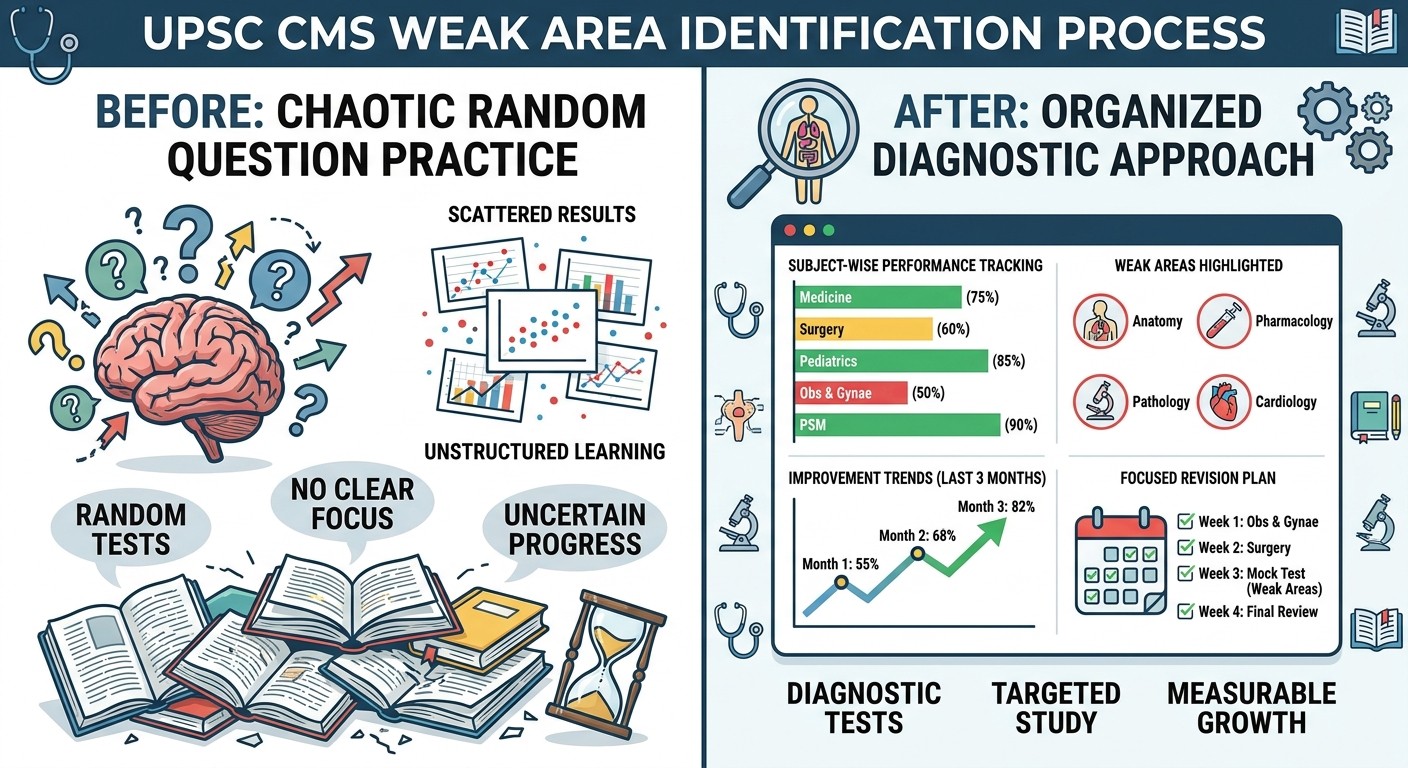
What you need is a question bank strategy that works like a diagnostic tool — one that exposes exactly where your reasoning breaks down, which concepts you're confusing, and what types of mistakes you make repeatedly. This isn't about memorizing 10,000 questions. It's about understanding the 2,000 that matter most.
Why Random Question Grinding Fails
Most CMS aspirants treat question banks like flash cards. They attempt a question, check if they got it right or wrong, maybe glance at the explanation, then move to the next one. This approach creates three major problems:
Surface-level learning: You memorize specific question-answer pairs instead of understanding the underlying principles. When UPSC changes the clinical scenario slightly, you're lost. Weak area blindness: Without systematic tracking, you keep practicing topics you're already good at while avoiding the ones that actually need work. Your Medicine score stays steady while your Surgery knowledge stagnates. False confidence: Getting 70% in mixed practice feels good, but if those correct answers come from easy topics while you're consistently missing Preventive Medicine questions, you're not exam-ready.
The solution isn't more questions. It's smarter question analysis.
What a Good UPSC CMS Question Bank Workflow Should Reveal
Your question bank practice should function like a continuous diagnostic test. After every session, you should know:
Which subjects drag your scores down: Are you consistently missing Surgery questions while acing Medicine? That's a clear signal.
What types of reasoning traps catch you: Do you fall for similar distractors in community medicine? Miss the same pathophysiology connections?
Where time pressure hurts most: Some topics you know well but can't access quickly under exam conditions.
A proper workflow reveals these patterns within 2-3 weeks of consistent practice. Here's what that looks like in practice.
The Diagnostic Question Bank Strategy
Phase 1: Cold Assessment (Week 1)
Start with a completely cold run through mixed questions across all CMS subjects. Don't study first — this baseline reveals your true starting point.
Day 1-2: Attempt 40 questions each from Paper I subjects (General Medicine, Paediatrics) without time pressure. Mark every question you're unsure about, even if you get it right. Day 3-4: Same approach for Paper II (Surgery, Gynaecology & Obstetrics, Preventive & Social Medicine). Focus on identifying question types, not just topics. Day 5: Review all incorrect answers, but don't just read explanations passively. For each wrong answer, identify the reason:
Concept gap (didn't know the principle)
Application error (knew the concept, applied it wrong)
Careless mistake (misread the question)
Reasoning trap (fell for a well-designed distractor)
This first week gives you a map of where you stand. Most doctors discover they're stronger in clinical reasoning than they expected but weaker in Preventive Medicine and surgical emergencies.
Phase 2: Targeted Practice (Weeks 2-4)
Now you practice strategically based on your weak area map. But here's the key: you don't just drill your worst subjects. You practice them in the context they'll appear on the exam.
Subject-wise practice: Take your weakest subject from Phase 1 and do 30-question focused blocks. But Oncourse's adaptive question bank helps here by automatically adjusting question difficulty based on your performance, ensuring you're not just drilling the same easy questions repeatedly. Mixed practice: After each subject-focused session, attempt 20 mixed questions from all subjects. This prevents the false confidence that comes from single-subject practice. Clinical vignette focus: CMS loves complex clinical scenarios. Practice reading these efficiently — scan for age, sex, presenting complaint, and key investigation results first. The rest is often distractor information.
When reviewing explanations, ask yourself: "If they changed one detail in this clinical scenario, would I still get it right?" If not, you haven't learned the underlying principle.
Phase 3: Timed Simulation (Weeks 5-6)
This is where exam reality hits. Start practicing full Paper I and Paper II simulations under strict time conditions.
120-question blocks: Each paper gets 2 hours. That's 60 seconds per question including reading time. No exceptions. Paper-specific strategy: Paper I tends to have longer clinical vignettes in Medicine questions. Paper II has more straightforward Surgery questions but complex community medicine scenarios. Practice accordingly. Performance tracking: After each timed session, analyze not just which questions you got wrong, but which ones took too long. If you're spending 2-3 minutes on Preventive Medicine questions, you need better pattern recognition there.
This is where Oncourse's performance analytics becomes crucial — it tracks your timing patterns across subjects and shows exactly where time pressure is hurting your performance.
Reading Explanations Without Passive Memorization
Most question bank explanations are written like textbook chapters. They give you everything about the topic when you only need to understand why your reasoning went wrong. Here's how to read explanations actively:
Start with the wrong answers: Before reading why the correct answer is right, understand why each wrong answer is wrong. This builds elimination skills. Identify the key differentiator: What one piece of information in the question stem made the difference? This is what you should have recognized faster. Connect to broader principles: How does this question relate to other CMS questions you've seen? Building these connections prevents isolated learning.
When you encounter an explanation that doesn't make sense, don't skip it. This is exactly where you need clarity. Oncourse's explanation chat feature lets you ask follow-up questions on confusing concepts instead of leaving gaps unresolved — particularly useful for community medicine calculations or complex surgical decision trees.
Subject-Specific Weak Area Patterns
Paper I Weak Areas
General Medicine: Most doctors struggle with integrated clinical reasoning rather than factual knowledge. You know what hypertension is, but CMS asks about managing hypertension in a 65-year-old diabetic with kidney disease. Practice multi-system thinking. Paediatrics: Growth charts, immunization schedules, and developmental milestones are high-yield but often poorly practiced. These aren't clinical reasoning questions — they're fact-based, so drill them until automatic.
Paper II Weak Areas
Surgery: Trauma management protocols and surgical emergencies trip up many candidates. These follow standard algorithms, so practice decision trees rather than isolated facts. Gynaecology & Obstetrics: Antenatal care guidelines and emergency obstetrics require memorization of specific protocols. Practice with real clinical scenarios, not theoretical questions. Preventive & Social Medicine: This is where most CMS aspirants lose marks. Community medicine isn't intuitive for clinically trained doctors. It requires memorizing program details, statistical formulas, and policy knowledge. Break this into weekly modules and practice calculation-based questions repeatedly.
Weak Area Tagging System
Create a simple tagging system to track your mistakes systematically. After every question session, categorize each wrong answer:
Knowledge Gap (K): You didn't know the concept or fact needed to answer correctly. Application Error (A): You knew the concept but applied it incorrectly to this specific scenario. Speed Error (S): You knew the answer but rushed and made a careless mistake. Trap Error (T): You fell for a well-designed distractor because you didn't read carefully.
After 2-3 weeks of consistent tagging, patterns emerge. If most of your Surgery mistakes are Tagged 'K', you need more content review. If they're tagged 'A', you need more clinical scenario practice. If they're 'S' or 'T', you need better exam technique, not more studying.
This tagging system works particularly well with question banks that track your performance over time. Instead of just seeing "Surgery: 65%", you see "Surgery: 10 K-errors, 3 A-errors, 2 T-errors" — which tells you exactly what to fix.
Weekly Review Loops
Every week, conduct a formal review session. Don't just look at what you got wrong — analyze the patterns:
Monday: Review all tagged errors from the previous week. Create 3-4 bullet point summaries for each Knowledge Gap. Wednesday: Attempt 20 questions from your worst-performing subject, focusing on question types you consistently miss. Friday: Mixed practice session, then compare this week's performance to last week's in each subject. Sunday: Plan next week's focus areas based on which tags appeared most frequently.
This weekly rhythm prevents you from practicing aimlessly. Each session has a specific diagnostic purpose.
Timed vs Untimed Practice
Both serve different purposes in CMS preparation:
Untimed practice (Weeks 1-4): Use this for learning new concepts, understanding explanations deeply, and building clinical reasoning skills. Don't worry about speed yet. Timed practice (Weeks 5-8): This builds exam stamina and teaches you to recognize patterns quickly. Start with generous time limits, then gradually tighten to exam conditions. Mixed sessions: Even during timed practice, include some untimed questions from your weak areas. This ensures you're not sacrificing understanding for speed.
The mistake most aspirants make is jumping straight to timed practice. You need the foundation first.
Final 30-Day Strategy
Your last month should shift from learning to performance optimization:
Days 1-15: Full paper simulations every other day. Alternate between Paper I and Paper II. Focus on maintaining accuracy under time pressure. Days 16-25: Subject-wise rapid review combined with high-yield question drilling. If community medicine is still weak, dedicate extra sessions to calculation-based questions. Days 26-30: Light practice only. Full paper simulations twice a week maximum. Focus on maintaining confidence and timing rather than learning new content.
During this final phase, your question bank becomes purely diagnostic — you're not learning new concepts, just identifying and fixing any remaining weak spots before exam day.
Common Mistakes in Question Bank Practice
Mistake 1: Explanation addiction
Reading every explanation, even for questions you got right, wastes time. Only read explanations for wrong answers and questions you weren't confident about.
Mistake 2: Subject avoidance
If you hate Preventive Medicine, you'll unconsciously avoid those questions. Force yourself to practice weak subjects first when your mental energy is highest.
Mistake 3: Perfectionism paralysis
Trying to get 100% accuracy in practice creates exam anxiety. Aim for consistent improvement, not perfection. CMS candidates who score 70-75% in practice often perform better than those who chase 90% scores.
Mistake 4: Solo practice only
Never discussing difficult questions with peers means you miss alternative approaches to clinical reasoning. Join study groups or use discussion features in question banks.
Mistake 5: Static difficulty
Using the same question bank for months without increasing difficulty level leads to overconfidence. Your practice questions should get harder as you improve.
Converting Weak Areas Into Revision Plans
Once you've identified weak areas, convert them into specific revision tasks:
For knowledge gaps: Create 1-2 page summaries for each weak topic. Focus on high-yield facts, not comprehensive coverage. For application errors: Collect 10-15 similar clinical scenarios for each weak area. Practice recognizing the pattern across different presentations. For speed issues: Time yourself on weak subject questions specifically. If Surgery questions take too long, practice Surgery-only blocks with strict timing. For reasoning traps: Make a list of common distractors in your weak areas. Before attempting questions, remind yourself what to watch for.
This conversion process is what separates diagnostic practice from random grinding. You're not just identifying problems — you're creating specific solutions.
Frequently Asked Questions
How many questions should I practice daily for UPSC CMS?
Quality beats quantity. Practice 80-120 questions daily with proper analysis rather than attempting 200+ questions superficially. The diagnostic approach requires reviewing explanations, tagging errors, and identifying patterns — which takes time but builds lasting understanding.
Should I practice subject-wise or mixed questions?
Use both strategically. Start with subject-wise practice to build confidence and identify weak areas, then shift to mixed practice to simulate exam conditions. In your final 4 weeks, mixed practice should dominate to prevent subject-specific overconfidence.
How do I improve my speed in CMS question solving?
Speed comes from pattern recognition, not rushing. Practice untimed first to build accuracy, then gradually introduce time pressure. Focus on reading questions efficiently — scan for key clinical details first, ignore irrelevant information. Time yourself on weak subjects specifically.
What's the best way to handle negative marking in CMS?
Practice the elimination method consistently. If you can confidently eliminate 2 options, attempt the question. If not, skip it. During practice, track how often your "educated guesses" are correct — this builds confidence in your elimination skills for exam day.
How many mock tests should I take before CMS?
Quality over quantity applies here too. Take 15-20 full-length mocks, but analyze each one thoroughly. One properly analyzed mock teaches more than five that you complete without review. Focus on paper-wise simulations in your final month.
When should I stop learning new topics and focus only on revision?
Stop adding new content 30 days before the exam. Your final month should focus on strengthening weak areas identified through question practice, not covering fresh topics. Use this time for high-yield revision and performance optimization through mock tests.
---
UPSC CMS success isn't about memorizing more facts — it's about developing diagnostic thinking under time pressure. Your question bank practice should mirror what you'll do on exam day: read efficiently, recognize patterns, eliminate wrong answers, and make confident decisions.
The doctors who succeed in CMS treat their preparation like they'd treat a patient: systematically identify the problem areas, create targeted treatment plans, monitor progress regularly, and adjust strategies based on what's working.
Your weak areas aren't permanent limitations. They're simply the topics that need more focused attention. With the right diagnostic approach to question bank practice, every mistake becomes a step toward exam success.
Prepare smarter with Oncourse AI — adaptive MCQs, spaced repetition, and AI explanations built for UPSC CMS. Download free on Android and iOS.