Back
Medical Student Weak Areas: How Oncourse AI Turns Analytics into the Next Study Session
Stop guessing your weak areas. Learn how performance analytics reveal true knowledge gaps and convert data into targeted study sessions for medical exam success.
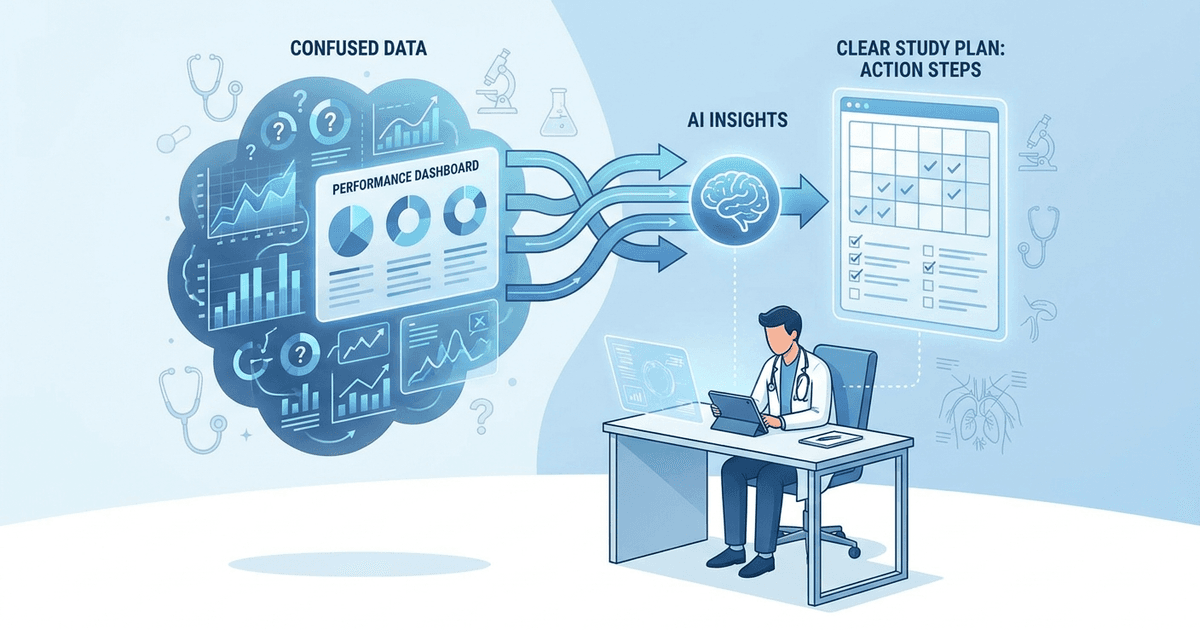
Medical Student Weak Areas: How Oncourse AI Turns Analytics into the Next Study Session
You know that sinking feeling when you realize you just bombed a practice test — but you cant pinpoint exactly where you went wrong. You felt confident about cardiology, yet missed 3 out of 4 cardiac questions. Your internal medicine scores keep fluctuating between 60% and 85%, but you cant tell if its knowledge gaps, timing issues, or test anxiety.
Most medical students rely on gut feelings to identify weak areas. "I think I need to study more pharmacology." "Anatomy feels shaky." But intuition is a terrible diagnostic tool. Research from BMC Medical Education shows that 67% of first-year medical students ranked in the 50th percentile or below when it came to effective use of study resources — largely because they couldn't accurately identify what needed attention.
The solution isn't studying harder. Its studying smarter by letting performance analytics reveal your actual weak areas and convert that data into your next study session.
Why Weak Areas Are So Hard to Spot
Medical exam preparation suffers from a massive data problem. You answer thousands of practice questions across dozens of subjects, but most students only see their final scores. They miss the patterns hiding in their performance data.
The Confidence vs Competence Gap
Feeling confident about a topic and being competent in it are completely different things. A 2024 study in Medical Science Educator found that students using multiple study methods felt more prepared but scored lower on written exams than those using focused approaches. The problem? They confused effort with effectiveness.
When you spend hours reading about myocardial infarction management, you feel like you know it. But if you consistently miss the ECG interpretation questions and nail the treatment protocol ones, your weak area isn't "cardiology" — its ECG pattern recognition specifically.
Performance Has Multiple Layers
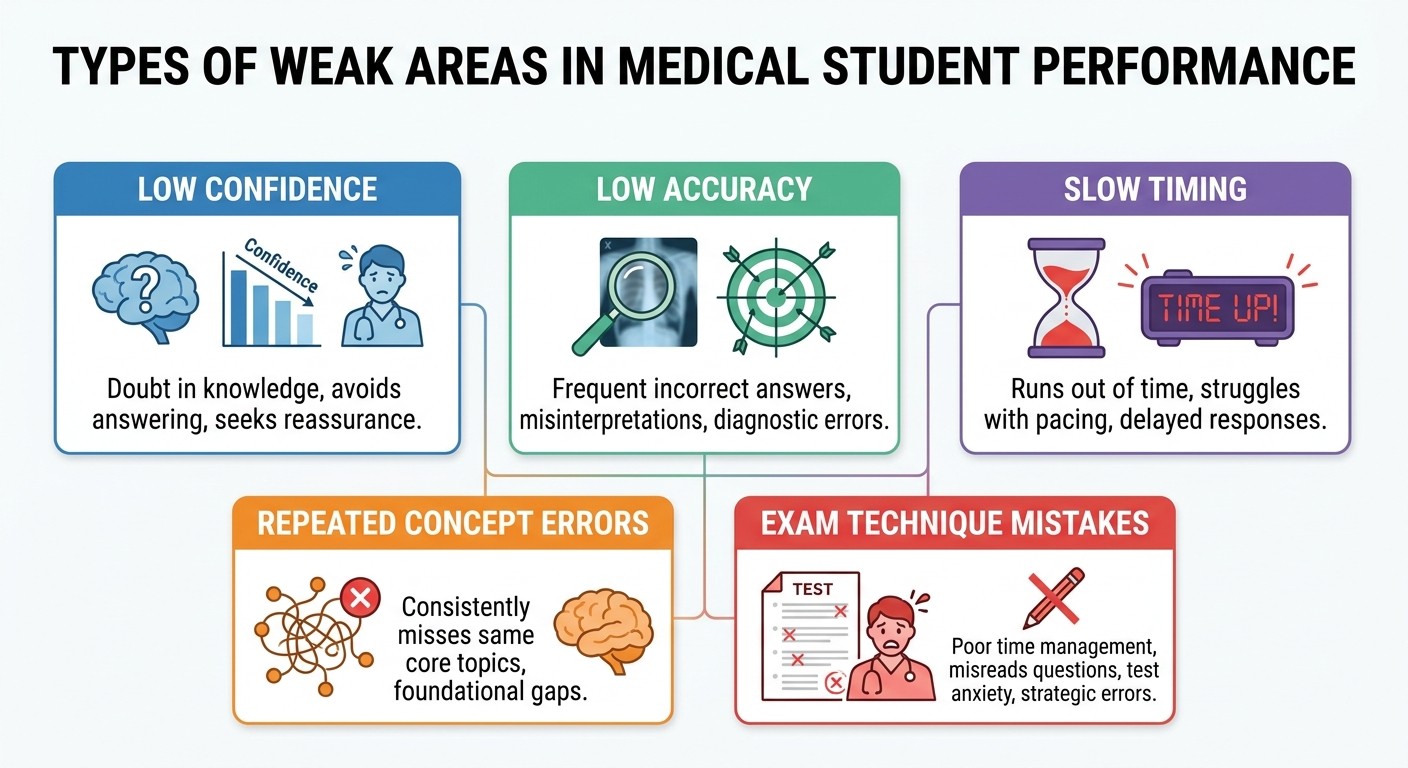
Medical student weak areas come in five distinct flavors:
Low confidence areas: Topics where you feel uncertain but might actually perform well. Often overestimated as weaknesses. Low accuracy areas: Subjects where your percentage correct is genuinely below target. These need content review and concept reinforcement. Slow timing areas: Topics where you get questions right but take too long. The weakness isnt knowledge — its recall speed and pattern recognition. Repeated concept misses: Specific mechanisms, pathways, or reasoning patterns you consistently get wrong across different questions and subjects. Exam technique errors: Missing questions due to misreading stems, falling for distractors, or poor elimination strategies rather than knowledge gaps.
Most students lump everything together as "need to study more." But each type requires a completely different intervention.
The Problem with Traditional Weak Area Analysis
Walk into any medical school library and youll see students manually tracking their question performance in spreadsheets. They might note "Cardiology: 12/20 (60%)" but miss the actionable insights buried in that data.
Traditional methods fail because they focus on surface metrics:
Overall subject percentages
Number of questions attempted
Time spent studying each topic
Subjective confidence ratings
These metrics tell you what happened, but not why it happened or what to do next.
Pattern Blindness in Self-Assessment
Research from the University of Washington Medical School found that students accuracy in predicting their own performance was essentially random. They overestimated performance in areas where they spent more time studying and underestimated performance in topics they found interesting but hadnt formally reviewed.
The reason? Humans are terrible at detecting patterns in their own performance data. You need systems that can spot the trends you cant see.
How Performance Analytics Reveal True Weak Areas
Modern learning analytics can transform raw question data into actionable insights. Instead of seeing "Pharmacology: 65%", you can identify that you consistently miss questions about drug interactions but nail mechanism questions. Instead of "need to study more cardiology," you discover you struggle with heart failure management but excel at arrhythmia recognition.
Drilling Down by Subject, System, and Topic
Effective weak area analysis happens at multiple levels:
Subject level: Your broadest performance categories (Medicine, Surgery, Pharmacology) System level: Organ system breakdowns within subjects (Cardiovascular, Respiratory, GI) Topic level: Granular concept areas within systems (Heart failure vs MI vs Valvular disease) Mechanism level: Specific reasoning patterns (Pathophysiology vs Diagnosis vs Treatment vs Side effects)
The deeper you drill, the more precise your study interventions can become. Instead of spending 3 hours on "cardiology review," you can target 45 minutes on "heart failure medication mechanisms" — the actual gap in your knowledge.
Error Pattern Recognition
Some of the most valuable insights come from analyzing error patterns across different contexts. Maybe you consistently mix up beta-blocker contraindications whether the question appears in cardiology, respiratory, or endocrine contexts. That tells you the weakness isn't subject-specific — its a specific drug class knowledge gap.
Oncourse AI's performance analytics track these cross-cutting patterns automatically. When you miss questions about similar mechanisms across different subjects, the system flags it as a repeated concept miss rather than multiple unrelated weak areas.
Time-Based Performance Analysis
Timing data reveals a different layer of weakness. Consider two students who both score 70% on infectious disease questions:
Student A gets questions right but averages 2.1 minutes per question (target: 1.5 minutes)
Student B hits the timing target but makes careless errors under time pressure
Student A needs pattern recognition practice to speed up recall. Student B needs test-taking strategy work and anxiety management. Same score, completely different interventions needed.
Converting Analytics into Your Next Study Session
Raw data is useless without a clear path to action. The magic happens when analytics systems can tell you not just what youre weak at, but what to do about it right now.
The Three-Decision Framework
Every analytics insight should answer three questions:
1. What should I study next? (Content prioritization)
2. How should I study it? (Method selection based on weakness type)
3. When should I revisit it? (Spacing intervals for different knowledge types)
For example, if analytics show you miss 80% of questions about renal physiology mechanisms, thats a clear content gap requiring concept review and active recall practice. If you miss 40% of renal questions but they all involve similar calculation errors, you need problem-solving practice, not content review.
Adaptive Daily Planning
The most powerful analytics systems don't just diagnose — they prescribe. Oncourse AI's adaptive daily plan takes your performance data and automatically generates targeted study sessions. Instead of generic "do 50 questions," you get specific recommendations like "Review heart failure pathophysiology, then practice 15 HF mechanism questions, followed by 10 mixed cardiology questions for interleaving."
This approach directly addresses the research finding that focused, targeted practice outperforms generic question grinding. When University of Edinburgh researchers tracked medical students using analytics-guided study plans vs traditional approaches, the analytics group showed 23% faster improvement in weak area scores.
Dynamic Intervention Selection
Different weak area types need different interventions:
For content gaps: Concept review followed by spaced repetition. Start with high-level mechanisms, then drill specific details. Use active recall testing every 48-72 hours. For timing issues: Pattern recognition practice under timed conditions. Focus on rapid categorization and decision trees rather than detailed review. For repeated concept errors: Direct explanation review. When you miss a question about drug mechanisms, use Rezzy AI to get targeted explanations of why your reasoning went wrong and how to approach similar questions correctly. For test-taking errors: Question stem analysis practice and distractor identification training.
The key insight: method matters more than minutes. Fifteen minutes of targeted intervention can be more valuable than an hour of generic review.
When to Drill vs Schedule vs Explain
Not every weak area needs immediate intensive focus. Analytics should guide not just what to study, but when and how intensively.
The Drill Decision
Drill a weak area intensively when:
Your accuracy is below 60% in a high-yield topic
You consistently miss fundamental concepts that appear across multiple question types
You have less than 4 weeks before your exam
Drilling means focused sessions with immediate feedback. Do 20-30 questions in the weak area, review every explanation, then test retention 24-48 hours later.
The Schedule Decision
Schedule spaced review when:
Your accuracy is 60-80% but needs reinforcement
The topic is moderate-yield but you have sufficient time before your exam
You previously drilled the area and need retention practice
Use spaced intervals: review in 3 days, then 7 days, then 14 days. Mix the weak topic with stronger areas to prevent forgetting.
The Explain Decision
Seek deeper explanations when:
You get questions wrong despite feeling confident in your answer choice
You consistently fall for the same types of distractors
Your errors involve faulty reasoning rather than missing facts
This is where AI tutors like Rezzy become invaluable. Instead of just seeing "incorrect," you can ask why your reasoning was flawed and how to approach similar questions correctly. The goal isn't more information — its better thinking patterns.
Avoiding the Strength-Study Trap
One of the biggest mistakes revealed by learning analytics: students spend too much time reinforcing topics they already know. Its psychologically rewarding to practice areas where you feel confident and score well, but its not efficient exam preparation.
Research from King Saud University's medical program found that high-performing students spent 60% of their practice time on below-average subjects, while struggling students spent 60% of their time on topics they had already mastered.
The 70-20-10 Rule
Allocate your daily study time using performance data:
70% on genuine weak areas (below target accuracy)
20% on moderate areas that need reinforcement
10% on strong areas to maintain performance
Your analytics dashboard should make this split obvious. If you find yourself gravitating toward comfortable topics, use the data to redirect your focus.
Maintenance vs Improvement Time
Strong subjects need maintenance, not improvement time. Instead of doing 30 cardiology questions because you scored 85% last time, do 5-10 mixed cardiology questions every few days to prevent forgetting.
Use the time you save to drill your actual weak areas. The difference in score improvement between maintaining an 85% area at 85% vs improving a 55% area to 70% is enormous.
Weekly Weak Area Review Workflow
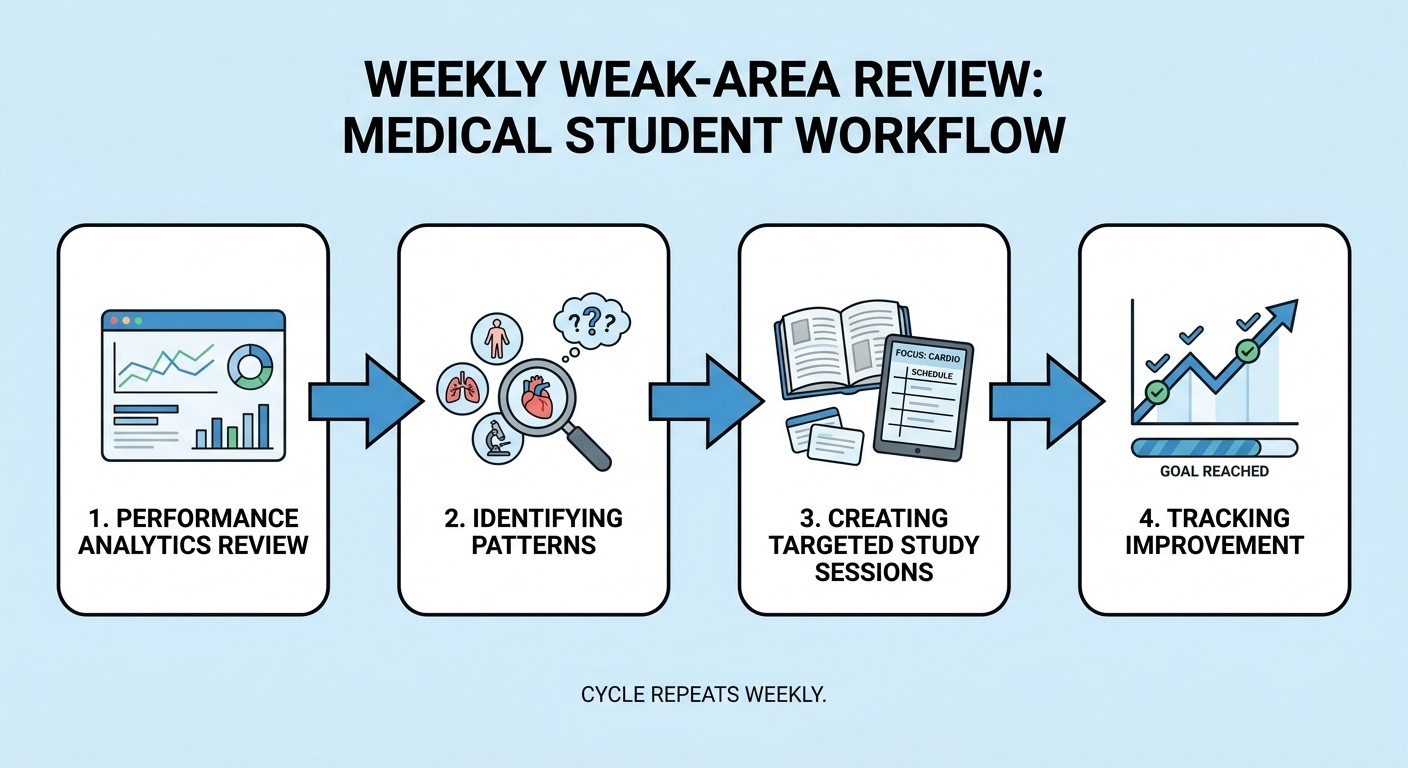
High-performing medical students don't just track their weak areas — they have systematic workflows for converting analytics into improved performance. Heres a proven weekly review process:
Sunday: Analytics Review (15 minutes)
Open your performance dashboard and identify:
Topics where accuracy dropped compared to last week
New patterns in error types
Areas where timing improved or worsened
Subjects you haven't touched in >5 days
Create a priority list: 3 areas need immediate drilling, 2 need scheduled review, 1 needs explanation work.
Monday-Wednesday: Target Drilling
Focus 70% of your question practice on your top 3 weak areas. Use concentrated sessions: 20 questions in the weak topic, immediate review of explanations, then 5 mixed questions to test transfer.
Track improvement daily. If accuracy increases by 15+ percentage points over 3 days, move to spaced review. If no improvement, switch methods — maybe you need concept review before more questions.
Thursday-Friday: Mixed Practice
Combine your improving weak areas with stronger subjects. This prevents the "practice effect" where you get better at specific question types but don't transfer the learning to mixed contexts.
Use your analytics to guide the mix. If cardiology was weak but improving, include 5-10 cardiology questions in every mixed session.
Saturday: Retention Testing
Test everything you worked on during the week without immediate feedback. This reveals whether your improvements are genuine learning or just short-term practice effects.
Areas that show retention can move to weekly review. Areas that decline need another cycle of targeted drilling.
Final 30-Day Weak Area Prioritization
When you have a month or less before your exam, analytics become critical for resource allocation. You cant fix everything — you need to maximize score improvement with limited time.
The Impact Matrix
Plot weak areas on two dimensions:
X-axis: Frequency in your exam (high-yield vs low-yield topics)
Y-axis: Potential for rapid improvement (knowledge gaps vs deeply engrained errors)
Focus on the upper-right quadrant: high-yield topics where you can make quick gains. A 20-point improvement in high-yield infectious diseases beats a 40-point improvement in low-yield genetics.
Triage Categories
Red (immediate focus): High-yield topics below 60% accuracy where you have clear knowledge gaps. These get 50% of your remaining study time. Yellow (targeted work): Moderate-yield topics or high-yield areas with complex improvement needs. These get 30% of your time. Green (maintenance only): Low-yield topics or areas above 75% accuracy. These get 20% of your time, focused on retention.
The Point-of-No-Return Cutoff
Some weak areas cant be meaningfully improved with limited time. If youre consistently scoring 30% on biochemistry with 2 weeks to go, accept that those points are likely lost. Focus your energy on areas where you can realistically move from 60% to 75%.
This is harsh but necessary. Analytics help you make these decisions based on data rather than panic or wishful thinking.
Common Analytics Reading Mistakes
Even with good performance data, students make predictable errors in interpretation and action planning.
Mistake 1: Overreacting to Single Sessions
One bad performance in infectious diseases doesn't make it a weak area. Look for patterns across multiple sessions and question types. Oncourse AI's trend analysis helps by showing 7-day and 30-day performance patterns rather than single-session snapshots.
Mistake 2: Ignoring Context Variables
A 65% score at 11 PM after a 12-hour study day means something different from a 65% score during a fresh morning session. Factor in timing, fatigue, and recent study focus when interpreting analytics.
Mistake 3: Confusing Correlation with Causation
Just because you scored well in cardiology after watching 3 hours of videos doesn't mean videos are your optimal cardiology study method. The improvement might come from increased focus on the topic, not the specific method used.
Test method effectiveness by trying different approaches for similar weak areas and comparing results.
Mistake 4: Analysis Paralysis
Some students spend more time analyzing their performance data than studying. Keep analytics reviews brief and action-focused. The goal is better study decisions, not perfect data interpretation.
Mistake 5: Ignoring Timing Data
Accuracy percentages tell only half the story. If youre scoring 80% on respiratory questions but averaging 2.5 minutes each (vs 1.5 minute targets), thats a significant weakness that needs addressing before exam day.
Building Your Analytics-Driven Study System
Ready to move beyond intuition-based weak area identification? Here's how to build a systematic approach:
Step 1: Choose Analytics-Rich Practice
Not all question banks provide actionable performance analytics. Look for platforms that track:
Subject and topic-level performance trends
Timing data per question and category
Error pattern analysis across sessions
Spaced repetition scheduling based on performance
Clear identification of knowledge vs technique errors
Step 2: Establish Review Rhythms
Schedule weekly analytics reviews as seriously as you schedule study sessions. Block 15-20 minutes every Sunday for performance data analysis and next-week planning.
Step 3: Test Your Interventions
When analytics suggest a weak area intervention, track whether it works. If targeted pharmacology drilling doesn't improve your scores within a week, try a different approach or drill deeper into prerequisites.
Step 4: Connect Analytics to Action
Every data insight should lead to a specific study decision. "I'm weak in cardiology" isn't actionable. "I consistently miss heart failure medication questions due to mechanism confusion, so I'll spend 30 minutes reviewing HF drug pathways then practice 15 targeted questions" is a clear action plan.
The most successful medical students treat their analytics dashboard like a diagnostic tool. They regularly check their performance vital signs, identify concerning trends early, and intervene with targeted treatments before small gaps become major deficiencies.
Performance analytics transform medical exam preparation from guesswork into science. Instead of hoping your study hours align with your actual needs, you can target the precise gaps that matter most for your upcoming exam.
Remember: the goal isn't perfect analysis — its better study decisions. Let the data guide your focus, but don't let analytics replace actual studying. The best performance dashboard in the world cant help you if you dont act on its insights.
Frequently Asked Questions
How often should I check my weak area analytics?
Check your performance trends weekly for major patterns, daily for immediate study decisions. Obsessing over single-question performance creates noise rather than insight. Focus on 7-day and 30-day trends to guide significant study adjustments.
What percentage constitutes a "weak area" that needs drilling?
Below 60% accuracy in high-yield topics needs immediate drilling. 60-75% accuracy needs targeted practice. Above 75% needs maintenance only, unless you have abundant time and lower-yield areas are already strong. Adjust these thresholds based on your exam timeline.
Can I rely on analytics alone to identify weak areas?
Analytics provide objective performance data, but combine them with your subjective experience. If you feel confused about a topic even while scoring well, investigate further. Similarly, if analytics show weakness in an area you feel confident about, trust the data over your feelings.
How do I know if my weak area interventions are working?
Track accuracy improvements over 3-7 days of targeted practice. Look for sustained gains, not just immediate practice effects. Test retention by mixing improved weak areas with other topics. If performance holds up in mixed practice, your intervention is working.
Should I focus on my worst weak areas or try to improve everything evenly?
Prioritize based on exam yield and improvement potential. Focus intensively on high-yield topics below 60% accuracy before addressing moderate-yield areas. Better to improve 3 important areas significantly than 10 areas marginally.
What if I have too many weak areas to address before my exam?
Use the 70-20-10 rule ruthlessly. Accept that some low-yield weak areas won't be addressed. Focus your limited time on high-yield gaps where you can make meaningful improvement. Sometimes strategic weakness acceptance is more valuable than scattered effort.
Turn Data Into Your Next Study Win
Most medical students drown in performance data but starve for actionable insights. They know they scored 65% on their latest practice test but have no idea whether to drill cardiology, review test-taking strategies, or focus on timing improvement.
Stop guessing what to study next. Performance analytics can reveal your exact knowledge gaps, identify why you're missing questions, and prescribe targeted interventions that maximize your score improvement per study hour.
Prepare smarter with Oncourse AI — adaptive MCQs, spaced repetition, and AI explanations built for medical exam success. Download free on Android and iOS and let analytics turn your weak areas into your next breakthrough.