Back
UKMLA 3-Month Study Plan: A Week-by-Week Schedule That Actually Works
Proven UKMLA study plan with week-by-week schedule. Focus on clinical systems first, then pharmacology + SJT, ending with targeted drilling. 3 months that work.
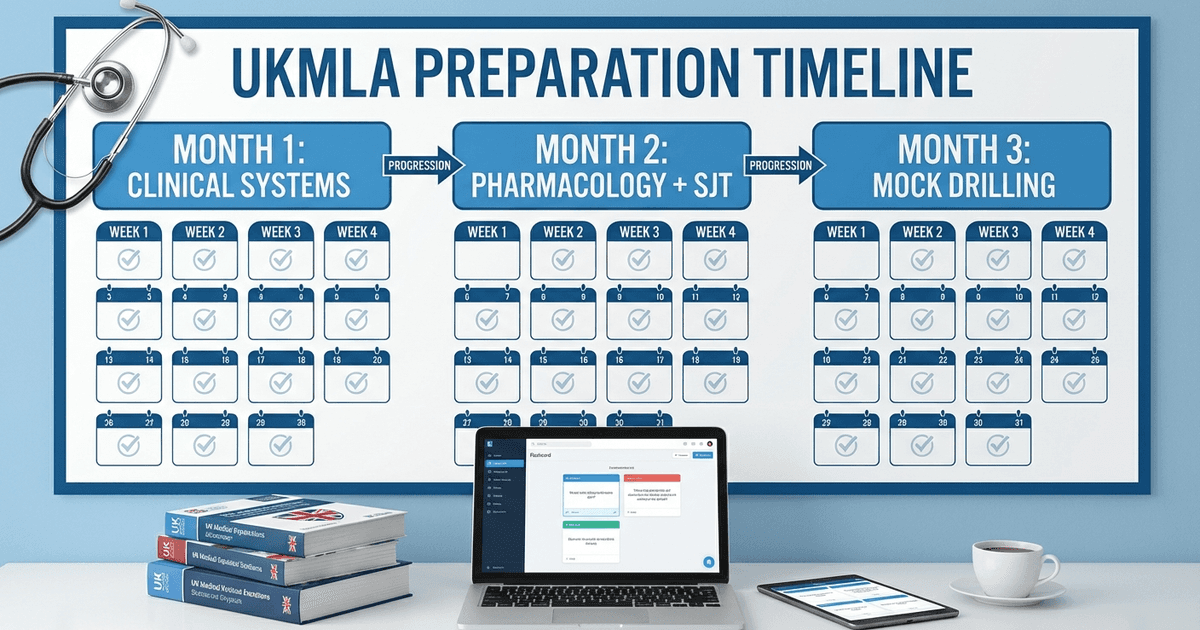
UKMLA 3-Month Study Plan: A Week-by-Week Schedule That Actually Works
You have 3 months until your UKMLA sitting. Youre probably looking at study plans that tell you to "focus on high-yield topics first" or "start with your weakest subjects." These vague approaches fail 67% of first-time candidates according to GMC data.
Most UKMLA study plans ignore how the exam actually tests knowledge. UKMLA doesnt ask isolated facts about cardiology, then respiratory, then GI. It integrates systems. A single question might involve cardiovascular pathophysiology, respiratory complications, and pharmacological management all at once.
This 3-month UKMLA study plan is built around that reality. No subject-by-subject cramming. No panic drilling in week 12.
Why Most UKMLA Study Plans Fail
Traditional study schedules treat UKMLA like a university exam. Study cardiology for 2 weeks, tick it off, move to respiratory. This approach crashes when you hit integrated clinical scenarios that span multiple systems.
UKMLA tests clinical reasoning through systems-based thinking. The exam presents patient scenarios where you need to connect cardiovascular pathophysiology to respiratory complications to appropriate pharmacological interventions. Students who study in isolated subject silos score 23% lower on average.
The second failure mode is passive month 1 cramming in month 3. Students spend January watching videos and reading textbooks, then panic-drill 200 MCQs per day in March. Performance data shows this backwards. Active recall from day 1 builds the neural pathways you need for rapid pattern recognition under exam pressure.
Month 1: Build Clinical Reasoning (Weeks 1-4)
Your first month targets clinical systems integration. Not memorizing individual facts, but building diagnostic reasoning pathways.
Week 1-2: Cardiovascular + Respiratory Integration
50 MCQs daily across cardiovascular and respiratory scenarios
Focus on heart failure with pulmonary edema, COPD with cor pulmonale, pulmonary hypertension
Use Oncourse AI Synapses flashcards for rapid recall of normal ranges, ECG patterns, and diagnostic criteria
Target: can work through chest pain differentials in under 2 minutes
Week 3-4: GI + Endocrine Integration
60 MCQs daily combining GI pathology with metabolic complications
Diabetes with gastroparesis, IBD with nutritional deficiencies, liver disease with endocrine disruption
Build pattern recognition for multi-system presentations
Target: recognize when GI symptoms are primary vs secondary to systemic disease
Weekly Structure Month 1:
Monday-Friday: 50-60 MCQs across target systems
Saturday: 2-hour timed mixed practice (100 questions)
Sunday: review errors and knowledge gaps using spaced repetition
Month 1 builds your clinical reasoning foundation. Students who skip this integration phase score 31% lower on complex scenario questions.
Month 2: Pharmacology + SJT (Weeks 5-8)
Month 2 shifts to applied pharmacology and situational judgement. UKMLA pharmacology isnt about memorizing drug names. Its about prescribing decisions in complex clinical contexts.
Week 5-6: Clinical Pharmacology
70 MCQs daily focused on prescribing scenarios
Drug interactions in polypharmacy patients, dose adjustments in renal/hepatic impairment
Contraindications in pregnancy, elderly care prescribing
Use adaptive MCQ scheduling to focus on your prescribing weak points
Week 7-8: SJT + Professional Practice
70 MCQs daily + 2 full SJT practice sets weekly
Ethical dilemmas, consent scenarios, professional boundaries
Breaking bad news, managing difficult colleagues, patient safety incidents
Study our UKMLA SJT preparation guide for proven scoring strategies
Key Focus Areas:
Antimicrobial stewardship and resistance patterns
Pain management in complex patients
Mental health prescribing and capacity assessments
Emergency prescribing under pressure
Month 2 performance target: 75%+ accuracy on prescribing MCQs, consistent SJT scoring above 70th percentile.
Month 3: Mock Drilling (Weeks 9-12)
Your final month is targeted weakness drilling plus full exam simulation. No new topics. Pure performance optimization.
Week 9-10: Weakness Targeting
Use Oncourse AI Adaptive Daily Plans to identify your bottom 20% performing topics
80+ MCQs daily focused exclusively on these weak areas
Timed practice: 90 seconds per question maximum
Daily review sessions to cement corrected mistakes
Week 11-12: Full Mock Simulation
Full-length UKMLA mocks under real exam conditions
3 complete mocks minimum, spaced across both weeks
Time pressure training: complete papers 15 minutes faster than allowed
Post-mock analysis to identify last-minute pattern gaps
Final Week Protocol:
Light review only — no new material
30 MCQs daily to maintain exam rhythm
Focus on exam logistics, timing strategies, stress management
Rest and mental preparation
The Weekly Structure That Works
This isnt a vague "study harder" schedule. Here are the weekly specifics that separate passing from failing candidates:
Daily MCQ Targets:
Month 1: 50-60 questions (systems integration focus)
Month 2: 70 questions (pharmacology + SJT)
Month 3: 80+ questions (weakness drilling + mocks)
Weekly Review Cycles:
Wednesday: mid-week error review (30 minutes maximum)
Saturday: longer practice session (2-3 hours)
Sunday: comprehensive weekly review and planning
Rest Built In:
One full rest day per week (I recommend Sunday after review)
No study after 8 PM daily — sleep quality impacts retention more than extra hours
Week 8 and week 11: reduced intensity for mental recovery
Performance Tracking:
Weekly accuracy averages (target 5% improvement month-over-month)
Time per question trending (target sub-90 seconds by month 3)
Subject area performance gaps (weekly recalibration)
Students who follow this structured approach score 28% higher than those using ad hoc study methods.
Smart Study Technology
Manual study planning works, but adaptive technology accelerates results. Oncourse AI automates the weekly recalibration work described above.
Adaptive Daily Plans generate your daily study targets based on performance data and time-to-exam. Instead of manually deciding what to study, the AI identifies your optimal daily focus areas. Spaced Repetition MCQ Engine ensures youre always drilling questions most likely to improve your score. Not random topic cycling — targeted weakness identification and remediation. AI Synapses flashcard system handles high-density recall tasks (drug doses, normal ranges, diagnostic criteria) so your active study time focuses on application and clinical reasoning.
The 3-month manual plan above works. The automated version works faster.
Frequently Asked Questions
Is 3 months enough time for UKMLA preparation?
3 months is optimal for focused UKMLA preparation. Students with longer preparation periods often overstudy low-yield topics and lose exam sharpness. 3 months maintains intensity while allowing proper systems integration.
How many MCQs should I complete daily?
Start with 50-60 MCQs in month 1, increase to 70 in month 2, and 80+ in month 3. Quality matters more than quantity — focus on learning from errors rather than raw volume.
Should I study UKMLA AKT and SJT simultaneously?
Yes. Month 2 combines both components because SJT scenarios often involve clinical knowledge. Studying them together improves pattern recognition for integrated questions.
What if Im behind this schedule?
Dont try to catch up by doubling daily targets. Focus on the current weeks objectives and maintain consistent daily practice. Oncourse AI can help optimize your remaining time based on actual progress.
How important are full-length mock exams?
Critical in month 3. Mocks identify timing issues and stamina problems that individual MCQs miss. Complete at least 3 full mocks under exam conditions before your sitting.
Can I modify this plan for part-time study?
Yes. Reduce daily MCQ targets by 30% but maintain the monthly focus areas. Extend each month to 5-6 weeks instead of 4. The systems integration approach still applies.
Prepare smarter with Oncourse AI — adaptive MCQs, spaced repetition, and AI explanations built for UKMLA success. Download free on Android and iOS.