Types of Disasters in Forensic Medicine: Mass Disaster Management High-Yield Guide for NEET PG (2026)
Master disaster classification, DVI protocols, and victim identification methods for NEET PG 2026. Complete guide on natural vs man-made disasters, primary vs secondary identifiers, triage systems, and high-yield MCQ patterns.
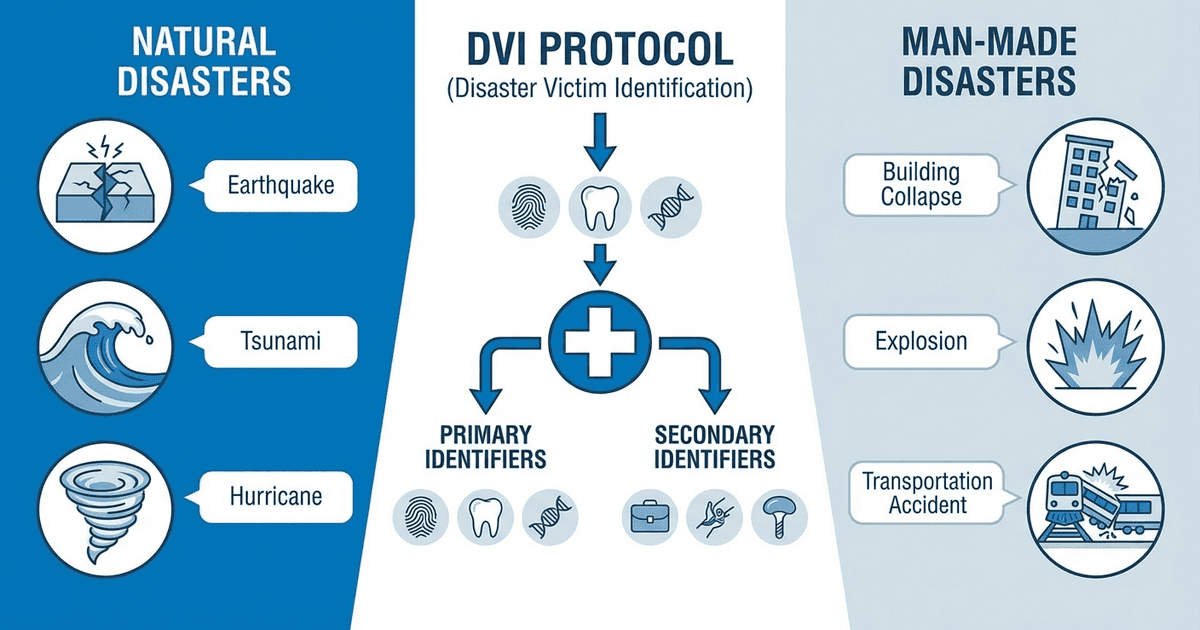
Types of Disasters in Forensic Medicine: Mass Disaster Management High-Yield Guide for NEET PG (2026)
You are probably staring at your forensic medicine textbook wondering how disasters fit into your NEET PG preparation. Here's the thing — disaster-related questions make up 8-12% of forensic medicine MCQs, and they love testing disaster classification and victim identification protocols.
NEET PG examiners have a specific pattern: they dont just ask "what is a disaster?" They want you to classify disasters, understand mass casualty protocols, and know exactly which identification method works best in different scenarios. The most repeated question format? "Which of the following is the MOST reliable method of victim identification in a mass disaster?"
If you have ever struggled with remembering the difference between primary and secondary identifiers or wondered why DNA profiling isnt always the gold standard — this guide breaks down everything you need to score those crucial marks in 2026.
Understanding Disaster Classification in Forensic Medicine
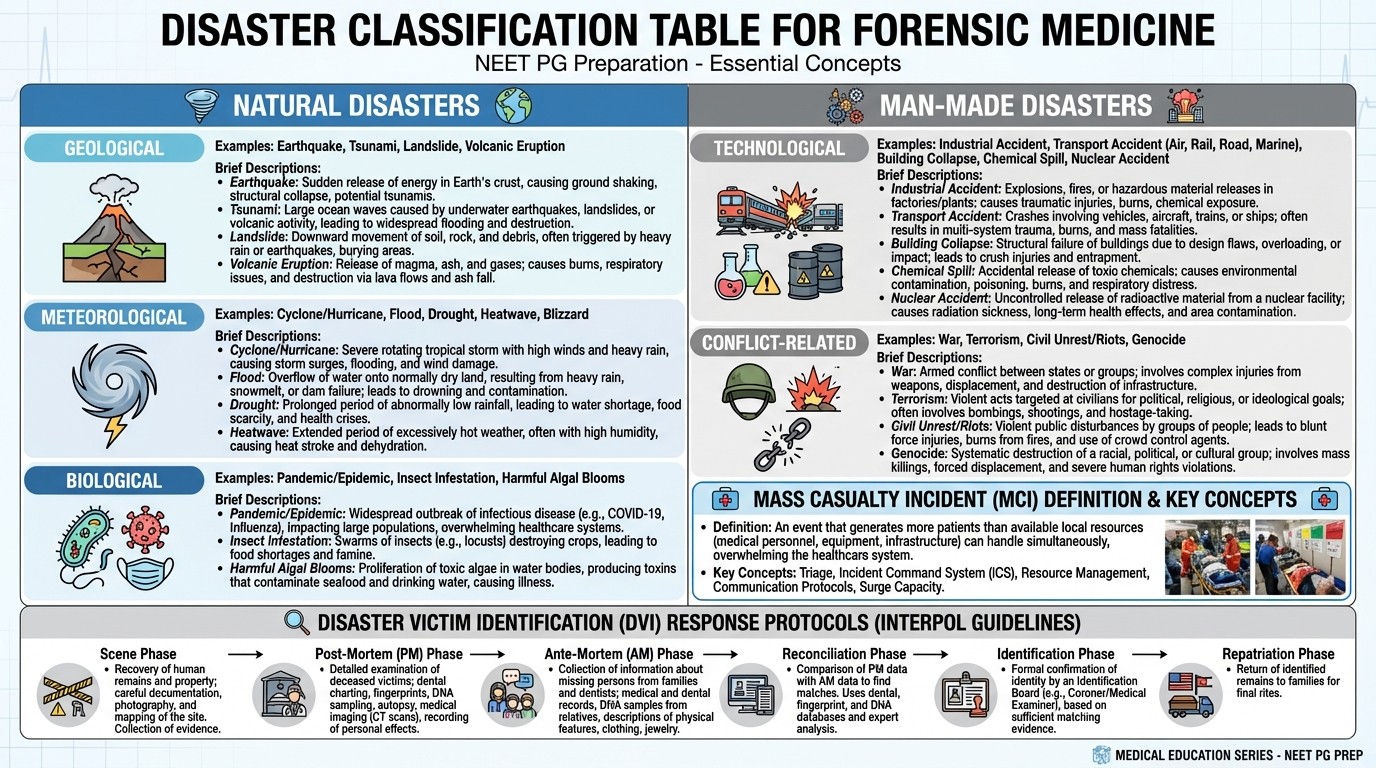
Natural vs Man-Made Disasters
Natural disasters originate from environmental forces beyond human control:
Geological: Earthquakes, tsunamis, volcanic eruptions, landslides
Meteorological: Hurricanes, tornadoes, floods, droughts
Biological: Pandemics, epidemics, pest infestations
Man-made disasters result from human activities or technological failures:
Technological: Industrial accidents, building collapses, transportation crashes
Conflict-related: Wars, terrorist attacks, civil unrest
Environmental: Chemical spills, nuclear accidents, oil spills
The key distinction for NEET PG: natural disasters often cause widespread destruction with multiple casualty sites, while man-made disasters typically have concentrated casualties at specific locations.
Simple vs Compound Disasters
Simple disasters affect one geographic area with a single cause:
Localized earthquake
Single building fire
Isolated transportation accident
Compound disasters involve multiple events or affect multiple areas:
Earthquake triggering tsunami and fires
Hurricane causing floods and building collapses
Nuclear accident with radiation and explosion
NEET PG tip: Compound disasters require multi-phase DVI operations and different identification protocols for each phase.
Mass Casualty Incidents (MCI) Definition
A mass casualty incident occurs when the number and severity of casualties exceed the immediate capacity of available emergency medical resources.
Key thresholds for MCI classification:
10+ casualties requiring immediate medical attention
Resource demand exceeds local emergency response capacity
Multiple agencies required for effective response
Practice with our disaster victim identification lessons to master these concepts.
Mass Disaster Victim Identification (DVI) Protocol
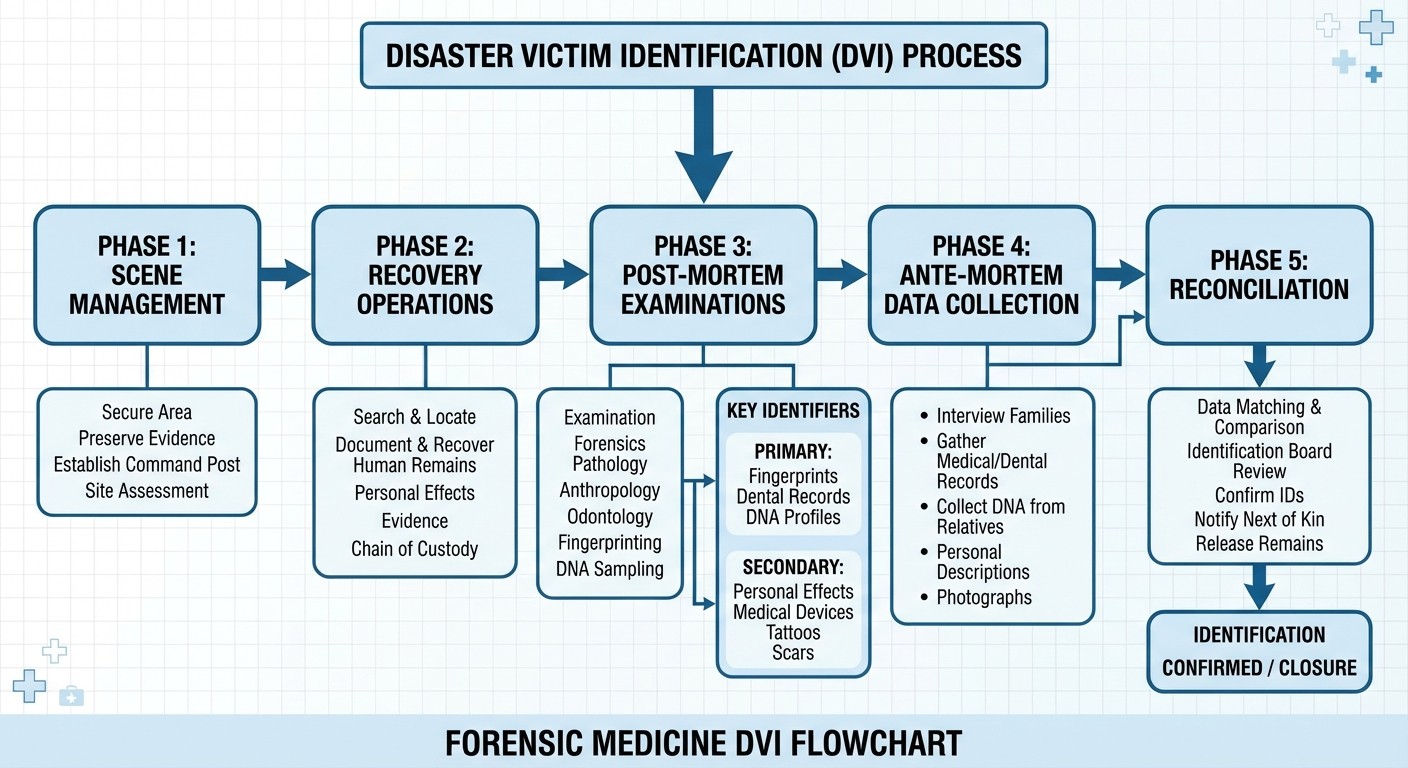
The Five Phases of DVI Operations
The Interpol DVI protocol follows a systematic 5-phase approach:
#### Phase 1: Scene Management
Secure the disaster site and establish perimeter
Document scene conditions with photography and sketches
Coordinate with emergency services for initial triage
Preserve evidence for forensic examination
#### Phase 2: Recovery Operations
Systematic body recovery using grid search patterns
Maintain chain of custody for all human remains
GPS coordinate mapping of body locations
Personal effects documentation and collection
#### Phase 3: Post-Mortem Examinations
Complete autopsy with cause of death determination
Primary identifier collection: fingerprints, dental records, DNA samples
Secondary identifier documentation: scars, tattoos, medical devices
Radiological examination for bone fractures and prosthetics
#### Phase 4: Ante-Mortem Data Collection
Missing person reports from family members
Medical record retrieval from healthcare providers
Dental record collection from dentists
Personal descriptor interviews with relatives
#### Phase 5: Reconciliation
Data comparison between post-mortem and ante-mortem findings
Positive identification confirmation using multiple identifiers
Body release to families with proper documentation
Final reporting to authorities and families
Master these phases with our DVI operations lessons and test your knowledge with disaster management MCQs.
Interpol DVI Guidelines: Primary vs Secondary Identifiers
Primary Identifiers (Scientific and Unique)
1. Fingerprints
Most reliable when good quality ante-mortem records exist
Unique pattern remains unchanged throughout life
Limitation: Requires intact finger pads (not always available in disasters)
NEET PG fact: Fingerprints can be recovered even from severely burned bodies using special techniques
2. Dental Records
Excellent preservation in fires and decomposition
Detailed comparison possible with ante-mortem dental charts
Include: Fillings, crowns, bridges, root canals, missing teeth patterns
High success rate in disaster victim identification (70-80% of cases)
3. DNA Profiling
Gold standard when other methods fail
STR analysis (Short Tandem Repeats) most commonly used
Mitochondrial DNA for degraded samples
Limitation: Requires ante-mortem comparison samples from relatives
Secondary Identifiers (Circumstantial Evidence)
Personal Effects: Jewelry, clothing, documents, mobile phones Medical Devices: Pacemakers, prosthetics, surgical implants with serial numbers Physical Features: Scars, tattoos, birthmarks, deformities Anthropological Data: Age, sex, race, height estimation Radiological Findings: Healed fractures, spinal abnormalities NEET PG key point: Primary identifiers alone can establish positive identification, while secondary identifiers require combination of multiple features for confirmation.
Strengthen your understanding with our DNA profiling lessons and practice with identification MCQs.
Role of Forensic Pathologist in Mass Disasters
Pre-Disaster Preparedness
DVI team training and protocol development
Equipment inventory and maintenance checks
Inter-agency coordination planning
Legal framework understanding for jurisdiction
During Disaster Response
Scene assessment and safety evaluation
Triage coordination with emergency medical services
Autopsy planning and resource allocation
Evidence preservation and documentation
Post-Mortem Examination Responsibilities
Complete autopsy with detailed documentation
Cause and manner of death determination
Identity verification using multiple methods
Court testimony preparation for legal proceedings
Family Communication
Identification process explanation to relatives
Progress updates during investigation
Sensitive notification of positive identification
Support coordination with social services
The forensic pathologist serves as the primary coordinator between medical examination, law enforcement, and family support services.
Triage Principles in Mass Disasters
START Triage (Simple Triage and Rapid Treatment)
Used for initial field triage in the first 30-60 minutes:
Red (Immediate): Life-threatening injuries requiring immediate intervention
Respiratory rate >30 or <10 breaths/minute
Capillary refill >2 seconds
Unable to follow simple commands
Yellow (Delayed): Serious injuries that can wait 1-2 hours
Stable vital signs
Conscious and alert
Non-life-threatening injuries
Green (Minor): Walking wounded with minor injuries
Able to walk and follow commands
Minimal medical intervention needed
Black (Deceased): No vital signs or incompatible with life
No spontaneous respirations
No pulse or blood pressure
SALT Triage (Sort, Assess, Lifesaving Interventions, Treatment/Transport)
More comprehensive system for ongoing disaster management:
Step 1: Sort - Separate walking wounded from non-ambulatory Step 2: Assess - Detailed evaluation of critical patients Step 3: Lifesaving Interventions - Airway, hemorrhage control Step 4: Treatment/Transport - Priority-based evacuation
Learn triage protocols in detail through our triage systems lessons.
DNA Identification in Mass Disasters
Sample Collection Priorities
1. Muscle tissue (best DNA preservation) 2. Bone fragments (long-term DNA stability) 3. Teeth (excellent DNA source) 4. Hair with roots (nuclear DNA available)
DNA Analysis Methods
STR Analysis (Short Tandem Repeats)
Standard method for nuclear DNA
13-20 genetic loci compared
High discrimination power
Requires good quality DNA samples
Mitochondrial DNA (mtDNA)
Used when nuclear DNA degraded
Maternal lineage identification
Higher copy number in cells
Lower discrimination than nuclear DNA
SNP Analysis (Single Nucleotide Polymorphisms)
Newest technology for degraded samples
Shorter DNA fragments analyzed
Increasing use in disaster scenarios
Challenges in Mass Disaster DNA Analysis
Sample degradation from fire, water, chemicals
Mixed DNA profiles from multiple victims
Reference sample collection from family members
Laboratory capacity limitations during large disasters
Study DNA profiling concepts with our forensic biology lessons and test with DNA identification flashcards.
High-Yield NEET PG MCQ Patterns
Pattern 1: Most Reliable Identification Method
Common question: "Which of the following is the MOST reliable method of victim identification in a mass disaster involving fire?" Answer approach:
Fire scenarios: Dental records (teeth resist high temperatures)
Decomposition/water: DNA profiling (bones preserve DNA)
Recent deaths: Fingerprints (if skin intact)
Mixed scenarios: Combination of primary identifiers
Pattern 2: Disaster Classification
Common question: "A building collapse during an earthquake that triggers a fire would be classified as:" Answer: Compound disaster (multiple causative events)
Pattern 3: DVI Phase Identification
Common question: "Systematic documentation of personal effects at the disaster site occurs during which DVI phase?" Answer: Phase 2 - Recovery Operations
Pattern 4: Triage Color Coding
Common question: "A conscious patient with a respiratory rate of 35/minute and capillary refill of 3 seconds should be triaged as:" Answer: Red (Immediate) - meets two critical criteria
Pattern 5: Primary vs Secondary Identifiers
Common question: "Which of the following is considered a primary identifier in DVI?" Answer options typically include:
✓ DNA profiling (Primary)
✓ Dental records (Primary)
✓ Fingerprints (Primary)
✗ Tattoos (Secondary)
✗ Personal jewelry (Secondary)
Practice these patterns extensively with our disaster victim identification MCQs and review key concepts using forensic medicine flashcards.
Case-Based Learning: Major Disaster Examples
2004 Indian Ocean Tsunami
Challenge: Massive scale (230,000+ deaths across 14 countries)
DVI lessons: Importance of international cooperation
Identification methods: Primarily dental records and DNA
NEET PG relevance: Multi-country victim repatriation protocols
2001 World Trade Center Attack
Challenge: Extreme fragmentation and fire damage
DVI innovation: Advanced DNA techniques development
Identification success: 1,641 of 2,749 victims identified
Lesson: Combination approach with multiple identifier types
2018 Kerala Floods
Challenge: Waterlogged conditions and decomposition
Local response: State disaster management protocols
Methods used: Anthropological analysis and DNA profiling
Relevance: Monsoon-related disaster preparedness
Study detailed case analyses through our major disaster case studies.
Quick Reference Tables for NEET PG
Disaster Type Quick Classification
Disaster | Type | Complexity | Primary Challenge |
|---|---|---|---|
Earthquake | Natural | Simple/Compound | Crushing injuries |
Tsunami | Natural | Compound | Water damage to remains |
Building Fire | Man-made | Simple | Thermal damage |
Terrorist Bomb | Man-made | Simple | Fragmentation |
Hurricane + Flood | Natural | Compound | Multiple injury patterns |
Identifier Reliability by Disaster Type
Disaster Scenario | 1st Choice | 2nd Choice | 3rd Choice |
|---|---|---|---|
Fire/Explosion | Dental | DNA | Radiology |
Water/Flooding | DNA | Dental | Fingerprints |
Fresh casualties | Fingerprints | Dental | DNA |
Decomposed remains | DNA | Dental | Anthropology |
Triage Priority Checklist
Assessment | Red | Yellow | Green | Black |
|---|---|---|---|---|
Walking | No | No | Yes | No |
Breathing | Abnormal | Normal | Normal | Absent |
Circulation | Poor | Adequate | Good | Absent |
Mental status | Altered | Alert | Alert | Unresponsive |
Frequently Asked Questions
What is the difference between primary and secondary identifiers in DVI?
Primary identifiers (fingerprints, dental records, DNA) are scientifically unique and can establish positive identification alone. Secondary identifiers (scars, tattoos, personal effects) are circumstantial evidence requiring multiple features for identification confirmation.
Which identification method is most reliable in fire disasters?
Dental records are most reliable in fire disasters because teeth can withstand temperatures up to 1000°C. Dental enamel preserves well, and ante-mortem dental charts allow detailed comparison of fillings, crowns, and tooth patterns.
How long does DNA analysis take in mass disasters?
Standard STR DNA analysis takes 2-4 weeks for routine cases. In mass disasters with degraded samples requiring mitochondrial DNA or specialized techniques, analysis can take 2-6 months depending on laboratory capacity and sample quality.
What makes a disaster "compound" versus "simple"?
Simple disasters have one causative event (single building fire). Compound disasters involve multiple events or cascading effects (earthquake triggering tsunami and fires). Compound disasters require multi-phase DVI responses and different identification strategies.
When is START triage used versus SALT triage?
START triage is used for rapid initial assessment in the first 30-60 minutes using simple criteria (breathing, circulation, mental status). SALT triage is more comprehensive for ongoing disaster management with detailed assessment and treatment protocols.
Why isnt DNA profiling always the first choice for victim identification?
DNA profiling requires ante-mortem comparison samples (usually from family members), takes weeks to complete, and is expensive. Fingerprints or dental records can provide faster identification when ante-mortem records exist and remains are suitable for comparison.
Prepare smarter with Oncourse AI — adaptive MCQs, spaced repetition, and AI explanations built for NEET PG. Download free on Android and iOS.