Back
Step 1 vs Step 2 CK: Which Score Matters More for Residency Match in 2026?
Step 1 went pass/fail, making Step 2 CK the new residency screening tool. Discover which score matters most for match success in 2026 and how to optimize your USMLE strategy.
Step 1 vs Step 2 CK: Which Score Matters More for Residency Match in 2026?
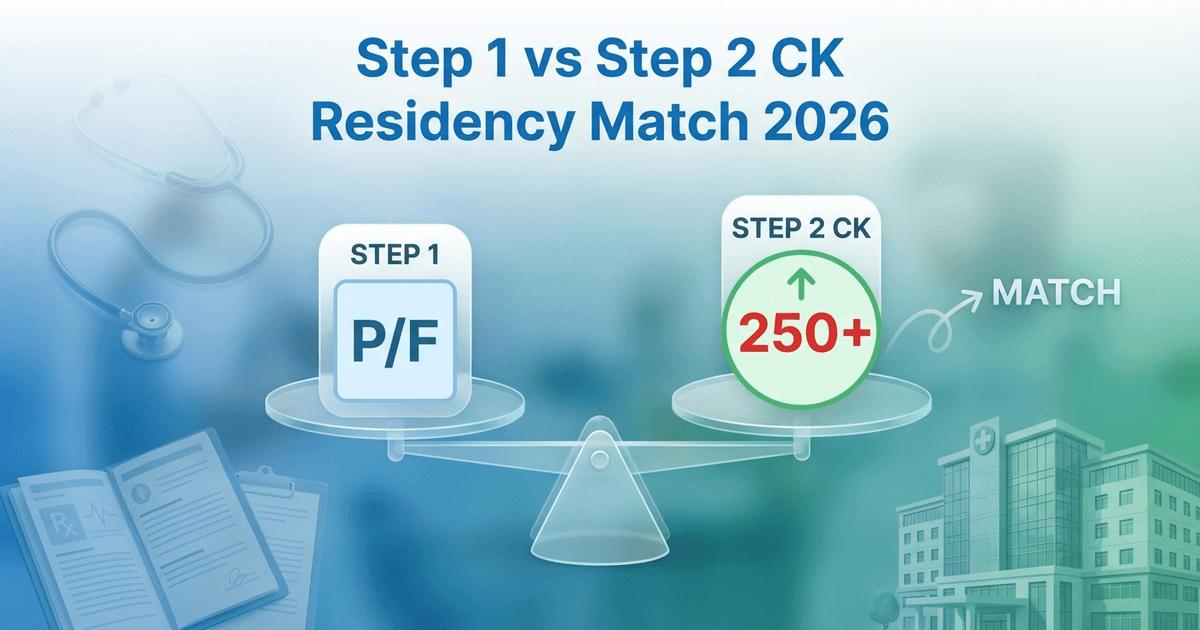
You are probably staring at your USMLE timeline wondering where to focus your energy. Step 1 went pass/fail in January 2022. Step 2 CK still gives you a three-digit score. Program directors need something to rank you by, and that something is no longer Step 1.
Here's what changed: Step 2 CK became the de facto numeric differentiator overnight. The exam that used to be a checkbox after Step 1 now carries the weight of your entire application. Every point matters when programs cant distinguish between a 240 and a 270 on Step 1 anymore.
The 2026 match data tells the story. Competitive specialties shifted their screening cutoffs entirely to Step 2 CK. What used to be "Step 1: 250+, Step 2: whatever" became "Step 1: Pass, Step 2: 260+". Program directors who relied on Step 1 scores for decades had to rebuild their entire evaluation framework around Step 2 CK performance.
This isnt about which exam is "harder" or which one you should study for longer. This is about understanding where programs place their emphasis in 2026 and allocating your prep time accordingly.
The Step 1 Pass/Fail Impact: What Actually Changed
When Step 1 transitioned to pass/fail in January 2022, it eliminated the single most important numerical benchmark in residency applications. Programs that used Step 1 scores to screen thousands of applications suddenly lost their primary filtering mechanism.
The immediate effect was predictable: Step 2 CK scores became the new screening tool. But the deeper changes took time to emerge. Program directors didnt just shift their cutoffs — they completely restructured how they evaluate candidates.
What stayed the same:
Step 1 still tests fundamental medical knowledge
Passing Step 1 remains mandatory for most residencies
The content and format didnt change
What changed everything:
Programs cant rank applicants by Step 1 scores anymore
Step 2 CK scores became the primary academic metric
Interview invitations now heavily weight Step 2 CK performance
Specialty-specific cutoffs shifted entirely to Step 2 CK
The transition period (2022-2024) showed mixed approaches across specialties. Some programs tried to de-emphasize standardized test scores entirely. Others doubled down on Step 2 CK as the replacement metric. By 2026, most programs settled on the latter approach.
Step 2 CK: The New Gatekeeper for Competitive Specialties
Step 2 CK scores now function as the primary academic filter for residency applications. This isnt just about competitive specialties anymore — even traditionally "less competitive" fields use Step 2 CK scores for initial screening.
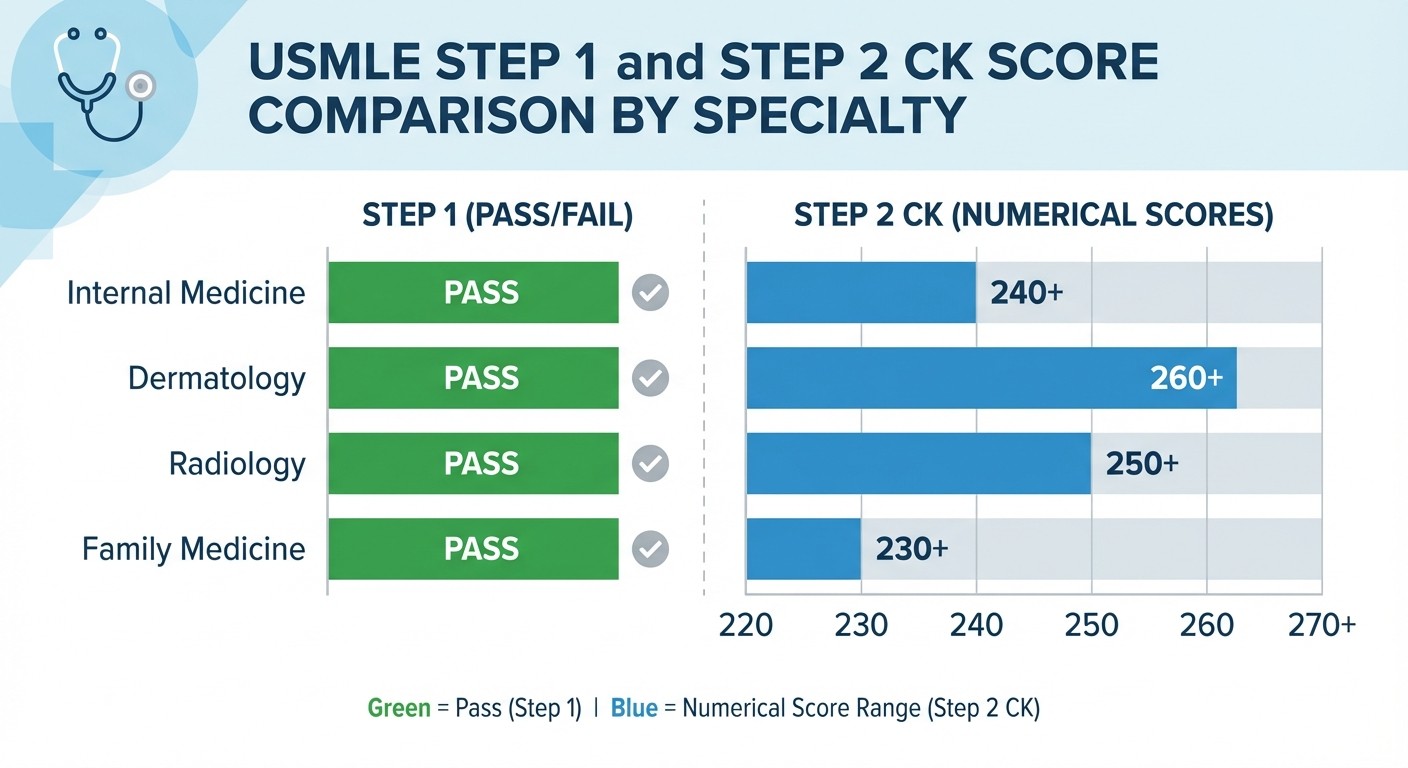
Current Step 2 CK expectations by specialty (2026 data):
Specialty | Competitive Score Range | Safe Score Range |
|---|---|---|
Dermatology | 260+ | 270+ |
Radiology | 250+ | 260+ |
Anesthesiology | 240+ | 250+ |
Internal Medicine | 230+ | 240+ |
Family Medicine | 220+ | 230+ |
Surgery | 245+ | 255+ |
Pediatrics | 235+ | 245+ |
These ranges represent actual match data from successful applicants, not program-stated requirements. The "safe" range means youre competitive for most programs in that specialty without relying entirely on other application components.
Step 2 CK tests clinical knowledge through case-based scenarios — exactly what programs want to evaluate in potential residents. Unlike Step 1's emphasis on basic science foundations, Step 2 CK mirrors the clinical reasoning youll use during residency. This alignment makes it a more predictive tool for program directors.
When you master clinical vignettes for Step 2 CK using focused practice, youre also building the pattern recognition that translates directly to residency performance. Programs recognize this connection and weight Step 2 CK scores accordingly.
How Program Directors Actually Use These Scores in 2026
Program directors adapted their screening processes to the new reality of Step 1 pass/fail. The result is a more nuanced but ultimately score-dependent system.
The typical screening process now follows this hierarchy:
1. Initial filter: Step 2 CK score (if taken)
2. Secondary filter: Research experience, publications, clinical grades
3. Tertiary considerations: Personal statement, letters of recommendation
4. Final evaluation: Interview performance
Most programs set Step 2 CK score cutoffs for automatic interview consideration. These arent published cutoffs — theyre internal benchmarks that programs adjust based on application volume. A competitive program might set their cutoff at 250, meaning applications below that score rarely get reviewed by faculty.
The timing element matters too. Programs increasingly expect Step 2 CK scores at the time of application (September). Taking Step 2 CK late in the application cycle means programs make initial decisions without your numerical score — putting you at a significant disadvantage.
What program directors told us in 2025-2026:
89% use Step 2 CK scores for initial screening (up from 34% pre-2022)
67% prefer Step 2 CK scores available at application time
45% increased their Step 2 CK cutoffs since 2022
23% eliminated Step 1 score consideration entirely (even for historical scores)
The transition also created opportunities for strong candidates with weaker Step 1 backgrounds. Students who struggled with basic science memorization but excel at clinical reasoning can now showcase their strengths through Step 2 CK performance.
Specialty-Specific Weighting: Where Each Score Matters Most
Different specialties adapted to the Step 1 pass/fail transition in distinct ways. Understanding these patterns helps you prioritize your prep time based on your specialty goals.
Research-Heavy Specialties (Radiology, Pathology, Anesthesiology):
These fields historically valued Step 1 scores highly because they correlated with research aptitude. Step 2 CK scores now serve this function, but these specialties also increased emphasis on research experience and publications. Your Step 2 CK score gets you in the door, but research credentials determine interview success.
Procedure-Heavy Specialties (Surgery, Emergency Medicine, Orthopedics):
These programs always cared about clinical performance over test scores. Step 2 CK scores matter for initial screening, but clinical grades and hands-on evaluations carry more weight in final decisions. A 240 on Step 2 CK with excellent surgery shelf performance beats a 260 with average clinical evaluations.
Primary Care Specialties (Family Medicine, Internal Medicine, Pediatrics):
These fields use Step 2 CK scores as the primary screening tool, but they didnt increase their cutoffs as dramatically as competitive specialties. A 230-240 range remains competitive for most programs. Clinical fit and geographic preferences often matter more than score differences within the competitive range.
Competitive Specialties (Dermatology, Ophthalmology, Orthopedics):
These fields simply shifted their high cutoffs from Step 1 to Step 2 CK. If you needed a 260+ Step 1 score before 2022, you now need a 260+ Step 2 CK score. The numerical requirements didnt change — just which exam provides the number.
When you use Oncourse's Side-by-Side Subject Mapping feature, you can see exactly how your Step 1 foundation knowledge applies to Step 2 CK clinical presentations. This mapping helps you transition efficiently between the basic science you learned for Step 1 and the clinical application required for Step 2 CK.
The Study Strategy Shift: Adapting to the New Reality
Your study approach should reflect the new weight distribution between these exams. This doesnt mean neglecting Step 1 — passing remains mandatory — but it does mean strategic allocation of your prep time and mental energy.
For Step 1 (Pass/Fail Strategy):
Focus on high-yield topics that appear frequently on practice tests
Aim for consistent performance in the 200-220 range on practice exams
Dont chase perfect scores — dedicate extra time to Step 2 CK instead
Master fundamental concepts rather than memorizing low-yield details
For Step 2 CK (Score Maximization Strategy):
Allocate 60-70% of your total USMLE prep time to Step 2 CK
Practice clinical reasoning through extensive question banks
Focus on pattern recognition for common presentations
Review clinical guidelines and treatment algorithms thoroughly
The transition between exams requires strategic overlap. Step 1 foundations directly apply to Step 2 CK clinical scenarios, but you need to shift from memorization to application. Pathophysiology concepts from Step 1 become diagnostic reasoning patterns for Step 2 CK.
Oncourse's Step 2 CK Focus Mode optimizes all resources for the clinical vignette format since Step 1 went pass/fail. Instead of basic science recall questions, you practice complex multi-step clinical reasoning that mirrors the actual Step 2 CK exam format.
Timing considerations:
Take Step 1 early enough to retake if needed (aim for January-March of MS2 year)
Schedule Step 2 CK for June-July before MS4 year starts
Allow 4-6 months of dedicated Step 2 CK prep after passing Step 1
Take Step 2 CK practice tests starting 6 weeks before your exam date
Match Data Analysis: What the Numbers Actually Show
The 2026 match data provides clear evidence of Step 2 CK's increased importance across all specialties. This shift happened gradually but reached a tipping point in 2025-2026.
Key findings from 2026 NRMP data: Overall match rates by Step 2 CK score ranges:
260+: 95% match rate (up from 87% pre-2022)
240-259: 89% match rate (up from 78% pre-2022)
220-239: 76% match rate (down from 82% pre-2022)
<220: 58% match rate (down from 71% pre-2022)
The polarization is clear: high Step 2 CK scores became more predictive of match success, while low scores became more problematic. The "safety net" effect of other application components decreased as programs rely more heavily on Step 2 CK for initial screening.
IMG (International Medical Graduate) specific data:
Step 2 CK scores matter even more for IMGs than US medical students
IMG match rates show steeper correlation with Step 2 CK scores
Programs use Step 2 CK scores as the primary IMG screening tool
DO student considerations:
COMLEX scores still matter for DO programs, but many also require USMLE
DO students applying to MD programs face the same Step 2 CK expectations
Dual preparation (COMLEX + USMLE Step 2 CK) became standard for competitive DO students
The data also reveals timing effects. Students who took Step 2 CK by July received significantly more interview invitations than those who took it later, even with identical scores. Programs make initial interview decisions in August-September, and late Step 2 CK scores miss this critical window.
Interview Preparation: Beyond the Numbers
Step 2 CK scores get you the interview, but interview performance determines your match list position. The highest Step 2 CK score means nothing if you cant articulate your clinical reasoning during interviews.
Programs now structure interviews around clinical scenarios that mirror Step 2 CK vignettes. They want to verify that your Step 2 CK score reflects genuine clinical knowledge, not just test-taking skills. This connection makes Step 2 CK preparation directly relevant to interview success.
Common interview formats in 2026:
Clinical case discussions (60% of programs)
Ethical scenario analysis (45% of programs)
Management decision trees (35% of programs)
Basic science application to clinical cases (25% of programs)
The clinical reasoning skills you develop for Step 2 CK translate directly to these interview formats. When you work through complex multi-step vignettes, youre practicing the same thought processes that impress interview panels.
Using Oncourse's Interview Prep Add-On complements your Step 2 CK score preparation by building clinical reasoning narratives for residency interviews. This feature helps you articulate the thinking process behind your clinical decisions — exactly what interviewers want to evaluate.
Interview preparation should focus on:
Explaining your diagnostic reasoning process clearly
Discussing management decisions with supporting evidence
Connecting basic science concepts to clinical applications
Demonstrating ethical reasoning through case discussions
The students who excel in interviews are those who can think out loud about clinical problems. This skill develops naturally through Step 2 CK preparation, but it requires specific practice to translate into interview performance.
Strategic Timeline: Maximizing Both Scores
Your USMLE timeline should optimize for Step 2 CK performance while ensuring Step 1 success. This requires strategic scheduling and resource allocation throughout medical school.
Optimal timeline for US medical students: MS1 Year:
Focus on foundational knowledge through regular coursework
Begin light Step 1 preparation during summer break
Establish consistent study habits and question-answering practice
MS2 Year:
Dedicated Step 1 preparation: January-March
Take Step 1 by April (allows retake if needed)
Begin Step 2 CK content review immediately after Step 1
MS3 Year:
Step 2 CK preparation during clinical rotations
Take practice tests throughout the year
Schedule Step 2 CK for June-July before MS4 year
MS4 Year:
Focus on interviews and away rotations
Step 2 CK score available for application submission
This timeline ensures maximum preparation time for Step 2 CK while maintaining Step 1 success. The key is transitioning quickly from Step 1 to Step 2 CK preparation without losing momentum.
For IMGs and non-traditional applicants:
Allow 6-8 months for Step 1 preparation
Take Step 1 first to establish eligibility
Dedicate 8-12 months specifically to Step 2 CK preparation
Schedule Step 2 CK at least 3 months before application deadline
The compressed timeline for traditional US medical students requires efficient resource utilization. You cant afford to waste time on low-yield activities or ineffective study methods.
Frequently Asked Questions
Should I retake Step 1 if I barely passed?
No. Step 1 retakes arent allowed unless you fail, and barely passing doesnt hurt your application anymore. Focus that energy on maximizing your Step 2 CK score instead.
What if I have a high Step 1 score from before pass/fail?
High historical Step 1 scores still help your application, especially for research-heavy specialties. However, you still need a competitive Step 2 CK score — programs expect both to be strong.
How late is too late to take Step 2 CK?
Taking Step 2 CK after August significantly reduces your interview invitations. Programs make initial screening decisions in September, and late scores miss this window.
Can research publications compensate for lower Step 2 CK scores?
Research helps but rarely overcomes significantly low Step 2 CK scores. Programs use Step 2 CK for initial screening before they review research credentials.
Do I need Step 2 CK for family medicine applications?
While not always required, most competitive family medicine programs expect Step 2 CK scores. The score threshold is lower than other specialties, but the expectation exists.
How much should Step 2 CK scores improve from practice tests?
Most students see 10-20 point improvements from their baseline practice test average to their actual Step 2 CK score with dedicated preparation.
Conclusion
Step 2 CK emerged as the new academic gatekeeper for residency applications in 2026. Program directors who relied on Step 1 scores for screening now use Step 2 CK performance as their primary filtering mechanism. This shift isnt temporary — its the permanent reality of residency applications.
Your prep strategy should reflect this new emphasis. Pass Step 1 efficiently, then dedicate maximum effort to Step 2 CK score optimization. The three-digit score that determines your residency future now comes from Step 2 CK, not Step 1.
The students who adapt fastest to this new reality gain a significant advantage over those still preparing as if Step 1 scores matter most. Your residency applications succeed or fail based on Step 2 CK performance in 2026.
Prepare smarter with Oncourse AI — adaptive MCQs, spaced repetition, and AI explanations built for USMLE success. Download free on Android and iOS.