Back
How Step 2 CK Affects Your Residency Match Chances (By Specialty) — 2026 Guide
Learn exactly how Step 2 CK scores impact residency match chances in 2026. Get specialty-specific cutoffs, program director insights, and strategic advice for maximizing your match success.

How Step 2 CK Affects Your Residency Match Chances (By Specialty) — 2026 Guide
You are probably staring at your Step 2 CK score report wondering: is this enough? The truth is, your Step 2 Clinical Knowledge score has become the single most important numerical factor in residency matching since Step 1 went pass/fail in 2022. Program directors now use it as their primary screening tool, interview filter, and ranking signal.
Here's what the numbers tell us: the median Step 2 CK score for matched US medical students jumped from 245 in 2021 to 252 in 2024. For international medical graduates (IMGs), it rose from 242 to 248. This isnt gradual score inflation — it's a fundamental shift in how programs evaluate candidates.
But raw numbers dont tell the whole story. A 250 might get you into internal medicine, but it wont even get you screened for dermatology. Each specialty has developed its own unofficial cutoffs, and understanding these thresholds can mean the difference between matching and scrambling.
This guide breaks down exactly how program directors use Step 2 CK scores in 2026, with specific data for each major specialty. We'll cover the three critical stages where your score matters: initial screening, interview invitations, and final ranking decisions.
How Program Directors Actually Use Step 2 CK Scores
The 2024 NRMP Program Director Survey revealed that 94% of program directors consider Step 2 CK scores when selecting applicants for interviews — the highest percentage for any single factor. Here's how they break it down:
Initial Application Screening (The Filter)
Most programs set hard cutoffs in their electronic residency application service (ERAS) filters. Applications below this threshold never reach human eyes. According to the survey data:
78% of programs use Step 2 CK as their primary screening criterion
Average cutoff range: 230-240 for most specialties
Competitive specialties: Often set cutoffs at 250+ without explicitly stating it
"We receive 3,000+ applications for 12 spots," explains Dr. Sarah Chen, program director for emergency medicine at a major academic center. "Step 2 CK gives us an objective way to narrow the pool to manageable numbers."
Interview Selection (The Boost)
Once you pass the initial screen, higher Step 2 CK scores significantly increase your interview invitation rate. The data shows clear breakpoints:
240-249: Decent interview rate for most specialties
250-259: Strong interview rate, competitive for most programs
260+: Exceptional — opens doors to top-tier programs
Your Progress Tracker in Oncourse can help project whether you're on track to hit these targets based on your current performance trends.
Final Ranking (The Tiebreaker)
When program directors rank their final match lists, Step 2 CK often serves as the tiebreaker between similar candidates. As one internal medicine program director noted: "When we have two candidates with similar clinical grades and research, the higher Step 2 score usually gets ranked higher."
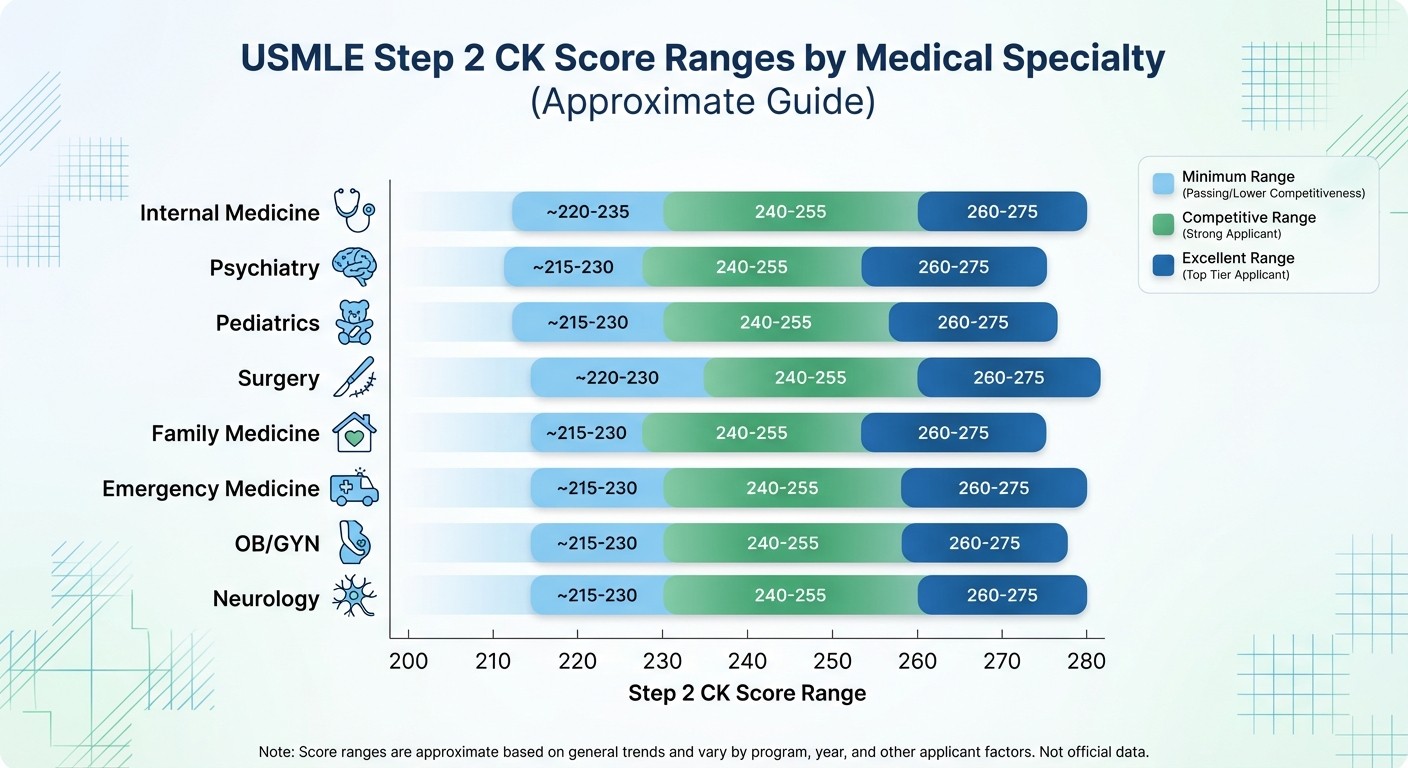
Step 2 CK Score Requirements by Specialty
Let's break down the realistic score targets for major specialties based on match data and program director feedback:
Highly Competitive Specialties
Dermatology
Screening threshold: 260+
Competitive range: 265-270+
Match rate correlation: Scores below 260 have <10% match rate
Radiation Oncology
Screening threshold: 258+
Competitive range: 262-268
Note: Research and publications still heavily weighted
Ophthalmology
Screening threshold: 255+
Competitive range: 260-265
Regional variation: Coastal programs often higher
Orthopedic Surgery
Screening threshold: 250+
Competitive range: 255-260
Away rotations can offset slightly lower scores
Moderately Competitive Specialties
Emergency Medicine
Screening threshold: 245+
Competitive range: 250-255
Geographic flexibility helps with lower scores
Anesthesiology
Screening threshold: 240+
Competitive range: 245-250
Score matters less after interview stage
Radiology
Screening threshold: 245+
Competitive range: 250-255
Research productivity increasingly important
Psychiatry
Screening threshold: 235+
Competitive range: 240-245
Personal statements and interviews heavily weighted
Less Competitive Specialties
Internal Medicine
Screening threshold: 230+
Competitive range: 240-245
University programs: Usually 235+ minimum
Pediatrics
Screening threshold: 235+
Competitive range: 240-245
Subspecialty fellowship plans may require higher scores
Family Medicine
Screening threshold: 225+
Competitive range: 235-240
Rural programs often more flexible
IMG-Specific Considerations
International medical graduates face additional hurdles beyond just Step 2 CK scores. The data shows IMGs typically need scores 10-15 points higher than US medical students for equivalent match rates.
IMG Score Adjustments by Specialty
Internal Medicine (IMG-friendly)
Target range: 245-250 (vs 240-245 for USMDs)
Many programs explicitly welcome IMGs
Family Medicine
Target range: 240-245 (vs 235-240 for USMDs)
Rural programs offer best opportunities
Psychiatry
Target range: 245-250 (vs 240-245 for USMDs)
Personal connections and research matter more
Emergency Medicine
Target range: 255-260 (vs 250-255 for USMDs)
Becoming increasingly competitive for IMGs
IMG Match Strategy Tips
1. Apply broadly: IMGs should apply to 80-120 programs vs 30-50 for USMDs
2. Target IMG-friendly programs: Research programs' historical IMG match rates
3. Consider less competitive locations: Rural and underserved areas often welcome IMGs
4. Emphasize clinical experience: US clinical rotations can offset slightly lower scores
The Clinical Reasoning Module in Oncourse helps IMGs practice the clinical decision-making patterns emphasized on Step 2 CK, which often differ from medical education in other countries.
Step 2 CK Score Timing and Strategy
When to Take Step 2 CK
Traditional Timeline
End of 3rd year or beginning of 4th year
Allows time for retaking if needed
Score available for ERAS application submission
Pros of early testing:
More time to retake if needed
Less competition pressure during application season
Can focus on rotations and research
Cons of early testing:
Less clinical knowledge and experience
May not represent your peak performance
Should You Retake?
The decision to retake Step 2 CK depends on your target specialty and current score:
Definitely retake if:
Score is below screening threshold for your target specialty
You scored 20+ points below your practice test average
You have time before application deadlines
Consider retaking if:
Score is in the bottom 25th percentile for your specialty
You're an IMG targeting competitive specialties
Your goal is a top-tier academic program
Probably dont retake if:
Score is above the 50th percentile for your specialty
You have strong clinical grades and research
Retaking would delay graduation or other applications
How to Maximize Your Step 2 CK Performance
High-Yield Study Strategies
Focus on clinical reasoning patterns: Step 2 CK tests your ability to work through complex clinical scenarios. Practice breaking down vignettes systematically — chief complaint, risk factors, physical exam findings, diagnostic workup, and management decisions. Master the common presentations: About 60% of Step 2 CK questions test the most common presentations of common diseases. Focus your time on typical manifestations before diving into rare syndromes. Time management is crucial: You have 63 seconds per question across 370 questions. Practice maintaining this pace consistently. The Clinical Reasoning Module in Oncourse includes timed practice that mirrors actual exam conditions.
Specialty-Specific Preparation
Different specialties require different emphases in your Step 2 CK preparation:
For Internal Medicine applicants: Focus heavily on adult ambulatory medicine, common inpatient scenarios, and chronic disease management. For Surgery applicants: Emphasize perioperative care, trauma, and surgical complications. Don't neglect medical management — it's still 70% of the exam. For Pediatrics applicants: While adult medicine dominates the exam, ensure you're solid on pediatric emergency presentations and common childhood diseases.
The Residency Match Prep Paths in Oncourse align study schedules with the score targets you need for specific specialties, so you're not overstudying low-yield topics when you should be drilling high-yield patterns.
What If Your Step 2 CK Score Is Lower Than Expected?
A lower-than-hoped Step 2 CK score doesnt end your residency dreams, but it does require strategic adjustments:
Immediate Actions
Broaden your specialty consideration: If you scored below the competitive range for your target specialty, research related fields that might be more accessible. Research program preferences: Some programs weight Step 2 CK less heavily than others. Look for programs that emphasize research, clinical grades, or personal fit. Strengthen other application components:
Seek additional research opportunities
Excel in relevant clinical rotations
Build relationships with faculty who can write strong letters
Application Strategy Adjustments
Apply more broadly: Increase your number of applications by 30-50% if you're below median scores. Consider geographic flexibility: Programs in less competitive locations often have more reasonable score expectations. Target programs that fit your profile: Research-heavy applicant? Target academic programs. Strong clinical grades? Emphasize community programs that value bedside skills. Write compelling personal statements: Explain your passion for the specialty and what unique perspective you bring beyond test scores.
Beyond the Numbers: What Else Matters
While Step 2 CK scores have become increasingly important, they're not the only factor. Here's what else program directors consider:
Clinical Performance (25-30% weight)
Shelf exam scores in relevant rotations
Clinical grades and evaluations
Letters of recommendation from faculty
Research and Publications (15-20% weight)
Peer-reviewed publications in your target field
Poster presentations at national conferences
Research projects showing sustained commitment
Personal Factors (20-25% weight)
Geographic ties to the program location
Demonstrated interest in the specialty
Leadership experience and extracurriculars
Personal statement quality and interview performance
Program Fit (10-15% weight)
Alignment with program mission and values
Experience in underserved populations
Language skills for diverse patient populations
Regional and Program-Specific Variations
Step 2 CK expectations can vary significantly by geographic region and program type:
Academic vs Community Programs
Academic Programs:
Often have higher Step 2 CK expectations
May emphasize research productivity more
Typically more competitive overall
Community Programs:
May be more flexible with scores
Often value clinical skills and personality fit
May have geographic preferences for applicants
Geographic Differences
East and West Coast:
Generally higher score expectations
More competitive applicant pools
Research and pedigree often emphasized
Midwest and South:
May have slightly more reasonable expectations
Often value cultural fit and commitment to region
Sometimes more IMG-friendly
Rural and Underserved Areas:
Most flexible with Step 2 CK scores
High demand for physicians
May offer loan forgiveness programs
Planning Your Application Timeline
12 Months Before Match
Take Step 2 CK if not already completed
Begin research projects in target specialty
Start building relationships with faculty mentors
Research programs and their requirements
9 Months Before Match
Retake Step 2 CK if necessary
Complete away rotations in target specialty
Begin drafting personal statement
Request letters of recommendation
6 Months Before Match
Finalize program list based on Step 2 CK score
Submit ERAS application
Prepare for interviews
Continue research projects and publications
3 Months Before Match
Complete interviews
Submit rank lists
Plan for backup options if needed
Prepare for potential Supplemental Offer and Acceptance Program (SOAP)
Frequently Asked Questions
What's considered a "good" Step 2 CK score in 2026?
A good Step 2 CK score depends entirely on your target specialty. For most specialties, scores above 245 are considered good, above 255 are very good, and above 265 are excellent. However, family medicine might consider 235+ good, while dermatology might consider anything below 260 inadequate.
How much can a high Step 2 CK score compensate for other weaknesses?
A high Step 2 CK score can help offset minor weaknesses but cant overcome major deficits. It might compensate for average clinical grades or limited research, but it wont make up for poor professionalism evaluations or a complete lack of experience in your target specialty.
Should IMGs target different specialties based on Step 2 CK scores?
IMGs should be realistic about their competitive position. Internal medicine, family medicine, and psychiatry remain the most IMG-friendly specialties. With scores above 250, IMGs can consider moderately competitive specialties, but should still apply broadly and have backup plans.
How important is the percentile vs raw score?
Program directors focus more on raw scores than percentiles because they provide consistent benchmarks year to year. However, percentiles can give you context about your performance relative to other test-takers and help predict competitiveness.
Can research publications make up for a lower Step 2 CK score?
Strong research can help, especially for academic programs, but rarely completely overcomes a significantly low Step 2 CK score. Research is more likely to be the tiebreaker between candidates with similar scores rather than a complete compensatory factor.
What if my Step 2 CK score doesnt match my practice test scores?
If your actual score is significantly lower than your practice scores (15+ points), consider whether test anxiety, timing issues, or content gaps affected your performance. If you have time before applications, retaking might be worthwhile, especially if you can identify and address specific weaknesses.
---
The residency match has become increasingly competitive, and Step 2 CK scores play a central role in determining your success. While the numbers matter, remember that they're just one piece of a larger puzzle. Focus on performing your best, apply strategically based on your scores, and strengthen all aspects of your application.
Your Step 2 CK score isnt just a number — it's your ticket to the interview room where your personality, passion, and clinical acumen can shine. Make sure you're prepared to make the most of those opportunities.
Prepare smarter with Oncourse AI — adaptive MCQs, spaced repetition, and AI explanations built for USMLE success. Download free on Android and iOS.