Back
Pituitary Disorders High-Yield Guide for NEET PG 2026
Master pituitary disorders for NEET PG 2026. Learn the 6 anterior pituitary hormones, feedback loops, and nail acromegaly, prolactinoma, and Sheehan syndrome concepts.
Pituitary Disorders High-Yield Guide for NEET PG 2026
The 6 Hormones • Acromegaly • Prolactinoma • Sheehan Syndrome • FAQ
You cant score well in NEET PG endocrinology without nailing pituitary disorders. Here's what actually matters: 6 anterior pituitary hormones drive 80% of questions. Master the mnemonic, understand 3 feedback loops, and recognize the classic triad of disorders. This is your 550-word blueprint.
The 6 Anterior Pituitary Hormones
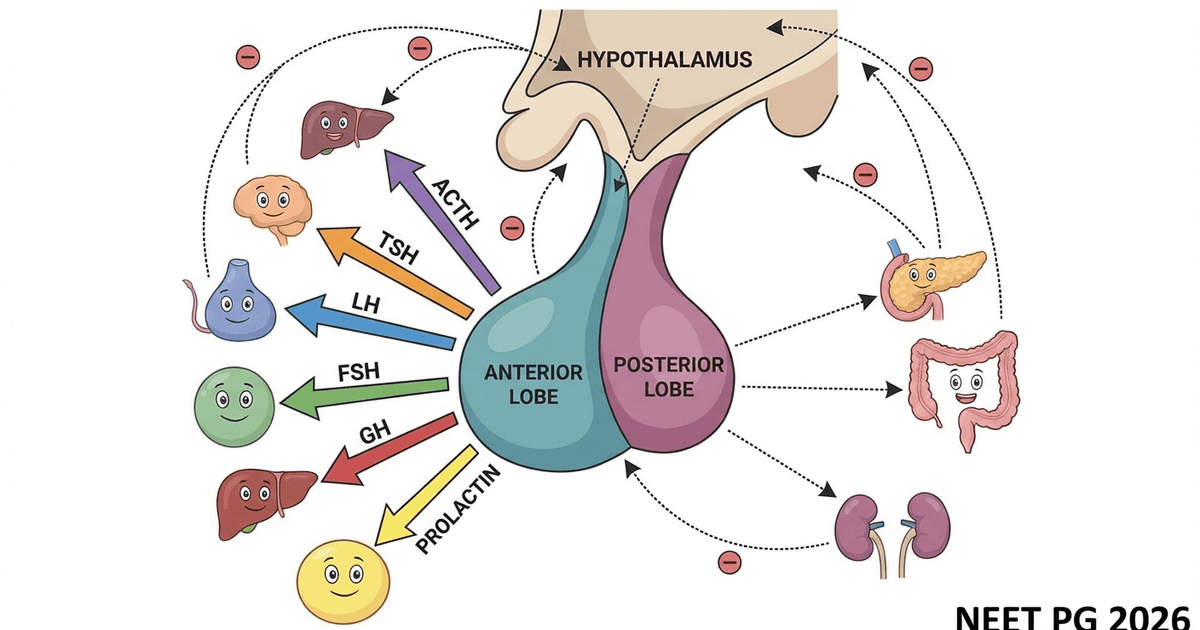
FLATPG mnemonic: FSH, LH, ACTH, TSH, Prolactin, Growth Hormone.
These aren't random. Each has a releasing hormone, each has feedback loops, each gets tested relentlessly. Oncourse Mnemonics encodes FLATPG as a retrieval challenge — you recall the hormone, it surfaces the target organ and feedback mechanism instantly.
High-yield feedback loops:
GH-IGF-1: Growth hormone stimulates liver IGF-1 production. IGF-1 inhibits GH release via negative feedback to hypothalamus and pituitary
ACTH-Cortisol: ACTH stimulates adrenal cortisol. Cortisol inhibits CRH and ACTH via negative feedback
TSH-T3/T4: TSH stimulates thyroid hormone production. T3/T4 inhibit TRH and TSH
When Rezzy explains dexamethasone suppression test logic, it walks through this ACTH-cortisol loop step-by-step. Dexamethasone (synthetic cortisol) suppresses ACTH in normal patients but not in Cushing disease (pituitary adenoma resistance).
Acromegaly: The Growth Hormone Excess
Classic question pattern: 45-year-old with enlarged hands, feet, jaw prominence, and diabetes. Key facts for NEET PG:
Most common cause: GH-secreting pituitary adenoma (98%)
Diagnosis: IGF-1 levels (screening), oral glucose tolerance test with GH (confirmatory)
GH should suppress to less than 1 ng/mL after glucose load. In acromegaly, it doesnt
Treatment: Transsphenoidal surgery (first-line), octreotide/lanreotide (somatostatin analogs)
Complications tested: Cardiomyopathy, sleep apnea, colon polyps, diabetes, visual field defects.
The Probe Game surfaces drug-disorder pairs under time pressure — octreotide for acromegaly, bromocriptine for prolactinoma, cabergoline for resistant prolactinoma. These drug questions appear in 60% of pituitary MCQs.
Prolactinoma: The Most Common Pituitary Tumor
Classic presentation: Amenorrhea-galactorrhea in women, decreased libido in men. NEET PG high-yield points:
Accounts for 40% of pituitary adenomas
Prolactin greater than 200 ng/mL suggests prolactinoma (vs. other causes of hyperprolactinemia)
Microadenoma (less than 1 cm): more common in women
Macroadenoma (greater than 1 cm): more common in men, causes visual field defects
Treatment ladder:
1. Dopamine agonists (bromocriptine, cabergoline) — first-line
2. Surgery if medical therapy fails
3. Radiation therapy for resistant cases
Differential diagnosis trap: Rule out pregnancy, medications (metoclopramide, risperidone), hypothyroidism before diagnosing prolactinoma.
Sheehan Syndrome: The Postpartum Trap
Classic scenario: Postpartum hemorrhage followed by failure to lactate, then progressive hormone deficiencies. Pathophysiology: Pituitary infarction due to postpartum hemorrhage. Enlarged pregnancy pituitary is vulnerable to ischemia. Hormone loss sequence (NEET PG favorite):
1. GH and LH/FSH (most sensitive)
2. ACTH (life-threatening)
3. TSH
4. Prolactin (preserved longest)
Clinical presentation:
Acute: Severe fatigue, inability to lactate
Chronic: Secondary amenorrhea, hypothyroidism, adrenal insufficiency
Diagnosis: Low pituitary hormones with low/normal target organ hormones. MRI shows empty sella. Treatment: Hormone replacement therapy — hydrocortisone (before thyroxine), levothyroxine, estrogen/progesterone.
Key Differentials for NEET PG
Hyperprolactinemia causes:
Physiological: Pregnancy, lactation, sleep, stress
Medications: Antipsychotics, antiemetics, opioids
Pathological: Prolactinoma, hypothyroidism, renal failure
Empty sella syndrome vs Sheehan:
Empty sella: Usually asymptomatic, incidental finding
Sheehan: Postpartum history, progressive hormone deficiencies
Review these concepts with Oncourse pituitary disorder flashcards and test your knowledge with targeted practice questions.
Frequently Asked Questions
What's the most common pituitary disorder in NEET PG questions?
Prolactinoma appears in 35% of pituitary MCQs, followed by acromegaly (25%) and Sheehan syndrome (20%).
How do I differentiate between prolactinoma and other causes of high prolactin?
Prolactin greater than 200 ng/mL strongly suggests prolactinoma. Drug-induced hyperprolactinemia rarely exceeds 150 ng/mL.
What's the classic presentation of Sheehan syndrome?
Postpartum hemorrhage + failure to lactate + progressive fatigue. The inability to lactate immediately postpartum is the key early clue.
Which hormone deficiency is most dangerous in hypopituitarism?
ACTH deficiency causing secondary adrenal insufficiency. This can be life-threatening and requires immediate cortisol replacement.
What's the difference between primary and secondary endocrine disorders?
Primary: Problem in target organ (high TSH, low T4 in primary hypothyroid). Secondary: Problem in pituitary (low TSH, low T4 in secondary hypothyroid).
How is GH deficiency diagnosed in adults?
ITT (insulin tolerance test) or GHRH-arginine stimulation test. Random GH levels are useless due to pulsatile secretion.
Prepare smarter with Oncourse AI — adaptive MCQs, spaced repetition, and AI explanations built for NEET PG. Download free on Android and iOS.