Back
Neurosurgery Residency Match Rate 2026: NRMP Data, Step 2 Score Requirements, and What Applicants Need to Know
NRMP 2026 neurosurgery match rate: 48% overall, 62% for US MDs. Step 2 CK requirement: 245+ for competitive applications. Complete guide to research, auditions, and match strategy.
Neurosurgery Residency Match Rate 2026: NRMP Data, Step 2 Score Requirements, and What Applicants Need to Know
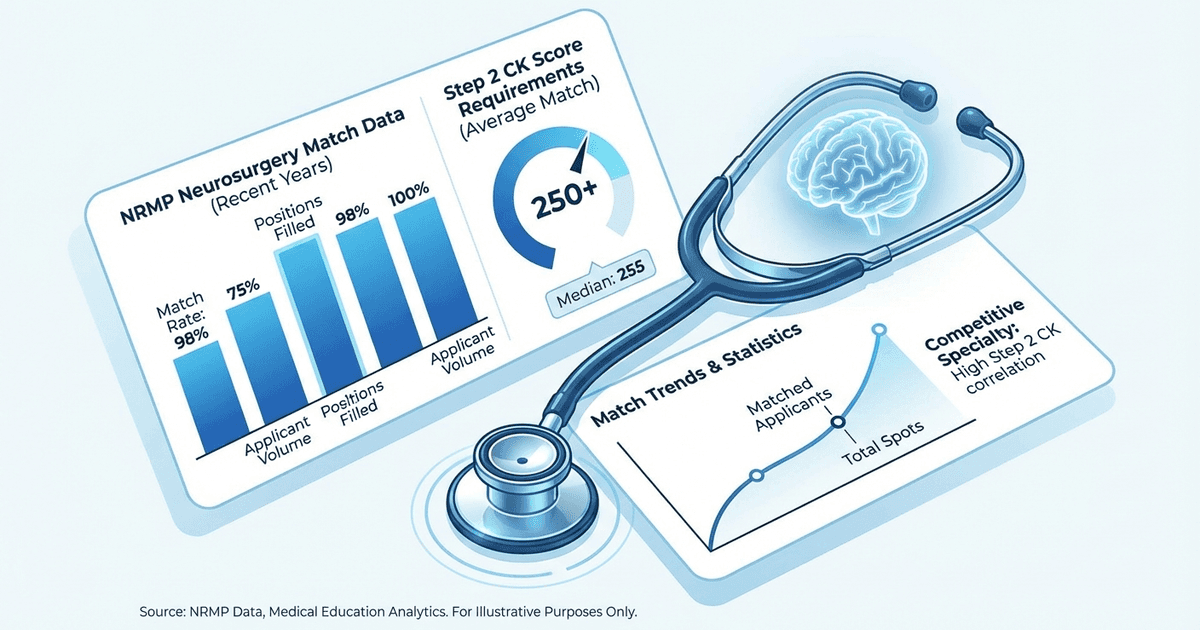
You are staring at the NRMP data. Neurosurgery matched 325 positions out of 342 available in 2026. That is a 95% fill rate, but only a 48% match rate for applicants. You need a Step 2 CK score of 245+ to be competitive, 15 research publications minimum, and perfect audition rotations.
This isnt the time for wishful thinking. Neurosurgery remains one of the most competitive medical specialties, and the 2026 match cycle proved it again. If you are an MS3 or MS4 seriously considering neurosurgery, you need the real numbers, not coaching center platitudes.
Here is what the 2026 NRMP data tells us about neurosurgery competitiveness, Step 2 CK score benchmarks, and what actually moves the needle for your application.
NRMP 2026 Neurosurgery Match Statistics: The Hard Numbers
The 2026 Main Residency Match offered 342 neurosurgery positions across all programs. 325 positions were filled, creating a 95% fill rate — one of the highest among surgical specialties.
But here is the reality check: 678 applicants competed for those 325 spots. That means a 48% match rate for neurosurgery applicants overall.
Metric | 2026 Data | 2025 Comparison |
|---|---|---|
Positions Offered | 342 | 338 |
Positions Filled | 325 | 321 |
Fill Rate | 95% | 95% |
Total Applicants | 678 | 665 |
Match Rate | 48% | 48% |
US MD Match Rate | 62% | 61% |
US IMG Match Rate | 19% | 18% |
US MD graduates had a 62% match rate in neurosurgery, while US IMGs faced a brutal 19% match rate. International medical graduates matched at just 8%.
These numbers havent budged much since Step 1 went pass/fail. Neurosurgery programs are finding other ways to differentiate applicants, and Step 2 CK scores have become the primary academic screening tool.
Step 2 CK Score Requirements: What Actually Gets You Looked At
With Step 1 pass/fail since 2022, Step 2 CK scores carry the entire academic weight of your application. Neurosurgery programs receive 200+ applications per position, and they need hard cutoffs.
Mean Step 2 CK Scores for 2026 Match
Applicant Category | Mean Step 2 CK Score | 25th Percentile | 75th Percentile |
|---|---|---|---|
Matched Neurosurgery | 248 | 242 | 254 |
Unmatched Neurosurgery | 232 | 225 | 239 |
All Matched Surgical Specialties | 241 | 235 | 247 |
Matched neurosurgery applicants averaged a 248 on Step 2 CK. The 25th percentile was 242 — meaning 75% of matched applicants scored 242 or higher. Unmatched neurosurgery applicants averaged 232 — a 16-point gap that often determines your entire career trajectory.
For context, Oncourse's adaptive question bank tracks student performance against these benchmarks in real-time, identifying gaps in Surgery and Neurology domains that neurosurgery programs scrutinize most heavily.
The 240+ Threshold
Most neurosurgery programs use 240 as an informal cutoff for initial screening. Scoring below 240 doesnt automatically disqualify you, but it puts you at a severe disadvantage in a field where every point matters.
Programs like Johns Hopkins Neurosurgery and UCSF Neurosurgery receive applications from students with 250+ Step 2 CK scores, 20+ publications, and stellar audition rotations. Your application needs to compete in that pool.
Beyond Step 2 CK: What Else Determines Your Match
Step 2 CK scores get you past the initial filter, but neurosurgery programs evaluate applications holistically. Here is what moves the needle beyond test scores.
Research Publications and Scholarly Activity
Matched neurosurgery applicants averaged 18.2 research publications in 2026, with 7.8 specifically in neurosurgery journals. Compare that to the average matched applicant across all specialties: 4.1 publications.
Top programs expect:
15+ total publications, with at least 5 in neurosurgery
First-author papers in peer-reviewed journals
Abstracts presented at major conferences (AANS, CNS)
Basic science research experience — many programs value lab work
Research quality matters more than quantity. A well-designed prospective study published in Neurosurgery carries more weight than 10 case reports in obscure journals.
Audition Rotations: Your Interview Preview
Neurosurgery audition rotations serve as extended interviews. Programs use these 4-week rotations to evaluate your surgical skills, work ethic, and fit with their culture.
Key audition rotation strategies:
Apply early — most programs cap audition spots at 8-12 per year
Target 3-4 programs maximum — quality over quantity
Prepare like an interview — know recent faculty publications and current research
Demonstrate stamina — neurosurgery residents work 80+ hour weeks
Programs often fill 30-40% of their spots from audition rotations. These rotations matter more than your personal statement or away electives in other specialties.
For students tracking their preparation, Oncourse's spaced repetition system helps retain high-yield neurosurgery concepts (cerebrovascular anatomy, ICP management, herniation syndromes) throughout busy audition rotation periods — keeping Board-level knowledge fresh during interview season.
Letters of Recommendation Strategy
Neurosurgery programs require letters from neurosurgery faculty — general surgery or medicine letters carry minimal weight. Your letter strategy should include:
Department Chair or Program Director letter (if possible)
Attending from your audition rotation — your strongest clinical advocate
Research mentor who can speak to your scholarly potential
Fourth letter from another neurosurgery faculty member
Generic letters kill neurosurgery applications. Each letter needs specific examples of your performance, research contributions, and potential as a neurosurgeon.
Step 2 CK Study Strategy for Neurosurgery-Level Scores
Scoring 245+ on Step 2 CK requires a targeted approach. You cant afford the "broad review" strategy that works for less competitive specialties.
High-Yield Topics for Neurosurgery Applicants
Step 2 CK heavily tests clinical scenarios, and neurosurgery programs pay attention to your performance in specific domains:
Surgery (25% of Step 2 CK):
Emergency surgery scenarios
Pre/post-operative management
Surgical complications
Trauma protocols
Neurology (8-10% of Step 2 CK):
Stroke evaluation and management
Seizure disorders
Movement disorders
Neurocritical care
Emergency Medicine (15% of Step 2 CK):
Head trauma evaluation
Acute neurological emergencies
ICU management
Airway management
6-Week Study Plan for 245+ Scores
Weeks 1-2: Foundation Building
Complete 80 questions daily from a high-quality question bank
Focus on Surgery and Neurology blocks
Review explanations thoroughly — understanding matters more than speed
Oncourse's adaptive question bank adjusts to your weak areas in real-time, ensuring you spend more time on Surgery and Emergency Medicine scenarios where neurosurgery applicants need to excel. Weeks 3-4: Targeted Improvement
Increase to 120 questions daily
Simulate test-day conditions with timed blocks
Use analytics to identify remaining weak areas
Weeks 5-6: Peak Performance
Take practice NBMEs weekly
Focus on test-taking strategy and timing
Maintain 240+ scores consistently on practice exams
Oncourse's performance analytics dashboard shows your percentile ranking by subject and difficulty tier, helping you benchmark against the 245+ target range week-over-week.
Critical Timeline: When to Take Step 2 CK and Apply
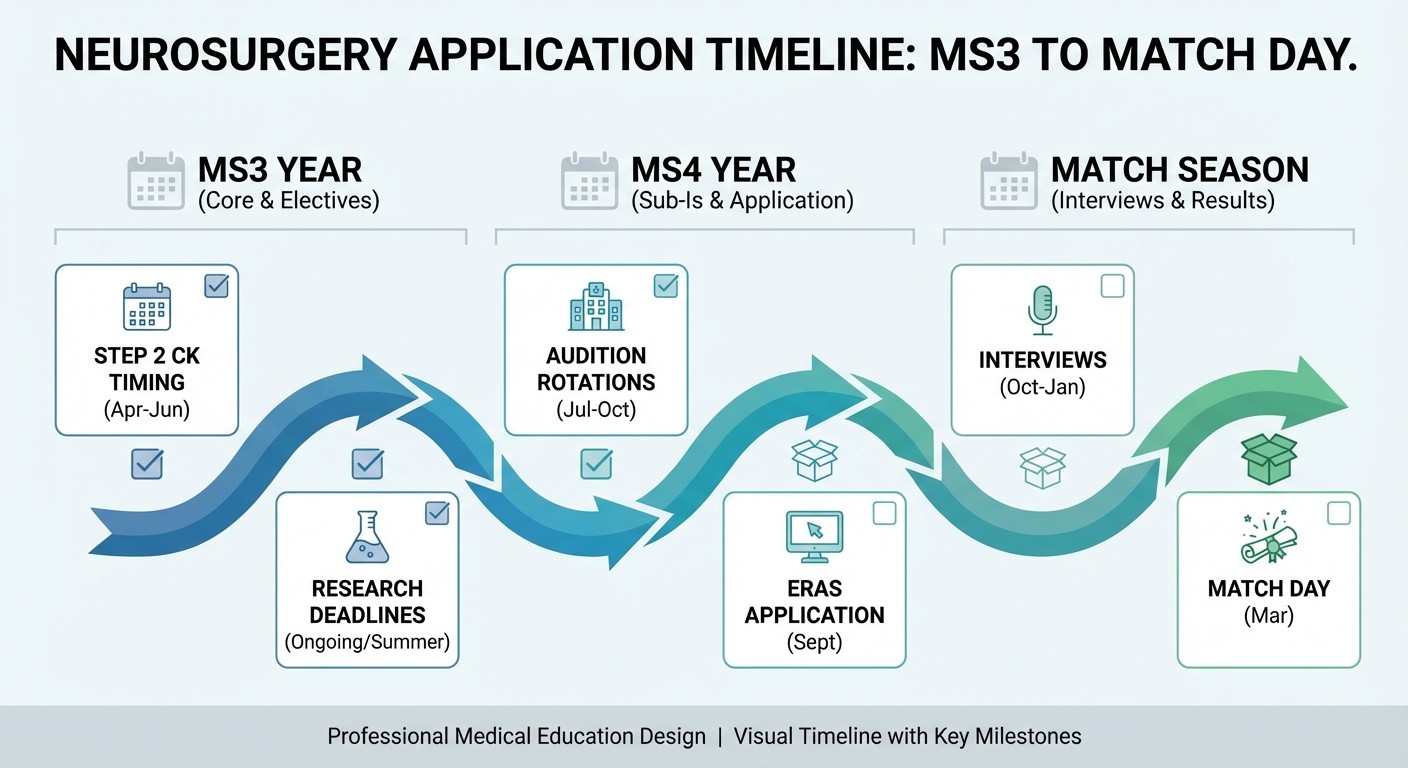
Timing matters enormously in neurosurgery applications. Miss these deadlines, and you are applying the following year.
MS3 Year Critical Milestones
January-March MS3:
Begin neurosurgery research if you havent already
Schedule Step 2 CK for May-June MS3
Connect with neurosurgery faculty for mentorship
April-June MS3:
Take Step 2 CK (score release before ERAS opens)
Secure neurosurgery research positions for the summer
Plan audition rotations for MS4 year
July-August MS3:
Summer research intensive — aim for 2-3 abstracts
Begin personal statement draft
Request letters of recommendation early
MS4 Year Application Cycle
September MS4:
ERAS applications open (typically Sept 1)
Submit applications on opening day — neurosurgery programs review in order received
Apply broadly: 30-50 programs for competitive applicants
October-December MS4:
Audition rotations (schedule Oct-Dec)
Interview invitations sent (Oct-Jan)
Complete interviews by February
January-March MS4:
Final interviews (Jan-Feb)
Rank order list submission (Feb)
Match Day (March)
Step 2 CK Timing Strategy
Take Step 2 CK no later than June of MS3 year. Scores must be available when ERAS opens in September MS4. Taking Step 2 CK after July creates unnecessary risk — you need time to retake if necessary.
Programs use Step 2 CK scores for initial screening. Late scores mean your application sits unreviewed while interview spots disappear.
Signal Strategy: ERAS Preference Signals for Neurosurgery
The 2026 ERAS cycle allowed applicants to send preference signals to programs — a way to indicate genuine interest beyond just applying.
Neurosurgery signal strategy:
Use signals for your top 5-7 programs
Signal programs where you completed audition rotations
Signal programs in your preferred geographic region
Dont signal safety programs — save signals for reaches
Programs receive hundreds of applications but only 10-20 signals from any individual applicant. Signals carry significant weight in interview invitation decisions.
Research shows that signaled programs are 3x more likely to extend interview invitations to competitive applicants.
What Neurosurgery Programs Actually Want
Beyond the numbers, neurosurgery programs look for specific qualities that predict success in their rigorous training environment.
The Intangibles That Matter
Stamina and Resilience:
Neurosurgery residency involves 16-hour days, complex cases, and life-or-death decisions. Programs want evidence you can handle sustained pressure.
Research Potential:
Most neurosurgery programs are research-intensive. They want residents who will contribute to publications and grants throughout training.
Technical Skills:
Fine motor skills matter in neurosurgery. Programs evaluate hand-eye coordination, spatial reasoning, and precision during audition rotations.
Leadership and Teaching:
Neurosurgery residents teach medical students and junior residents. Programs value applicants with teaching experience and leadership roles.
Red Flags That Sink Applications
Academic Issues:
Step 2 CK score below 235
Failed any USMLE step (even if passed on repeat)
Poor clinical grades in surgery or neurology rotations
Professionalism Concerns:
Any disciplinary actions or unprofessional behavior
Poor evaluations from rotation attendings
Inappropriate behavior during audition rotations
Weak Research:
Zero neurosurgery research experience
Only case reports or review articles
No conference presentations or abstracts
Post-Step 1 Pass/Fail: How Evaluation Has Changed
Since Step 1 went pass/fail in 2022, neurosurgery programs have adjusted their evaluation criteria. The changes affect how you should structure your application.
New Emphasis Areas
Step 2 CK Carries More Weight:
Previously, Step 1 scores served as the primary academic filter. Now Step 2 CK scores determine academic competitiveness almost entirely.
Clinical Grades Matter More:
With no Step 1 score to reference, programs scrutinize MS3 clinical grades more carefully. Honor grades in surgery and neurology rotations are nearly essential.
Research Quality Over Quantity:
Programs now spend more time evaluating research quality since they cant rely on Step 1 scores for quick academic screening.
Audition Rotations Are Critical:
Without Step 1 scores to predict clinical performance, programs rely more heavily on direct observation during audition rotations.
Alternative Pathways and Backup Plans
Not matching neurosurgery doesnt end your career aspirations. Several pathways can lead to neurosurgery training or similar specialties.
Research Years and Reapplication
Many unsuccessful neurosurgery applicants take research years to strengthen their applications. A productive research year can add 5-8 publications and demonstrate continued commitment to the field.
Successful reapplicants typically:
Score 250+ on Step 2 CK (if retaking)
Add 6+ publications in neurosurgery journals
Secure stronger letters of recommendation
Complete additional audition rotations
Related Specialties
Orthopedic Surgery (Spine):
Overlapping interest in spinal surgery with shorter training (5 years vs 7 years for neurosurgery). Competitive but broader match opportunities.
Radiation Oncology:
Strong overlap with neuro-oncology interest. Highly competitive but different application timeline and requirements.
Neurology with Fellowship:
Neurology residency followed by interventional neurology fellowship provides minimally invasive neurovascular training.
Frequently Asked Questions
What Step 2 CK score do I need for neurosurgery?
Target 245+ for competitive applications. The 25th percentile of matched applicants scored 242 in 2026. Scoring below 240 significantly reduces your interview opportunities at top programs.
How many neurosurgery programs should I apply to?
Apply to 30-50 programs if you are competitive (245+ Step 2 CK, 15+ publications, strong auditions). Less competitive applicants should consider 50+ programs and backup specialties.
Can I match neurosurgery as an IMG?
US IMGs matched at 19% in 2026, while international IMGs matched at 8%. You need exceptional scores (250+ Step 2 CK), extensive US clinical experience, and strong research to be competitive.
How important are away rotations in neurosurgery?
Critical. Most programs fill 30-40% of spots from audition rotation students. Complete 3-4 audition rotations at programs where you want to match.
What research is most valuable for neurosurgery applications?
Clinical research in neurosurgery journals carries the most weight. Basic science research demonstrates research skills but clinical studies show understanding of neurosurgical problems.
Should I retake Step 2 CK if I scored 240?
Depends on the rest of your application. With strong research and audition rotations, 240 can be competitive. Without other strengths, consider retaking for 245+.
Prepare smarter with Oncourse AI — adaptive MCQs, spaced repetition, and AI explanations built for USMLE Step 2 CK. Download free on Android and iOS.