Back
NEET PG Subject Wise Weightage 2026: Complete Marks Distribution, High-Yield Subjects and Topper Strategy
Complete NEET PG 2026 subject wise weightage breakdown: 200 MCQs distribution, high-yield subjects analysis, and proven topper strategies for maximum marks. Master the NBE pattern.
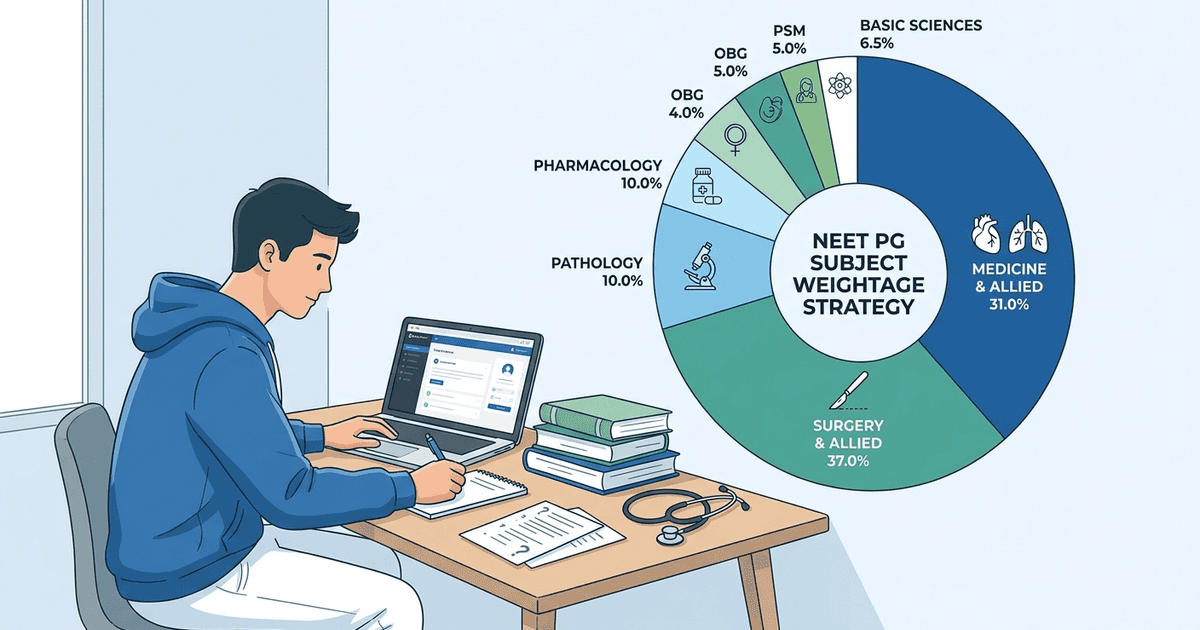
NEET PG Subject Wise Weightage 2026: Complete Marks Distribution, High-Yield Subjects and Topper Strategy
You are staring at 200 questions that determine your PG seat. Each carries 4 marks. Get one wrong, lose 1 mark. You have 210 minutes — roughly 63 seconds per question.
But here's what separates toppers from the rest: they know exactly where these 200 questions come from. They understand that Medicine alone contributes 45 questions while Radiology gives just 5. They've built their entire preparation around this marks distribution.
NEET PG 2026 follows the NBE pattern with sectional timing — 50 questions each for Pre-clinical and Para-clinical sections (45 minutes each), and 100 questions for Clinical subjects (120 minutes). Once you move to the next section, there's no going back.
This complete weightage breakdown will show you exactly how toppers allocate their study time, which subjects deliver maximum marks, and how to build your revision strategy around the actual exam pattern.
NEET PG 2026 Exam Structure: The Numbers That Matter
Total Questions: 200 MCQs Total Marks: 800 (4 marks per correct answer) Negative Marking: -1 mark per wrong answer Duration: 3 hours 30 minutes (210 minutes) Format: Computer-based test with sectional timing
Sectional Breakdown with Time Allocation
Section | Subjects Covered | Questions | Time Limit | Strategy Window |
|---|---|---|---|---|
Section A (Pre-Clinical) | Anatomy, Physiology, Biochemistry | 50 | 45 minutes | 54 seconds per question |
Section B (Para-Clinical) | Pathology, Pharmacology, Microbiology, Forensic Medicine, Community Medicine | 50 | 45 minutes | 54 seconds per question |
Section C (Clinical) | Medicine, Surgery, OBG, Pediatrics, ENT, Ophthalmology, Orthopedics, Dermatology, Psychiatry, Radiology, Anesthesia | 100 | 120 minutes | 72 seconds per question |
The clinical section gets more time per question because these involve case-based scenarios and image interpretation. Use this extra buffer to analyze clinical vignettes carefully.
Complete Subject Wise Marks Distribution 2026
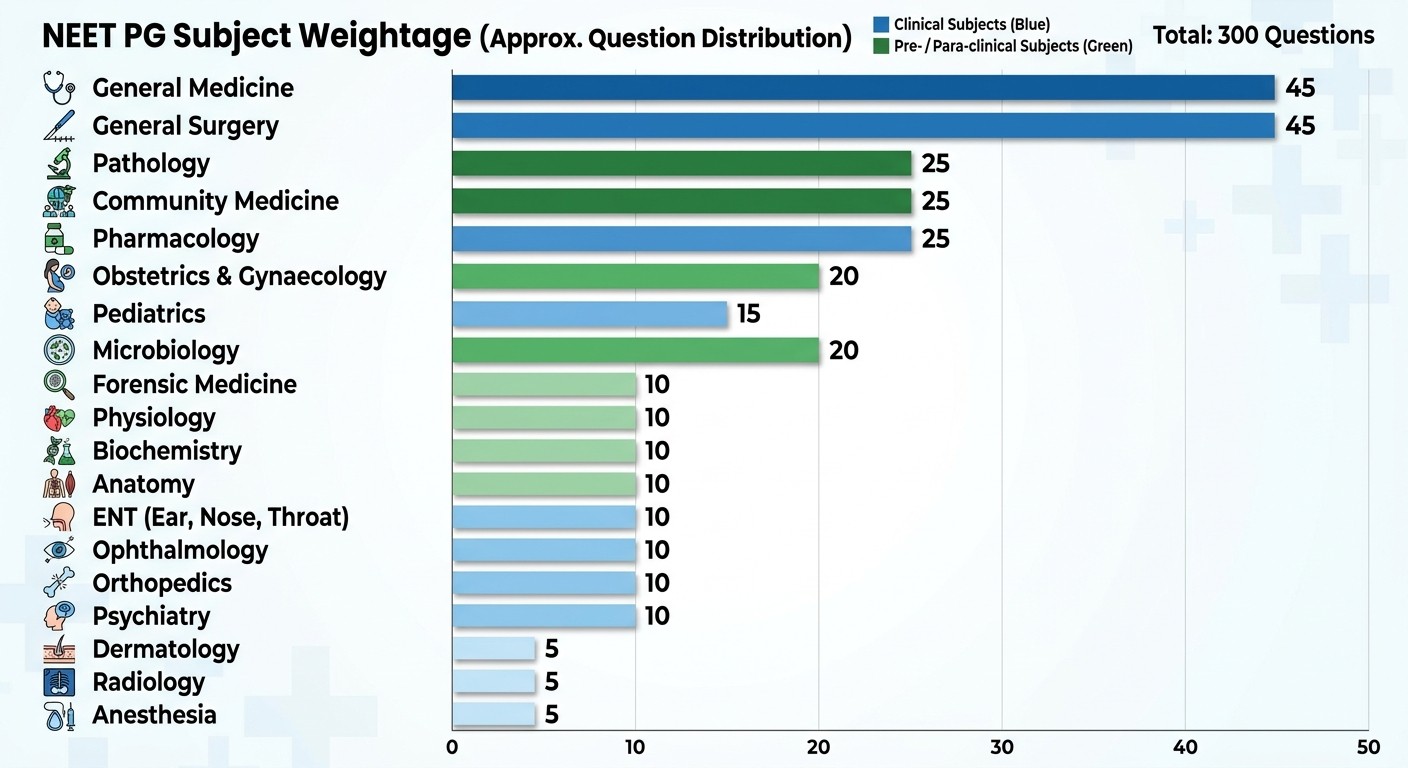
Here's the actual question count and marks distribution based on NBE patterns and previous year analysis:
Pre-Clinical Subjects (Section A)
Subject | Expected Questions | Marks Range | Key Focus Areas |
|---|---|---|---|
Anatomy | 17 | 68 | Neuroanatomy, Embryology, Clinical correlations |
Physiology | 17 | 68 | Cardiovascular, Respiratory, Renal physiology |
Biochemistry | 16 | 64 | Metabolism, Clinical biochemistry, Enzymology |
Para-Clinical Subjects (Section B)
Subject | Expected Questions | Marks Range | Key Focus Areas |
|---|---|---|---|
Pathology | 25 | 100 | Neoplasia, Hematopathology, Systemic pathology |
Pharmacology | 20 | 80 | Antimicrobials, CNS drugs, Cardiovascular drugs |
Microbiology | 20 | 80 | Bacteriology, Virology, Mycology |
Community Medicine | 25 | 100 | Epidemiology, Biostatistics, Health programs |
Forensic Medicine | 10 | 40 | Medical jurisprudence, Toxicology, Autopsy |
Clinical Subjects (Section C)
Subject | Expected Questions | Marks Range | Key Focus Areas |
|---|---|---|---|
General Medicine | 45 | 180 | Cardiology, Endocrinology, Neurology |
General Surgery | 45 | 180 | GI surgery, Trauma, Surgical oncology |
Obstetrics & Gynecology | 30 | 120 | High-risk pregnancy, Gynec oncology |
Pediatrics | 20 | 80 | Neonatology, Growth disorders, Infections |
ENT | 20 | 80 | Head neck surgery, Otology, Rhinology |
Ophthalmology | 20 | 80 | Retinal disorders, Glaucoma, Ocular emergencies |
Orthopedics | 15 | 60 | Trauma, Joint disorders, Spine |
Dermatology | 10 | 40 | Infectious skin diseases, Autoimmune disorders |
Psychiatry | 10 | 40 | Mood disorders, Schizophrenia, Child psychiatry |
Radiology | 8 | 32 | Cross-sectional imaging, Interventional procedures |
Anesthesia | 7 | 28 | Critical care, Pain management, Pharmacology |
High-Yield Subject Analysis: Where Toppers Focus
The Big 4: Maximum ROI Subjects
1. General Medicine (45 questions = 180 marks)
Medicine dominates NEET PG with the highest question count. Focus heavily on cardiology (MI management, arrhythmias), endocrinology (diabetes complications), and infectious diseases.
When drilling medicine concepts, Oncourse's subject-wise question bank lets you practice cardiology and pulmonology separately — perfect for targeting your weak subspecialties within this massive subject.
2. General Surgery (45 questions = 180 marks)
Surgery questions are increasingly case-based with emphasis on perioperative management. Master GI surgery, trauma protocols, and surgical oncology.
3. Pathology (25 questions = 100 marks)
Pathology forms the foundation for clinical reasoning. Neoplasia, hematopathology, and systemic pathology are high-yield. Every medicine and surgery question has pathology underlying it.
4. Community Medicine (25 questions = 100 marks)
Often underestimated but carries equal weightage to Pathology. Epidemiology, biostatistics, and national health programs are frequent topics.
The Supporting Cast: Medium-Yield Subjects
Pharmacology (20 questions = 80 marks)
Critical for clinical decision-making questions. Focus on antimicrobials, CNS drugs, and cardiovascular pharmacology.
Microbiology (20 questions = 80 marks)
Increasingly integrated with clinical scenarios. Culture media, antibiotic sensitivity, and infectious disease management are key.
OBG (30 questions = 120 marks)
High-risk obstetrics and gynecological oncology dominate. Questions often involve managing complications.
Strategic Subjects: Focused Preparation
ENT & Ophthalmology (20 questions each = 80 marks each)
These subjects have well-defined, focused syllabi. Ophthalmology questions are often image-based (fundus photos, slit-lamp images), while ENT focuses on surgical anatomy and procedures.
Oncourse tags these image-based questions as high-yield based on NBE patterns, so you can filter practice sessions to focus specifically on visual recognition — exactly what you need for these subjects.
Topper Strategy: Time Allocation Formula
Study Time Distribution (Based on Marks Weightage)
High-Priority Subjects (60% of study time):
General Medicine: 18% of total study time
General Surgery: 18% of total study time
Pathology: 12% of total study time
Community Medicine: 12% of total study time
Medium-Priority Subjects (30% of study time):
Pharmacology: 8% of total study time
Microbiology: 8% of total study time
OBG: 8% of total study time
ENT: 3% of total study time
Ophthalmology: 3% of total study time
Foundation Subjects (10% of study time):
Anatomy, Physiology, Biochemistry: 3% each
Pediatrics, Orthopedics, others: remaining time
3-Month Revision Strategy
Month 1: System-wise Integration
Week 1-2: Cardiovascular system (Medicine + Surgery + Pathology + Pharmacology)
Week 3-4: Respiratory system (comprehensive integration)
During this phase, use Oncourse's performance analytics to track your accuracy across different systems. The platform shows exactly which cardiovascular topics you're missing, letting you course-correct before moving to the next system.
Month 2: High-Yield Topic Mastery
Week 1: Medicine subspecialties (Cardiology, Endocrinology)
Week 2: Surgery subspecialties (GI, Trauma)
Week 3: Pathology (Neoplasia, Hematopathology)
Week 4: Community Medicine + Pharmacology integration
Month 3: Final Sprint + Mock Pattern
Week 1-2: Sectional practice (45-45-120 minute timing)
Week 3: Weak area targeting based on mock analysis
Week 4: High-yield revision + previous year questions
Changes from NEET PG 2024 to 2026 Pattern
Key Pattern Shifts
1. Increased Clinical Integration
2026 pattern shows 60-65% questions now involve clinical scenarios compared to 50% in 2024. Pure theoretical questions are declining across all subjects.
2. Image-based Question Growth
Expect 25-30% image-based questions in 2026 vs 20% in previous years. This affects Radiology, Pathology, Ophthalmology, and Dermatology significantly.
3. Sectional Timing Enforcement
Unlike 2024 where section timing was advisory, 2026 strictly enforces the 45-45-120 minute distribution. No flexibility to manage time across sections.
4. Para-clinical Weightage Increase
Community Medicine and Microbiology questions increased from 15-18 each to 20-25 each, reflecting current healthcare priorities.
Adaptive Strategy for 2026
Given these changes, successful candidates are adjusting their approach:
More case-study practice: Less textbook reading, more scenario-based learning
Image bank preparation: Dedicated time for radiology, pathology slides, and clinical photos
Sectional mock tests: Practice with strict timing to simulate actual exam pressure
Common Preparation Mistakes and Solutions
Mistake 1: Ignoring Para-Clinical Subjects
The Problem: Many candidates focus heavily on Medicine and Surgery while giving minimal time to Pathology, Pharmacology, and Microbiology. The Reality: Para-clinical subjects contribute 50 questions (200 marks) — equal to the entire clinical section's major subjects combined. Solution: Allocate 30% of your preparation time to para-clinical subjects. These form the foundation for understanding clinical scenarios.
Mistake 2: Under-preparing Pharmacology and Microbiology
The Problem: Treating these as "memorization subjects" and leaving them for last-minute cramming. The Reality: Modern NEET PG integrates these subjects into clinical scenarios. A medicine question about sepsis will test microbiology concepts and antibiotic choices simultaneously. Solution: Study these subjects in context with clinical cases. When learning about pneumonia treatment, simultaneously cover the microbiology of causative organisms and pharmacology of antibiotics.
Mistake 3: Neglecting Community Medicine
The Problem: Considering PSM as low-yield due to its "theoretical" nature. The Reality: Community Medicine carries 25 questions (100 marks) — equal to Pathology. Recent patterns show increasing focus on current health programs and epidemiological data. Solution: Create a structured approach to biostatistics formulas and stay updated with national health program modifications.
Subject-Specific Preparation Strategies
For High-Yield Clinical Subjects
Medicine Preparation Strategy:
Focus 40% time on cardiology and endocrinology
Practice ECG interpretation and lab value analysis
Master emergency protocols and treatment algorithms
Use Oncourse's medicine question bank to drill cardiology MCQs specifically — you can practice 100+ cardiology questions in focused sessions rather than mixing them with other subspecialties. Surgery Preparation Strategy:
Emphasize pre-operative and post-operative management
Study surgical anatomy with clinical correlations
Focus on indication and contraindication patterns
For Foundation Subjects (Pre-Clinical)
Anatomy Strategy:
Don't skip this thinking it's "basic." Anatomy questions are increasingly applied — neuroanatomy questions appear as clinical scenarios with neurological deficits.
Physiology Strategy:
Connect every mechanism to its clinical application. Cardiac physiology directly links to cardiology questions in the clinical section.
Biochemistry Strategy:
Focus on metabolic pathways that have clinical relevance — diabetes, liver diseases, and genetic disorders.
Para-Clinical Deep Dive
Pathology Mastery:
This subject bridges basic sciences with clinical medicine. Every disease you study in Medicine or Surgery has pathology underlying it. Focus on:
Neoplasia (classification, staging, molecular markers)
Hematopathology (leukemias, lymphomas, coagulation disorders)
Systemic pathology (organ-specific disease processes)
Master pathology concepts early, as they reinforce learning in other subjects. Study pathology lessons systematically before diving into clinical subjects. Pharmacology Focus:
Antimicrobials (mechanism, spectrum, resistance)
Cardiovascular drugs (mechanism-based learning)
CNS pharmacology (especially antiepileptics and antipsychotics)
Microbiology Priorities:
Culture media and diagnostic tests
Antibiotic sensitivity patterns
Hospital-acquired infections and control measures
Building Your Personal Study Schedule
Daily Time Allocation (8-hour study day)
High-Yield Day Structure:
2.5 hours: Medicine (including subspecialties)
2.5 hours: Surgery (including subspecialties)
1.5 hours: Pathology/Pharmacology (alternate days)
1 hour: Community Medicine/Microbiology
0.5 hours: Quick revision of previous day topics
Weekly Pattern:
Monday-Tuesday: Medicine focus
Wednesday-Thursday: Surgery focus
Friday: Pathology and para-clinical integration
Saturday: Mock tests and analysis
Sunday: Weak area targeting and revision
Mock Test Strategy Based on Weightage
Phase 1 (4-6 months before exam):
Subject-wise tests focusing on high-yield topics. Start with 25-question tests for Medicine, 25 for Surgery, etc.
Phase 2 (2-3 months before exam):
Sectional tests with timing - 45 minutes for 50 questions in pre-clinical and para-clinical sections, 120 minutes for 100 clinical questions.
Phase 3 (Last month):
Full-length tests with exact exam pattern. Analyze performance by subject weightage.
After each mock, Oncourse shows your accuracy breakdown by subject, letting you immediately see if you're under-performing in high-weightage areas like Medicine or Surgery versus lower-yield subjects like Radiology.
Last-Minute Revision: 15 Days Before Exam
High-Yield Rapid Revision
Days 1-5: Clinical Subjects
Medicine: Focus on emergency protocols, treatment algorithms
Surgery: Pre-op evaluation, post-op complications
OBG: High-risk pregnancy management
Days 6-10: Para-Clinical Foundation
Pathology: Neoplasia staging, tumor markers
Pharmacology: Drug interactions, contraindications
Microbiology: Antibiotic spectra, resistance mechanisms
Days 11-15: Integration and Mock Analysis
Sectional timing practice
Weak area drilling based on mock performance
Previous year question pattern analysis
Technology Integration: Smart Preparation Tools
Using Analytics for Strategic Advantage
Modern toppers leverage data-driven preparation. Track your performance metrics:
Accuracy by subject: Identify which high-weightage subjects need more attention
Time per question: Ensure you're not spending too much time on low-yield subjects during practice
Weak topic identification: Focus revision on areas that contribute maximum marks
When you practice with Oncourse, the platform automatically tracks these metrics. After completing medicine questions, you can see exactly which cardiology subtopics you're missing and allocate extra time there rather than generic "medicine" study.
High-Yield Question Practice
Rather than solving random questions, filter practice by:
Subject weightage: Spend more time on 45-question subjects
Previous year patterns: Focus on topics that repeat frequently
High-yield tags: Questions marked based on NBE examination trends
Oncourse's high-yield question filtering ensures you practice exactly the type of questions NBE prefers for high-weightage subjects — case-based medicine scenarios, image-heavy pathology questions, and integrated pharmacology concepts.
Frequently Asked Questions
How many questions come from Medicine in NEET PG 2026?
General Medicine contributes approximately 45 questions out of 200 total questions, making it 180 marks. This includes cardiology, pulmonology, gastroenterology, endocrinology, and other medicine subspecialties. It's the single largest contributor to your score.
Which subjects should I prioritize in the last 3 months?
Focus on the Big 4: Medicine (45 questions), Surgery (45 questions), Pathology (25 questions), and Community Medicine (25 questions). These four subjects alone contribute 140 questions out of 200 — that's 70% of your total marks.
Is the subject weightage fixed every year?
No, the exact question count can vary by 2-3 questions per subject annually. However, the overall pattern remains consistent — Medicine and Surgery dominate, followed by major para-clinical subjects like Pathology and Community Medicine.
How much time should I spend on Anatomy and Physiology?
Pre-clinical subjects (Anatomy, Physiology, Biochemistry) contribute 50 questions total. Spend about 15% of your preparation time on these subjects — they're important for building foundation but dont over-invest at the expense of high-yield clinical subjects.
Should I skip low-weightage subjects like Radiology and Anesthesia?
Never completely skip any subject, but allocate time proportionally. Radiology (8 questions) and Anesthesia (7 questions) together contribute only 15 questions. Study the high-yield topics in these subjects but dont spend weeks mastering every detail.
How does sectional timing affect my strategy?
With 45 minutes each for pre-clinical and para-clinical sections, you get 54 seconds per question. For the clinical section, you have 120 minutes for 100 questions (72 seconds each). Practice sectional tests to master this timing since you cannot go back to previous sections.
---
NEET PG success comes from strategic preparation aligned with actual marks distribution. The 200 questions aren't equally important — Medicine and Surgery alone contribute 90 questions (360 marks).
Build your preparation around these numbers. Allocate time based on weightage. Focus your energy where it delivers maximum score.
Prepare smarter with Oncourse AI — adaptive MCQs, spaced repetition, and AI explanations built for NEET PG. Download free on Android and iOS.