Back
NEET PG Subject-Wise Preparation: How to Balance High-Yield Topics and Weak Areas
Master NEET PG preparation with data-driven subject allocation. Learn to balance high-yield topics with weak area repair using mock analysis, active recall, and strategic time distribution across all 19 subjects.

NEET PG Subject-Wise Preparation: How to Balance High-Yield Topics and Weak Areas
You probably picked up this guide because you cant figure out where to spend your limited study hours. Should you chase every high-yield topic or fix your failing subjects first? The answer isnt "both equally" — that leads to mediocre scores across everything.
Here's what works: 200 NEET PG questions demand surgical precision. You need 70-20-10 allocation — 70% on high-yield topics in strong-to-moderate subjects, 20% fixing critical weak areas that kill your confidence, and 10% maintaining already-strong domains. This isnt about studying harder; its about studying with data-driven priorities.
The students who break 600+ dont spread time evenly across 19 subjects. They identify their weak topics from mock analysis, target high-yield areas within each subject, and use active recall systems to make both stick. Let me show you exactly how to build this balance.
Why Subject-Wise Preparation Needs Strategic Imbalance
Traditional advice says "give equal time to all subjects." That's mathematically impossible and strategically wrong. NEET PG weightage is heavily skewed — Medicine (40-45 questions), Surgery (35-40), and Pharmacology (20-25) together give you 95+ questions. That's nearly half the paper from three subjects.
Your preparation should mirror this imbalance. If you're scoring 40% in Medicine but 80% in Forensic Medicine, spending equal hours on both subjects makes no sense. Medicine weak areas can cost you 25+ marks; Forensic weak spots might cost 3-4 marks.
The key insight: weak areas in high-weightage subjects kill your rank more than missing entire low-weightage subjects. Fix a Medicine cardiology gap before perfecting your Forensic toxicology.
But there's a catch — you cant ignore genuine weak subjects entirely. If your Surgery score is below 50%, those 35-40 questions become a massive liability. The trick is identifying which weak areas deserve immediate attention versus which can wait.
How to Identify Your Weak Subjects and Topics from Mock Data
Mock tests are diagnostic tools, not just practice sessions. Every incorrect answer tells you something specific about your preparation gaps. Here's how to extract actionable intelligence:
The 3-Layer Analysis System
Layer 1: Subject-Level Performance (10 minutes)
After each mock, calculate your accuracy per subject. Create a simple table:
Medicine: 15/22 (68%)
Surgery: 12/20 (60%)
Pathology: 14/18 (78%)
Pharmacology: 8/15 (53%)
Any subject below 60% becomes a priority repair target. Between 60-75% needs targeted topic work. Above 75% requires maintenance only.
Layer 2: Topic-Level Breakdown (20 minutes)
For each subject, identify which topics you missed:
Medicine: Missed 4/6 cardiology questions, 2/4 nephrology, 1/5 endocrinology
Surgery: Missed all 3 trauma questions, 2/4 GI surgery, 1/3 oncology
This shows you cardiology and trauma as urgent weak topics, even though Medicine and Surgery overall aren't your worst subjects.
Layer 3: Question-Type Analysis (15 minutes)
Categorize each mistake:
Concept gap: Never learned it properly
Recall failure: Knew it once, cant access under pressure
Application error: Know the fact, missed the clinical connection
Silly mistake: Misread or clicked wrong option
Concept gaps need lesson review. Recall failures need flashcard drilling. Application errors need more clinical MCQ practice.
For weak-area targeting, Oncourse AI automatically tracks these patterns across your practice sessions, surfacing topics where you consistently struggle without manual calculation.
The Weekly Weak-Area Review
Every Sunday, compile your week's mock data:
1. List all topics with <60% accuracy
2. Rank by question weightage (Medicine cardiology beats Forensic toxicology)
3. Choose your top 5 weak topics for next week's focused practice
4. Track improvement — if a topic hits >75% accuracy for 2 consecutive weeks, move it to maintenance mode
This creates a dynamic target list that evolves as you improve, preventing you from endlessly drilling topics you've already mastered.
A Practical Weekly Subject Rotation That Works
Random daily subject switching leads to shallow learning. Here's a proven 7-day rotation that balances high-yield focus with weak-area repair:
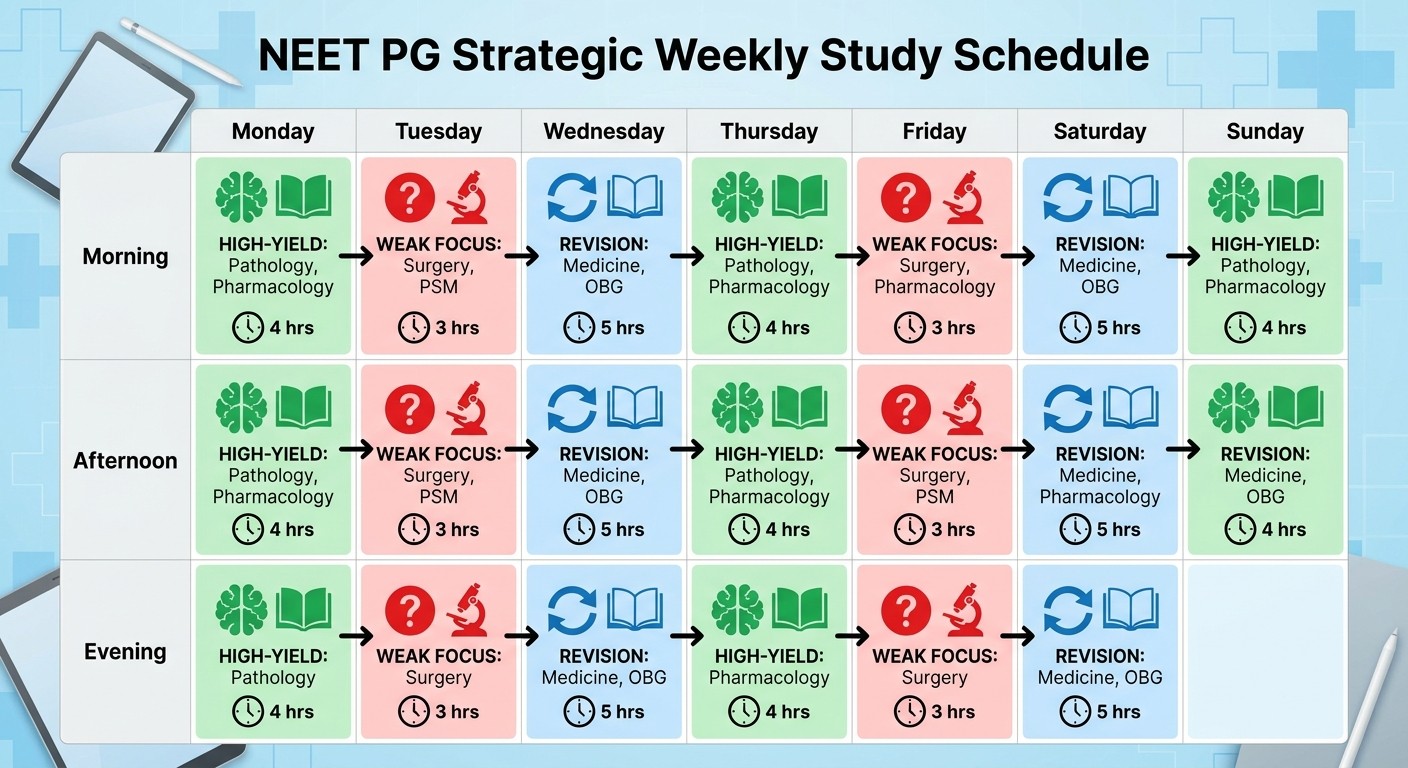
The 70-20-10 Weekly Distribution
Monday & Tuesday: High-Yield Power Subjects (70% of time)
Monday: Medicine focus (cardiology, nephrology, gastro high-yield topics)
Tuesday: Surgery focus (GI surgery, trauma, surgical emergencies)
Daily structure: 4 hours new content, 2 hours MCQ practice, 1 hour previous day revision
Wednesday & Thursday: Targeted Weak-Area Repair (20% of time)
Wednesday: Your worst performing subject from recent mocks
Thursday: Your second-worst performing subject
Daily structure: 3 hours concept building, 2 hours intensive MCQ drilling, 1 hour active recall
Friday: Foundation Subjects (10% maintenance)
Rotate between Anatomy, Physiology, Biochemistry
Focus: Quick revision, image-based questions, formula recall
Daily structure: 2 hours rapid review, 1 hour MCQ practice
Weekend: Integration & Assessment
Saturday: Mixed practice, mock test, PYQ solving
Sunday: Mock analysis, weak-area identification, next week planning
This rotation ensures high-weightage subjects get consistent attention while systematically addressing your specific weak areas. The key is flexibility — if your mock data shows Pediatrics suddenly becoming a problem, swap it into your Wednesday slot.
Oncourse Daily Plan automates this rotation based on your performance data, adjusting the focus subjects weekly as your scores improve.
Subject-Wise High-Yield Strategy for All 19 NEET PG Subjects
Each subject has its own learning personality. Here's how to approach high-yield topics while addressing common weak areas:
Tier 1: Core High-Weightage Subjects
Medicine (40-45 questions)
High-yield topics: Cardiology (MI, arrhythmias, heart failure), Nephrology (AKI, CKD, acid-base), Gastroenterology (IBD, liver diseases), Endocrinology (DM, thyroid disorders)
Common weak areas: ECG interpretation, acid-base analysis, drug interactions
Study approach: Case-based learning, diagnostic algorithms, treatment flowcharts
Daily target: 2-3 topics, 50 MCQs, focus on clinical reasoning
Surgery (35-40 questions)
High-yield topics: GI surgery (appendix, hernia, bowel obstruction), Trauma (chest, abdominal, head injury), Surgical emergencies, Oncology principles
Common weak areas: Anatomy application, surgical techniques, post-op complications
Study approach: Visual learning, surgical videos, step-by-step procedures
Daily target: 1-2 major topics, 40 MCQs, emphasize applied anatomy
Pathology (18-22 questions)
High-yield topics: Neoplasia (classification, staging, markers), Inflammation (acute, chronic, healing), CVS pathology, GIT pathology
Common weak areas: Microscopic identification, tumor markers, staging systems
Study approach: Image-heavy flashcards, comparison tables, systematic pathology
Daily target: 2-3 topics, 30 MCQs, focus on visual recognition
Pharmacology (20-25 questions)
High-yield topics: Antimicrobials (classification, spectrum, resistance), CVS drugs (antihypertensives, antiarrhythmics), CNS drugs (antidepressants, antiepileptics)
Common weak areas: Drug interactions, dosing, contraindications, adverse effects
Study approach: Mechanism-based learning, drug classification charts
Daily target: 1 drug class thoroughly, 25 MCQs
Tier 2: Medium-Weightage Subjects
OBG (15-18 questions)
High-yield: High-risk pregnancy, labor complications, gynecological cancers, contraception
Weak area focus: Normal values, danger signs, surgical indications
Approach: Protocol-based learning, guidelines memorization
Pediatrics (12-15 questions)
High-yield: Growth milestones, vaccination schedule, neonatal emergencies, genetic disorders
Weak area focus: Age-specific normal values, developmental milestones
Approach: Age-based categorization, milestone charts
Microbiology (12-15 questions)
High-yield: Bacterial infections, culture media, antibiotic sensitivity, viral hepatitis
Weak area focus: Laboratory diagnosis, culture characteristics
Approach: Organism-wise study, laboratory flowcharts
Anatomy (10-14 questions)
High-yield: Neuroanatomy, cardiac anatomy, applied surgical anatomy
Weak area focus: Cross-sectional anatomy, embryology
Approach: Visual learning, 3D models, clinical correlations
Tier 3: Focused High-Yield Subjects
ENT (6-8 questions)
Focus only on: Ear infections, hearing loss, throat cancers, nasal polyps
Skip: Detailed anatomy, rare conditions
Ophthalmology (6-8 questions)
Focus only on: Glaucoma, cataract, retinal diseases, refractive errors
Skip: Detailed surgical procedures
Forensic Medicine (5-7 questions)
Focus only on: Cause of death, post-mortem changes, injury patterns
Skip: Legal procedures, toxicology details
The pattern is clear: In high-weightage subjects, go deep on high-yield topics and systematically fix weak areas. In low-weightage subjects, cherry-pick only the highest-yield concepts and move on.
How to Use Active Recall and Spaced Repetition for Volatile Facts
Medical facts have different forgetting curves. Drug dosages and normal values vanish quickly. Pathophysiology concepts stick longer if you understand them. Your review system needs to match this reality.
The 3-Tier Retention System
Tier 1: Volatile Facts (Daily Review)
Drug dosages, normal lab values, classification lists
Review frequency: Failed cards daily, mastered cards weekly
Example: Digoxin dose, HbA1c targets, Glasgow Coma Scale
Tier 2: Conceptual Knowledge (Weekly Review)
Pathophysiology, treatment rationales, diagnostic criteria
Method: Active recall through self-explanation
Review frequency: Major concepts weekly, details bi-weekly
Example: Heart failure pathophysiology, diabetes complications
Tier 3: Applied Skills (Continuous Practice)
ECG reading, X-ray interpretation, clinical reasoning
Method: Repeated MCQ practice with variety
Review frequency: Daily practice with different cases
Example: MI ECG patterns, pneumonia X-rays
Active Recall Implementation
Instead of re-reading notes, test yourself constantly:
The 5-Minute Rule: After reading any topic, close your book and write everything you remember in 5 minutes. Check for gaps and re-read only what you missed. The Teaching Test: Explain complex topics aloud as if teaching a junior. If you stumble, that's a weak area needing attention. Question-First Learning: Before reading a new topic, attempt 5-10 MCQs on it. This primes your brain to notice relevant information while reading.
For systematic spaced repetition, Oncourse Synapses automatically surfaces your missed concepts and volatile facts based on forgetting curve algorithms, ensuring you review exactly when you're about to forget.
Common Mistakes in Subject-Wise Preparation
Mistake 1: Equal Time Allocation
Wrong approach: Spending 1 hour each on all 19 subjects daily Right approach: 3 hours on Medicine/Surgery, 2 hours on medium subjects, 1 hour total on small subjects
Mistake 2: Weak Subject Avoidance
Wrong approach: Skipping difficult subjects until "later" Right approach: Identifying why they're weak (concept gap vs poor practice) and addressing the root cause
Mistake 3: High-Yield Topic Hopping
Wrong approach: Studying only "high-yield" topics without ensuring mastery Right approach: Going deep on fewer high-yield topics, ensuring 90%+ accuracy before moving on
Mistake 4: Revision Without Recall
Wrong approach: Re-reading highlighted notes passively Right approach: Testing yourself first, then reviewing only what you couldn't recall
Mistake 5: Mock Analysis Paralysis
Wrong approach: Spending 3 hours analyzing every mock in detail Right approach: 45 minutes focused analysis identifying top 5 actionable weak areas
Mistake 6: Static Study Plans
Wrong approach: Following the same weekly schedule regardless of progress Right approach: Adjusting subject focus based on weekly mock performance
Mistake 7: Perfectionism in Low-Yield Subjects
Wrong approach: Trying to master every topic in Forensic Medicine Right approach: Targeting 60-70% accuracy in low-weightage subjects, focusing energy on high-weightage gaps
The most successful NEET PG candidates adapt their strategy based on data, not emotion. If your mock analysis shows Surgery improving from 40% to 65%, reduce Surgery time and redirect those hours to persistent weak areas in Medicine or Pharmacology.
How to Review Mock Tests at Subject and Topic Level
Mock analysis is where average students separate from toppers. Toppers don't just see what they got wrong — they extract patterns that guide next week's preparation.
The 45-Minute Mock Analysis Protocol
Phase 1: Quick Subject Scan (10 minutes)
Create a performance table:
```
Subject | Attempted | Correct | Accuracy | Change from last mock
Medicine | 22 | 15 | 68% | +5%
Surgery | 20 | 11 | 55% | -8%
Pathology | 18 | 14 | 78% | +3%
```
Immediately identify: biggest drops (Surgery -8%), persistent low performers (<60%), and improvement validation.
Phase 2: Topic-Level Drilling (20 minutes)
For each subject below 70%, list the specific topics missed:
Surgery: Missed 4/5 trauma questions, 2/3 GI surgery, 1/2 oncology
Medicine: Missed 3/5 cardiology, 2/4 nephrology, 1/3 infectious disease
This shows trauma and cardiology as immediate priorities, not just "Surgery" and "Medicine" generally.
Phase 3: Error Pattern Recognition (15 minutes)
Categorize each wrong answer:
1. Never learned it: Complete concept gap requiring lesson review 2. Forgot under pressure: Recall failure requiring flashcard drilling 3. Knew but misapplied: Application gap requiring more clinical MCQs 4. Silly mistake: Misread question or clicked wrong option
Track these patterns over multiple mocks. If you consistently have recall failures in Pharmacology, your issue isn't more reading — it's better spaced repetition systems.
The Weekly Performance Dashboard
Every Sunday, compile your week's data:
Trending Up Subjects (maintain current approach):
Consistent accuracy >75%
Improvement trajectory from previous weeks
Action: Reduce time allocation, move to maintenance mode
Trending Down Subjects (immediate intervention needed):
Accuracy declining or stuck <60%
Same topics failing repeatedly
Action: Increase time allocation, change study method
Volatile Subjects (strategy reassessment):
Accuracy swinging wildly (65% to 45% to 70%)
No clear weak topics — random mistakes
Action: Focus on fundamentals, reduce advanced practice
The key insight: consistent 70% beats volatile 80%. Exams reward reliability over peak performance. Oncourse's analytics dashboard automatically tracks these patterns across your practice sessions, highlighting exactly which topics need attention without manual calculation.
Frequently Asked Questions
How much time should I spend on weak subjects versus high-yield topics?
Follow the 70-20-10 rule: 70% on high-yield topics in decent subjects, 20% on critical weak areas, 10% on maintaining strong subjects. If you're failing a high-weightage subject (below 50%), flip this temporarily — spend 50% fixing that weak subject until it reaches 60%+ accuracy.
Should I skip low-weightage subjects entirely if I'm short on time?
No, but be strategic. Target 60-70% accuracy in subjects like ENT, Ophthalmology, and Forensic Medicine by focusing only on highest-yield topics. These "easy marks" often determine rank differences. Skip only if you're failing multiple high-weightage subjects.
How often should I reassess my weak areas?
Weekly reassessment based on mock performance. Daily practice adjustments based on question accuracy. If a previously weak topic shows 75%+ accuracy for 2 consecutive weeks, move it to maintenance mode and identify new weak areas from recent mocks.
Is it better to fix one weak subject completely or improve multiple subjects slightly?
Fix one high-weightage weak subject completely first. Going from 40% to 70% in Medicine (worth 8-12 extra marks) beats improving from 70% to 80% in three different small subjects (worth 2-3 extra marks total). Sequential improvement beats parallel improvement.
How do I balance PYQs with weak area practice?
Use PYQs to identify weak areas, not just for practice. Solve topic-wise PYQs after studying each topic to cement learning. Save full-length PYQ papers for final month revision. Your weak area practice should include recent PYQ questions from those specific topics.
What if my weak areas keep changing every week?
This suggests fundamental knowledge gaps rather than specific topic weakness. Focus on building conceptual foundations in your worst subject for 2-3 weeks before returning to targeted weak-area practice. Sometimes you need to go slower to go faster.
---
NEET PG success isn't about perfection across all subjects — it's about strategic excellence where it matters most. Your subject-wise preparation should mirror the exam's weightage, target your specific weak areas with precision, and use active recall systems to make both high-yield topics and improved weak areas stick.
The students who break through to top ranks don't study more hours — they study with better data. Every mock test, every missed question, every recall failure gives you intelligence about where to focus next. Use that intelligence strategically.
Prepare smarter with Oncourse AI — adaptive MCQs, spaced repetition, and AI explanations built for NEET PG. Download free on Android and iOS.