Back
NEET PG Revision Strategy 2026: What to Revise When the Exam Is Close
Strategic NEET PG revision plan for final weeks. Learn how to prioritize high-yield topics, use active recall techniques, and convert weak areas into focused study sessions for maximum score improvement.

NEET PG Revision Strategy 2026: What to Revise When the Exam Is Close
You have 23 days left. Your pharmacology accuracy is stuck at 52%. You spent yesterday cramming microbiology only to realize you forgot half the cardiology you studied last week. Meanwhile, that perfectly organized 6-month study plan you created is now a distant memory, replaced by the very real panic of "what do I actually need to revise before this exam?"
Here's the truth about late-stage NEET PG revision: it's not the same as first-pass studying. You're not trying to learn everything from scratch — you're trying to maximize retention of what you already know while rapidly filling the gaps that matter most. The students who score 600+ in the final stretch don't study more; they revise smarter.
This is exactly why you need a close-to-exam revision strategy that prioritizes ruthlessly, reviews systematically, and turns your weak spots into focused action items instead of sources of stress.
Why Late-Stage Revision Requires a Different Approach
Most students treat revision like a slower version of studying. They re-read notes, watch videos again, and hope repetition will somehow stick. But when you're weeks away from NEET PG, your brain isn't a blank slate — it's a partially filled database that needs strategic updates.
The difference between revision and studying lies in three key shifts:
From comprehensive to selective: Instead of covering everything, you target high-impact areas. A 3-hour session on volatile pharmacology facts will boost your score more than re-reading an entire pathology chapter you already know well. From passive to active: Reading notes feels productive but doesn't improve recall speed. Close-to-exam revision demands active techniques — flashcards, teach-back, and rapid-fire MCQ practice — that force your brain to retrieve information under pressure. From rigid to responsive: Your study plan should adapt based on yesterday's mock test results. If you scored 3/15 in dermatology but 13/15 in anatomy, today's revision priorities just changed. Tools like Oncourse's Daily Plan automatically rebalance your schedule based on weak area analytics, turning performance data into focused revision sessions.
How to Split Your Revision Into Strategic Categories
Not all medical content deserves equal revision time. When you're close to the exam, you need to categorize everything you've studied into six revision buckets and allocate time accordingly.
High-Yield Systems (40% of revision time)
These are the subjects that contribute the most questions to NEET PG: Internal Medicine (25-30 questions), Surgery (25-30 questions), and Pathology (20-25 questions). Even if you're comfortable with these areas, they deserve the biggest chunk of your revision because the point impact is massive.
Focus on integrated concepts within these systems. Instead of reviewing cardiology in isolation, connect it to cardiothoracic surgery, cardiac pharmacology, and ECG interpretation. This approach mirrors how NEET PG increasingly tests cross-subject integration.
Volatile Facts and Figures (25% of revision time)
These are the details you forget quickly — drug dosages, normal values, statistical cutoffs, and classification systems. Your brain naturally deprioritizes these specifics, but NEET PG loves testing them directly.
Create separate revision flashcards specifically for volatile content. Normal hemoglobin values, antihypertensive drug classifications, and cancer staging criteria should be in rapid-fire flashcard format, not buried in comprehensive notes.
Recent Mock Mistakes (20% of revision time)
Every question you got wrong in recent mocks represents a knowledge gap that's likely to appear again. But don't just re-read the explanations — actively study the underlying concept.
If you missed a question about diabetic ketoacidosis management, don't just memorize that answer. Review DKA pathophysiology, compare it to HHS, and practice 5-10 related questions to solidify the concept cluster.
Images and Clinical Scenarios (10% of revision time)
NEET PG increasingly emphasizes visual diagnosis and clinical integration. Dedicate focused time to image-based questions, ECG patterns, histopathology slides, and radiology findings.
This isn't just about memorizing pictures — it's about pattern recognition under time pressure. Practice describing abnormalities out loud before looking at answer choices.
Formula-Heavy Topics (3% of revision time)
Calculate dosages, clearance ratios, statistical measures, and physiological equations regularly. These topics require muscle memory, not conceptual understanding.
For quick recall practice, the Synapses game can help with rapid association between formulas and their applications, turning calculation practice into focused drill sessions.
Weak Areas from Analytics (2% of revision time)
Use performance data to identify your personal blind spots. If your accuracy in rheumatology consistently sits below 40%, that's a higher-priority revision target than subjects where you regularly score 85%+.
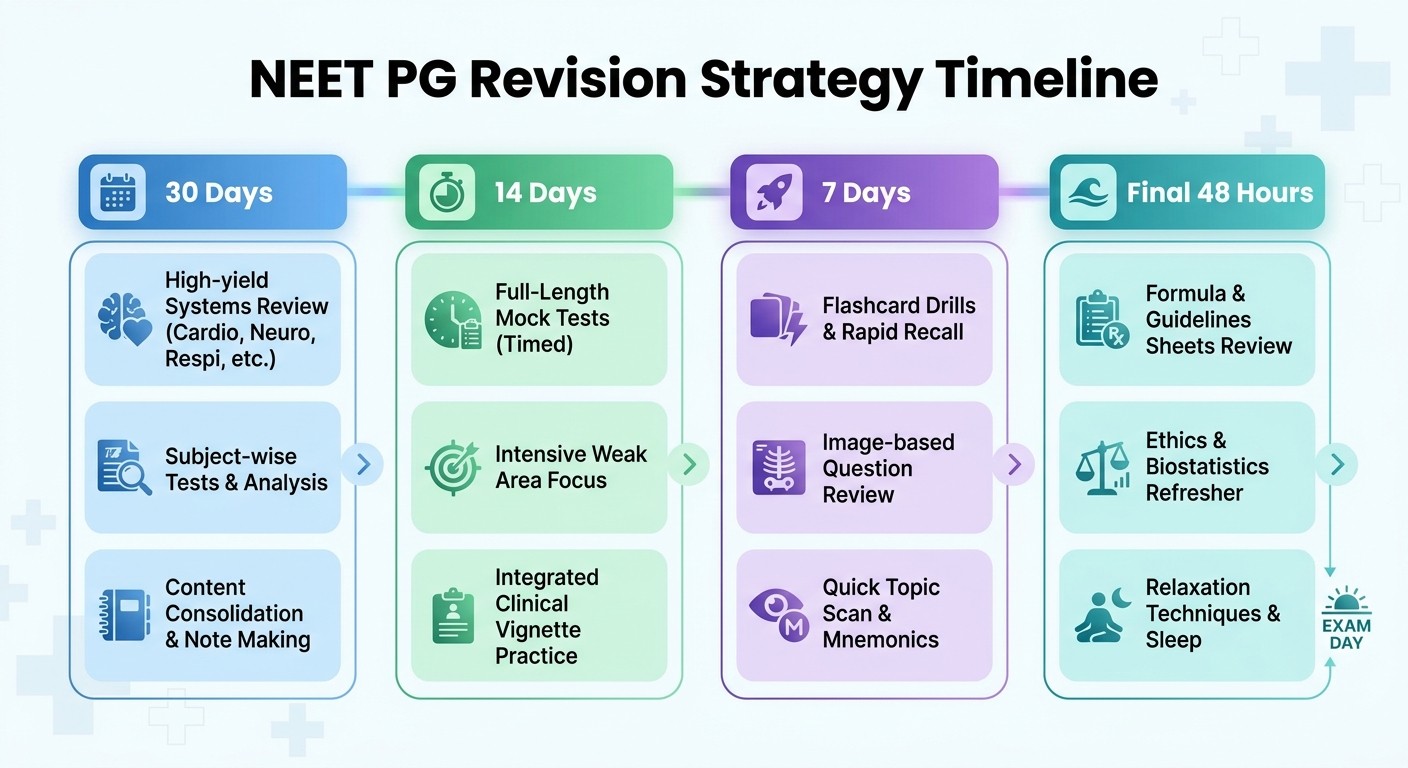
The 30-Day Revision Framework
When you have exactly 30 days before NEET PG, your revision needs structure without rigidity. This framework adapts based on your performance while maintaining consistent forward momentum.
Days 30-21: Foundation Consolidation
Goal: Complete one full revision cycle of all major subjects while identifying weak areas. Daily structure:
4 hours: Subject-wise revision (rotate through Medicine, Surgery, Pathology, Pharmacology)
2 hours: Mixed MCQ practice (100-150 questions daily)
1 hour: Image-based questions and clinical scenarios
30 minutes: Flashcard review of previous day's missed concepts
Weekly targets: Cover 4-5 major subjects completely. Take one full-length mock test every 3 days. Create a running list of topics that consistently trip you up.
During this phase, use active recall techniques constantly. Don't just re-read pathology notes — close the book and explain acute MI management out loud. If you can't do it confidently, that topic needs more attention.
Days 20-15: Rapid Integration
Goal: Connect concepts across subjects and accelerate weak area improvement. Daily structure:
3 hours: Integrated topic review (cardiology + cardiac surgery + cardiac drugs)
2.5 hours: Targeted weak area practice using analytics
1 hour: Previous year question analysis
30 minutes: Speed flashcard drills
Weekly targets: Complete integrated revision of 3 major systems. Take 2-3 full mocks. Start daily weak area sessions using Oncourse's targeted practice for your lowest-scoring subjects.
This is when spaced repetition becomes critical. Review yesterday's weak topics today, last week's problem areas, and concepts you missed 2 weeks ago. Your brain needs multiple exposure cycles to cement information.
Days 14-8: Mock Mastery Phase
Goal: Simulate exam conditions while fine-tuning performance through mistake analysis. Daily structure:
3 hours: Full-length mock test + detailed review
2 hours: Revision of mock mistakes and related concepts
1.5 hours: High-yield fact drilling (normal values, drug classifications)
30 minutes: Image pattern recognition
Weekly targets: Complete 5-7 full mocks. Achieve target accuracy (varies by student, but aim for 65%+ overall). Identify 2-3 subjects that need final week attention.
This phase is about building exam stamina and refining your question-solving approach. Time yourself strictly, practice dealing with uncertainty, and develop strategies for educated guessing.
Days 7-1: Peak Performance Preparation
Goal: Maintain what you know while polishing final weak spots. Daily structure:
2 hours: Light revision of volatile facts and formulas
2 hours: Mock test (alternate between full and sectional)
1 hour: Mistake review and related concept drilling
1 hour: Confidence-building activities (review strong subjects)
Weekly targets: 3-4 final mocks. Zero new topics. Complete final flashcard cycles. Prepare exam day logistics.
The 14-Day Rapid Revision Protocol
When you have only 2 weeks, everything must be high-impact. This protocol assumes you've completed at least one full pass through all subjects and need strategic reinforcement.
Days 14-11: Priority Triage
Identify your 5 weakest subjects using mock test analytics. These get 80% of your attention. The remaining subjects get maintenance-level review only.
Daily flow:
Morning (3 hours): Deep dive on 1 weak subject
Afternoon (2 hours): Mixed MCQ practice emphasizing weak areas
Evening (1.5 hours): Flashcard cycles + image review
Night (30 minutes): Formula and fact drilling
Days 10-6: Integration Sprint
Connect your weak subjects to high-yield areas. If pediatrics is weak, link it to pediatric surgery, pediatric pharmacology, and relevant pathology.
Daily flow:
2.5 hours: Integrated weak area revision
2 hours: Full mock test every other day
1.5 hours: Previous mistake review
1 hour: Speed practice on volatile facts
Days 5-1: Confidence Building
Daily flow:
2 hours: Light subject review (mostly strong areas)
1.5 hours: Sectional mocks in weak areas
1 hour: Final flashcard review
30 minutes: Relaxation and positive visualization
The 7-Day Final Push
You have one week. Panic won't help, but laser focus will. This protocol prioritizes retention over learning new content.
Subject Priority Framework
Tier 1 (4 hours daily): Medicine, Surgery, Pathology — the big point contributors
Tier 2 (2 hours daily): Pharmacology, Pediatrics, Anatomy — moderate contributors
Tier 3 (1 hour daily): All remaining subjects — maintenance only
Daily Structure
6 AM - 9 AM: Tier 1 subject revision + related MCQs
10 AM - 12 PM: Mock test (full or sectional)
1 PM - 3 PM: Tier 2 subject focus + flashcards
4 PM - 6 PM: Mock review + mistake analysis
7 PM - 8 PM: Tier 3 subjects + image review
9 PM - 10 PM: Formula drills + relaxation
Critical Tasks
Complete 3-4 final mocks with detailed analysis
Review all flagged flashcards twice
Practice image identification for 30 minutes daily
Maintain consistent sleep schedule (7-8 hours nightly)
Final 48-Hour Strategy: The Confidence Phase
Day -2: Light revision only. Review high-confidence topics, do a few practice questions, organize exam materials. No new learning. Early dinner, no heavy studying after 7 PM. Day -1: Maintenance mode. Light flashcard review of volatile facts. One short practice session (50 questions max). Prepare everything for exam day. Sleep by 10 PM. Exam day morning: Light breakfast, quick review of 1-2 strong topics for confidence, arrive at center 30 minutes early.
How to Use Active Recall and Spaced Repetition Effectively
Active recall and spaced repetition aren't just study buzzwords — they're the scientific foundation of effective revision. Here's how to implement them specifically for NEET PG preparation.
Active Recall Techniques That Work
The Explain-Back Method: After reviewing a topic, close your notes and explain the concept out loud as if teaching someone else. If you can't do this fluently, you don't know it well enough for exam conditions. Question-First Reviewing: Before re-reading any topic, first attempt 5-10 related MCQs without notes. This reveals what you actually remember versus what you think you remember. Rapid-Fire Flashcards: Use spaced repetition flashcards for facts that need instant recall — drug names, normal values, classification criteria. Oncourse's flashcard system schedules review based on your forgetting curve, ensuring you see difficult concepts more frequently.
Spaced Repetition Implementation
1-3-7-21 Day Cycles: When you study a new topic or review a weak area, schedule follow-up sessions at 1 day, 3 days, 7 days, and 21 days later. This pattern maximizes long-term retention. Mistake-Based Spacing: Questions you get wrong need more frequent review than concepts you know well. Create separate review cycles for mistakes — daily for the first week, then every 3 days. Subject Rotation Strategy: Don't study the same subject for more than 3 consecutive days. Rotate between 3-4 subjects weekly to prevent interference and maintain fresh perspective.
How to Stop Over-Revising Strong Areas
One of the biggest time wasters in close-to-exam revision is spending too much time on subjects you already know well. It feels productive and builds confidence, but it doesn't improve your score.
The 80/20 Accuracy Rule
If you consistently score 80%+ in a subject across multiple mocks, limit it to maintenance-level revision — maximum 20 minutes daily. Focus the majority of your time on subjects below 70% accuracy.
Time-Boxing Strong Subjects
Set strict time limits for high-confidence areas. Give anatomy 30 minutes max if you're consistently scoring well. Use a timer and move on when it rings, even if you feel like reviewing more.
Confidence vs. Competence Tracking
Track both your confidence level (how sure you feel) and actual performance (mock test scores) for each subject. Students often over-revise areas where confidence is low but performance is adequate, while under-revising areas where confidence is high but performance is inconsistent.
How to Review Notes and Flashcards Without Getting Stuck
Revision paralysis is real. You open your notes, start reading, and somehow three hours pass without completing meaningful progress. Here's how to maintain momentum during review sessions.
The 25-Minute Review Protocol
Use focused 25-minute blocks for all revision activities. In each block, cover one specific topic completely — read notes, answer related questions, and test recall. Take a 5-minute break, then move to the next topic.
Progressive Note Reduction
Each time you review a topic, condense your notes further:
First review: Highlight key points in full notes
Second review: Create a one-page summary
Third review: Reduce to flashcard-sized facts
Final reviews: Use only the flashcards
Active Flashcard Strategies
Don't just flip through flashcards passively. Use these techniques to maximize retention:
Speed rounds: Go through 50 cards in 10 minutes, marking ones you hesitate on for immediate re-review. Explanation cards: For complex concepts, create flashcards that require you to explain the mechanism, not just recall the fact. Connection mapping: Link flashcards to related concepts. When reviewing "ACE inhibitor side effects," immediately think of related cards about hypertension management and heart failure treatment.
Using Mock Mistakes and Weak-Area Analytics for Daily Decisions
Your mock test performance isn't just a score — it's a precise diagnosis of where to focus your next study session. Here's how to turn that data into actionable revision priorities.
The Mock Analysis Framework
After each mock test, spend 30 minutes categorizing every mistake:
Knowledge gaps: You didn't know the concept at all Application errors: You knew the facts but couldn't apply them correctly Careless mistakes: You knew the answer but selected wrong due to time pressure or misreading Recall failures: You knew this before but couldn't remember during the test
Each category requires different revision approaches. Knowledge gaps need concept review, application errors need more practice questions, careless mistakes need speed training, and recall failures need spaced repetition.
Daily Priority Setting
Use analytics to determine tomorrow's study focus. Oncourse's weak area analytics can identify which subjects need immediate attention based on recent performance patterns.
Red zone topics (below 50% accuracy): Get 2 hours of focused revision daily Yellow zone topics (50-70% accuracy): Get 1 hour of targeted practice Green zone topics (above 70%): Get maintenance-level review only
The Rolling Week Strategy
Don't just react to yesterday's mock — look at patterns over the past week. If you've scored below 60% in pharmacology three times in the past week, that's a stronger signal than one bad performance in pediatrics.
Create a rolling priority list that updates weekly based on consistent patterns, not daily fluctuations.
Critical Mistakes to Avoid During Close-to-Exam Revision
Starting New Topics
When you're close to the exam, resist the urge to learn completely new subjects. If you haven't covered orthopedics at all, don't try to master it in the final two weeks. Instead, learn high-yield orthopedics facts that commonly appear in MCQs.
Perfectionist Note-Making
Stop creating beautiful, comprehensive notes during revision phase. You need quick, functional review materials, not works of art. Use bullet points, abbreviations, and rapid sketches.
Mock Test Cramming
Taking multiple mocks daily in the final week doesn't improve performance — it creates fatigue and anxiety. Limit to one mock daily maximum, with equal time spent on detailed review.
Ignoring Sleep and Breaks
Pulling all-nighters during revision phase backfires. Sleep deprivation impairs memory consolidation, which is exactly what you need for retention. Maintain consistent 7-8 hours of sleep.
Social Media Comparison
Avoid exam-related social media groups during the final weeks. Seeing others discuss topics you haven't covered creates unnecessary panic. Focus on your preparation, not others' claims about their readiness.
Frequently Asked Questions
How many hours should I study per day during the final month?
Aim for 8-10 focused hours during the final 30 days, but prioritize quality over quantity. Four hours of active revision beats eight hours of passive note-reading. Structure your day with regular breaks to maintain concentration.
Is it too late to improve my weak subjects if the exam is in 2 weeks?
You can significantly improve weak subjects in 2 weeks with targeted practice. Focus on high-yield concepts within those subjects rather than comprehensive coverage. Even raising a subject from 40% to 60% accuracy can add 10-15 points to your total score.
Should I attempt new mock tests or repeat previous ones during final revision?
Take new mock tests to assess current preparation level, but also repeat 2-3 previous mocks to track improvement in areas you've focused on. This gives you both assessment and confidence-building data.
How do I manage exam anxiety during the final weeks?
Maintain consistent routines, practice relaxation techniques daily, and avoid overanalyzing mock test scores. Focus on process goals (completing daily revision targets) rather than outcome goals (achieving specific mock scores).
What should I do if I realize major gaps just days before the exam?
Don't panic. Create a priority list of the most commonly tested concepts within those gap areas. Learn high-yield facts and common question patterns rather than trying to understand everything deeply. Sometimes strategic cramming of frequently tested points is more valuable than comprehensive understanding.
How important are image-based questions for NEET PG 2026?
Image-based questions comprise about 15-20% of NEET PG. Dedicate 30 minutes daily to image recognition practice, focusing on classic presentations, normal variants, and commonly tested abnormalities. Pattern recognition improves rapidly with focused practice.
Prepare smarter with Oncourse AI — adaptive MCQs, spaced repetition, and AI explanations built for NEET PG. Download free on Android and iOS.