Back
Average Step 2 Score: How AI Tutoring Transforms USMLE Prep in 2026
Discover what your Step 2 CK score means for residency matching. Learn how AI-powered tutoring and explanation chat revolutionize weak area improvement and question review strategies.

You just got your NBME score back. 247. You stare at the three digits wondering: Is this competitive? Will dermatology programs even look at me? Should I push back my exam date and retake?
The average Step 2 CK score sits around 248-250 nationally, but that single number tells you almost nothing about your match prospects. What matters is how your score positions you within your target specialty, your backup options, and most importantly — whether you can improve it strategically.
Heres what actually determines if your Step 2 score opens doors or closes them: the gap between where you are and where you need to be, multiplied by how much time you have left. And in 2026, AI-powered tutoring is changing that equation completely.
What Your Step 2 Score Actually Means
The USMLE Step 2 CK operates on a three-digit scale from 1-300, with most students scoring between 220-270. But raw scores without context are meaningless. What you need is percentile positioning and specialty-specific benchmarks.
National Score Distribution (2026 Data):
270+: 95th percentile (top 5%)
260-269: 90th percentile (top 10%)
250-259: 75th percentile (top 25%)
240-249: 50th percentile (average)
230-239: 25th percentile (bottom 25%)
220-229: 10th percentile (bottom 10%)
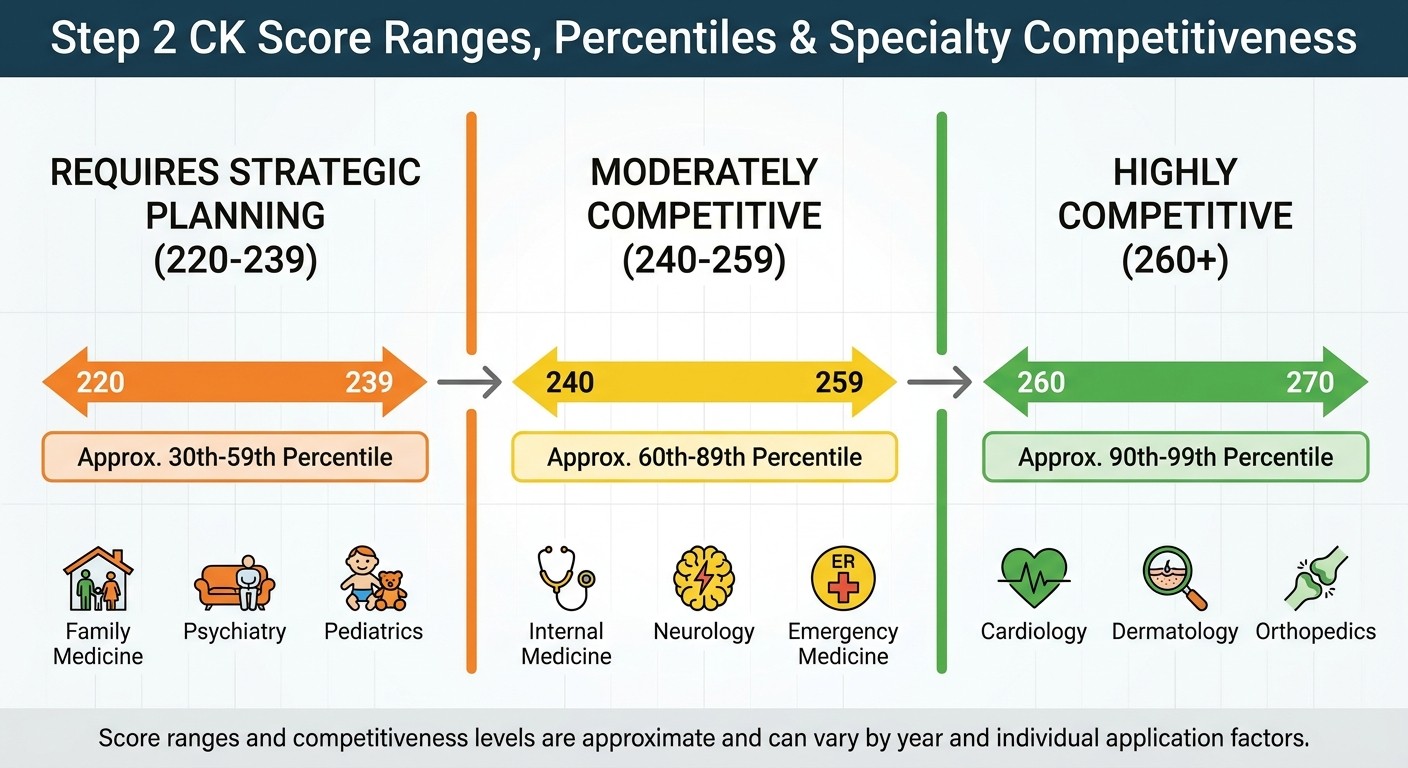
The current passing threshold sits at 218, but dont let that fool you. Match competitiveness starts much higher. According to the National Residency Matching Program, match rates plummet below certain score thresholds for each specialty.
Score Interpretation by Competitiveness Zone: Highly Competitive (260+):
Strong match prospects across all specialties, including ultra-competitive fields. Programs actively recruit students in this range.
Moderately Competitive (240-259):
Solid positioning for most specialties. Success depends on specialty choice and other application factors.
Requires Strategic Planning (220-239):
Limited options in competitive specialties. Focus on fit-friendly programs and strong backup plans.
Average Step 2 Scores by Specialty: The 2026 Reality
Specialty averages shifted dramatically since Step 1 became pass/fail. Programs now use Step 2 CK as their primary numerical screening tool, and score inflation has hit nearly every field.
Ultra-Competitive Specialties (255+ expected):
Dermatology: 265 average (75th percentile: 272)
Radiation Oncology: 262 average
Interventional Radiology: 258 average
Anesthesiology: 256 average
Highly Competitive Specialties (250+ expected):
Emergency Medicine: 254 average (up 8 points since 2023)
Diagnostic Radiology: 253 average
Orthopedic Surgery: 251 average
Obstetrics/Gynecology: 250 average
Moderately Competitive Specialties (245+ competitive):
General Surgery: 249 average
Neurology: 247 average
Internal Medicine: 246 average (academic programs trend higher)
Pediatrics: 244 average
Broadly Accessible Specialties (240+ solid):
Psychiatry: 242 average
Family Medicine: 240 average
Pathology: 238 average
These numbers represent matched applicants only. Unmatched applicants in competitive specialties typically score 10-15 points lower than matched peers in the same field.
The key insight: crossing 250 creates meaningful advantages across multiple specialties. Hitting 260+ opens doors to ultra-competitive programs that were previously unreachable.
How Score Ranges Impact Your Match Strategy
Your Step 2 score doesnt just determine if you match — it shapes your entire application strategy, backup plans, and timeline.
If You Scored 240-249:
You are right at the national average, which creates interesting strategic choices. This range works well for family medicine, psychiatry, and community internal medicine programs. For competitive specialties, you will need exceptional clinical grades, research, and geographic flexibility.
The risk zone: programs increasingly screen at 245+ for preliminary filtering. At 242, you might not reach the second round of review at top-tier programs, regardless of your other qualifications.
If You Scored 250-259:
This is the sweet spot for most medical students. You are competitive for the majority of specialties while having realistic backup options. Emergency medicine becomes feasible, most surgical specialties remain in play, and you have leverage in internal medicine.
Strategy shifts here focus on optimizing the rest of your application rather than frantically improving your score.
If You Scored 260+:
You have numerical advantage across all specialties. The question becomes: how do I leverage this score strategically? High scorers can take calculated risks — applying to ultra-competitive programs, prioritizing geography over program ranking, or focusing entirely on research fit.
But heres what most students miss: the score gap between you and your target matters more than your absolute score. A 250 aiming for family medicine has more margin for error than a 265 chasing dermatology.
The AI Revolution in Step 2 Preparation
Traditional tutoring fails most students because it is reactive, expensive, and time-limited. You get 2 hours per week with someone who explains concepts you already understand while missing the patterns you actually struggle with.
AI tutoring flips this model. Instead of scheduled explanations, you get instant, personalized feedback the moment you miss a question. Instead of generic content review, the AI identifies your specific weak areas and creates targeted practice around them.
Rezzy AI tutor represents the next evolution in medical education. When you miss a cardiology question about heart failure management, Rezzy doesnt just explain why ACE inhibitors were correct. It walks you through the pathophysiology, generates similar scenarios to test pattern recognition, and tracks whether you have truly internalized the concept or just memorized the explanation.
The difference: traditional tutoring teaches you content. AI tutoring teaches you clinical reasoning patterns.
How Explanation Chat Changes Question Review
Most students review missed questions wrong. They read the explanation, nod along, and move to the next question. No wonder they keep missing similar questions weeks later.
Explanation chat transforms passive review into active learning. Instead of reading that "diuretics are first-line for acute heart failure," you can ask:
"Walk me through why we use diuretics before ACE inhibitors in acute settings."
"What happens if this patient has kidney disease?"
"Give me three similar cases where the answer changes."
Each question spawns deeper understanding. You are not just learning facts — you are building clinical decision trees that mirror how attendings actually think.
The AI remembers your question patterns too. If you consistently struggle with endocrine emergencies, it will generate more practice scenarios until the pattern clicks. If you keep second-guessing ethics questions, it will walk you through the reasoning framework until you stop changing correct answers.
This personalized feedback loop is what traditional resources cant replicate. Your textbook doesnt know you always confuse DKA and HHS management. Your question bank doesnt track that you miss easy questions when you are tired. But AI tutoring does.
Targeted Weak Area Improvement Strategies
Generic study plans assume everyone has the same knowledge gaps. The reality: your weak areas are unique, and they require personalized solutions.
Step 1: Identify Your True Weak Areas
Most students think they know their weak areas, but they are usually wrong. They confuse "topics I dont like" with "topics that actually hurt my score."
Run a diagnostic assessment: take a mixed 40-question block covering all major organ systems. Sort your misses by category, not just by topic. Look for patterns in:
Knowledge gaps (didnt know the fact)
Application errors (knew the fact, chose wrong anyway)
Test-taking mistakes (rushed, second-guessed, misread)
Step 2: Attack Each Category Differently
Knowledge gaps need targeted content review. But application errors need practice with similar question stems. Test-taking mistakes need timed simulation and anxiety management.
This is where AI shines. Instead of generic "cardiology review," you get "heart failure medication sequencing in acute vs chronic settings" based on your specific error patterns.
Step 3: Measure Improvement Systematically
Create improvement feedback loops. After targeted review of a weak area, test yourself with 10-15 similar questions. Track your accuracy over time. If you are still missing the same pattern after focused study, the issue isnt more content — its your approach.
The AI tracks these metrics automatically. It knows if your nephrology scores improved from 60% to 85% after focused review. It adjusts future practice accordingly.
Question Review That Actually Sticks
The standard question review process wastes most students time:
1. Answer question
2. Check if correct
3. Read explanation if wrong
4. Move to next question
This creates recognition memory, not recall memory. You recognize the right answer when you see the explanation, but you cant generate it independently.
The AI-Enhanced Review Process:
1. Answer question without looking at choices first (forces active recall)
2. If wrong, explain your reasoning before seeing the correct answer
3. Chat with AI to understand why your reasoning failed
4. Generate 2-3 similar scenarios to test pattern recognition
5. Schedule spaced repetition of the concept in 3-7 days
This process converts every missed question into durable learning. You are not just memorizing explanations — you are rewiring your clinical reasoning patterns.
Example: Cardiology Question Review
Question: 65-year-old with chest pain, elevated troponins, normal ECG. Next step?
Wrong answer chosen: Stress test
Correct answer: Coronary angiography
Traditional review: Read explanation about NSTEMI management, move on.
AI-enhanced review:
"Why did I choose stress test?" (Non-invasive seemed safer)
"When do we use stress tests vs angiography?" (Stable vs unstable presentations)
"Generate three similar unstable angina cases" (Builds pattern recognition)
"Schedule NSTEMI review in 5 days" (Spaced repetition)
The result: you dont just learn this question. You master the entire decision tree around chest pain workup.
Practice Integration With AI Tutoring
The most effective Step 2 preparation combines systematic practice with intelligent review. AI tutoring orchestrates this combination automatically.
Morning Routine: Diagnostic Practice
Start each study session with 20-40 timed questions covering your historically weak areas. The AI selects questions that target your specific knowledge gaps while maintaining the difficulty progression you need.
Real-Time Support: Explanation Chat
When you miss questions during practice, explanation chat provides immediate clarification. No waiting for office hours, no generic explanations that miss your specific confusion. You get targeted help the moment you need it.
Evening Review: Pattern Recognition
End each day by reviewing the patterns behind your missed questions. The AI identifies common threads: "You missed 4/6 renal questions today, all involving electrolyte disorders." This focus your next-day preparation automatically.
Building Clinical Reasoning Through AI Interaction
Step 2 CK tests clinical reasoning more than fact recall. You need to think like a clinician: gather information, generate differential diagnoses, and select appropriate management.
AI tutoring develops this reasoning through structured dialogue:
Differential Diagnosis Building:
"Patient presents with chest pain and shortness of breath. What are you thinking?"
"Good start. Now they have a negative D-dimer. How does that change your differential?"
"They also have a friction rub on exam. What are you considering now?"
Management Decision Trees:
"You have diagnosed acute heart failure. Walk me through your immediate management."
"Why diuretics first instead of ACE inhibitors?"
"What if they have a creatinine of 2.5?"
This interactive approach mirrors how you will actually think during residency. You are not just memorizing management algorithms — you are internalizing the reasoning process that generates them.
Advanced AI Features for Score Optimization
Beyond basic question review, AI tutoring offers advanced features that target score optimization specifically:
Adaptive Difficulty Progression:
The AI adjusts question difficulty based on your improving performance. As your cardiology scores improve, it introduces more complex scenarios to push your understanding further.
Weakness Radar:
Even strong students have subtle weak areas that traditional study methods miss. AI tutoring identifies these through pattern analysis across hundreds of practice questions.
Simulation Mode:
Full-length practice exams with AI-powered performance analysis. The system tracks your stamina patterns, identifies late-block performance drops, and suggests pacing adjustments.
Explanation Quality Scoring:
When you attempt to explain your reasoning, the AI evaluates the quality of your clinical thinking and suggests improvements. This metacognitive training accelerates improvement.
Common Mistakes in Step 2 Preparation (And How AI Fixes Them)
Mistake 1: Passive Content Review
Students spend hours reading review books without active engagement.
AI solution: Forces active recall through questioning and explanation requirements.
Mistake 2: Unfocused Question Practice
Random question blocks without systematic weak area targeting.
AI solution: Curated practice based on individual performance patterns.
Mistake 3: Poor Question Review
Reading explanations without understanding the reasoning process.
AI solution: Interactive dialogue that builds understanding step-by-step.
Mistake 4: Ignoring Test-Taking Skills
Focusing only on content while ignoring timing, stamina, and anxiety management.
AI solution: Simulation mode with performance analytics and improvement suggestions.
Mistake 5: Inconsistent Practice Schedule
Cramming followed by gaps, without systematic progression.
AI solution: Personalized study schedules with adaptive pacing based on your learning curve.
The Future of Medical Education
AI tutoring represents a fundamental shift in how medical students learn. Instead of one-size-fits-all resources, you get personalized education that adapts to your learning style, schedule, and goals.
The traditional model: consume content, practice questions, hope for the best.
The AI-enhanced model: diagnose your specific weaknesses, target them with personalized practice, measure improvement systematically, and optimize your preparation strategy continuously.
Early adopters report 15-25 point score improvements within 6-8 weeks of switching to AI-enhanced preparation. The difference isnt just higher scores — its deeper understanding and more confident clinical reasoning.
As residency programs continue emphasizing Step 2 CK scores, the students who leverage AI tutoring effectively will have significant advantages over traditional preparation methods.
Frequently Asked Questions
What is considered a good Step 2 CK score in 2026?
A "good" score depends entirely on your specialty goals. For family medicine, 240+ is solid. For internal medicine, 245+ is competitive. For dermatology, you need 260+. The key is scoring above your target specialty's average while leaving room for other application components.
How much can I realistically improve my Step 2 score?
Most students can improve 15-25 points with focused preparation over 6-8 weeks. The key is identifying whether your issues are knowledge gaps, application errors, or test-taking problems. AI tutoring accelerates this process by pinpointing your specific improvement areas.
Is 240 a competitive Step 2 score?
240 places you right at the national average. It is competitive for family medicine, psychiatry, and some internal medicine programs. For surgical specialties or highly competitive fields, 240 limits your options significantly. You would need exceptional grades and research to compensate.
How long should I spend reviewing missed questions?
Quality matters more than quantity. Spend 3-5 minutes per missed question understanding the reasoning process, not just memorizing the correct answer. AI-enhanced review makes this process more efficient by focusing on your specific confusion points.
Should I retake Step 2 if I scored below my target?
Consider retaking if: (1) you are more than 15 points below your specialty average, (2) you have 3+ months before applications, and (3) you can identify specific improvement strategies. A 10-point improvement often isnt worth delaying your timeline.
How do I know if AI tutoring is working for me?
Track your practice question accuracy over time. You should see steady improvement in your weak areas within 2-3 weeks. More importantly, you should feel more confident in your clinical reasoning, not just your fact recall.
Prepare smarter with Oncourse AI — adaptive MCQs, spaced repetition, and AI explanations built for USMLE success. Download free on Android and iOS