NBME Step 2 CK Practice Exam Review Strategy: Weak Areas, Timing and Score Readiness in 2026
Master the systematic approach to reviewing NBME Step 2 CK practice exams. Learn to identify weak areas, audit timing patterns, and make data-driven readiness decisions for optimal exam performance.
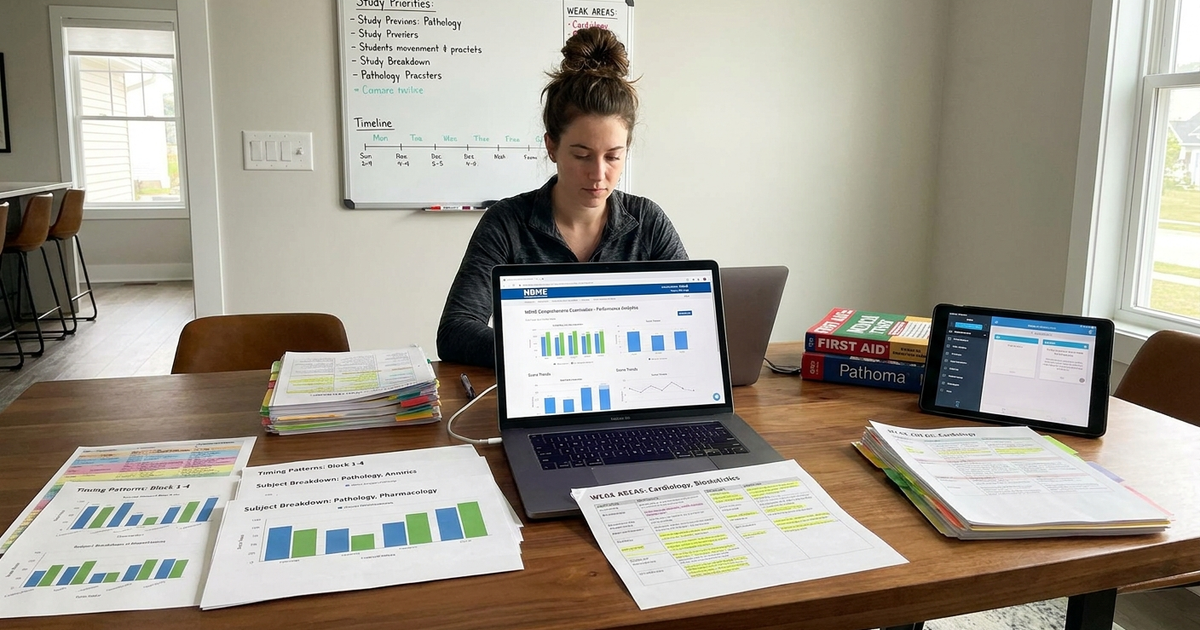
NBME Step 2 CK Practice Exam Review Strategy: Weak Areas, Timing and Score Readiness in 2026
You just finished your third NBME Step 2 CK practice exam. The score report sits on your screen — 237, up from 229 two weeks ago. You're relieved, but also confused. Half the questions you missed felt like you knew the answer. Three cardiology questions slipped by because you ran out of time in block 3. And that one infectious disease question? You changed from the right answer to wrong in the final 30 seconds.
Sound familiar? Here's the thing most students dont realize: the NBME score is just the starting point. The real value lies in what you do in the first 6 hours after that exam. This isnt about celebrating or panicking over a number. It's about turning every practice exam into a precision-guided audit of your readiness.
In this guide, we'll walk through the exact workflow successful Step 2 CK test-takers use to extract maximum value from each NBME. You'll learn how to separate timing mistakes from knowledge gaps, convert incorrect questions into specific study targets, and make data-driven decisions about when you're truly ready to sit for the real exam.
The First Hour After Your NBME: A Systematic Approach
Most students either celebrate or spiral after seeing their NBME score. Both reactions waste the most valuable window you have — when the questions and your decision-making process are still fresh in your memory.
Immediate Score Context (0-15 Minutes)
Before diving into question review, establish context. Your raw score tells you where you stand, but the trend matters more. If this is your second or third NBME, plot it against your previous scores. A 237 after two weeks of focused study following a 229 suggests steady progress. The same 237 after a 245 two weeks ago? That's a plateau worth investigating.
Write down these three data points immediately:
1. Total score and date
2. Time per block (did you finish early, right on time, or feel rushed?)
3. Energy level throughout the exam (fresh in block 1, tired by block 4?)
Question-by-Question Timing Log (15-45 Minutes)
Here's where most students go wrong. They jump straight into reviewing incorrect answers without understanding their timing patterns. Before you look at any explanations, create a timing audit.
Go through each block and mark questions that took you more than 90 seconds. Note questions where you changed your answer in the final review. Flag questions you guessed on due to time pressure. This timing data reveals patterns that pure content review misses.
For each timed-out question, ask: "Did I know the concept but ran out of time to apply it?" These aren't knowledge gaps — they're process problems that require different solutions.
Initial Weak Area Identification (45-60 Minutes)
Your NBME score report breaks down performance by subject areas. But don't stop at the percentiles. Look for subjects where you're more than 10 points below your total score. These are your immediate priorities.
More importantly, cross-reference this with your timing log. If you missed 4 out of 8 cardiology questions and 3 of them were in your "rushed" category, you've identified a compound problem: cardiology knowledge AND timing management when cardiology appears.
At Oncourse, we've built weak area insights that help students identify these compound patterns automatically. Instead of manually cross-referencing timing and subject data, our platform analyzes your practice history to surface exactly these hidden connections between content gaps and test-taking patterns.
Separating Knowledge Gaps from Timing Mistakes
The difference between a knowledge miss and a timing miss determines your next study priorities. Get this wrong, and you'll waste weeks studying content you already know.
The Three Types of NBME Misses
Every incorrect answer falls into one of three categories:
Knowledge Gap: You didnt know the underlying concept. The stem made sense, but you couldnt connect the clinical picture to the correct diagnosis or next step. These require content review. Application Error: You knew the concept but misapplied it under test conditions. Maybe you identified heart failure but chose the wrong next step for acute vs. chronic presentation. These require targeted practice, not broad content review. Process Error: You knew the answer initially but second-guessed yourself, or you ran out of time and guessed. These require strategy changes, not more studying.The 90-Second Rule for Classification
For each incorrect answer, give yourself 90 seconds to re-read the question stem and answer choices. If you can immediately identify the correct answer and explain why the others are wrong, this was likely a process error or application mistake.
If you're still unsure after 90 seconds of focused review, it's a knowledge gap. This simple timing test separates what you need to study from what you need to refine.
Tracking Answer Changes
Your NBME interface tracks every answer change. Export this data or note it manually. Students who pass Step 2 CK on their first attempt typically change 10-15% of their answers during the exam. More concerning is the pattern of changes.
Changed-to-correct suggests good clinical reasoning and self-correction. Changed-to-wrong often indicates anxiety or overthinking. Track the ratio. If you're changing correct answers to wrong ones more than 20% of the time, this is a test-taking strategy issue, not a content problem.
Converting Incorrect Questions into Study Priorities
Once you've classified your misses, the next step is converting them into actionable study priorities. This is where most students get overwhelmed. They see 23 incorrect answers across 8 different subjects and try to review everything.
The 3-5 Priority System
From your NBME review, identify exactly 3-5 specific study targets for the next week. Not subjects — specific, testable concepts. Instead of "review cardiology," your priority might be "acute heart failure management: IV diuretics vs. inotropes, when to add vasopressors."
This specificity matters because it turns your next study session into focused practice rather than passive review. When you know exactly what you're hunting for, you can target high-yield cardiology questions that test these decision points.
Subject Clustering Strategy
If you missed questions across multiple subjects but with similar reasoning patterns, cluster them by the underlying skill rather than the subject.
For example: three misses in "when to obtain imaging" — one in GI (CT vs. colonoscopy), one in pulmonary (CT vs. bronchoscopy), and one in cardiology (echo vs. catheterization). This isn't three separate content gaps. It's one reasoning pattern: risk stratification for invasive procedures.
Oncourse's Daily Plan feature excels at this type of clustering. Instead of manually organizing these cross-subject patterns, it automatically groups related concepts based on your specific miss patterns and creates a targeted daily schedule that addresses the underlying reasoning gaps.
The Explanation Deep-Dive Protocol
For each priority concept, spend 20-30 minutes in active explanation mode. Don't just read the answer explanation. Use Oncourse's explanation chat feature to ask follow-up questions: "Why was this answer tempting?" "What clue in the stem ruled out my chosen answer?" "What would I need to see in a similar question to pick the right answer next time?"
This transforms passive reading into active problem-solving. More importantly, it helps you build the decision trees you'll need for similar questions on test day.
Timing Audit: Beyond Just Speed
Most students think timing issues mean "going faster." But Step 2 CK timing problems are usually about rhythm, not raw speed. A systematic timing audit reveals exactly where your pacing breaks down.
Block-by-Block Energy Mapping
Chart your performance across the four blocks. Many students see their accuracy drop in block 3 or 4, not because the questions get harder, but because their decision-making becomes less systematic when fatigued.
Track three metrics per block:
- Questions completed on time (first pass through the block)
- Questions flagged for review (but still answered)
- Questions guessed due to time pressure
If block 3 shows a spike in flagged questions and a drop in first-pass completions, you've identified a fatigue pattern. The solution isn't more content review — it's stamina building and pacing adjustments.
The 90-180-90 Rhythm
Successful Step 2 CK test-takers develop a three-phase rhythm within each block:
- First 90 seconds: Read stem, identify the clinical scenario, narrow to 2-3 likely answers
- Next 180 seconds: Evaluate answer choices, apply decision rules, eliminate clearly wrong options
- Final 90 seconds: Choose best answer, flag if uncertain, move on
Identifying Time Sinks
From your timing log, identify questions that took more than 4 minutes. For each one, classify why:
- Calculation-heavy (arterial blood gas, dosing, clearance calculations)
- Buzzword hunting (scanning stem for hidden clues you might have missed)
- Option paralysis (knew it was A or B but couldn't decide)
Score Readiness: When to Take Another NBME vs. Focus on Gaps
The hardest decision in Step 2 CK prep is knowing when you're ready for the real exam. Your NBME scores provide crucial data, but interpreting them correctly requires understanding both the numbers and the trends.
The Two-Score Minimum Rule
Never make readiness decisions based on a single NBME score. The standard error of measurement for NBMEs is approximately 8-10 points. That means your "true" score could be 10 points higher or lower than what you see.
Take at least two NBMEs spaced 2-3 weeks apart before making any major decisions about test timing. Look for three patterns:
Upward trend: Second score is 8+ points higher than the first. This suggests your study methods are working and you're building momentum. Plateau: Scores within 5 points of each other. This suggests you've reached your current ceiling with your current study methods. Downward trend: Second score is 8+ points lower. This suggests fatigue, confidence issues, or study method problems that need addressing before test day.The 15-Point Buffer Strategy
For Step 2 CK, most students need their NBME scores to be 15+ points above their target score to feel confident on test day. If you're aiming for 240, consistent NBME performance of 255+ suggests solid readiness.
This buffer accounts for test-day variables: nerves, unfamiliar question styles, fatigue, and the natural variation in exam difficulty. Students who test with smaller buffers often score near their target but with much higher stress and risk.
Identifying When to Delay
Three scenarios warrant serious consideration of delaying your exam:
1. Plateau below target: Two consecutive NBMEs more than 10 points below your goal, with scores flat despite focused study
2. Consistent timing issues: Performance drops significantly in blocks 3-4 across multiple practice exams
3. Knowledge vs. timing confusion: You can't clearly separate your content gaps from your test-taking issues
Each scenario needs different solutions, but all require more time to address systematically.
The Final NBME Decision Point
Your last NBME should be taken 5-7 days before your exam date. This timing allows enough space to address any final gaps without creating test-day anxiety from a disappointing score.
If this final NBME is within 10 points of your previous score and both are in your target range, you're ready. If there's a significant drop (15+ points), you need to decide quickly: address the specific issues revealed or postpone.
Most importantly, don't take this final NBME if you're not prepared to act on the results. Having 3-4 days to make minor adjustments is reasonable. Having 3-4 days to overhaul your knowledge base is not.
Avoiding Score Overreaction: The Long View
NBME scores trigger strong emotional reactions, especially when they don't meet expectations. But overreacting to a single score can derail weeks of productive study.
The 20-Point Rule
Any single NBME score that differs from your recent average by more than 20 points is likely an outlier. Before changing your entire study plan, consider alternative explanations:
- Testing conditions: Did you take the exam when tired, stressed, or in an unfamiliar environment?
- Content timing: Did the exam happen to heavily weight your weakest areas?
- Technical issues: Internet problems, software glitches, or other disruptions during the exam
Trend Over Individual Scores
Your readiness is determined by patterns across multiple assessments, not single data points. A student with scores of 235, 242, 238 is in a much different position than someone with 225, 255, 225 — even though both average to 238.
The first pattern suggests consistent performance with minor variation. The second suggests something is systematically off, creating unpredictable results. Focus on understanding and reducing this variation before test day.
Score vs. Timing Trends
Sometimes your scores plateau while your timing improves, or vice versa. Both trends matter for test-day readiness.
A student scoring consistently at 240 but finishing blocks with time to spare is different from someone scoring 245 but rushing through the final 5 questions of each block. The first student has room for growth through content refinement. The second risks accuracy drops under pressure.
Track both metrics across multiple NBMEs. Ideal readiness shows stable scores with comfortable timing margins.
Practical Implementation: Your Next NBME Review Session
Here's how to apply this framework to your next NBME review session:
Hour 1: Data Collection
- Record total score, block timing, and energy patterns
- Create timing log of 90+ second questions
- Identify immediate weak areas from score report
- Note all answer changes and their patterns
Hour 2: Classification
- Apply 90-second rule to each incorrect answer
- Separate knowledge gaps from application errors from process mistakes
- Group similar reasoning patterns across subjects
- Select 3-5 specific study priorities
Hours 3-4: Deep Review
- Focus exclusively on your priority concepts
- Use active explanation methods for each gap
- Create decision frameworks for similar future questions
- Practice related questions to reinforce patterns
Hour 5: Strategic Planning
- Based on score trends, timing patterns, and gap analysis
- Decide: another NBME, targeted content work, or test-taking strategy refinement
- Set specific goals for next assessment
- Plan daily study priorities to address identified weaknesses
Frequently Asked Questions
How Many NBMEs Should I Take Before Step 2 CK?
Take 3-4 NBMEs spaced 2-3 weeks apart during your dedicated study period. The first establishes your baseline, the middle ones track progress and identify persistent gaps, and the final one (5-7 days before your exam) confirms readiness. More than 4 NBMEs rarely provides additional useful data and can become a substitute for actual studying.
What If My NBME Scores Are Inconsistent?
Inconsistent scores (variation of 15+ points between exams) usually indicate either test-taking strategy issues or knowledge gaps in areas that are heavily weighted on some forms but not others. Focus on identifying patterns in your mistakes across forms rather than trying to explain individual score variations. Consider working with targeted question blocks to build consistency.
Should I Retake the Same NBME Form?
No, don't retake the same NBME form within 2-3 months. You'll remember specific questions and get an artificially inflated score that doesnt reflect your true improvement. If you need additional assessment data, use a different NBME form or supplement with UWSA practice exams.
How Do I Know If I'm Ready Based on My NBME Score?
You're likely ready if your last two NBME scores are both within 15 points of your target score and show stable or improving performance. Focus more on trends than individual scores. A consistent pattern of 235-240-238 suggests better readiness than 225-255-230, even though the second sequence has a higher peak score.
What Should I Do If My Score Drops on My Final NBME?
First, determine if there was an obvious reason for the drop (fatigue, testing conditions, heavy weighting of weak areas). If the drop is unexplained and more than 10 points below your recent average, consider whether you have time to address the specific gaps identified or if delaying would be more appropriate. Don't panic — use the score report data to guide your final week of preparation.
How Much Time Should I Spend Reviewing Each NBME?
Plan 4-6 hours of review for each full-length NBME. This includes immediate data collection (1 hour), systematic question review (2-3 hours), and strategic planning based on the results (1-2 hours). Students who spend less than 3 hours reviewing typically don't extract enough value from the exam to justify the time spent taking it.
---
Prepare smarter with Oncourse AI — adaptive MCQs, spaced repetition, and AI explanations built for Step 2 CK. Download free on Android and iOS.