MRCP Part 1 Question Bank: Use Oncourse AI to Practice the Questions That Expose Weak Areas
Learn how to use MRCP Part 1 question banks diagnostically to identify weak areas in clinical sciences and convert missed questions into targeted practice with Oncourse AI.

MRCP Part 1 Question Bank: Use Oncourse AI to Practice the Questions That Expose Weak Areas
You're staring at your MRCP Part 1 study plan, knowing you need to cover 17 specialties plus clinical sciences in 200 MCQs. The breadth feels overwhelming — cardiology to psychiatry, cell biology to clinical pharmacology. Here's what most candidates miss: treating your question bank as a completion exercise instead of a diagnostic tool.
Your question bank isnt just practice. Its your weakness detector.
MRCP Part 1 tests pattern recognition across medical systems, not memorization. The candidates who pass dont just answer more questions — they use questions to expose knowledge gaps, then target those exact areas. This systematic approach transforms random practice into surgical improvement.
This guide shows you how to turn question bank misses into targeted weak-area practice using a diagnostic workflow. No generic study advice — specific strategies to identify where your clinical reasoning breaks down and convert those discoveries into focused improvement.
Why MRCP Part 1 Feels Impossibly Broad
MRCP Part 1 covers 25 clinical sciences questions plus 175 specialty questions across 16 domains. Thats everything from molecular biology to palliative care in 6 hours. The breadth isnt accidental — its testing your foundation across internal medicine.
Most candidates approach this by trying to cover everything equally. Wrong strategy. The exam weights topics differently:
Cardiology: ~14 questions
Clinical Pharmacology: ~15 questions
Clinical Sciences: ~25 questions
Infectious Diseases: ~14 questions
Each remaining specialty: 4-14 questions
The key insight: Your weak areas arent random. They cluster around specific reasoning patterns — mechanism confusion, diagnostic sequence errors, or management protocol gaps. A good question bank exposes these patterns early.
Traditional study materials teach topics in isolation. MRCP Part 1 tests integration. When you miss a cardiology question, its often because you lack the underlying physiology concept, not the cardiology fact itself.
Use Your Question Bank Diagnostically, Not Just for Completion
Stop chasing completion percentages. Start hunting patterns in your mistakes.
The diagnostic approach: After every 40-question block, spend 15 minutes categorizing your errors. Not by subject, but by reasoning type:
1. Mechanism gaps: You know the condition but not why the treatment works
2. Differential confusion: You recognize the presentation but choose the wrong disease
3. Investigation sequence: You understand the diagnosis but pick the wrong next step
4. Clinical clues: You miss the key detail that points to the answer
Track these patterns across subjects. If you're missing mechanism questions in cardiology and endocrinology, thats a clinical sciences weakness, not two separate specialty problems.
Practical workflow: Create a simple spreadsheet with columns for Question ID, Subject, Error Type, and Follow-up needed. After 10 blocks, you'll see clear patterns emerge. This diagnostic data drives your next study session — not arbitrary topic rotation.
The best question banks provide detailed explanations that help you categorize your errors. When reviewing incorrect answers, ask: "Did I miss this because I dont know the fact, or because I dont understand the underlying process?" The answer determines your remediation strategy.
Split Practice by Systems and Recurring Weak Patterns
Your question bank becomes most powerful when you stop doing random mixed blocks and start doing targeted pattern practice.
System-based blocks: Instead of mixing all 17 specialties, create focused blocks around physiological systems:
Cardiovascular system: cardiology + relevant clinical sciences + pharmacology
Endocrine system: diabetes/metabolism + relevant biochemistry + therapeutics
Infectious diseases: microbiology + immunology + clinical pharmacology
This integration mimics how MRCP Part 1 actually tests knowledge — rarely in pure specialty silos.
Pattern-based blocks: Once you identify your recurring weak reasoning patterns, create custom blocks that target those specific gaps:
If you struggle with investigation sequences, do a block focusing only on "next best investigation" questions across all specialties
If mechanism understanding is weak, practice only "most likely explanation" and "mechanism of action" questions
If differential diagnosis trips you up, focus on questions with similar presentations but different final diagnoses
Oncourse AI tracks your performance patterns automatically, identifying which clinical reasoning types you consistently miss. Instead of manually categorizing errors, the platform routes your next practice session toward your specific weak patterns — whether thats drug mechanisms, diagnostic sequences, or clinical red flags.
The 70-30 rule: Spend 70% of your question bank time on targeted weak-area practice, 30% on mixed blocks for exam simulation. This ratio maximizes improvement while maintaining breadth.
Review Incorrect Answers for Mechanism, Distractor Logic, and Clinical Clues
Most candidates read the explanation for their chosen wrong answer, then move to the next question. This misses 80% of the learning value.
The three-layer review process: Layer 1 - Mechanism deep-dive: For every incorrect answer, understand not just what the right answer is, but why it works at the physiological level. If the correct answer is "ACE inhibitor", dont just memorize that fact. Understand why ACE inhibition helps this specific condition, what happens to blood pressure and cardiac output, and which patients wouldnt benefit. Layer 2 - Distractor analysis: Examine why each wrong answer exists. MRCP Part 1 distractors arent random — theyre designed to test common misconceptions or partial knowledge. If you chose "beta-blocker" instead of "ACE inhibitor", understand what clinical situation would make beta-blockers appropriate, and what clinical clues pointed away from that choice. Layer 3 - Clinical clue recognition: Identify the key pieces of information in the question stem that should have guided you to the correct answer. Was it the patient's age? A specific symptom? A lab value? Mark these decision points so you recognize them in future questions.
When you approach explanations this way, each incorrect answer teaches you about 4-5 related concepts, not just one isolated fact.
Rezzy AI excels at this layered analysis — you can ask it to explain why specific distractors were included, what clinical clues you might have missed, and how the underlying mechanism connects to other similar questions. This turns passive explanation reading into active pattern recognition training.
Create a Repeat Loop from Missed Questions Into Weak-Area Revision
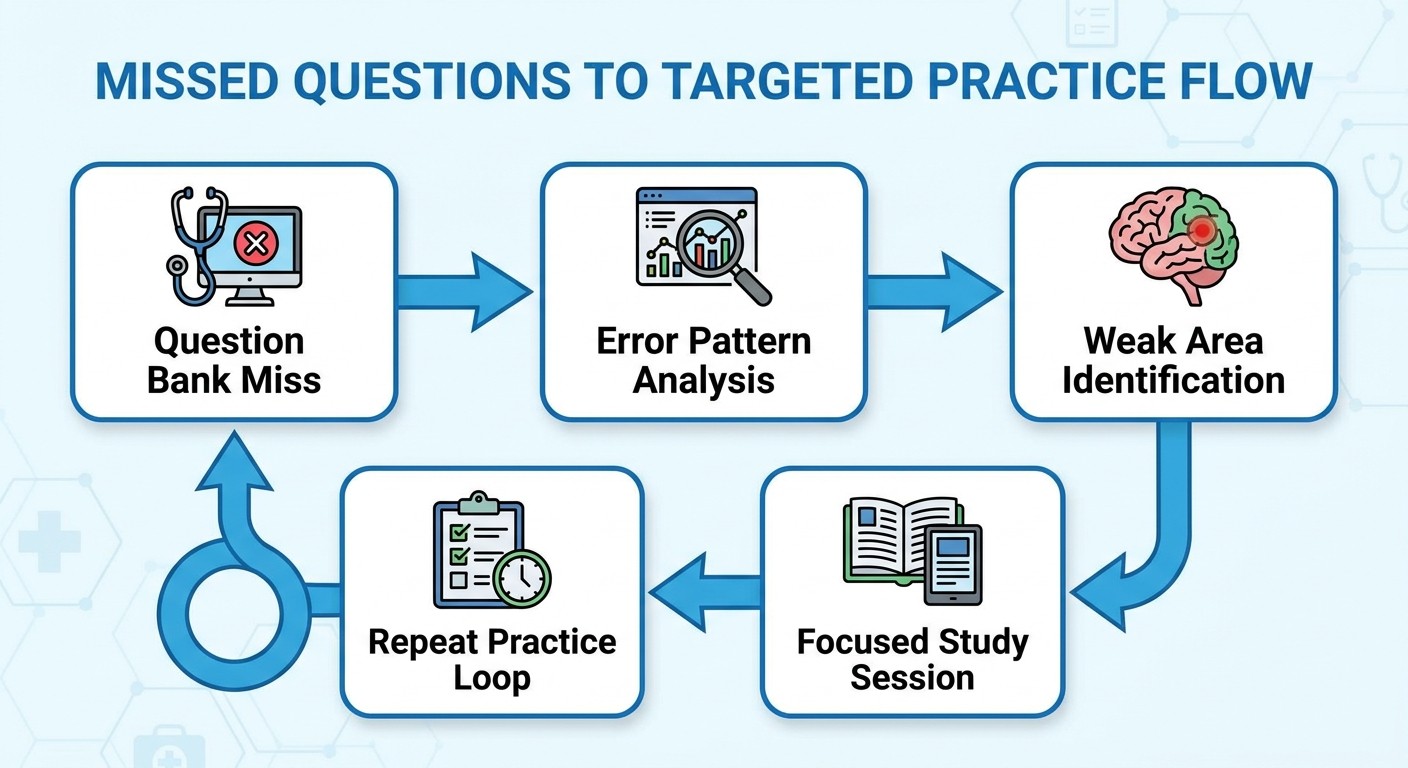
The biggest mistake in question bank practice: doing a question once, reading the explanation, then never seeing it again until review week. This approach wastes the diagnostic power of your mistakes.
The repeat loop system: Day 1: Complete your question block and identify mistakes using the three-layer review process above. Tag each missed question with its error pattern type. Day 3: Return to the missed questions, but dont just re-read them. Try to answer them fresh, without looking at your previous choice. If you get them right now, the gap is closed. If you still miss them, the underlying concept needs deeper work. Day 7: Test the underlying concepts with related questions. If you missed a cardiology question about heart failure management, seek out other heart failure questions — different presentations, different management stages, different complications. The goal is transferring the learned concept to new contexts. Day 14: Mixed practice including your previously missed topics alongside new material. This spaced repetition schedule ensures your improvements stick long-term.
Most question banks dont automate this process — you have to manually track what to review when. Oncourse AI's Daily Plan handles this automatically, surfacing your missed questions at optimally spaced intervals and mixing them with related concept practice. The platform remembers not just what you got wrong, but why you got it wrong, ensuring your repeat practice targets the actual knowledge gap.
Creating concept clusters: When you miss a question, dont just bookmark that specific question. Identify the broader concept family it belongs to. A question about acute coronary syndrome management belongs to the "cardiac emergencies" cluster, which connects to questions about arrhythmias, heart failure, and cardiac pharmacology. Practice the whole cluster, not just the individual question.
Balance Timed Mixed Blocks with Targeted Topic Blocks
Your question bank strategy needs two distinct phases: diagnostic practice and exam simulation. Most candidates do too much of one and not enough of the other.
Diagnostic phase (Weeks 1-8 of preparation):
80% targeted topic blocks
Focus on one clinical system per day
Untimed to allow deep thinking
Immediate explanation review
Detailed error tracking
Simulation phase (Weeks 9-12):
60% mixed blocks mimicking actual exam conditions
Strict timing: 108 seconds per question
Complete 100-question blocks without interruption
Review explanations only after full block completion
Focus on stamina and question management
The bridge strategy: During weeks 5-8, start incorporating "mini-mixed" blocks — 20 questions covering 3-4 related systems. This bridges pure topic practice with full exam simulation. Timing targets for MRCP Part 1:
Diagnostic phase: 2-3 minutes per question (allows thinking time)
Simulation phase: 1 minute 48 seconds per question (actual exam pace)
Review time: 1-2 minutes per explanation during diagnostic phase, 30 seconds during simulation phase
The key insight: you need untimed practice to learn concepts deeply, and timed practice to access those concepts quickly under pressure. Neither alone is sufficient.
Common Mistakes That Sabotage Question Bank Learning
Mistake #1: Passive explanation reading
You read the correct answer, think "that makes sense," and move on. This feels like learning but doesnt test whether you actually understood. Force yourself to explain the answer out loud or write a one-sentence summary before moving to the next question.
Mistake #2: Ignoring patterns in repeated misses
You keep missing immunology questions but treat each as an isolated event. After missing 3-4 immunology questions, pause your random practice and do a focused immunology block. Your brain is telling you theres a systematic gap.
Mistake #3: Only practicing familiar subjects
Cardiology feels comfortable, so you do extra cardiology blocks. Immunology feels hard, so you avoid it. This widens your knowledge gaps instead of closing them. Spend more time on uncomfortable subjects, not less.
Mistake #4: Chasing high scores instead of learning
You repeat easy blocks to boost your percentage score instead of tackling difficult material. MRCP Part 1 success comes from raising your floor (your worst subjects), not raising your ceiling (your best subjects).
Mistake #5: No connection between question practice and concept review
You do 50 questions in the morning, then read textbooks in the afternoon with no connection between the two activities. Instead, let your question bank misses drive your reading priority. Missed an endocrinology question about insulin resistance? Thats your afternoon reading topic.
Mistake #6: Treating all incorrect answers equally
A careless mistake on a concept you know well requires different follow-up than a fundamental knowledge gap. Categorize your errors and respond appropriately — quick review for careless errors, deep concept work for knowledge gaps.
7-Day Weak-Area Question Bank Sprint
When you've identified a major weak area (let's say immunology), dont just add "review immunology" to your to-do list. Execute a focused 7-day sprint to systematically eliminate that weakness.
Day 1: Baseline assessment
Complete a 40-question immunology-only block
Score and categorize errors (mechanism vs factual vs application)
Identify the 3-4 most frequent error types
Choose target concepts for the week
Day 2: Mechanism deep-dive
Study the underlying processes for your missed concepts
Focus on pathways, cellular interactions, antibody functions
Use Rezzy AI to get mechanism explanations tailored to MRCP Part 1 level
Complete 20 mechanism-focused questions to test understanding
Day 3: Clinical application
Practice questions that test immunology in clinical contexts
Focus on presentations, investigations, and management
30 questions mixing immunology with other specialties
Day 4: Comparative practice
Practice questions that require distinguishing between similar immunological conditions
Focus on differential diagnosis within immunology
25 questions emphasizing clinical reasoning
Day 5: Integration testing
Mixed 40-question block including immunology (25%) and other subjects (75%)
Test whether your immunology improvements hold up in mixed practice
Identify any remaining gaps
Day 6: Weak spot reinforcement
Return to question types you still missed on Day 5
Focus practice on your most stubborn weak points
20-30 targeted questions
Day 7: Final assessment
Repeat a similar 40-question immunology block to Day 1
Compare performance — you should see significant improvement
Note any remaining gaps for future focused work
This sprint approach transforms a vague weak area into systematic improvement. The time-bound structure prevents endless unfocused review.
Frequently Asked Questions
How many questions should I complete daily during MRCP Part 1 preparation?
Aim for 40-60 questions daily during your main preparation phase. This includes both diagnostic practice (targeted blocks) and review of previously missed questions. Quality matters more than quantity — spending 90 minutes on 40 questions with thorough explanation review beats rushing through 100 questions with minimal learning.
Should I review explanations for questions I answered correctly?
Yes, but selectively. Review correct answers when: (1) you guessed and got lucky, (2) the explanation teaches a concept you're weak on, or (3) the question tests a high-yield topic likely to appear again. Skip reviewing explanations for topics you're already strong in — focus your time on knowledge gaps.
How do I know if my question bank is too easy or too difficult?
Your question bank difficulty is appropriate if you score 60-75% on untimed blocks and 55-70% on timed blocks. Below 50% suggests the material is too advanced for your current level — step back to foundational review. Above 80% suggests you need more challenging material or should focus on timed practice under exam conditions.
What's the best ratio between topic-specific and mixed practice blocks?
During early preparation (first 8 weeks): 70% topic-specific, 30% mixed. During exam simulation phase (final 4 weeks): 30% topic-specific, 70% mixed. This progression ensures you build strong foundations in weak areas before testing exam performance under realistic conditions.
How often should I repeat questions I previously answered incorrectly?
Follow a spaced repetition schedule: review missed questions after 2-3 days, then again after 1 week, then after 2 weeks. This timing optimizes retention. However, dont just re-read the same questions — test the underlying concepts with similar but different questions to ensure true understanding.
Should I focus more time on high-yield subjects like cardiology and clinical sciences?
Yes, but not at the expense of completely neglecting lower-yield subjects. Allocate study time roughly proportional to exam weighting: spend 25% of your question practice on clinical sciences, 15% each on cardiology and clinical pharmacology, and distribute remaining time across other specialties based on your personal weak areas.
---
Your MRCP Part 1 question bank becomes most powerful when you stop treating it as a test and start using it as a diagnostic tool. Every missed question reveals a specific knowledge gap or reasoning error — but only if you analyze it systematically and convert those insights into targeted improvement.
The candidates who pass MRCP Part 1 dont just practice more questions. They practice smarter, using their mistakes to guide focused study and building systematic approaches to clinical reasoning. Your question bank performance isnt just measuring your current knowledge — its mapping the exact path to exam success.
Prepare smarter with Oncourse AI — adaptive MCQs, spaced repetition, and AI explanations built for MRCP Part 1. Download free on Android and iOS.