Back
INICET Study Plan 2026: Build an Adaptive Daily Plan Around Weak Areas
Create an adaptive INICET 2026 study plan that adjusts daily schedules based on weak area performance. Learn baseline assessment, subject prioritization, time blocks, and weekly adjustments for exam success.

INICET Study Plan 2026: Build an Adaptive Daily Plan Around Weak Areas
You have 200 MCQs. 180 minutes. One shot at your dream INICET seat.
Here's the thing - most INICET aspirants follow rigid study schedules that ignore their actual performance data. They spend equal time on medicine (where they score 80%) and pathology (where they barely hit 45%). That's not strategy, thats stubbornness.
The toppers? They build adaptive daily plans that shift resources toward weak areas while maintaining strong subjects. They dont study harder - they study based on what their practice scores reveal.
If you want to crack INICET 2026, your daily plan needs to respond to your performance, not follow some generic timetable. Let me show you exactly how to build one.
Understanding INICET 2026: Why Adaptive Planning Matters
INICET 2026 follows a computer-based format with 200 MCQs across pre-clinical, para-clinical, and clinical subjects. You get 180 minutes total - roughly 54 seconds per question.
The exam carries a 1/3 negative marking, meaning wrong answers cost you. But here's what most students miss: the weightage distribution isn't equal. Clinical subjects typically carry 45-50% weightage, para-clinical gets 25-30%, and pre-clinical rounds out with 20-25%.
This unequal distribution means your study plan cant treat all subjects equally. If you're weak in high-yield clinical areas like Medicine or Surgery, those gaps hurt more than struggles with lower-weightage pre-clinical topics.
Your adaptive plan needs to account for both subject weightage and your individual performance patterns. When you consistently miss Pharmacology questions but nail Anatomy, your daily schedule should reflect that reality.
Phase 1: Baseline Assessment - Know Your Starting Point
Before building any study schedule, you need honest data about where you stand. Most students skip this step and waste weeks on inefficient planning.
Create Your Diagnostic Framework
Take a full-length INICET mock test within 48 hours of reading this article. Don't prep for it - you want raw, honest performance data.
After the test, create a subject-wise accuracy breakdown:
Strong areas (70%+ accuracy): Subjects you already handle well
Moderate areas (50-70% accuracy): Topics needing consistent practice
Weak areas (Below 50% accuracy): Your high-priority focus zones
Document your time per question in each subject. If you're spending 90 seconds on Pathology questions but 30 seconds on Anatomy, that timing pattern affects your daily schedule.
Track Error Patterns
Beyond just accuracy, categorize your mistakes:
1. Knowledge gaps: You didn't know the concept
2. Application errors: You knew the concept but misapplied it
3. Silly mistakes: Misreading questions or careless errors
4. Time pressure: Running out of time and guessing
Each error type needs a different fix. Knowledge gaps require more study time, while application errors need more practice questions. When you track weak areas through platforms like Oncourse, you get detailed analytics that show exactly where these patterns emerge, helping you target specific topics rather than entire subjects.
Phase 2: Subject Prioritisation Using the 50-30-20 Rule
Your daily time allocation should follow a weighted approach based on INICET's actual exam pattern and your performance gaps.
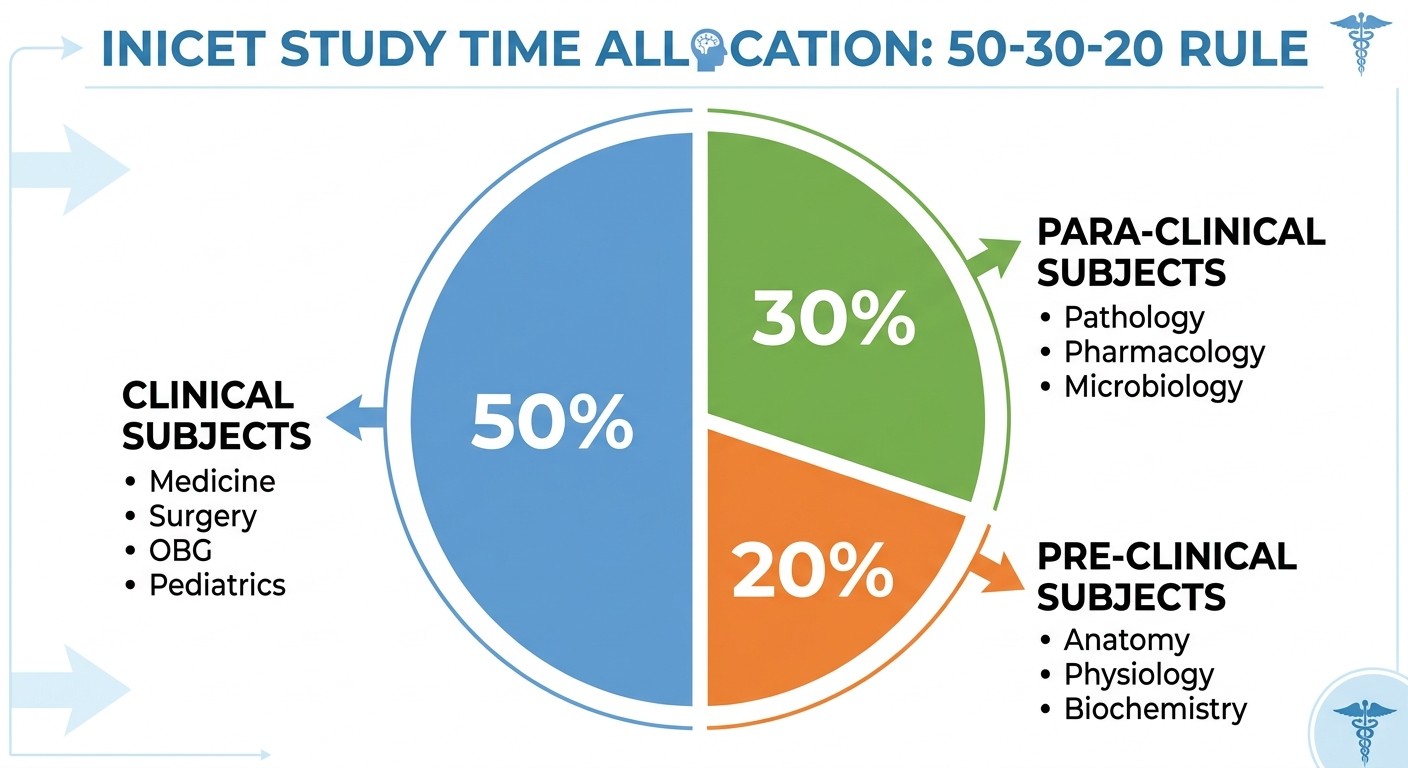
High-Priority Clinical Block (50% of study time)
Medicine: Cardiology, Neurology, Gastroenterology, Infectious diseases
Surgery: Trauma, GI surgery, Urology, Basic surgical principles
OBG: Antenatal care, Labor management, High-risk pregnancy
Pediatrics: Growth and development, Pediatric emergencies, Immunization
Medium-Priority Para-Clinical Block (30% of study time)
Pathology: General pathology, Hematology, Cancer biology
Pharmacology: Autonomic drugs, Antimicrobials, CNS pharmacology
Microbiology: Virology, Clinical bacteriology, Immunology basics
Community Medicine: Epidemiology, Biostatistics, Health programs
Foundation Pre-Clinical Block (20% of study time)
Anatomy: Neuroanatomy, Clinical correlations, Imaging anatomy
Physiology: Cardiovascular, Respiratory, Endocrine systems
Biochemistry: Clinical enzymology, Molecular biology, Metabolism
But here's where the adaptive part kicks in: if your weak areas don't align with this distribution, you adjust. If you're scoring 40% in Pharmacology but 75% in Medicine, temporarily flip your priorities until you bring that Pharmacology score up.
Phase 3: Building Daily Time Blocks That Respond to Performance
Your daily schedule needs structure but also flexibility to shift based on weekly performance reviews.
Morning Block (6:00-9:00 AM): Attack Your Weakest Area
Reserve your highest-energy hours for your most challenging subject. If Pathology is your weak link, that's where your fresh morning brain goes.
Within this block, spend:
90 minutes on concept study (textbooks, notes, lectures)
60 minutes on targeted MCQ practice
30 minutes reviewing mistakes and creating quick-revision notes
Mid-Morning Block (9:30-11:30 AM): Moderate-Difficulty Subject
This is typically a para-clinical subject where you score 50-70%. Mix theory with immediate practice - read a topic, then solve 10-15 related questions.
When you practice through structured question banks, you can immediately identify which subtopics within these moderate areas need extra attention, allowing you to fine-tune your focus even further.
Afternoon Block (2:00-4:30 PM): High-Yield Clinical Practice
After lunch and a short break, tackle clinical subjects with heavy MCQ practice. This mimics your post-lunch exam timing and builds stamina.
Focus on case-based questions and clinical scenario practice. Aim for 80-100 questions during this block, with immediate review of incorrect answers.
Evening Block (5:00-7:00 PM): Previous Day Revision + Weak Topic Reinforcement
Never end a day without revisiting yesterday's mistakes. Spend the first hour reviewing your error log and the second hour drilling weak topics identified from recent practice sessions.
Night Block (8:00-9:30 PM): Quick Revision + Planning Tomorrow
Light revision of high-yield facts, mnemonics, and formulas. End by planning tomorrow's focus areas based on today's performance patterns.
Phase 4: PYQ Practice and Mock Test Integration
Previous Year Questions (PYQs) aren't just practice material - they're your roadmap to INICET's actual testing patterns.
Weekly PYQ Schedule
Monday & Wednesday: Topic-wise PYQs aligned with your current study focus
Friday: Mixed-topic PYQ sets (40-50 questions) under timed conditions
Sunday: Full-length mock test with comprehensive analysis
Mock Test Review Protocol
After each mock test, spend 2-3 hours on analysis:
1. Subject-wise performance tracking: Update your accuracy percentages
2. Question-type analysis: Are you missing more theoretical or application-based questions?
3. Time distribution review: Which subjects are eating up too much time?
4. Mistake categorization: Update your error log with new patterns
Use this data to adjust next week's daily blocks. If your Surgery scores dropped, increase Surgery time and decrease time from your strongest subject.
Phase 5: Spaced Revision System
Forgetting is your biggest enemy in medical exam prep. Your adaptive plan needs built-in revision cycles that prevent knowledge decay.
The 1-7-21 Revision Cycle
Day 1: Learn the topic thoroughly
Day 7: Quick revision (30-45 minutes max)
Day 21: Final reinforcement before moving to long-term memory
Daily Revision Integration
Reserve 30 minutes each morning for spaced revision. Review topics you studied 1 week ago and 3 weeks ago. This prevents the common problem where you nail topics studied yesterday but forget everything from a month back.
Active spaced repetition through digital flashcards helps automate this process, showing you exactly which concepts need reinforcement based on your forgetting patterns rather than arbitrary schedules.
Subject Rotation Pattern
Don't study the same subject for multiple consecutive days. Your brain needs variety for optimal retention. A sample rotation:
Monday: Medicine (morning), Pathology (afternoon)
Tuesday: Surgery (morning), Pharmacology (afternoon)
Wednesday: Pediatrics (morning), Microbiology (afternoon)
Thursday: OBG (morning), Anatomy (afternoon)
Friday: Mixed practice and weak area focus
Phase 6: Weekly Performance Reviews and Plan Adjustments
Every Sunday, conduct a comprehensive review of the week's performance data.
Key Metrics to Track
Subject-wise accuracy trends
Average time per question by subject
Total questions attempted vs target
Mistake categories and their frequency
Energy levels and productivity hours
Adjustment Triggers
Make plan changes when you notice:
Accuracy plateau: Same subject showing no improvement for 2 weeks
Time inefficiency: Spending too long on low-yield topics
Energy mismatch: Studying hard subjects when you're tired
Weak area neglect: Not seeing improvement in identified weak areas
Sample Weekly Adjustment
If your Medicine accuracy improved from 60% to 72% but Surgery dropped from 65% to 58%, next week's plan shifts more morning time blocks to Surgery while maintaining (not increasing) Medicine practice.
This responsive approach ensures your plan evolves with your actual learning rather than following a static schedule.
Phase 7: Final Month Strategy Adjustments
The last 30 days before INICET require a different approach. Stop learning new topics and focus on consolidation and performance optimization.
Week 1-2 of Final Month: Intensive Revision
Morning: Subject with lowest recent mock score
Afternoon: High-yield topic revision across all subjects
Evening: PYQ practice (60-80 questions daily)
No new chapters or detailed theory study
Week 3-4: Mock Marathon
Daily full-length mocks or sectional tests
2 hours post-test analysis for each mock
Quick revision of only high-yield facts
Maintain mistake log but don't deep-dive into weak areas
Last Week: Confidence Building
Light revision of strong subjects
Quick glance through mistake logs
Solve familiar PYQs to maintain confidence
Focus on exam day strategy and timing practice
Building Your Personal Adaptive Framework
Now that you understand the components, here's how to implement your personal adaptive INICET study plan:
Step 1: Assessment Week
Take 2-3 full-length mocks
Document subject-wise performance
Identify clear strong/moderate/weak categories
Set up tracking system for daily performance
Step 2: Plan Design Week
Allocate daily time blocks based on your weak area data
Create subject rotation schedule
Set up spaced revision calendar
Design weekly review protocol
Step 3: Implementation with Weekly Adjustments
Follow plan for one week
Conduct Sunday performance review
Adjust time allocations based on data
Repeat cycle with improved focus
Step 4: Final Month Transition
Switch to consolidation mode 30 days before exam
Increase mock test frequency
Reduce new learning, maximize revision
Fine-tune exam day strategy
Frequently Asked Questions
How do I know if my adaptive plan is working?
Track these metrics weekly: overall mock test scores trending upward, accuracy in previously weak subjects improving by 10-15%, and consistent timing (staying within 54 seconds per question average). If you see improvement in 2 out of 3 metrics, your plan is working.
What if I have multiple equally weak subjects?
Prioritize based on weightage and improvement potential. Focus on high-weightage subjects (Medicine, Surgery) first. If two subjects have similar weightage, choose the one where you see quicker improvement patterns in practice questions.
How much time should I spend on PYQs vs new learning?
In the first 60 days: 70% new learning, 30% PYQ practice. In the middle phase: 50-50 split. Final 30 days: 20% new learning, 80% PYQ and revision. Adjust based on your baseline - if you haven't covered basic concepts, spend more initial time on learning.
Should I completely abandon strong subjects?
No. Maintain strong subjects with 15-20% of your daily study time to prevent score drops. The key is not increasing time on strong subjects when weak areas need attention.
What if I'm consistently slow in one subject?
Analyze question types in that subject. If you're slow due to lengthy clinical scenarios, practice speed-reading techniques. If its calculation-heavy (like Community Medicine biostatistics), drill formula recall until it becomes automatic.
How often should I take full-length mock tests?
Start with one per week in the first month. Increase to 2 per week in the middle phase. Final month: 4-5 per week. But remember - mocks are for assessment and adaptation, not just practice.
---
Building an adaptive INICET study plan isn't about following someone else's schedule - it's about creating a system that responds to your actual performance data and adjusts accordingly.
The students who crack INICET don't just work hard. They work smart by letting their practice scores guide their daily decisions. Your weak areas become your priority areas, your time blocks shift based on real data, and your plan evolves as you improve.
Prepare smarter with Oncourse AI - adaptive MCQs, spaced repetition, and AI explanations built for INICET 2026. Download free on Android and iOS