INICET Question Bank Strategy: Practice Weak Areas, PYQs and Mock Review
Master INICET 2026 with strategic question bank practice. Learn to identify weak areas, use PYQs effectively, and review mocks for maximum score improvement in 54 seconds per question.

INICET Question Bank Strategy: Practice Weak Areas, PYQs and Mock Review
You are probably staring at your INICET question bank wondering where to even start. With 200 questions in 180 minutes, thats just 54 seconds per question — and 60% of them arent simple recall anymore. They're clinical vignettes that test whether you can actually think like a doctor under pressure.
INICET 2026 changed the game with sectional timing. You get 45 minutes for each 50-question block, and you cant jump between sections. This means your weakest subject cant hide behind your strongest one anymore. Every section needs a strategy.
The difference between ranking 50 and ranking 500 isnt how many questions you solve — its how you solve them. This guide breaks down the exact workflow for turning your question bank, PYQs, and mocks into a rank-boosting system.
INICET Question Bank Framework: The Three-Track System
Your question bank isnt just a pile of MCQs. Its a diagnostic tool that reveals exactly where you lose marks. Most students practice randomly — some fresh questions today, a few PYQs tomorrow, maybe a mock on Sunday. This scattered approach misses the point.
Use this three-track system instead:
Track 1: Fresh Topic Practice (40% of daily questions)
New questions from topics youre currently studying. These build your knowledge base and pattern recognition.Track 2: Weak Area Drilling (35% of daily questions)
Targeted practice on topics where you consistently score below 70%. These questions give you the highest return on time invested.Track 3: Mixed PYQ and Mock Review (25% of daily questions)
Previous year questions and review of missed mock questions. These teach you INICET-specific patterns and exam behavior.Your daily question mix should follow this 40-35-25 split. If you solve 100 questions daily, thats 40 fresh, 35 weak area, and 25 PYQ/review questions.
How to Identify Your True Weak Areas
Most students think they know their weak subjects. "Im bad at Surgery" or "Anatomy kills me." But INICET tests patterns, not subjects. You need to dig deeper.
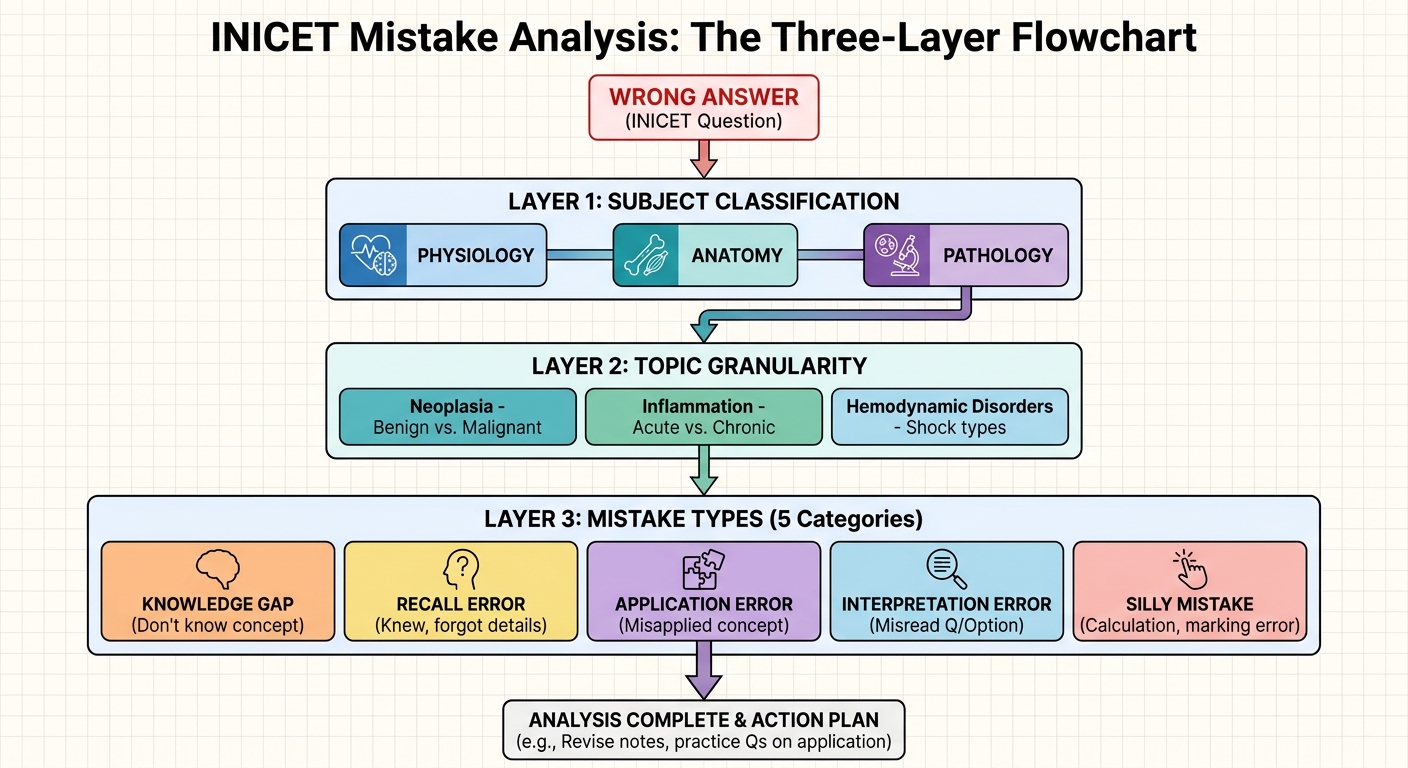
The Three-Layer Analysis Method
After every practice session or mock test, categorize your mistakes into three layers:
Layer 1: Subject Classification Medicine, Surgery, Pharmacology, Pathology, etc. This is the obvious level everyone sees. Layer 2: Topic Granularity Within each subject, drill down to specific topics. Not just "Medicine," but "Cardiology emergencies" or "CNS infections." Layer 3: Mistake Type This is where most students stop analyzing, but its the most important layer:- Knowledge Gap: You didnt know the concept
- Retention Failure: You studied it but couldnt recall under pressure
- Application Error: You knew the concept but applied it wrong
- Reading Error: You misread the question or options
- Time Pressure: You knew the answer but ran out of time
Converting Weak Areas Into Practice Blocks
Once you identify your mistake patterns, convert them into targeted practice blocks:
- Knowledge Gaps: Study the topic first, then practice 20-30 questions
- Retention Failures: Use spaced repetition with flashcards and active recall techniques
- Application Errors: Practice 15-20 similar clinical scenarios to build pattern recognition
- Reading Errors: Slow down and underline keywords in questions
- Time Pressure: Practice timed blocks of 10-15 questions until you build speed
Previous Year Questions (PYQ) Strategy
PYQs arent just old questions — theyre your window into INICET's evolving pattern. The 2024 pattern shift toward clinical vignettes means recent PYQs (2021-2025) are more valuable than older ones.
The PYQ Three-Phase Approach
Phase 1: Cold Attempt (Week 1-2) Take 2-3 complete PYQ papers under exam conditions. No notes, no breaks. This gives you a baseline and shows you authentic INICET patterns. Phase 2: Pattern Recognition (Week 3-4) Analyze which concepts repeat across years. INICET loves certain topics:- Stroke protocols in Medicine
- ATLS guidelines in Surgery
- Latest WHO recommendations in Community Medicine
- Recent drug approvals in Pharmacology
PYQ Timing Strategy
Dont spread PYQs over months. Concentrate them into focused blocks:
| Week | PYQ Focus | Daily Questions | Goal |
|---|---|---|---|
| Week 1 | 2024-2025 papers | 50 PYQ + 50 fresh | Identify recent patterns |
| Week 2 | 2022-2023 papers | 50 PYQ + 50 fresh | Build pattern recognition |
| Week 3 | 2021-2022 papers | 30 PYQ + 70 fresh | Fill knowledge gaps |
| Week 4 | Mixed practice | 25 PYQ + 75 fresh | Integrate learning |
Mock Test Strategy: Beyond Just Taking Tests
Taking mocks is easy. Reviewing them properly is where students fail. Most people check their score, scan through wrong answers, and move on. This approach wastes the mock's diagnostic value.
The Complete Mock Review Checklist
Immediately After the Mock (15 minutes): 1. Note your section-wise timing breakdown 2. Identify which section felt rushed 3. Mark questions where you changed answers 4. Count how many questions you skipped vs attempted Detailed Review Phase (60-90 minutes): 1. Categorize every wrong answer using the three-layer method 2. Review all correct answers you werent confident about 3. Analyze your changed answers (were changes helpful or harmful?) 4. Time stamp when you started struggling in each section Action Planning (15 minutes): 1. List your top 3 weakest topics from this mock 2. Plan specific practice blocks for the next 3 days 3. Adjust your sectional timing strategy if neededMock Test Schedule by Preparation Phase
6-Month Plan:- Month 1-2: Focus on topic-wise practice, no full mocks
- Month 3-4: One mock per week + detailed review
- Month 5: Two mocks per week
- Month 6: One mock every other day
- Month 1: One mock every 10 days + intensive topic practice
- Month 2: Two mocks per week
- Month 3: Mock every other day with light topic review
- Week 1: Mock every other day
- Week 2: Daily mocks
- Week 3: Mock daily + mistake review only
- Week 4: Light review, no new mocks
Weekly Study Cadence: The INICET Rhythm
INICET preparation isnt a marathon — its interval training. Your weekly rhythm determines whether you build stamina or burn out.
The 6-Day Cycle
Day 1-2: Topic Focus- 40% fresh questions on your planned topic
- 35% weak area drilling from previous analysis
- 25% PYQ/review questions
- Study time: 6-7 hours
- 50% mixed questions across all subjects
- 30% weak area practice
- 20% PYQ questions
- Study time: 5-6 hours
- Focus on clinical vignettes and case-based questions
- Practice explaining your reasoning (as if teaching a junior)
- Use Rezzy AI to discuss complex cases and clarify doubts in real-time
- Study time: 6-7 hours
- Full mock test (180 minutes)
- Detailed review (90 minutes)
- Plan next week's focus areas
- Study time: 4-5 hours
- Light review of notes
- Flashcard revision
- No new content
- Study time: 2-3 hours
Common Question Bank Mistakes to Avoid
Mistake 1: Question Bank Shopping
Jumping between different platforms dilutes your pattern recognition. Pick one comprehensive question bank and stick with it. Oncourse's question bank has detailed explanations and lets you track weak topics systematically — use features like this to build consistency rather than switching platforms.Mistake 2: Explanation Skipping
Reading only correct answer explanations misses the point. INICET tests why wrong options are tempting. Always read why each distractor is incorrect.Mistake 3: Timed Practice Avoidance
Solving questions without time pressure builds false confidence. Practice at least 50% of your daily questions under exam timing (54 seconds per question).Mistake 4: No Mistake Log Maintenance
Students review mistakes mentally but dont record them systematically. Without a written log, you repeat the same errors across months.Mistake 5: Subject Isolation
Practicing one subject for weeks, then switching to another. INICET tests integration. Mix subjects daily to build exam-like thinking patterns.Final Month Adjustments
Your strategy needs to shift dramatically in the final month. This isnt the time for new topics or deep concept building.
Week 4 Before Exam: Mock Marathon
- Daily full mocks
- 60-minute reviews maximum
- Focus only on highest-yield mistakes
- No new topic introduction
Week 3 Before Exam: Pattern Crystallization
- Mock every other day
- Review only recurring mistake patterns
- Practice explaining concepts aloud
- Use apps to quickly clarify remaining doubts rather than deep study
Week 2 Before Exam: Confidence Building
- Light mock practice (every third day)
- Review high-yield notes only
- Practice sectional timing
- Get exam logistics sorted
Week 1 Before Exam: Maintenance Mode
- One mock for timing practice
- Review mistake log highlights
- Focus on sleep schedule
- No new practice material
How to Use Technology in Your Question Bank Strategy
Modern preparation isnt just about books and PDFs. Smart use of technology can accelerate your progress.
AI-Powered Doubt Resolution
When you encounter a concept that trips you up repeatedly, dont just re-read the same explanation. Use AI tutoring features to approach the concept from different angles. For instance, if you keep missing questions about heart failure management, discussing the stepwise approach with an AI tutor can help you understand the clinical reasoning behind each step.Explanation Deep-Dives
After getting a question wrong, use explanation chat features to dig deeper into why you made that mistake. This turns a simple wrong answer into a learning opportunity that prevents similar mistakes in future questions.Smart Weak Area Targeting
Instead of manually tracking which topics you struggle with, use platforms that automatically identify your weak areas based on practice patterns. This data-driven approach ensures you spend time on topics that actually need work rather than ones you think need work.Frequently Asked Questions
How many questions should I solve daily for INICET preparation?
Aim for 100-150 questions daily during peak preparation. Break this into 40% fresh questions, 35% weak area practice, and 25% PYQ/review. In the final month, increase to 200+ questions daily with more focus on timed practice.
When should I start solving PYQs for INICET?
Start PYQs after completing your first round of topics, typically 2-3 months into preparation. Take 2-3 complete papers cold first, then use them for pattern recognition and targeted practice.
How do I balance question practice with theory study?
Follow a 60-40 split: 60% questions, 40% theory. But theory should be targeted based on your question performance, not random reading. Use your mistake analysis to guide what concepts need theoretical reinforcement.
Should I solve questions topic-wise or mixed from the beginning?
Start topic-wise for the first 2 months to build subject familiarity. Then shift to mixed practice to develop exam-like integration skills. In the final month, practice should be 80% mixed, 20% targeted weak areas.
How many mocks are enough for INICET preparation?
Minimum 20 full-length mocks, with at least 50% taken in the final 2 months. Quality of review matters more than quantity of mocks. One well-analyzed mock is better than three quickly attempted ones.
What should I do if my mock scores arent improving?
Pause full mocks and focus on sectional practice (50 questions in 45 minutes). Identify whether the problem is knowledge gaps, timing issues, or exam strategy. Address the root cause before resuming full mocks.
Prepare smarter with Oncourse AI — adaptive MCQs, spaced repetition, and AI explanations built for INICET. Download free on Android and iOS.