Back
How to Study Biochemistry for NEET PG 2026: High-Yield Topics, Enzyme Mechanisms and Exam Strategy
Master NEET PG biochemistry with this comprehensive guide covering high-yield topics, enzyme mechanisms, metabolic disorders, vitamins, and proven study strategies for 2026.

How to Study Biochemistry for NEET PG 2026: High-Yield Topics, Enzyme Mechanisms and Exam Strategy
You are probably staring at a 800-page biochemistry textbook wondering how to extract 15-20 questions worth of gold from this mountain of molecular pathways. NEET PG biochemistry isnt about memorizing every single enzyme — its about understanding the 20% of concepts that show up in 80% of questions.
Here's the reality: biochemistry contributes approximately 15-20 questions to NEET PG. That's roughly 5% of your total score, but these questions are often high-yield and predictable if you know the patterns. The examiners love testing enzyme mechanisms, vitamin-coenzyme connections, and classic metabolic disorders because they reveal whether you actually understand biochemical processes or just crammed names.
The mistake most students make? Treating biochemistry like anatomy — trying to memorize everything linearly. Instead, you need to think like the enzyme pathways themselves: interconnected, purposeful, and built around key regulatory points.
Understanding NEET PG Biochemistry Question Patterns
NEET PG biochemistry questions follow predictable patterns that you can exploit once you recognize them. The examiners dont test random enzymes — they focus on clinically relevant pathways and disorders that show up in medicine and pathology.
High-frequency question types:
Enzyme deficiency disorders (PKU, alkaptonuria, MSUD)
Vitamin-coenzyme pairs and their deficiency syndromes
Rate-limiting enzymes in major pathways
Cofactor requirements for specific reactions
Metabolic pathway interconnections
The key insight here is that NEET PG doesnt test biochemistry in isolation. Questions often bridge into pathology, medicine, or pediatrics. For example, they wont just ask about phenylalanine hydroxylase — they'll describe a child with intellectual disability and ask about the enzyme defect.
Practice with biochemistry MCQs that mirror this integrated approach rather than isolated factual questions.
High-Yield Biochemistry Chapters for NEET PG 2026
Based on previous year analysis, certain chapters consistently contribute more questions than others. Focus your energy on these high-yield areas:
1. Enzymes and Enzyme Kinetics
Why its tested: Foundation for understanding all metabolic processes Key concepts:
Michaelis-Menten kinetics
Competitive vs non-competitive inhibition
Allosteric regulation
Enzyme induction and repression
The enzyme mechanism questions in NEET PG often present scenarios rather than direct definitions. They might describe a drug that increases Km without affecting Vmax and ask about the inhibition type. Understanding the conceptual framework matters more than memorizing individual enzyme names.
For systematic enzyme mastery, explore detailed enzyme lessons that break down mechanisms step-by-step.
2. Carbohydrate Metabolism
Weight: 4-6 questions typically Must-know pathways:
Glycolysis (rate-limiting steps, regulation)
TCA cycle (entry points, energy yield)
HMP shunt (NADPH production, pentose synthesis)
Gluconeogenesis (key enzymes, regulation)
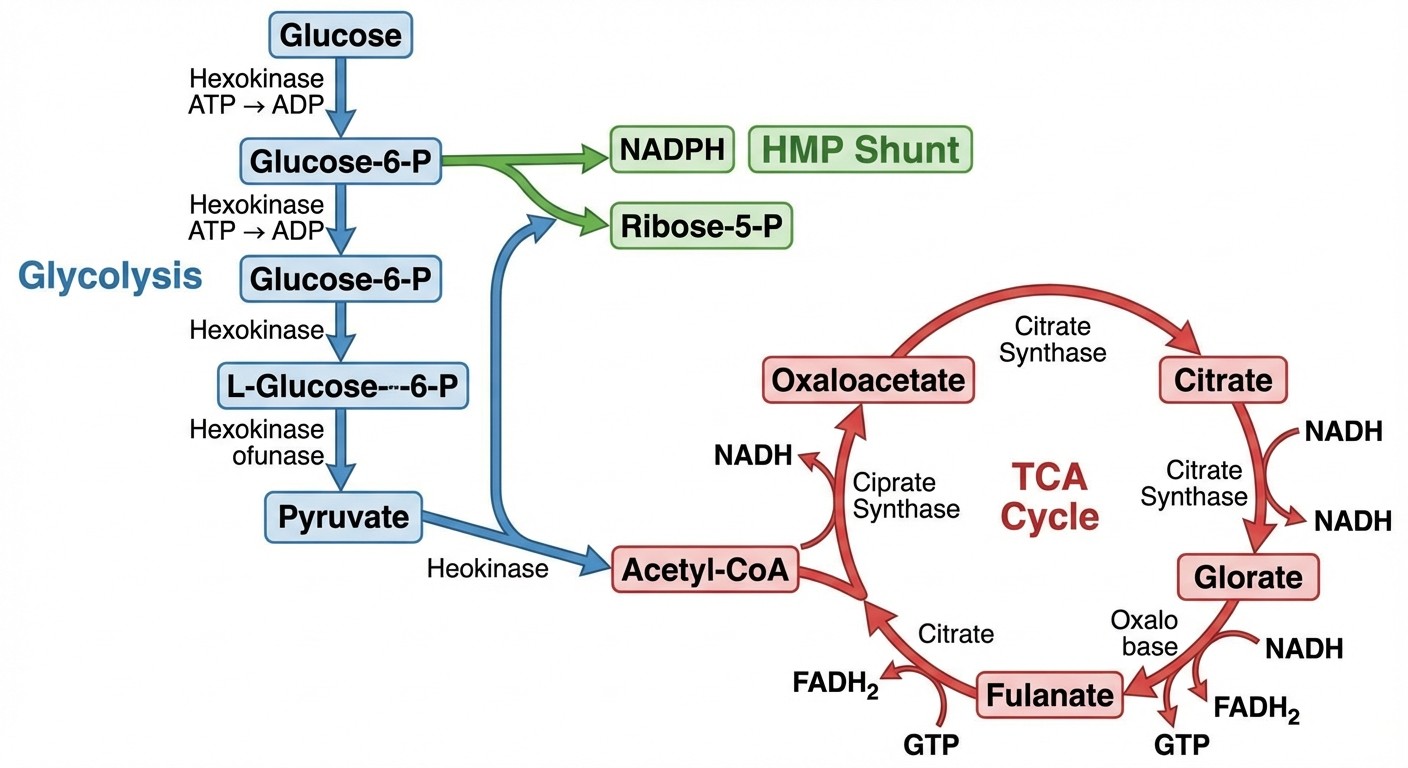
The secret to mastering carbohydrate metabolism isnt memorizing every intermediate — its understanding the logical flow and control points. For instance, knowing that phosphofructokinase is the rate-limiting enzyme in glycolysis helps you predict how the pathway responds to energy states.
Oncourse's adaptive system identifies whether you struggle more with pathway regulation vs intermediate structures, then feeds targeted practice questions accordingly.
3. Vitamins and Coenzymes
Weight: 3-4 questions High-yield vitamin-coenzyme pairs:
Thiamine (B1) → TPP → pyruvate dehydrogenase
Riboflavin (B2) → FAD → fatty acid oxidation
Niacin (B3) → NAD → glycolysis, TCA cycle
Folate → THF → one-carbon metabolism
B12 → methylcobalamin → methionine synthesis
The pattern in vitamin questions: they describe a deficiency syndrome and ask about the affected enzyme or pathway. Understanding the biochemical role helps you work backwards from clinical presentations.
Use vitamin and coenzyme flashcards to drill these connections until they become automatic — the memory load is too high for passive reading.
4. Genetic Disorders and Inborn Errors
Weight: 2-3 questions Must-know disorders:
Phenylketonuria (phenylalanine hydroxylase deficiency)
Alkaptonuria (homogentisic acid oxidase deficiency)
Maple syrup urine disease (branched-chain amino acid decarboxylase deficiency)
Homocystinuria (cystathionine synthase deficiency)
Glycogen storage diseases (von Gierke, Pompe)
Each disorder follows the same template: enzyme defect → substrate accumulation → product deficiency → clinical manifestations. Master this framework and you can tackle any inborn error question.
Review comprehensive genetic disorder lessons that connect biochemical defects to clinical presentations.
Mastering Enzyme Mechanism Questions
Enzyme questions are where most students lose easy marks because they overthink straightforward concepts. NEET PG enzyme questions follow predictable patterns once you recognize them.
Common Question Traps
1. Inhibition type confusion: They give you Km and Vmax changes and expect you to identify competitive vs non-competitive inhibition 2. Allosteric regulation: Questions about positive vs negative effectors and their binding sites 3. Clinical correlations: Enzyme deficiencies presented as patient scenarios
The Systematic Approach
When you see an enzyme question:
1. Identify what's changing (Km, Vmax, or both)
2. Determine if its inhibition, activation, or deficiency
3. Connect to the clinical context if provided
For example, if Km increases but Vmax stays constant, that's competitive inhibition — the substrate and inhibitor compete for the same binding site, requiring more substrate to reach half-maximal velocity.
Oncourse's spaced repetition surfaces enzyme mechanism cards exactly when you're about to forget the distinction between competitive and non-competitive inhibition, reinforcing the pattern recognition without overwhelming review sessions.
Strategic Study Timeline: When to Study Biochemistry
Biochemistry timing in your NEET PG preparation matters more than most students realize. Study it too early and you'll forget the details. Too late and you wont have time to connect it with clinical subjects.
Optimal Timing Strategy
Months 8-6 before exam: First pass through high-yield chapters
Focus on understanding pathways, not memorizing details
Build the conceptual framework for enzyme mechanisms
Connect major pathways (glycolysis → TCA → electron transport)
Months 4-2 before exam: Integration phase
Study biochemistry alongside pathology and medicine
Connect inborn errors with their clinical presentations
Practice mixed questions that bridge subjects
Final month: Pattern recognition
Focus on question patterns and common traps
Quick revision of vitamin-coenzyme pairs
Enzyme mechanism drill sessions
The key insight: biochemistry supports other subjects more than it stands alone. Studying it in isolation leads to forgetting. Studying it too late means missing connections with pathology and medicine.
Memory Strategies for Biochemical Pathways
Biochemistry is notoriously memory-intensive, but smart students use systems instead of brute force repetition. Here are the techniques that actually work:
1. Pathway Logic Over Memorization
Instead of memorizing every enzyme in glycolysis, understand why each step happens:
Step 1 (hexokinase): Traps glucose in the cell
Step 3 (phosphofructokinase): Commits to glycolysis (rate-limiting)
Step 10 (pyruvate kinase): Generates ATP
2. Clinical Anchoring
Connect every major enzyme to a clinical scenario:
G6PD deficiency → hemolytic anemia → HMP shunt importance
Pyruvate kinase deficiency → ATP shortage → red cell membrane damage
Phenylalanine hydroxylase deficiency → PKU → intellectual disability
3. Systematic Cofactor Patterns
Group vitamins by their biochemical roles rather than alphabetically:
Energy metabolism: B1 (TPP), B2 (FAD), B3 (NAD)
One-carbon transfers: Folate, B12
Amino acid metabolism: B6 (PLP)
The most effective memory strategy combines visual pathway maps with spaced repetition. Oncourse's flashcard system presents vitamin-coenzyme pairs just as forgetting begins, dramatically reducing the review burden compared to random drilling.
Common Mistakes to Avoid
1. Overemphasizing Low-Yield Details
Many students get trapped studying advanced enzyme kinetics or rare metabolic disorders that never appear on NEET PG. Stick to the high-frequency topics outlined above.
2. Ignoring Clinical Connections
Biochemistry questions increasingly present as clinical scenarios. Practice questions that describe patient presentations rather than direct biochemical facts.
3. Passive Reading Without Active Recall
Reading about the TCA cycle doesnt mean you'll remember the rate-limiting enzymes under exam pressure. Use active recall methods like flashcards and practice questions.
4. Studying Pathways in Isolation
Metabolic pathways are interconnected. Understand how glycolysis connects to the TCA cycle, how the HMP shunt provides NADPH, and how amino acid metabolism feeds into central pathways.
Revision Strategy for the Final Month
Your final month biochemistry revision should focus on pattern recognition and quick recall rather than learning new concepts.
Week 1: Enzyme Mechanisms
Practice 20 enzyme kinetics questions daily
Review competitive vs non-competitive inhibition patterns
Drill allosteric regulation concepts
Week 2: Metabolic Disorders
Focus on the 8-10 most commonly tested inborn errors
Connect each disorder to its enzyme defect and clinical presentation
Practice mixed questions that dont directly state the disorder name
Week 3: Vitamins and Integration
Rapid-fire vitamin-coenzyme pair drills
Practice questions that combine biochemistry with medicine/pathology
Review answers to understand the clinical reasoning
Week 4: Mock Tests and Weak Areas
Take full-length tests to identify remaining weak areas
Focus revision on your lowest-performing subtopics
Quick review of high-yield facts and mnemonics
Use performance analytics to track your accuracy by biochemistry subtopic and prioritize revision based on actual data rather than gut feeling about your weaknesses.
Integration with Other Subjects
The highest-yield biochemistry study strategy integrates it with related clinical subjects rather than treating it as an isolated basic science.
Biochemistry + Pathology
Study enzyme defects alongside their pathological consequences
Connect metabolic disorders with tissue damage patterns
Understand how biochemical imbalances cause disease
Biochemistry + Medicine
Learn drug mechanisms that target metabolic pathways
Understand how diseases affect normal metabolic processes
Connect vitamin deficiencies with clinical presentations
Biochemistry + Pediatrics
Focus on inborn errors of metabolism
Understand newborn screening programs
Connect genetic disorders with developmental problems
This integrated approach serves two purposes: it reinforces biochemical concepts through clinical context, and it helps you tackle interdisciplinary questions that increasingly appear on NEET PG.
Frequently Asked Questions
How many biochemistry questions appear in NEET PG 2026?
Biochemistry typically contributes 15-20 questions to NEET PG, representing about 5% of the total exam. While this might seem small, these questions are often straightforward if you know the key concepts, making them high-value targets for score improvement.
Should I study all enzyme pathways in detail?
No. Focus on the high-yield pathways: glycolysis, TCA cycle, HMP shunt, fatty acid oxidation, and amino acid metabolism. Understanding the logic and rate-limiting steps of these pathways is more valuable than memorizing every intermediate.
How do I remember all the vitamin-coenzyme pairs?
Group vitamins by function rather than memorizing random pairs. Energy metabolism vitamins (B1, B2, B3), one-carbon metabolism (folate, B12), and amino acid metabolism (B6) form logical clusters that are easier to remember and more likely to be tested together.
When should I start practicing biochemistry MCQs?
Start MCQ practice after completing your first pass through each topic, typically 4-6 months before the exam. This helps identify knowledge gaps early and reinforces learning through active recall.
Are genetic disorders high-yield for NEET PG?
Yes, but focus on 8-10 classic disorders: PKU, alkaptonuria, MSUD, homocystinuria, and major glycogen storage diseases. These appear repeatedly and follow predictable question patterns.
How do I approach enzyme kinetics questions?
Learn to recognize the patterns: competitive inhibition increases Km but maintains Vmax, non-competitive inhibition decreases Vmax but maintains Km. Practice identifying these patterns from experimental data rather than memorizing definitions.
Prepare smarter with Oncourse AI — adaptive MCQs, spaced repetition, and AI explanations built for NEET PG. Download free on Android and iOS.