Back
How to Study Anatomy for NEET PG 2026: Complete Checklist, High-Yield Systems and Topper Strategy
Master anatomy for NEET PG 2026 with this complete study guide. Get high-yield systems, clinical correlations, memory techniques, and a proven 8-week strategy that helped toppers score 18+ questions.

How to Study Anatomy for NEET PG 2026: Complete Checklist, High-Yield Systems and Topper Strategy
You are probably staring at Gray's Anatomy thinking "How do I memorize 1,400 pages?" Here's the reality: anatomy makes up 8-10% of NEET PG (16-20 questions), but it's the foundation for pathology, surgery, and clinical subjects that contribute another 40+ questions. Master anatomy wrong, and you'll struggle across multiple subjects. Get it right, and you've built a scoring machine.
The toppers didnt memorize everything. They identified the 200 high-yield facts that appear in 80% of anatomy questions, built rock-solid recall systems, and connected anatomy to clinical scenarios that show up in other subjects. This guide breaks down exactly what they studied, how they remembered it, and the specific checklist that turned anatomy from a memorization nightmare into a scoring strength.
In 2025, the highest-scoring candidates averaged 18.2 out of 20 anatomy questions correct. They werent anatomy geniuses - they followed a systematic approach that prioritized clinical relevance over rote learning.
Why Anatomy is Different from Other NEET PG Subjects
Anatomy isnt like pharmacology where you memorize drug mechanisms. Its spatial, visual, and layered. A single structure like the brachial plexus connects to orthopedics (nerve injuries), surgery (surgical approaches), and medicine (clinical examination findings).
Most students make three critical mistakes:
1. System isolation: They study each system separately without connecting clinical correlations
2. Image neglect: They rely on text descriptions instead of building visual memory
3. Zero revision cycles: They read once and expect recall during exam pressure
The scoring strategy flips this approach. You'll study anatomy in clinical clusters, build visual anchors for every high-yield structure, and use spaced repetition to lock in recall.
High-Yield Systems That Dominate NEET PG Questions
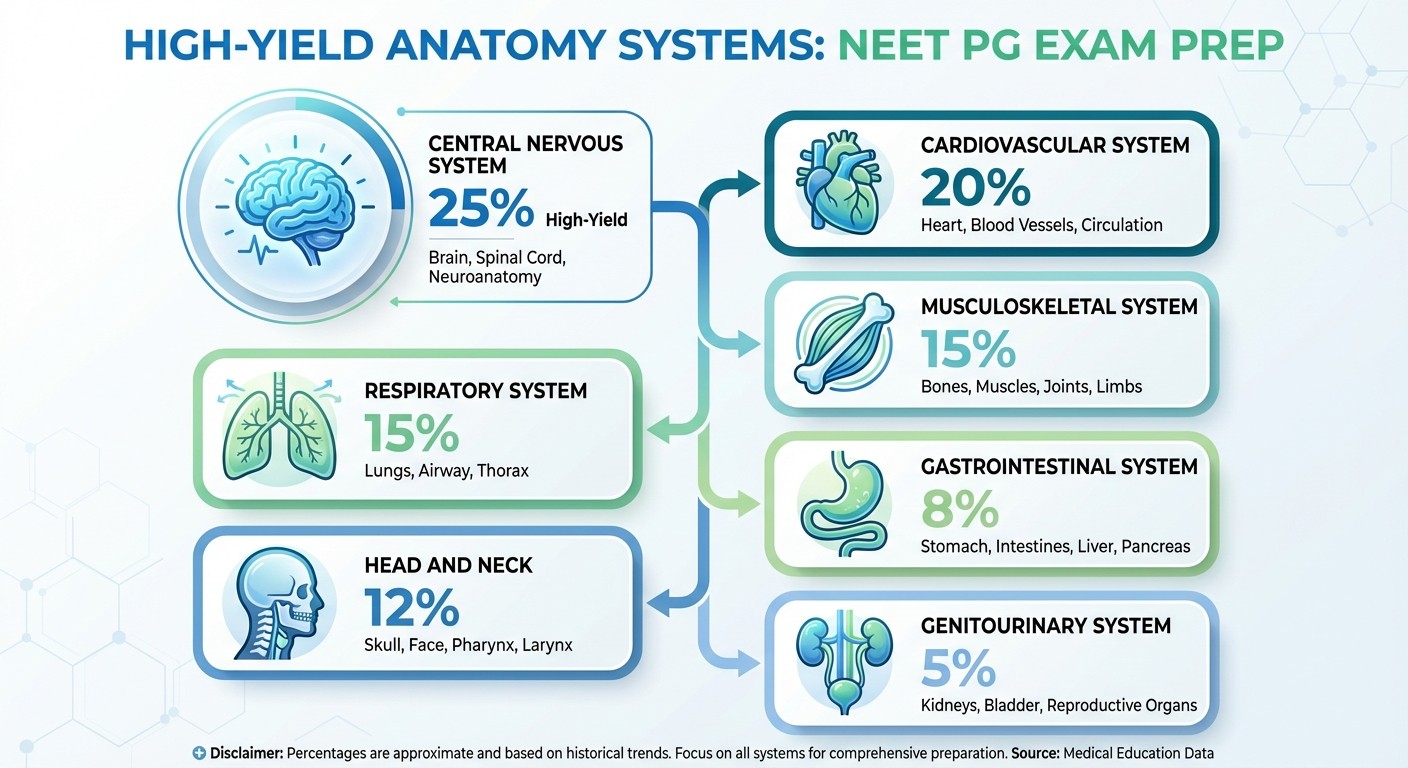
Question pattern analysis from the last 5 years reveals this distribution:
System | Question Weight | Key Focus Areas |
|---|---|---|
Central Nervous System | 25% | Cranial nerves, brain stem, spinal tracts |
Cardiovascular System | 20% | Heart chambers, coronary circulation, major vessels |
Respiratory System | 15% | Lung anatomy, pleural spaces, mediastinum |
Musculoskeletal System | 15% | Joint anatomy, muscle attachments, bone landmarks |
Head and Neck | 12% | Triangles of neck, cranial nerve pathways |
Gastrointestinal System | 8% | Portal circulation, peritoneal relations |
Genitourinary System | 5% | Kidney anatomy, reproductive tract |
Central Nervous System: The 25% Powerhouse
CNS dominates because it connects to neurology, psychiatry, and radiology questions. Focus on:
Cranial Nerves (guaranteed 3-4 questions)
All 12 cranial nerves: origin, course, branches, functions
Clinical testing methods for each nerve
Common injury patterns and their presentations
Brain Stem Anatomy
Medulla, pons, midbrain cross-sections
Nuclei locations and their functions
Ascending and descending tract pathways
Spinal Cord Tracts
Corticospinal tract pathway and decussation
Spinothalamic tract levels and clinical correlations
Dorsal column pathway for position and vibration
Pro tip: Use Oncourse's anatomy flashcards for cranial nerve recall. The spaced repetition algorithm ensures you see the trickiest nerves (like the facial nerve branches) right before you forget them.
Cardiovascular System: Clinical Integration Gold Mine
Heart anatomy connects directly to cardiology and surgery questions worth 20+ marks across subjects.
Heart Chamber Anatomy
Tricuspid and mitral valve structure and function
Coronary artery distribution and territories
Cardiac conduction system pathway
Major Vessel Relationships
Aortic arch branches and their distributions
Superior and inferior vena cava tributaries
Portal circulation anatomy
Clinical Correlations to Master
ECG lead positions and their anatomical correlations
Heart sound generation sites
Catheter insertion landmarks
Respiratory System: High-Yield Imaging Connections
Lung anatomy appears in radiology questions across multiple subjects.
Lung Segmental Anatomy
Bronchopulmonary segments and their clinical significance
Pleural spaces and their boundaries
Mediastinal compartments and contents
Surface Anatomy
Lung borders and auscultation points
Pleural reflection lines
Intercostal space anatomy for procedures
The 4-Phase Study Strategy That Builds Unshakeable Recall
Phase 1: Foundation Building (Weeks 1-2)
Start with Oncourse's anatomy lessons for structured system-wise coverage. Each lesson connects basic anatomy to clinical scenarios you'll see in other subjects.
Week 1 Focus:
Central nervous system overview
Basic cranial nerve anatomy
Heart and major vessel layout
Week 2 Focus:
Respiratory system fundamentals
Musculoskeletal basics
Head and neck triangles
Phase 2: Visual Memory Consolidation (Weeks 3-4)
Anatomy is visual. Build image-based recall for every high-yield structure.
Daily Image Study Protocol:
1. Study anatomical diagrams for 30 minutes
2. Close the book and sketch from memory
3. Compare your sketch to the original
4. Note gaps and repeat for weak areas
For complex structures like the brachial plexus, try Synapses mnemonics - visual memory aids designed specifically for anatomy recall. The "Robins Took My Car" mnemonic for brachial plexus roots makes sense when you see the visual association.
Phase 3: Clinical Integration (Weeks 5-6)
Connect anatomy to clinical presentations that appear across subjects.
Clinical Correlation Study Method:
For each anatomical structure, ask: "How does this relate to disease?"
Study nerve injury patterns and their clinical presentations
Learn surface anatomy landmarks for clinical examination
Connect anatomical variations to surgical approaches
Example: When studying the facial nerve, dont just memorize its course. Learn how Bell's palsy affects different branches, why the forehead might be spared in upper motor neuron lesions, and how to test each branch clinically.
Phase 4: Rapid Recall Training (Weeks 7-8)
Build exam-speed recall through intensive practice.
Daily Drill Schedule:
50 anatomy MCQs using Oncourse's question bank
15-minute anatomy rapid-fire revision
Weekly mock tests focusing on anatomy integration
Use Rezzy AI when you encounter confusing anatomy concepts. Ask specific questions like "Explain the difference between sympathetic and parasympathetic innervation of the heart" for targeted clarification.
High-Yield Topics Checklist: What Toppers Actually Study
Central Nervous System Checklist
[ ] 12 cranial nerves: origin, course, function, clinical tests
[ ] Brain stem cross-sections at 3 levels
[ ] Major ascending tracts: spinothalamic, dorsal column
[ ] Major descending tracts: corticospinal, extrapyramidal
[ ] Ventricular system and CSF circulation
[ ] Circle of Willis and cerebral circulation
[ ] Spinal cord anatomy and dermatomes
[ ] Autonomic nervous system pathways
Cardiovascular System Checklist
[ ] Heart chambers and valve anatomy
[ ] Coronary circulation and territories
[ ] Cardiac conduction system
[ ] Major arteries: aortic arch branches, carotid system
[ ] Venous drainage: portal circulation, caval systems
[ ] Lymphatic drainage patterns
[ ] Fetal circulation and changes at birth
Respiratory System Checklist
[ ] Bronchopulmonary segments
[ ] Pleural anatomy and recesses
[ ] Mediastinal compartments and contents
[ ] Respiratory muscle anatomy
[ ] Surface anatomy for clinical procedures
Musculoskeletal System Checklist
[ ] Major joint anatomy: shoulder, knee, hip
[ ] Muscle attachments for clinically important muscles
[ ] Bone landmarks for surface anatomy
[ ] Ligament anatomy and injury patterns
[ ] Compartment anatomy of limbs
Head and Neck Checklist
[ ] Triangles of the neck and contents
[ ] Parotid gland anatomy and relations
[ ] Thyroid gland anatomy and relations
[ ] Orbit anatomy and muscle actions
[ ] Nasal cavity and paranasal sinuses
[ ] Oral cavity and tongue anatomy
Gastrointestinal System Checklist
[ ] Portal circulation anatomy
[ ] Peritoneal relations of abdominal organs
[ ] Inguinal canal anatomy
[ ] Anal canal anatomy
[ ] Blood supply of GI tract
Genitourinary System Checklist
[ ] Kidney anatomy and relations
[ ] Ureter course and constrictions
[ ] Bladder anatomy and nerve supply
[ ] Reproductive tract anatomy (male and female)
Memory Techniques That Actually Work for Anatomy
The Location-Function-Clinical Triangle
For every structure, build three memory anchors:
1. Location: Where is it? (spatial memory)
2. Function: What does it do? (logical memory)
3. Clinical: What happens when it's damaged? (application memory)
Example for the median nerve:
Location: Travels through carpal tunnel at wrist
Function: Thumb opposition, first two fingers sensation
Clinical: Carpal tunnel syndrome causes numbness in thumb, index, middle fingers
Anatomy Mnemonics That Stick
Cranial Nerves: "Oh Oh Oh To Touch And Feel Very Green Vegetables AH" Brachial Plexus: "Robins Took My Car" (Roots, Trunks, Medial Cord) Carpal Bones: "Some Lovers Try Positions That They Cant Handle"
Create visual associations with each mnemonic. "Robins Took My Car" works better when you picture actual robins driving away in your car - the absurd image sticks.
Spaced Repetition Protocol
Your brain forgets 50% of new anatomy information within 24 hours without review. Combat this with systematic spacing:
Day 1: Learn new topic
Day 2: Quick review (10 minutes)
Day 7: Detailed review (20 minutes)
Day 21: Quick recall test (5 minutes)
Day 60: Final consolidation review
Oncourse's anatomy flashcards automate this spacing. The algorithm tracks your recall strength for each structure and presents weak areas more frequently.
Integration Strategy: Connecting Anatomy to Clinical Subjects
Anatomy → Pathology Connections
When studying anatomical structures, simultaneously learn their pathological correlations:
Heart Anatomy → Cardiology Pathology
Coronary territory → myocardial infarction patterns
Valve anatomy → valvular heart disease
Conduction system → arrhythmia mechanisms
Nervous System Anatomy → Neurology Pathology
Cranial nerves → cranial nerve palsies
Spinal tracts → stroke syndromes
Brain regions → dementia patterns
Anatomy → Surgery Connections
Surgical anatomy questions test your understanding of anatomical relations during procedures:
Thyroid Surgery → Recurrent Laryngeal Nerve Anatomy Appendectomy → McBurney's Point and Anatomical Relations Hernia Repair → Inguinal Canal Anatomy
Practice questions that ask: "During thyroidectomy, which nerve is at risk?" These require both anatomical knowledge and clinical reasoning.
Common Mistakes That Kill Anatomy Scores
Mistake #1: Passive Reading
Wrong approach: Reading anatomy textbooks like novels Scoring approach: Active recall with sketching and self-testing
After reading about the brachial plexus, close the book and draw the entire structure from memory. Mark what you missed in red, then study only those gaps.
Mistake #2: Ignoring Clinical Correlations
Wrong approach: Memorizing anatomical facts in isolation Scoring approach: Learning anatomy through clinical scenarios
Instead of memorizing "facial nerve has 5 branches," learn "facial nerve injury above the stylomastoid foramen affects all facial muscles including forehead, while cortical lesions spare the forehead due to bilateral innervation."
Mistake #3: Single-Pass Study
Wrong approach: Studying each system once and moving on Scoring approach: Multiple revision cycles with increasing speed
Plan 4 passes through anatomy:
Pass 1: Detailed learning (slow)
Pass 2: Quick review with focus on weak areas
Pass 3: Rapid recall testing
Pass 4: Integration with clinical scenarios
Mistake #4: Text-Only Learning
Wrong approach: Relying only on written descriptions Scoring approach: Visual-first anatomy learning
Anatomy is spatial. Start with diagrams, then read descriptions. Your brain stores visual patterns more efficiently than word sequences.
Last-Month Rapid Revision Strategy
Week 1: System-wise Rapid Review
Monday: CNS (cranial nerves + brain stem)
Tuesday: CVS (heart + major vessels)
Wednesday: Respiratory (lungs + pleura)
Thursday: MSK (major joints + muscles)
Friday: Head and neck
Weekend: Weak area focus
Week 2: Clinical Integration
Daily: 100 anatomy MCQs with clinical correlations
Focus on anatomy questions from medicine, surgery, and radiology
Use Oncourse's question bank to simulate exam-style integration questions
Week 3: High-Yield Fact Drilling
Create a one-page summary of the 50 most commonly tested anatomy facts. Review this list daily. Include:
12 cranial nerve functions
Major muscle nerve supplies
Coronary artery territories
Lung segment anatomy
Portal circulation pathway
Week 4: Mock Test Analysis
Take anatomy-focused mock tests and analyze every mistake:
Was it a knowledge gap or recall failure?
Does this topic appear in other subjects?
What clinical correlation did I miss?
For topics you keep missing, use Rezzy AI to get targeted explanations. Ask: "Why do I keep confusing the median and ulnar nerve distributions?" for personalized clarification.
Exam Day Strategy for Anatomy Questions
Time Allocation
Anatomy questions should take 45-60 seconds each. If you're spending 2+ minutes, you either know it or you dont - guess and move on.
Visual Question Approach
For anatomy diagrams:
1. Identify the view first (sagittal, coronal, cross-section)
2. Locate key landmarks
3. Use relationships to identify unknown structures
4. Eliminate obviously wrong options first
Clinical Correlation Questions
Pattern: "A patient presents with [symptoms]. Which anatomical structure is most likely affected?"
Strategy:
1. Identify the symptom pattern
2. Recall anatomical structures that could cause this pattern
3. Consider the most common anatomical cause
4. Verify with other symptoms mentioned
Frequently Asked Questions
How many months should I dedicate specifically to anatomy preparation?
Allocate 8 weeks for dedicated anatomy study, but continue daily revision throughout your preparation. Anatomy requires consistent recall training, not intensive cramming periods.
Should I use multiple anatomy textbooks or stick to one?
Stick to one primary textbook (BD Chaurasia or Gray's) for basic learning, then supplement with high-yield question banks. Multiple textbooks create confusion rather than clarity.
How do I balance gross anatomy with histology for NEET PG?
Focus 80% on gross anatomy and 20% on clinically relevant histology. NEET PG emphasizes clinical anatomy over microscopic details.
Is it worth memorizing every muscle attachment and nerve supply?
No. Focus on clinically relevant muscles and their nerve supplies. A muscle that appears in clinical scenarios (like the supraspinatus) deserves more attention than obscure deep muscles.
How do I remember complex anatomical pathways like the visual pathway?
Break complex pathways into segments and learn the clinical significance of each segment. Visual pathway becomes: retina → optic nerve → chiasm → tract → LGN → optic radiations → cortex. Each segment has specific clinical correlations when damaged.
Should I create my own anatomy notes or use pre-made resources?
Use pre-made high-quality resources like Oncourse's anatomy lessons for comprehensive coverage, then create brief summary notes for rapid revision. Creating detailed notes from scratch wastes time you could spend on practice questions.
Prepare smarter with Oncourse AI — adaptive MCQs, spaced repetition, and AI explanations built for NEET PG. Download free on Android and iOS.