How Rezzy AI Tutoring Works: Real-Time Doubt Solving for NEET PG, INICET and USMLE Prep (2026)
Discover how Rezzy AI tutor solves medical student doubts instantly. Unlike generic chatbots, Rezzy is trained for NEET PG, INICET, and USMLE patterns with 24/7 support.

How Rezzy AI Tutoring Works: Real-Time Doubt Solving for NEET PG, INICET and USMLE Prep (2026)
You are probably staring at a pharmacology question right now. It's 1 AM. NEET PG is 6 weeks away. The question asks why metformin is first-line for diabetes, but you cant remember if it's because of weight neutrality, insulin sensitivity, or cardiovascular benefits. Your coaching faculty went offline 3 hours ago. YouTube videos are too long and generic. You need an answer that connects this mechanism to how NEET PG actually tests it.
This exact scenario plays out for thousands of medical students every night. Traditional study resources fail when you need instant, exam-specific doubt clearing. Generic AI tools like ChatGPT give you textbook paragraphs when you need targeted, high-yield answers. Faculty coaching works during office hours, but medical exam preparation doesnt follow a 9-to-5 schedule.
This is where an ai tutor for medical students changes everything. But not just any AI — one that understands medical exam patterns, question stems, and the specific way NEET PG, INICET, and USMLE test concepts. Meet Rezzy: Oncourse's AI study partner built specifically for medical exam preparation.
What Makes Rezzy Different from Generic AI Chatbots
Most medical students have tried asking ChatGPT or other generic AI tools for study help. The results are predictably frustrating: verbose explanations that sound like textbook chapters, generic study advice, and answers that miss the exam-specific context you actually need.
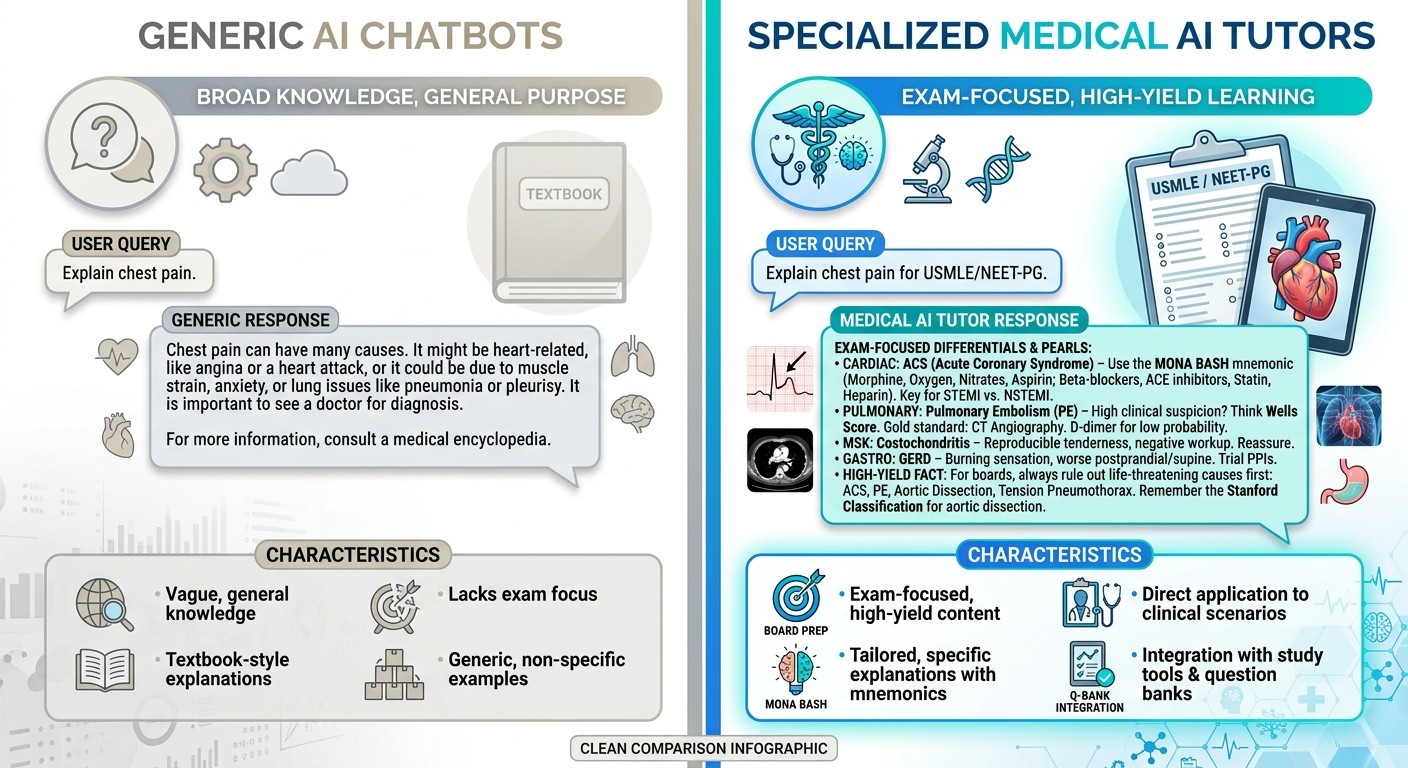
Rezzy was built differently. Instead of being trained on general internet content, Rezzy learned from the most trusted medical education resources. It understands how NBME frames USMLE questions, how the National Board of Examinations structures NEET PG stems, and what concepts appear repeatedly across years.
Here's what happens when you ask both systems the same question:
Generic AI Response to "What's high-yield in Pharmacology for Step 1?" "Pharmacology covers drug mechanisms, pharmacokinetics, pharmacodynamics, drug interactions, and therapeutic applications. Key areas include cardiovascular drugs, CNS pharmacology, antimicrobials..." Rezzy's Response: "Based on NBME trends and Step 1 patterns: 1. Antiarrhythmics — Class I-IV mechanisms 2. Autonomic drugs — Receptor selectivity 3. Antimicrobials — Mechanism + resistance Want me to create flashcards for these?"
The difference is obvious. Rezzy gives you exactly what you need for your specific exam, not a general medicine overview.
When you're working through pharmacology MCQs late at night, Rezzy can explain why iron sucrose is preferred over ferrous sulfate in specific patient scenarios — and do it in the context of how NEET PG tests iron therapy, not just general hematology.
How Rezzy Actually Works: The Complete Study Loop
The magic happens in how Rezzy integrates with your entire study process. It's not just a chat interface — it's a study partner that works with your practice questions, flashcards, and weak areas.
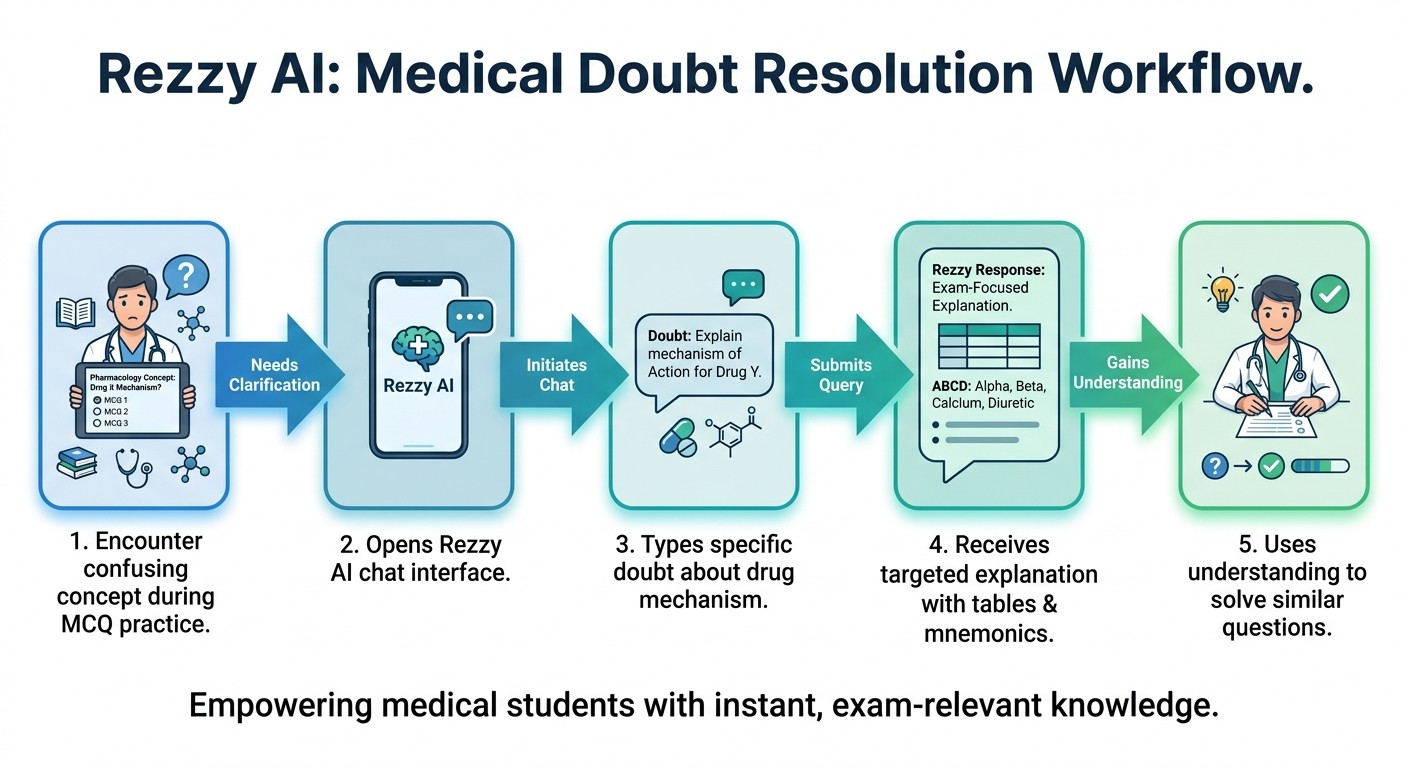
Step 1: Instant Doubt Resolution
You encounter a confusing concept while practicing MCQs. Instead of switching apps or searching through notes, you open Rezzy right within Oncourse. Ask specific questions like "Why is ACE inhibitor first-line in heart failure with reduced ejection fraction?" Rezzy provides the mechanism, clinical reasoning, and how this concept appears in different question formats.
Step 2: Exam-Contextualized Explanations
Rezzy doesnt just explain concepts — it explains them in the context of your target exam. For NEET PG students, it emphasizes Indian treatment guidelines and drug availability. For USMLE students, it focuses on US clinical practices and management algorithms. The same hypertension question gets different emphasis based on which exam you're preparing for.
Step 3: Active Learning Integration
After explaining a concept, Rezzy can generate on-the-spot quizzes to test your understanding. It might create 3 quick MCQs about beta-blocker mechanisms after explaining why propranolol causes bronchoconstriction. This immediate application solidifies the learning before you move on.
Step 4: Weak Area Targeting
Rezzy tracks your question patterns and identifies knowledge gaps. Bombing nephrology questions? It adjusts future explanations to reinforce renal physiology concepts. This creates a feedback loop where your weaknesses become learning priorities.
For students using Oncourse's clinical pharmacology lessons, Rezzy can elaborate on specific drug interactions mentioned in the lesson material, creating deeper understanding of concepts you're already studying.
Real Rezzy Interactions: What Actually Happens
Let's walk through how Rezzy handles different types of medical student doubts:
Pharmacology Mechanism Query
Student: "Explain why we use thiazides for hypertension but avoid them in diabetes?" Rezzy: "Thiazides work through:
Na-Cl cotransporter inhibition in distal tubule
Reduced sodium reabsorption → volume depletion
Long-term: direct vasodilation (unclear mechanism)
Diabetes concern: Hyperglycemia through:
K+ loss → impaired insulin release
Direct insulin resistance
NEET PG tests this as: 'Which diuretic worsens glucose tolerance?' Answer options include thiazides vs other diuretics."
Clinical Reasoning Support
Student: "22-year-old with chest pain and normal ECG. Next step?" Rezzy: "Age < 30 + normal ECG + chest pain suggests:
Step 1: Rule out life-threatening (PE, pneumothorax, aortic dissection)
Step 2: Consider musculoskeletal vs anxiety vs costochondritis
For USMLE: Next step = detailed history + physical
For INICET: Consider troponins if risk factors present
Key differentiator: Pleuritic vs substernal vs positional pain pattern"
Flashcard Generation Request
When you're struggling with ion channel mechanisms, Rezzy can create targeted flashcards: "Front: What happens when you block L-type calcium channels? Back: Negative inotropic effect → reduced cardiac contractility → used in heart failure with preserved ejection fraction (verapamil/diltiazem)"
The Complete Study Ecosystem: Rezzy + QBank + Flashcards
Rezzy's real power emerges when it works alongside Oncourse's adaptive question bank and spaced repetition system. This creates a seamless study loop that traditional coaching cant match.
Adaptive QBank Integration
Oncourse's question bank serves harder questions from your weak areas. When you get a nephrology question wrong, you can immediately ask Rezzy to explain the underlying physiology. Instead of just seeing why option C was correct, you understand the mechanism well enough to answer variations of this concept.
After Rezzy explains why loop diuretics cause hypokalemic metabolic alkalosis, the adaptive system ensures you'll see related electrolyte questions until you consistently get them right. Students working through clinical reasoning modules can ask Rezzy to walk through diagnostic algorithms for specific presentations.
Spaced Repetition Enhancement
Traditional flashcards show you the same fact repeatedly. When combined with Rezzy, you can explore any card you don't fully understand. Struggling with a vitamin deficiency flashcard? Rezzy can explain the biochemical pathway, clinical presentation, and why certain populations are at risk — then generate additional cards to reinforce the concept.
This creates active learning instead of passive repetition. You're not just memorizing that "B12 deficiency causes megaloblastic anemia" — you understand why B12 is needed for DNA synthesis, why the anemia is megaloblastic rather than microcytic, and how this connects to neurological symptoms.
Addressing the "Will AI Replace My Coaching" Concern
Medical students often worry that relying on AI tutoring means abandoning human mentorship. The data suggests otherwise. Medical schools are expanding coaching programs precisely because students need more personalized guidance, not less.
Rezzy doesnt replace your coaching faculty — it fills the gaps when human mentors aren't available. Your faculty can focus on complex clinical reasoning and career guidance, while Rezzy handles the 1 AM doubt-clearing sessions and repetitive concept explanations.
Think of it as having a study partner who never sleeps, never judges your questions, and has perfect recall of every medical concept you've ever discussed. When your coaching batch has 200 students but you need individual attention, Rezzy provides that personalization at scale.
The combination is powerful: human mentorship for strategic guidance and complex problem-solving, AI tutoring for immediate doubt resolution and concept reinforcement.
Who Benefits Most from AI Tutoring
Based on usage patterns from thousands of medical students, certain study profiles benefit significantly more from AI tutoring:
Solo Study Warriors
Students who prefer studying alone or don't have access to study groups. Rezzy provides the interactive element that makes solo study less isolating. Instead of reading passively, you can engage in Socratic-style questioning with an AI that understands medical concepts.
Odd-Hours Studiers
Night owls and early birds who study when traditional support isn't available. Medical exam preparation often requires studying during off-hours, especially for working professionals or students managing clinical rotations.
Concept Strugglers
Students who understand individual facts but struggle to connect concepts. Rezzy excels at showing how pharmacology connects to physiology, how pathology explains clinical presentations, and how basic science maps to clinical decision-making.
Question Bank Maximizers
Students who practice extensive MCQs but want deeper understanding of their mistakes. Instead of just reviewing explanations, they can explore the underlying concepts until they achieve mastery.
For students already using comprehensive resources like Oncourse's medical exam preparation platform, AI tutoring provides the missing piece: instant, personalized explanations that connect all your study materials.
Common Rezzy Use Cases Across Different Exams
NEET PG Students
Clarifying drug dosages and contraindications specific to Indian clinical practice
Understanding why certain antibiotics are first-line in specific infections
Connecting pathology concepts to clinical presentations
Quick revision of high-yield facts before exam day
INICET Aspirants
Comparing treatment protocols for the same condition across different specialties
Understanding subspecialty-specific approaches to common problems
Clarifying complex surgery and medicine interface topics
Rapid concept reviews during intensive preparation phases
USMLE Test-Takers
Breaking down clinical vignettes step-by-step
Understanding cultural and healthcare system differences
Mastering biostatistics and epidemiology concepts
Connecting basic science to clinical applications
Each exam has different emphasis areas, and Rezzy adapts its explanations accordingly. A cardiology question about heart failure management will emphasize ACE inhibitors and beta-blockers for USMLE students (focusing on evidence-based guidelines) while highlighting digoxin and diuretics for NEET PG students (reflecting Indian practice patterns).
The Science Behind Why AI Tutoring Works
Educational research supports several learning principles that AI tutoring implements effectively:
Immediate Feedback
Studies show that immediate correction of misconceptions leads to better retention than delayed feedback. When you get a pharmacology question wrong, asking Rezzy for immediate clarification prevents the wrong concept from solidifying in memory.
Elaborative Interrogation
This learning technique involves asking "why" questions about facts. Rezzy naturally encourages this by providing mechanism-based explanations rather than simple factual answers. Instead of memorizing "statins reduce cholesterol," you understand the HMG-CoA reductase pathway and why this leads to upregulation of LDL receptors.
Personalized Difficulty Adjustment
AI tutoring can match explanation complexity to your current understanding level. Early in preparation, Rezzy provides basic mechanism explanations. As you advance, it assumes greater baseline knowledge and focuses on subtle distinctions and clinical applications.
Active Recall Practice
Rather than passive content consumption, AI tutoring encourages active engagement. You formulate questions, process explanations, and can immediately test understanding through follow-up questions.
Technical Capabilities: What Rezzy Can and Cannot Do
What Rezzy Excels At:
Mechanism-based explanations for pharmacology and physiology
Comparison tables for differential diagnoses
Step-by-step clinical reasoning walkthroughs
Converting complex concepts into memory devices
Generating practice questions on specific topics
Connecting basic science concepts to clinical applications
Current Limitations:
Cannot access real-time medical literature updates
Doesn't replace hands-on clinical experience
May not reflect very recent guideline changes
Cannot provide personalized medical advice for actual patients
Limited ability to assess non-verbal clinical skills
Understanding these boundaries helps students use AI tutoring appropriately — as a powerful study tool, not a replacement for comprehensive medical education.
Integrating AI Tutoring into Your Study Routine
Daily Study Integration
Most successful students integrate Rezzy into specific study activities rather than using it as a standalone tool:
Morning Review: Ask Rezzy to quiz you on yesterday's weak areas before starting new content MCQ Practice: Immediately clarify any wrong answers through targeted questioning Concept Mapping: Use Rezzy to connect related concepts across different subjects Pre-Sleep Review: Quick clarification of any lingering doubts from the day's study
Weekly Study Planning
Rezzy can help identify patterns in your knowledge gaps and suggest topic priorities for the week. If you consistently struggle with renal physiology questions, it can recommend focusing on nephron function, acid-base balance, and related pharmacology.
Exam-Specific Preparation
Different preparation phases benefit from different AI tutoring approaches:
Foundation Building: Detailed mechanism explanations
Practice Phase: Quick fact clarification and concept connections
Revision Phase: High-yield fact testing and weak area targeting
Pre-Exam: Confidence building through concept reinforcement
Measuring Success: How to Know AI Tutoring Is Working
Quantitative Metrics
Reduced Time to Understanding: Concepts that previously took hours of research now clarify in minutes
Improved Practice Question Accuracy: Better performance on similar question types after AI tutoring sessions
Increased Study Session Efficiency: Less time spent stuck on individual concepts
Enhanced Retention: Better recall of concepts explained through AI tutoring
Qualitative Indicators
Greater Study Confidence: Feeling prepared to tackle unfamiliar question formats
Improved Concept Connections: Seeing relationships between topics more easily
Reduced Study Frustration: Fewer moments of feeling completely stuck
Enhanced Clinical Reasoning: Better ability to work through patient presentations systematically
Students report that the biggest change is psychological — knowing that immediate help is available reduces study anxiety and allows for more efficient learning sessions.
Future of AI Tutoring in Medical Education
The integration of AI tutoring into medical education is accelerating. Recent studies show that customized AI tutors improve student engagement and concept understanding, though they don't automatically boost exam scores without proper integration into study routines.
The key development is moving from generic AI to specialized medical AI systems. As these tools become more sophisticated, they'll provide even more targeted support for specific exam formats, learning styles, and knowledge levels.
For medical students in 2026, AI tutoring represents a fundamental shift in how we approach exam preparation — from passive content consumption to active, personalized learning partnerships.
Frequently Asked Questions
Can AI tutoring replace traditional coaching for medical exams?
AI tutoring complements rather than replaces human coaching. Use AI for immediate doubt resolution, concept clarification, and 24/7 study support. Reserve human mentorship for strategic planning, complex clinical reasoning, and career guidance.
How accurate are AI tutor explanations for medical concepts?
Medical AI tutors trained on curated educational content (like Rezzy) show high accuracy for established medical concepts. Always cross-reference critical information with official guidelines, especially for recent developments or controversial topics.
Does using AI tutoring make students dependent on technology?
When used properly, AI tutoring enhances independent learning by providing immediate feedback and concept clarification. The goal is building understanding, not creating dependence. Students should gradually require less AI support as knowledge solidifies.
How much time should I spend with AI tutoring versus other study methods?
AI tutoring works best as a support tool within your existing study routine. Spend 15-20% of study time in AI conversations, primarily for doubt clearing and concept reinforcement. Continue practicing MCQs, reading high-yield materials, and reviewing clinical cases.
Is AI tutoring suitable for all medical exam types?
AI tutoring is most effective for knowledge-based exams like NEET PG, INICET, USMLE Steps 1-3, and similar multiple-choice formats. It's less helpful for practical exams, clinical skills assessments, or exams requiring hands-on demonstration.
How do I know if an AI tutor is specifically trained for medical education?
Look for AI tutors that demonstrate exam-specific knowledge, provide mechanism-based explanations, use appropriate medical terminology, and show understanding of how concepts are tested. Generic chatbots typically give broad, textbook-style answers rather than targeted, exam-focused responses.
---
Ready to experience instant doubt resolution and exam-focused explanations? Try Rezzy and see how AI tutoring transforms your medical exam preparation.
Prepare smarter with Oncourse AI — adaptive MCQs, spaced repetition, and AI explanations built for NEET PG, INICET, and USMLE. Download free on Android and iOS.