
You've solved 500 questions. You've solved 2000. You still walk into the exam hall with a knot in your stomach. Sound familiar?
Here's the thing - most of us have access to a decent question bank. And for years, that was enough. Cover the syllabus, mix in some past papers, throw in a few image-based questions, and you're set. Right?
Not quite.
A good question bank checks all the obvious boxes: wide topic coverage, a healthy mix of simple recall and complex case-based questions, image-heavy questions, past exam patterns. It's a solid tool. But it's still just a tool. It doesn't know you. It doesn't adjust. It doesn't care if you got the last 10 right or wrong.
At OnCourse, we started with all of the above. Then we asked - what if the question bank actually worked with you, not just for you?
That's where AI changed the game.
No More "I've Run Out of Questions"
Traditional question banks have a ceiling. You finish them, and then what - reset and redo? With Oncourse, AI generates questions on the fly, tailored to what you need to practice. Want 50 more questions on renal physiology? Done. Need tougher clinical scenarios on hepatology? You got it. We call it the Infinite Question Bank - because your prep shouldn't stop just because the question bank ran out.


It Gets Harder When You Get Better
Every custom quiz or self-assessment on Oncourse is adaptive. The difficulty shifts based on how you're performing - in real time. Get a few right, and the questions push you further. Struggle with a concept, and it dials back to help you build up again. It's not about scoring high every time. It's about understanding exactly where you stand.
The Feedback That Actually Tells You Something
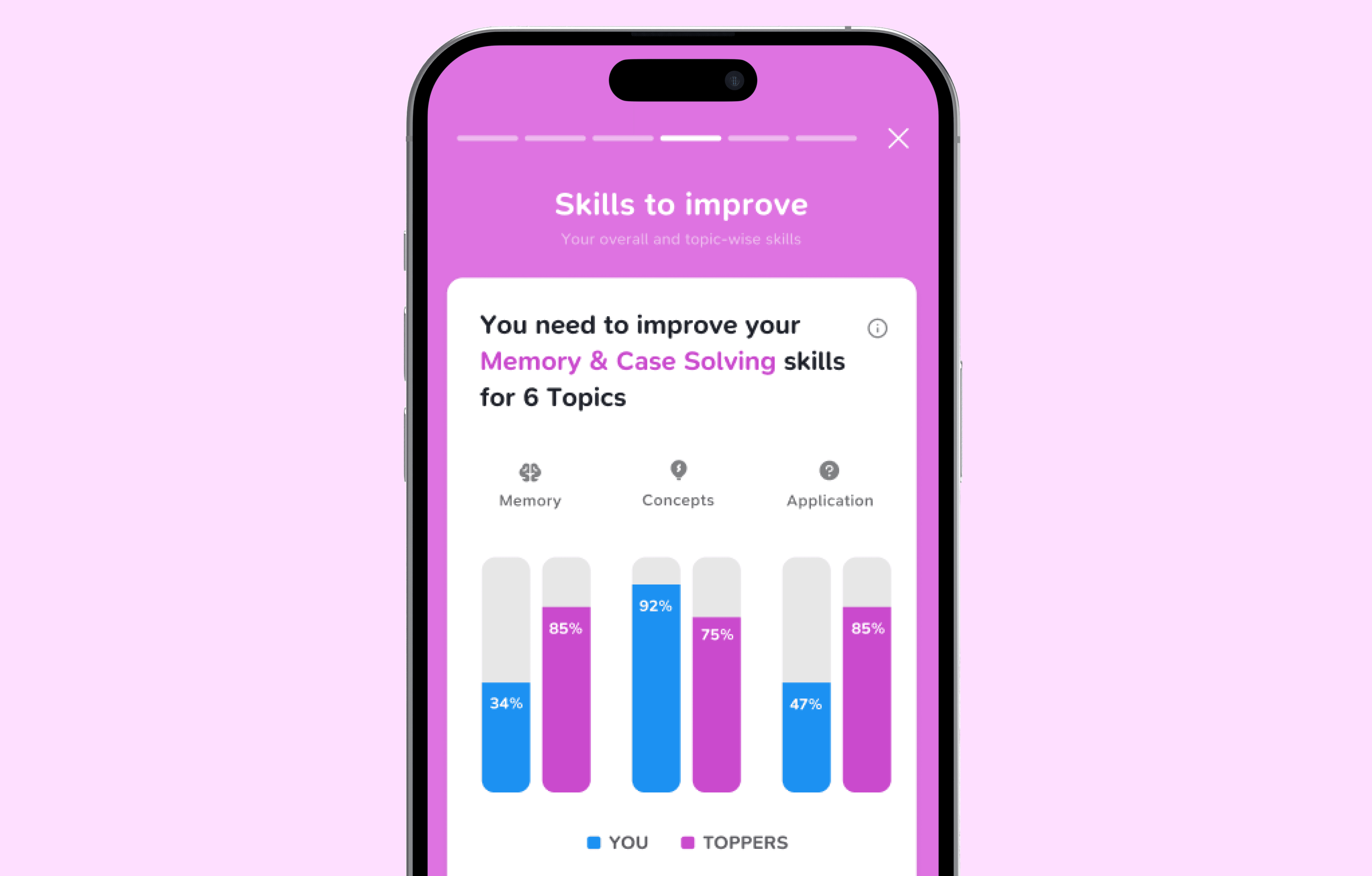
This is where it gets interesting. After each quiz, OnCourse doesn't just show you a score. It breaks down every question into three skill categories:
Recall & Conceptual Clarity - the foundation. Can you remember the facts and connect the dots? Think: What is the mechanism of action of Metformin? or Which cranial nerve is responsible for the afferent limb of the corneal reflex? These test whether the basics are locked in.
Application & Analytical Thinking - the next level. Can you use what you know? Think: A 45-year-old male with chronic alcoholism presents with megaloblastic anemia. Labs show elevated MCV and normal methylmalonic acid. What is the most likely deficiency? Here, you're not just recalling - you're differentiating between B12 and folate deficiency using clinical and lab clues.
Evaluation & Clinical Decision-Making - the real deal. Can you make the call? Think: A 60-year-old diabetic woman presents with acute onset chest pain, diaphoresis, and ST elevation in leads II, III, and aVF. She is allergic to aspirin. What is the most appropriate next step in management? This is where you juggle multiple variables, weigh risks, and arrive at a decision - exactly like you'll need to on the wards.
Knowing which of these three areas you're weak in changes how you study, not just what you study.
Explanations That Go Beyond "Option B Is Correct"
Every question comes with a detailed explanation - why the right answer is right, and why the others aren't. But that's just the starting point. From there, you can jump into a conversation with Rezzy, our AI study companion, and dig deeper. Confused about a mechanism? Ask. Want to see how the same concept shows up differently in another subject? Rezzy's there. It turns a static explanation into an actual learning moment.
Everything You Need, Right There
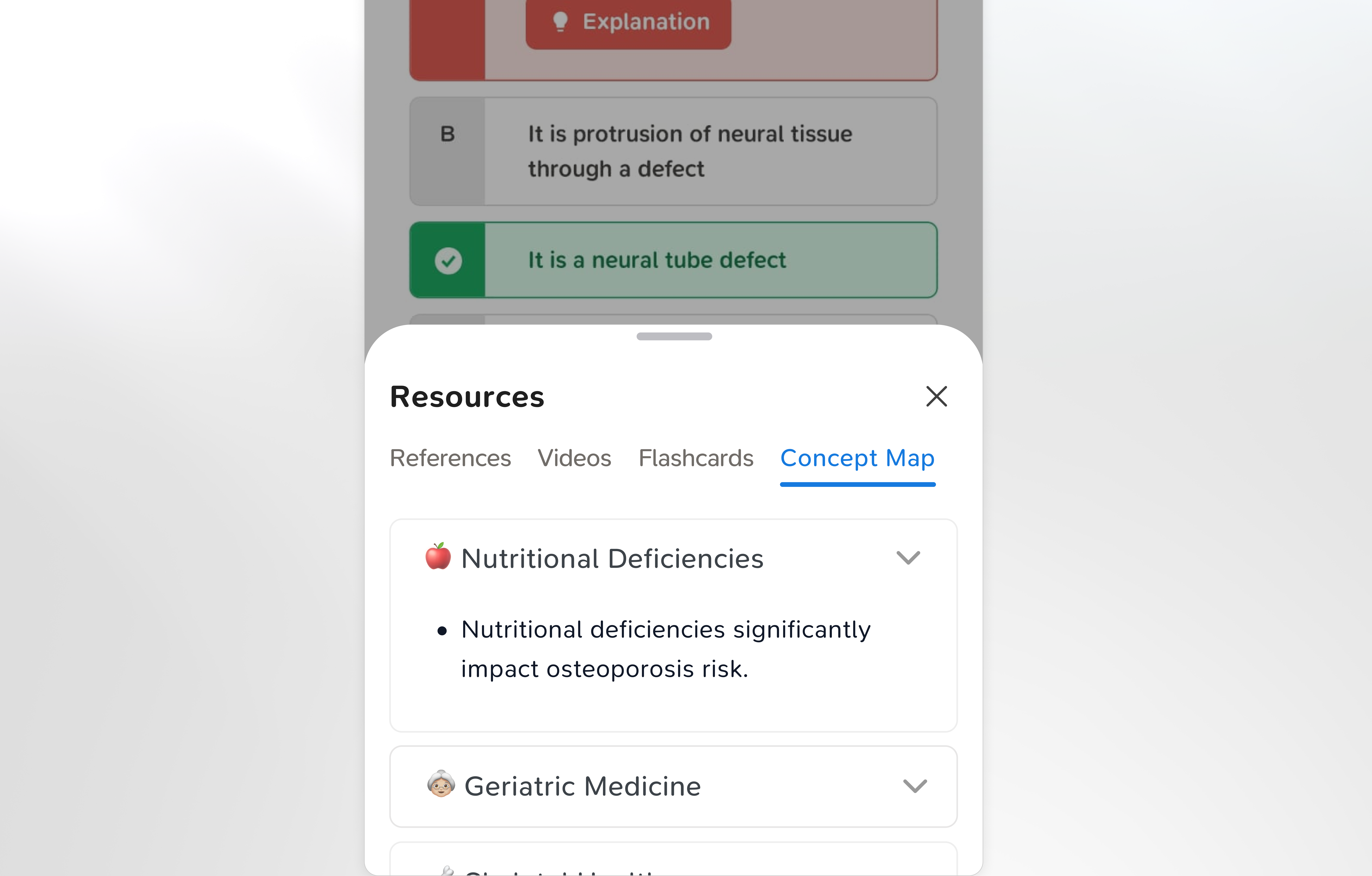
Each explanation also comes loaded with additional resources - video lectures covering the topic, concept maps that lay out the connections visually, and even textbook references with page numbers so you can go verify things yourself. No more hunting across five different apps and three textbooks.
Going through a question bank shouldn't feel like a chore you check off before the exam. It should feel like you're getting sharper with every question - not just solving more, but understanding more.
That's the difference between good and great. And honestly, once you feel it, there's no going back