Back
What Step 2 Score Do You Need for General Surgery Residency in 2026?
Discover the exact Step 2 CK scores needed for general surgery residency in 2026. Safe (245+), competitive (250+), and elite (255+) score ranges with program tier analysis and match strategies.
What Step 2 Score Do You Need for General Surgery Residency in 2026?
You just finished your surgery rotation. The attending keeps asking if you have considered general surgery. Your heart says yes, but your brain keeps calculating numbers. What Step 2 CK score do you actually need to be competitive for general surgery residency in 2026?
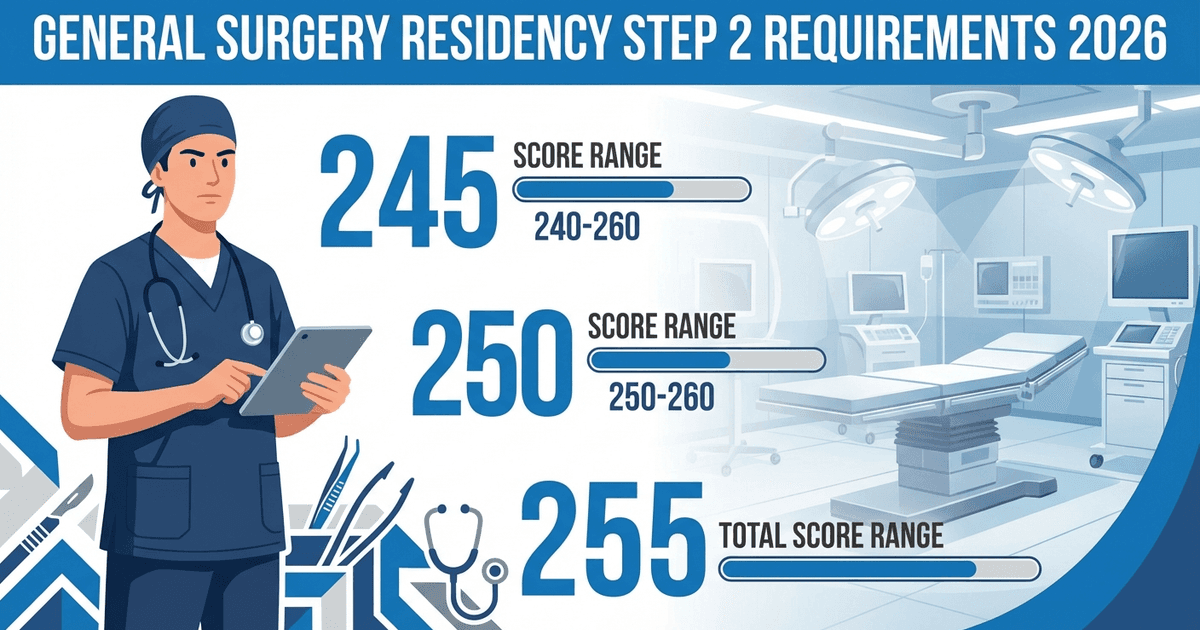
Here is the truth: general surgery residency requires a Step 2 CK score of 245+ to be considered safe, 250+ to be competitive, and 255+ to target elite programs. With the average matched general surgery applicant scoring 253, you cant afford to leave points on the table.
General surgery sits in that brutal middle ground — more competitive than family medicine but less cutthroat than orthopedics. The match rate hovers around 78% for US medical graduates, but that number masks significant variation based on your Step 2 CK performance. A 245 puts you in the danger zone. A 255 opens doors to top-tier programs.
This guide breaks down exactly where you need to score based on 2026 NRMP data, how different program tiers evaluate candidates, and strategic preparation approaches that successful surgery applicants use to hit their target scores.
General Surgery Residency Match Statistics: The 2026 Reality
General surgery residency competitiveness falls into a deceptive middle tier that catches many students off guard. The overall numbers look reasonable — until you dig deeper into the score distributions.
Match Rates by Applicant Type (2026 Cycle):
US MD graduates: 78%
US DO graduates: 68%
International Medical Graduates: 42%
Overall match rate: 74%
Application Volume Trends:
The average general surgery applicant submits 65-75 applications, up from 55-60 applications in 2020. Competitive applicants targeting academic programs often apply to 80+ programs to secure interviews at their top choices.
Geographic Competition Patterns:
Major academic centers in Boston, New York, California, and Chicago receive 400+ applications for 8-12 positions. Community programs in competitive markets still see 200-300 applications for similar position counts. Rural and underserved programs may receive 100-150 applications, creating opportunities for strategic applicants.
The key insight? General surgery isnt impossible to match into, but it demands strategic preparation and realistic target-setting based on your Step 2 CK performance.
Step 2 CK Score Requirements: The Three-Tier System
General surgery programs use Step 2 CK scores as their primary academic screening tool, with different program tiers having distinct expectations. Understanding these tiers helps you target the right programs for your score range.
Tier 1: Elite Academic Programs (255+ Required)
Target Score Range: 255-270+ Programs: Johns Hopkins, Massachusetts General, UCSF, Mayo Clinic
Elite academic programs typically use hard cutoffs around 255-260 for initial screening. These programs attract applicants with exceptional research portfolios, strong letters from department chairs, and consistent academic excellence.
What makes these programs different:
Research requirements: 15+ publications with first-author papers expected
Away rotation requirements: Often mandatory for serious consideration
Step 2 CK expectations: 75th percentile or higher (255+)
Additional factors: AOA membership, prestigious medical school, exceptional clinical grades
For these programs, your Step 2 CK score needs to be automatic — they want to focus on your research and fit, not worry about academic competency. Surgery-focused question banks that emphasize pre/post-op management and surgical emergencies become essential when targeting this tier, as these programs expect candidates to demonstrate advanced clinical reasoning from day one.
Tier 2: Competitive Academic and Community Programs (250-254)
Target Score Range: 250-254 Programs: Strong state university programs, well-regarded community hospitals
This tier represents the sweet spot for most general surgery applicants. Programs in this range are competitive but achievable for well-rounded candidates with solid clinical performance.
Characteristics of Tier 2 programs:
Research expectations: 5-10 publications, including some first-author work
Step 2 CK range: 50th-75th percentile (250-254)
Clinical grades: Honors in surgery clerkship expected
Geographic flexibility: May require willingness to relocate
A 250-254 puts you squarely in the running for these programs, especially if you complement your score with strong clinical grades and meaningful research experience.
Tier 3: Community and Regional Programs (245-249)
Target Score Range: 245-249 Programs: Community hospitals, regional medical centers
These programs focus heavily on clinical competency and fit over research productivity. They often prefer candidates who demonstrate genuine interest in community practice and long-term commitment to their region.
Program characteristics:
Research expectations: 2-5 publications, quality over quantity
Step 2 CK expectations: 25th-50th percentile (245-249)
Clinical focus: Strong emphasis on clerkship performance and clinical skills
Interview weight: Personal connection and fit heavily weighted
While a 245-249 keeps you competitive for these programs, you need to excel in other areas to stand out from the applicant pool.
Score Benchmarks: Safe, Competitive, and Elite Ranges
Understanding where your Step 2 CK score positions you helps set realistic expectations and application strategies.
Safe Range (245-249): 65% Match Rate
Opens doors to community and regional programs
Requires exceptional clinical grades and research to target academic programs
Application strategy: 70-80 programs with heavy emphasis on community programs
Competitive Range (250-254): 78% Match Rate
Competitive for most academic programs
Strong position for community programs
Application strategy: 60-75 programs with balanced academic/community mix
Elite Range (255+): 85% Match Rate
Competitive for any general surgery program
Opens doors to prestigious academic centers
Application strategy: 50-65 programs with focus on preferred geographic regions
Your score gap analysis becomes critical here — understanding exactly how many points you need to move between tiers helps focus your preparation efforts. Oncourse Score Gap Analyzer shows you precisely which clinical domains need improvement and how many points each domain contributes to your target score, letting you prioritize high-yield topics that maximize score improvement.
Program Tier Analysis: What Each Level Expects
Academic Medical Centers vs Community Programs
Academic Medical Centers (AMCs):
AMCs prioritize research productivity and academic potential alongside clinical competency. They expect Step 2 CK scores of 250+ and substantial research involvement.
Key expectations:
Research: 8+ publications with meaningful first-author contributions
Step scores: 250+ (competitive), 255+ (preferred)
Away rotations: Often required for serious consideration
Letters of recommendation: Department chairs and prominent faculty
Long-term goals: Academic surgery career interest
Community Programs:
Community programs emphasize clinical skills, patient care, and long-term commitment to community practice. They may be more forgiving of slightly lower Step 2 CK scores if other application elements are strong.
Key expectations:
Clinical performance: Honors in surgery and medicine clerkships
Step scores: 245+ (competitive), 250+ (preferred)
Research: 3-6 publications, focus on quality over quantity
Geographic ties: Preference for local/regional applicants
Practice goals: Commitment to community general surgery
Regional Variations and Competition Levels
Northeast (Most Competitive):
Programs in Boston, New York, and Philadelphia see the highest application volumes. Step 2 CK expectations run 5-10 points higher than national averages.
West Coast (Highly Competitive):
California and Washington programs attract strong applicant pools. Research expectations particularly high due to proximity to academic medical centers.
South/Southeast (Moderate Competition):
Strong programs with reasonable application volumes. Good balance of academic and community options.
Midwest/Mountain West (Variable Competition):
Mix of highly competitive academic centers and accessible community programs. Geographic preferences can significantly impact match likelihood.
Strategic Preparation for Your Target Score
High-Yield Study Approaches by Score Target
For 245+ Target (Solid Foundation Strategy):
Focus on core surgery principles and high-yield clinical scenarios. Emphasize breadth over depth initially.
Preparation timeline: 8-10 weeks dedicated study
Weeks 1-4: Core clinical knowledge review
Weeks 5-6: Surgery-specific content focus
Weeks 7-8: Full-length practice tests and weak area remediation
Weeks 9-10: Final review and test-taking strategy refinement
For 250+ Target (Competitive Strategy):
Layer advanced clinical reasoning on top of solid foundational knowledge. Emphasize pattern recognition in complex surgical scenarios.
Preparation timeline: 10-12 weeks dedicated study
Extended surgery shelf overlap content
Advanced clinical vignette practice
Subspecialty surgery exposure (trauma, vascular, etc.)
For 255+ Target (Elite Strategy):
Master both common and rare surgical presentations. Develop expertise in pre/post-operative management across all surgical subspecialties.
Preparation timeline: 12+ weeks dedicated study
Comprehensive surgery content mastery
Advanced reasoning in complex multi-system cases
Research review integration with clinical knowledge
Surgery-Focused Preparation Resources
High-Yield Surgery Topics for Step 2 CK:
Acute abdomen evaluation and management
Pre and post-operative care protocols
Surgical site infections and complications
Trauma surgery principles (ATLS protocols)
Basic surgical procedures and indications
Surgical anatomy essentials
Oncourse Step 2 Surgery Module concentrates on exactly these high-yield areas, with dedicated content covering the overlap between surgery shelf exams and Step 2 CK. The clinical vignettes mirror the complexity youll see on test day, with particular emphasis on surgical decision-making and peri-operative management scenarios.
Practice questions focusing specifically on surgical presentations help you recognize the clinical patterns that repeatedly appear on Step 2 CK. When working through cases involving surgical emergencies, acute abdominal pain, or post-operative complications, youre building the clinical reasoning skills that translate directly to exam performance.
Timeline and Application Strategy by Score Range
Application Strategy for Different Score Ranges
245-249 Score Strategy:
Apply to 75-85 programs
Target 60% community, 30% regional academic, 10% reach academic programs
Emphasize geographic ties and genuine interest in community practice
Focus on away rotations at target community programs
250-254 Score Strategy:
Apply to 65-75 programs
Target 40% academic, 50% strong community, 10% elite reach programs
Balance geographic preferences with realistic match likelihood
Consider away rotations at 2-3 target academic programs
255+ Score Strategy:
Apply to 50-65 programs
Target 60% academic programs, 30% top-tier community, 10% geographic preferences
Focus on research fit and career alignment
Strategic away rotations at top choice programs
Pre-Application Timeline Optimization
Third Year Strategy (Score Building Phase):
Surgery clerkship: Target honors grade, strong letters of recommendation
Research initiation: Begin meaningful research projects early
Step 2 CK preparation: Start content review 4-6 months before exam date
Away rotation planning: Research target programs and requirements
Fourth Year Strategy (Application Execution):
Step 2 CK completion: Take exam early enough for application inclusion
Away rotations: Complete 2-4 strategic rotations based on your score tier
Application submission: Submit early in the cycle for maximum consideration
Interview preparation: Practice surgery-specific interview scenarios
Frequently Asked Questions
Is 240 too low for general surgery residency?
A 240 Step 2 CK score significantly limits your general surgery options but doesnt eliminate them entirely. You would need exceptional clinical grades, substantial research, and strong geographic ties to community programs. Consider delaying applications to retake Step 2 CK if possible, as the score improvement often outweighs the delay.
How much does Step 2 CK score matter compared to research?
Step 2 CK serves as the initial screening tool — programs use it to determine interview invitations. Research becomes more important after youve cleared the score threshold. For most programs, you need both: a competitive Step 2 CK score (250+) AND meaningful research (5+ publications) to be seriously considered.
Should I retake Step 2 CK if I scored 248?
A 248 puts you in the borderline range for general surgery. Consider retaking if you have strong reason to believe you can score 255+ on a retake. However, factor in the time cost and application timeline. Sometimes its better to apply strategically with a 248 than delay applications for a retake attempt.
Do general surgery programs prefer certain medical schools?
While programs dont have official preferences, applicants from schools with strong surgery departments may have advantages through established relationships and away rotation opportunities. However, your individual performance matters more than your school name — a strong applicant from any accredited school can successfully match into general surgery.
How important are away rotations for general surgery?
Away rotations are highly important for general surgery, particularly for academic programs. They allow programs to evaluate your clinical skills directly and gauge genuine interest. Most successful applicants complete 2-4 away rotations at target programs. Choose rotations strategically based on your Step 2 CK score and career goals.
What happens if I dont match into general surgery?
If you dont match, you have several options: apply to the SOAP for unfilled surgery positions, pursue a transitional year or preliminary surgery position to reapply stronger next year, or consider related specialties like emergency medicine or internal medicine with future fellowship options. Many successful surgeons took non-traditional paths to their careers.
Prepare smarter with Oncourse AI — adaptive MCQs, spaced repetition, and AI explanations built for USMLE Step 2 CK. Download free on Android and iOS.