FMGE Study Plan 2026: How to Split Revision Between PYQs, Mocks and Weak Areas
Master the perfect FMGE revision split: 40% PYQs, 20% mocks, 25% review, 15% weak areas. Get structured 12-week, 8-week, and 4-week plans with daily schedules.

FMGE Study Plan 2026: How to Split Revision Between PYQs, Mocks and Weak Areas
You have 200 hours left. The FMGE exam has 300 questions, and you need 150 right answers to pass. The question is not what to study — you probably know that already. The real question is how to split those 200 hours between PYQs, mock tests, mock reviews, and fixing weak areas so that each hour moves you closer to that 50% passing mark.
Most students mess this up. They either become PYQ zombies (memorizing answers without understanding patterns), mock addicts (taking test after test without proper review), or comfort-zone revisers (spending 80% of time on subjects they already know). None of these approaches work because FMGE success requires a specific balance between recognition (PYQs), performance under pressure (mocks), learning from mistakes (review), and plugging knowledge gaps (weak areas).
This guide gives you three structured FMGE study plans with exact time splits, weekly schedules, and daily practice targets. Whether you have 12 weeks, 8 weeks, or just 4 weeks left, youll know exactly how many hours to spend on each type of practice.
The Four Pillars of FMGE Revision Strategy
Before diving into time splits, lets clarify what each revision method actually does for your FMGE score.
PYQs (Previous Year Questions): Pattern Recognition
PYQs build question familiarity and topic mapping. FMGE has clear patterns — Medicine and Surgery together contribute 75+ questions, OBG adds 28-30, and Pharmacology brings 15-18. When you solve 5-7 years of PYQs systematically, you start recognizing how examiners frame questions about MgSO4 protocols, drug-of-choice scenarios, and immunization schedules.
What PYQs dont do: They dont simulate exam pressure or teach you to manage 300 questions in 5 hours. Thats where mocks come in.
Mock Tests: Performance Under Pressure
Full-length mocks train your exam-day execution. They reveal whether you can maintain accuracy when tired (question 250+), spot clinical images quickly, and manage time across both paper sessions. Subject-wise mocks help you gauge your baseline in individual subjects.
What mocks dont do: They dont teach you anything if you dont review them properly. Taking 10 mocks without analysis is worse than taking 3 mocks with thorough review.
Mock Review: Converting Mistakes into Knowledge
This is where most students lose marks they could have saved. Every wrong answer represents either a knowledge gap, concept confusion, reading error, or clinical reasoning gap. Proper mock review categorizes your mistakes and creates targeted fix actions.
Weak Area Practice: Targeted Skill Building
Weak areas arent just subjects where you score low. Theyre specific skill gaps — maybe you miss drug mechanisms, confuse investigation sequences, or struggle with pediatric milestones. Weak area practice uses focused question sets and spaced repetition to build these specific skills.
The Optimal FMGE Time Split Formula
Based on successful FMGE candidates and learning science research, heres the proven weekly time allocation:
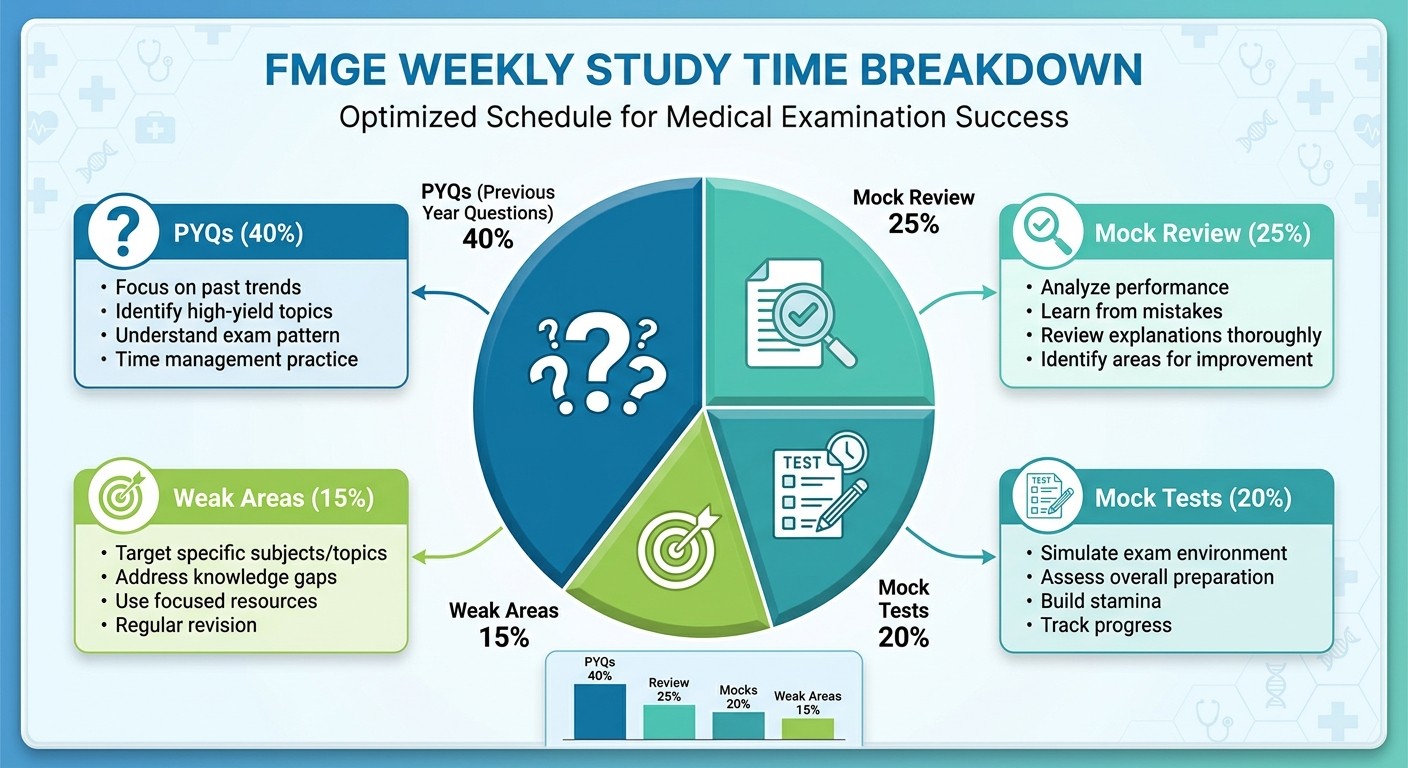
40% PYQs: Pattern recognition and topic familiarity
20% Mock Tests: Full-length and subject-wise tests
25% Mock Review: Analyzing mistakes and creating fix actions
15% Weak Areas: Targeted practice on identified gaps
This split maximizes your score improvement rate. Youre spending enough time on PYQs to recognize patterns, but not so much that you memorize answers. Youre taking enough mocks to train exam performance, but spending even more time learning from those mistakes.
12-Week FMGE Study Plan: Comprehensive Preparation
This plan works if youre starting FMGE revision 3 months before your exam date.
Weeks 1-4: Foundation Building
Daily Schedule (8 hours)
3 hours: PYQs (150-200 questions)
1.5 hours: Subject mock (every 3rd day)
2 hours: Mock review and mistake analysis
1.5 hours: Weak area focused practice
Weekly Structure:
Monday-Wednesday-Friday: High-yield subjects (Medicine, Surgery, OBG)
Tuesday-Thursday: Supporting subjects (Pharmacology, Pathology, PSM)
Saturday: Subject mock + review
Sunday: Weak area consolidation
Start with diagnostic mocks in Week 1 to identify your baseline in each subject. Focus PYQ practice on the big four clinical subjects that contribute 130+ marks. Use Oncourse AI's Daily Plan feature to automatically route your weak topics into targeted daily sessions — it analyzes your performance and creates personalized question sets for your specific knowledge gaps.
Weeks 5-8: Pattern Mastery
Daily Schedule (9 hours)
3.5 hours: Mixed PYQs across subjects
1 hour: Full-length mock (twice weekly)
2.5 hours: Detailed mock review
2 hours: Weak area repair work
Weekly Pattern:
Monday: Medicine + Surgery PYQs (100 questions each)
Tuesday: Full mock + 3-hour review session
Wednesday: OBG + Pediatrics PYQs (75 questions each)
Thursday: Pharmacology + Pathology PYQs (50 questions each)
Friday: Subject-wise mocks (weak subjects)
Saturday: Full mock + comprehensive review
Sunday: Weak area intensive + Synapses flashcard review
By Week 6, you should be recognizing FMGE question patterns. Youll spot drug-of-choice questions in the first line, recognize typical OBG protocol scenarios, and identify high-yield clinical images.
Weeks 9-12: Performance Optimization
Daily Schedule (10 hours)
3 hours: Timed PYQ sets (simulating exam conditions)
2 hours: Full-length mocks (every other day)
3 hours: Intensive mock review and error analysis
2 hours: High-yield weak area fixes
Weekly Focus:
Week 9: Speed building — complete 300 questions in 4.5 hours
Week 10: Accuracy focus — aim for 65%+ in practice mocks
Week 11: Weak subject intensive — double practice in lowest-scoring areas
Week 12: Confidence building + light revision
During mock review, use Rezzy AI tutor when explanations dont make sense or when you need help understanding why wrong options are incorrect. Its particularly helpful for complex clinical reasoning questions where the logic isnt immediately clear.
8-Week FMGE Study Plan: Focused Preparation
If you have 8 weeks, you need a more aggressive approach with less foundation building.
Weeks 1-2: Rapid Assessment
Daily Schedule (10 hours)
4 hours: High-volume PYQs (250-300 questions)
1.5 hours: Subject mocks (daily)
3 hours: Mock analysis and pattern identification
1.5 hours: Immediate weak area fixes
Start with full diagnostic tests to quickly map your subject strengths and weaknesses. No time for gradual buildup — jump directly into high-volume question practice.
Weeks 3-5: Intensive Practice
Daily Schedule (11 hours)
4 hours: Mixed PYQs with time pressure
2 hours: Full mocks (every other day)
3.5 hours: Deep mock review + mistake categorization
1.5 hours: Targeted weak area sessions
Focus on the mistake framework during review:
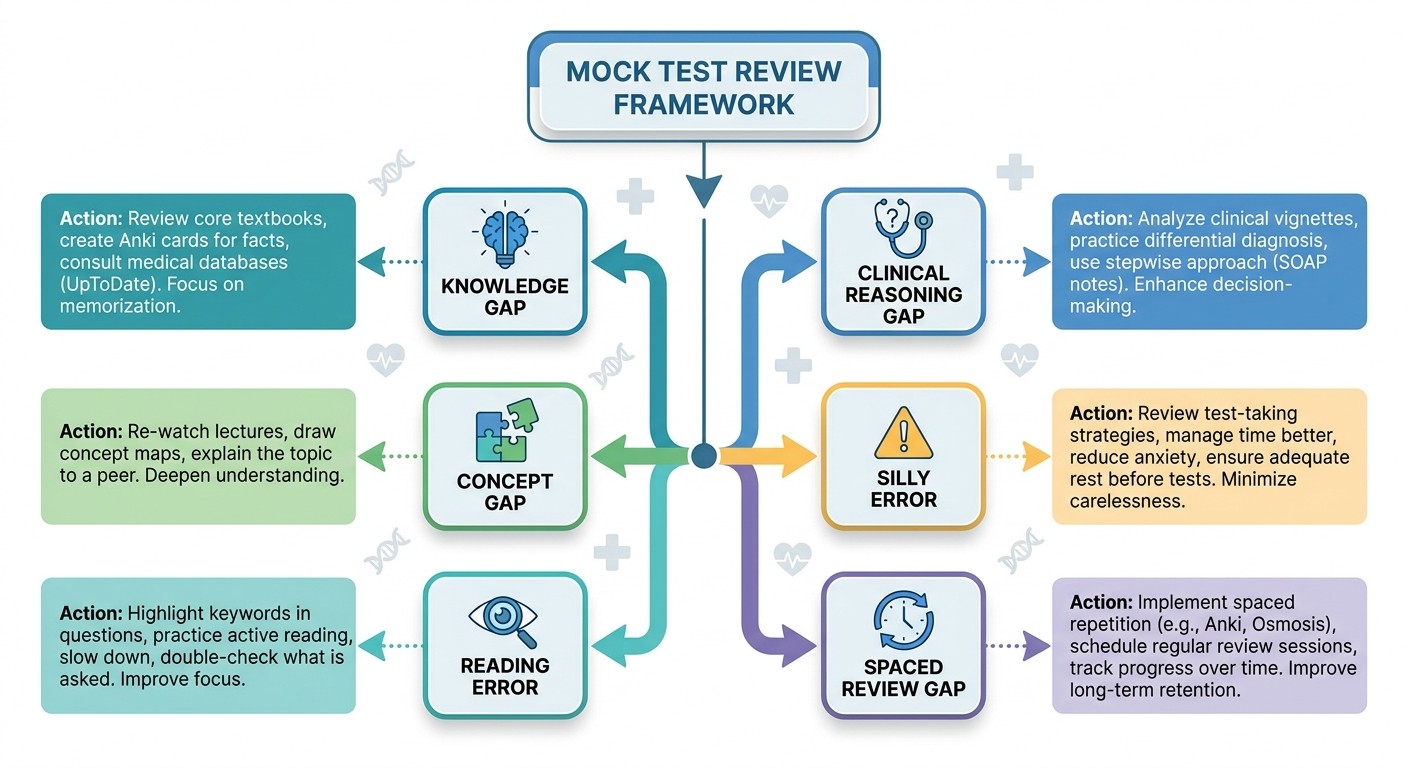
Knowledge Gap: You dont know the fact. Fix: Create flashcards, use spaced repetition. Concept Gap: You know the fact but dont understand the mechanism. Fix: Review concept maps, ask follow-up questions using Explanation Chat. Reading Error: You misread the question stem or options. Fix: Practice stem highlighting, slow down on clinical vignettes. Clinical Reasoning Gap: You cant connect symptoms to diagnosis. Fix: Practice more clinical cases in that area. Silly Error: You knew the answer but chose wrong. Fix: Develop checking routines. Spaced Review Gap: You knew this before but forgot. Fix: Add to daily review schedule.
Weeks 6-8: Performance Tuning
Daily Schedule (12 hours)
3.5 hours: Exam-pattern PYQs
3 hours: Daily full mocks
4 hours: Comprehensive review + weak area fixes
1.5 hours: High-yield revision (drugs, protocols, images)
Your goal: 70%+ accuracy in practice mocks and completion within time limits.
4-Week FMGE Study Plan: Crash Preparation
Four weeks is tight, but doable if you follow this aggressive schedule.
Week 1: Diagnostic + High-Yield
Daily Schedule (14 hours)
5 hours: PYQs from high-weightage subjects only
2 hours: Subject mocks (Medicine, Surgery, OBG)
4 hours: Mock review + immediate fixes
3 hours: High-yield memorization (drugs, protocols, images)
Focus only on subjects that contribute the most marks. Skip low-yield specialties unless theyre your strong areas.
Week 2-3: Intensive Mock Phase
Daily Schedule (15 hours)
3 hours: Strategic PYQ practice (weak areas only)
4 hours: Full mocks (one per day)
5 hours: Detailed mock analysis + fixes
3 hours: Memorization + revision
Take one full mock daily, spend 5 hours reviewing it. This sounds excessive, but its the only way to rapidly improve accuracy in a short timeframe.
Week 4: Final Preparation
Daily Schedule (12 hours)
2 hours: Light PYQ practice (confidence building)
2 hours: Final mocks (every other day)
4 hours: Review + weak area emergency fixes
4 hours: High-yield revision + memorization
Taper the intensity slightly to avoid burnout, but maintain daily practice.
How to Use PYQs Without Memorizing Answers
PYQs are powerful, but most students use them wrong. They memorize that "Question X has answer B" instead of understanding the underlying pattern.
The Pattern Recognition Method
1. Solve by Topic: Start with subject-wise PYQs, not random mixing
2. Question Analysis: After each question, identify:
- What clinical clue triggered the correct answer?
- What were the distractors trying to test?
- How might examiners vary this question in future?
3. Pattern Documentation: Keep a note of recurring themes:
- Drug-of-choice patterns (first-line vs second-line vs contraindications)
- Investigation sequences (screening vs confirmatory vs monitoring)
- Protocol variations (pediatric vs adult doses, emergency vs routine management)
The 3-Year Rule
Focus on PYQs from the last 3 years for pattern recognition, then solve 5-7 years total for comprehensive coverage. FMGE patterns do shift slightly, and recent years give you the most current examiner thinking.
Converting PYQs into Active Learning
Dont just solve and move on. For each wrong answer:
Identify the knowledge gap
Create a flashcard for spaced review
Find 2-3 similar questions to test the same concept
Add the topic to your weak area practice list
When you encounter confusing explanations, use Oncourse AI's Explanation Chat to ask follow-up questions like "Why is option C wrong?" or "What would change the answer to option B?" This helps you understand examiner logic, not just memorize facts.
Mock Test Strategy: Full-Length vs Subject Tests
Both have their place in your FMGE preparation, but the timing matters.
Subject-Wise Mocks (Weeks 1-6)
Use these for:
Baseline Assessment: Identify your strongest and weakest subjects
Topic Mastery: Deep-dive into specific subject patterns
Targeted Improvement: Focus practice time on low-scoring subjects
Confidence Building: Build success momentum in strong subjects
Take 2-3 subject mocks per week, rotating through high-weightage subjects.
Full-Length Mocks (Weeks 4-12)
Use these for:
Stamina Building: Train for 5-hour exam duration
Time Management: Learn to pace yourself across 300 questions
Cross-Subject Integration: Practice switching mental contexts
Exam-Day Simulation: Build familiarity with the actual test experience
Start with one full mock per week, increase to 3-4 per week in final month.
The Mock Review Framework
Spend at least 1.5 hours reviewing every hour of mock testing. Heres the systematic approach:
Immediate Review (30 minutes):
Check answers and note your score
Mark questions where you guessed
Identify subjects with lowest accuracy
Deep Analysis (60 minutes):
Read explanations for all wrong answers
Understand why each distractor was included
Note any pattern in your mistakes
Fix Planning (30 minutes):
Create specific study tasks for knowledge gaps
Schedule weak area practice sessions
Add forgotten facts to spaced repetition system
Weak Area Identification and Daily Practice
Weak areas arent always your lowest-scoring subjects. Sometimes a strong subject has hidden weak spots that cost you easy marks.
The Multi-Layer Analysis
Layer 1: Subject-Level
Which subjects consistently score below 50%? These are obvious weak areas requiring major time investment.
Layer 2: Topic-Level
Within strong subjects, which topics do you consistently miss? Maybe youre strong in Medicine but weak in cardiology drug mechanisms.
Layer 3: Skill-Level
What types of questions do you miss across subjects? Clinical images? Drug calculations? Protocol details?
Converting Weak Areas into Daily Practice
Once identified, convert each weak area into specific daily practice:
Knowledge Gaps: 20-30 targeted MCQs per day + flashcard review Concept Gaps: Conceptual reading + practice questions + mechanism diagrams Clinical Skills: Image-based questions + case study practice Memory Issues: Spaced repetition + mnemonics + regular review
Use Oncourse AI's Daily Plan to automatically generate these targeted practice sessions. It analyzes your weak areas and creates personalized question sets that focus on your specific gaps, removing the guesswork from daily practice planning.
Combining Flashcards with Question Practice
Flashcards and questions serve different purposes in FMGE preparation. Questions test application; flashcards build recall speed.
The Spaced Repetition Schedule
Daily Flashcard Routine:
Morning (20 minutes): Review due cards from previous sessions
Post-Mock (15 minutes): Create cards from new knowledge gaps
Evening (10 minutes): Quick review of high-yield facts
What to Put on Flashcards
Front Side - Question Format:
"First-line treatment for severe preeclampsia?"
"Investigation of choice for suspected pulmonary embolism?"
"Drug causing gray baby syndrome?"
Back Side - Complete Answer:
Full answer with mechanism/reasoning
Key differentiating points
Common exam variations
Use Synapses flashcards for optimal spaced repetition scheduling. The system automatically adjusts review intervals based on how well you remember each card, ensuring you spend more time on facts youre likely to forget.
Integration Strategy
1. Question → Flashcard: Every wrong answer becomes a flashcard
2. Flashcard → Question: Test flashcard knowledge with related MCQs
3. Combined Review: Use flashcards for rapid fact checks during mock review
Common FMGE Revision Mistakes to Avoid
Mistake 1: Resource Hoarding
Collecting 15 different question banks and PYQ sources. Stick to 1-2 comprehensive sources and exhaust them completely.
Mistake 2: Mock Without Review
Taking test after test without spending adequate time on analysis. Your improvement comes from review, not from the mock itself.
Mistake 3: Comfortable Subject Over-Revision
Spending 70% of time on subjects you already know well. This feels productive but doesnt improve your overall score.
Mistake 4: PYQ Answer Memorization
Memorizing that "Question 47 from 2023 has answer C" instead of understanding the clinical reasoning.
Mistake 5: Weak Area Avoidance
Skipping subjects or topics because theyre "too hard" or "low-yield." Every mark counts toward your 150-mark target.
Mistake 6: No Time Management Practice
Solving questions without time pressure. FMGE gives you 63 seconds per question — practice at that pace.
Revision Strategy for High-Yield Subjects
The big four subjects (Medicine, Surgery, OBG, Pediatrics) need different approaches despite their shared importance.
Medicine: Focus on Systems
Cardiology: ECG interpretation, heart failure drugs, arrhythmia management
Pulmonology: Asthma protocols, COPD staging, pleural fluid analysis
Gastroenterology: GI bleeding management, chronic liver disease, inflammatory bowel disease
Endocrinology: Diabetes management, thyroid disorders, adrenal conditions
Surgery: Focus on Protocols
Emergency Management: Trauma protocols, acute abdomen, shock management
Oncology: Staging, surgical indications, adjuvant therapy
GI Surgery: Appendicitis, hernia, GI bleeding sources
Orthopedics: Fracture management, joint disorders, spinal conditions
OBG: Focus on Guidelines
Obstetrics: Antenatal care protocols, labor management, complications
Gynecology: Menstrual disorders, contraception, gynecologic emergencies
Reproductive Medicine: Infertility workup, assisted reproduction
Pediatrics: Focus on Milestones and Protocols
Growth and Development: Milestones, nutrition, immunizations
Infections: Pediatric fever protocols, common infections
Emergencies: Pediatric resuscitation, poisoning management
For each subject, maintain a mix of 60% PYQs, 25% mock practice, and 15% weak area fixes.
Frequently Asked Questions
How many PYQs should I solve before the FMGE exam?
Aim for 3,000-4,000 PYQs total, covering 5-7 years. Focus on the last 3 years for current patterns, then expand backward for comprehensive coverage. Quality matters more than quantity — solve fewer questions with thorough review rather than rushing through large numbers.
Should I take subject mocks or full-length mocks first?
Start with subject mocks to establish baselines and identify weak areas. Transition to full-length mocks by Week 4 of preparation. In the final month, take mostly full-length tests to build stamina and exam-day familiarity.
How do I know if Im spending too much time on mock review?
You should spend 1.5-2 hours reviewing for every hour of mock testing. If youre spending more than 3 hours reviewing a 2.5-hour mock, youre likely over-analyzing. Focus on patterns and actionable fixes rather than understanding every detail.
What if I have less than 4 weeks to prepare?
Focus only on high-weightage subjects (Medicine, Surgery, OBG) and use a 60% PYQ, 40% mock strategy. Skip comprehensive review — focus on rapid pattern recognition and high-yield memorization. Take daily mocks with 2-hour review sessions.
How do I balance new learning with revision?
In the final 8 weeks before FMGE, prioritize revision and practice over new learning. If you encounter knowledge gaps during mock review, learn just enough to answer similar questions, then move on. Save comprehensive learning for after the exam.
Should I create my own notes or use existing ones?
Use existing high-quality notes for most subjects, but create your own notes for recurring mistake patterns and weak areas. Your personal mistake notes are more valuable than generic notes because they target your specific gaps.
Master Your FMGE Revision Split
The difference between FMGE success and failure often comes down to how you split your revision time, not just how many hours you put in. The 40-20-25-15 split (PYQs, mocks, review, weak areas) gives you the optimal balance between pattern recognition, performance training, and skill building.
Remember: PYQs teach you what examiners ask, mocks teach you how to perform under pressure, review teaches you from your mistakes, and weak area practice fills your knowledge gaps. Skip any one component, and you leave marks on the table.
Start with diagnostic mocks to understand your current level, then follow the structured weekly plans based on your available time. Use the mock review framework to systematically improve, and convert every mistake into targeted practice.
Prepare smarter with Oncourse AI — route weak areas into Daily Plan sessions, clarify confusing explanations with Rezzy, and retain high-yield facts with Synapses flashcards. Download free on Android and iOS.