FMGE 2026 Study Plan: 90-Day Strategy for Foreign Medical Graduates to Clear on First Attempt
Complete 90-day FMGE study plan for foreign medical graduates. Phase-wise strategy covering high-yield subjects, MCQ practice, and Indian medical protocols to crack FMGE 2026 on first attempt.

FMGE 2026 Study Plan: 90-Day Strategy for Foreign Medical Graduates to Clear on First Attempt
You are staring at the FMGE notification. Again. The Foreign Medical Graduate Examination — your gateway to practicing medicine in India after completing MBBS abroad. The statistics are brutal: only about 15% pass on their first attempt. Many of your batchmates from China, Russia, or Ukraine have already tried twice, maybe three times.
Here's what nobody tells you upfront: FMGE isn't just another Indian medical exam. Its a completely different beast that demands reconciling what you learned in foreign universities with the NMC's preferred exam pattern. You cant just memorize Harrison's or use the study methods that worked for your university finals. You need a surgical approach — 300 MCQs in one sitting, no negative marking, 50% to pass.
This 90-day study plan breaks down exactly how to bridge that gap. No fluff, no generic advice. Just the specific strategy that works for foreign medical graduates who need to crack this exam and move forward with their careers.
What Is FMGE and Why the Pass Rate Is So Low
The Foreign Medical Graduate Examination (FMGE) is the National Medical Commission's screening test for Indian citizens who completed their MBBS from foreign universities. Its the only way to get NMC registration and practice medicine legally in India.
Here's the reality: FMGE has a 300-question MCQ format conducted in a single 5-hour sitting. No negative marking. You need 150 correct answers (50%) to pass. The exam covers all major clinical subjects, but the question style and emphasis are distinctly different from what you faced in foreign universities.
Why do 85% of candidates fail?
The primary reason isn't lack of medical knowledge — its the mismatch between foreign curricula and Indian exam patterns. If you studied in China, your pharmacology focused heavily on Chinese herbs and different drug protocols. Russian medical programs emphasize theoretical pathophysiology over clinical MCQ reasoning. Philippine schools teach more US-oriented clinical approaches.
FMGE tests Indian clinical decision-making, drug preferences, and diagnostic protocols. A simple example: management of diabetic ketoacidosis. Your foreign textbook might recommend specific insulin protocols, but FMGE expects knowledge of drugs commonly used in Indian government hospitals and cost-effective treatment approaches.
The second issue is question style adaptation. Foreign medical education often uses essay-type assessments or practical examinations. FMGE MCQs require rapid pattern recognition and elimination of distractors — skills most foreign graduates havent practiced systematically.
The 90-Day Four-Phase Strategy
Phase 1: Foundation Building (Days 1-30)
Goal: Rebuild your clinical knowledge using Indian medical standards and exam patterns. Daily Schedule: 8-10 hours study time
6 hours: Subject reading from Indian textbooks
2 hours: Basic MCQ practice (50-75 questions)
1 hour: Note-making and concept mapping
Subject Priority (spend 60% of your time on these): 1. General Medicine - Covers 25-30% of FMGE questions 2. General Surgery - 20-25% of exam content 3. Obstetrics & Gynecology - 15-20% weightage 4. Pediatrics - 15-18% of questions
Start with Medicine because it overlaps with every other subject. Focus on common Indian clinical scenarios: dengue, malaria, tuberculosis, rheumatic heart disease. These diseases might have been briefly covered in your foreign curriculum but are heavily tested in FMGE.
For Surgery, prioritize emergency management protocols. Indian surgical approaches sometimes differ from Western protocols, especially in resource-limited settings. Learn the step-by-step management of acute abdomen, trauma protocols, and pre/post-operative care as practiced in Indian hospitals.
Weekly Targets:
Week 1: Medicine (cardiology, respiratory, GIT)
Week 2: Surgery (GIT surgery, emergency surgery)
Week 3: Obs/Gyn (maternal medicine, gynecologic oncology)
Week 4: Pediatrics (neonatology, pediatric emergencies)
During this phase, Oncourse's adaptive question bank helps identify which topics from your foreign education need reinforcement. Instead of randomly solving MCQs, the platform surfaces your weaker areas more frequently, ensuring you spend time on what actually impacts your score.
Phase 2: Consolidation & Weak Area Targeting (Days 31-60)
Goal: Deep-dive into moderate-yield subjects and strengthen identified weak areas through targeted MCQ practice. Daily Schedule: 10-12 hours study time
4 hours: Subject revision from Phase 1
4 hours: New subject coverage (moderate-yield subjects)
3 hours: Subject-wise MCQ practice (150-200 questions)
1 hour: Analyzing wrong answers and pattern identification
Subject Coverage:
Pharmacology (15-20% of exam): Focus on drug mechanisms, contraindications, and drug interactions. Pay special attention to Indian drug names and generic equivalents.
Pathology (10-15% of exam): Emphasize histopathology images and diagnostic criteria.
Community Medicine/PSM (8-10% of exam): Indian health programs, epidemiology, biostatistics.
Week 5-6: Complete Pharmacology and Pathology Week 7-8: Community Medicine, Microbiology, and weak areas from Phase 1
The key during consolidation is active recall testing. Dont just read — test yourself constantly. For every chapter you complete, solve at least 20-30 MCQs on that topic immediately. This identifies gaps that passive reading misses.
Oncourse's AI-powered explanations bridge the curriculum gap by explaining not just why the correct answer is right, but why each distractor is wrong according to Indian medical standards. For foreign graduates, this is crucial because your textbooks might consider multiple answers "reasonable" while FMGE has one preferred approach.
Phase 3: High-Yield Revision (Days 61-80)
Goal: Rapidly review the most tested topics using condensed notes and spaced repetition. Daily Schedule: 12-14 hours study time
6 hours: Rapid revision using short notes
4 hours: MCQ practice (200-250 questions daily)
3 hours: Memorizing high-yield facts, drug doses, normal values
1 hour: Reviewing previous day's mistakes
This phase is about velocity and retention. You should be able to complete a Medicine revision in 2 days, Surgery in 1.5 days, and so on. Create one-page summary sheets for each major topic.
High-Yield Memory Anchors:
Drug doses and contraindications
Diagnostic criteria for major diseases
Emergency management protocols
Normal laboratory values (Indian population-specific)
Surgical anatomy landmarks
Use spaced repetition with Synapses flashcards to lock in these facts. The platform schedules reviews at scientifically optimal intervals, ensuring you retain information without wasting time on topics you already know well. For example, if you consistently remember the mechanism of ACE inhibitors, Synapses will show that card less frequently while drilling you on drugs you mix up.
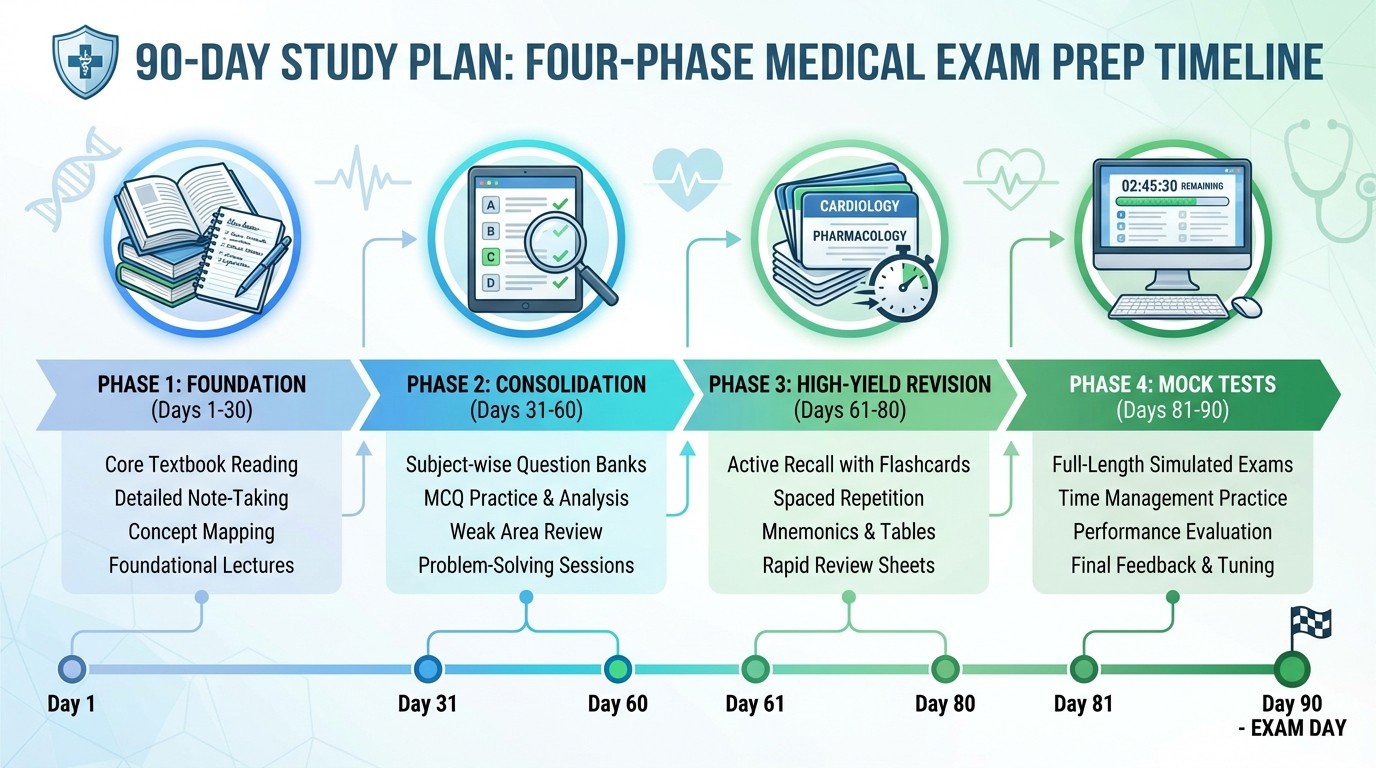
Phase 4: Mock Test Blitz (Days 81-90)
Goal: Simulate exact exam conditions and fine-tune time management for 300 MCQs in 5 hours. Daily Schedule: 10-12 hours total
5 hours: Full-length mock test (300 questions)
3 hours: Detailed analysis of mock test performance
2 hours: Targeted revision of weak topics identified
1-2 hours: Light revision to maintain confidence
Take one full 300-question mock test daily. No exceptions. This isn't just about knowledge testing — its about building the mental stamina to maintain concentration for 5 straight hours. Many foreign medical graduates underestimate this aspect.
Mock Test Strategy:
First attempt: Focus on accuracy, not speed
Questions 1-100: Aim for 50-55 correct (build confidence)
Questions 101-200: Your strongest subjects should be here
Questions 201-300: Save moderate-yield subjects for the end
Time Management:
60 seconds per question average
Spend maximum 90 seconds on any single question
Mark difficult questions and return if time permits
Complete easier questions first in each section
After each mock test, create a detailed error log. Categorize mistakes as: knowledge gaps, silly errors, time pressure mistakes, or confusion between similar options. Focus your remaining study time on knowledge gaps only.
Subject-Specific Preparation Strategy
Medicine (Priority #1): 25-30% of FMGE
High-Yield Topics:
Cardiology: Acute coronary syndromes, heart failure, ECG interpretation
Respiratory: Tuberculosis, pneumonia, pleural diseases
Gastroenterology: Chronic liver disease, inflammatory bowel disease
Nephrology: Acute kidney injury, chronic kidney disease
Infectious diseases: Malaria, dengue, enteric fever, HIV
Foreign Curriculum Gap: Your foreign textbooks likely covered global disease patterns. FMGE emphasizes diseases common in India. Study epidemiology, clinical presentations, and management protocols specific to the Indian healthcare system.
Practice with Medicine MCQs and use comprehensive Medicine lessons that align with NMC guidelines.
Surgery (Priority #2): 20-25% of FMGE
High-Yield Topics:
Emergency surgery: Acute abdomen, trauma management
GI surgery: Peptic ulcer disease, appendicitis, intestinal obstruction
Hepatobiliary surgery: Cholelithiasis, obstructive jaundice
Oncosurgery: Basic principles, staging systems
Orthopedics: Fracture management, bone tumors
Foreign Curriculum Gap: Many foreign medical schools emphasize theoretical surgical principles over practical decision-making. FMGE tests specific surgical approaches and post-operative management protocols used in Indian hospitals.
Obstetrics & Gynecology (Priority #3): 15-20% of FMGE
High-Yield Topics:
High-risk obstetrics: Pre-eclampsia, diabetes in pregnancy
Labor and delivery: Normal and abnormal labor patterns
Gynecologic emergencies: Ectopic pregnancy, ovarian torsion
Reproductive endocrinology: PCOS, infertility
Gynecologic oncology: Cervical, ovarian, endometrial cancers
Study Obstetrics & Gynecology materials focusing on maternal-fetal medicine approaches used in Indian healthcare settings.
Pediatrics (Priority #4): 15-18% of FMGE
High-Yield Topics:
Neonatology: Birth asphyxia, respiratory distress syndrome
Infectious diseases: Common childhood infections, immunization
Growth and development: Developmental milestones, failure to thrive
Pediatric emergencies: Dehydration, poisoning, seizures
Nutrition: Malnutrition, micronutrient deficiencies
Common Pitfalls That Kill FMGE Scores
Mistake #1: Ignoring Clinical Subjects for Basic Sciences
Many foreign medical graduates spend too much time on Anatomy, Physiology, and Biochemistry because these subjects feel "easier" after their university training. Wrong approach. Clinical subjects (Medicine, Surgery, Obs/Gyn, Pediatrics) make up 70-80% of FMGE questions. Basic sciences contribute only 15-20%.
Solution: Allocate your 90 days proportionally. Spend 70% of your time on clinical subjects, 20% on moderate-yield subjects (Pharmacology, Pathology), and only 10% on basic sciences.
Mistake #2: Theory Study Without MCQ Practice
Reading textbooks without solving MCQs is like learning to drive by reading the manual. FMGE success requires pattern recognition and rapid decision-making under time pressure.
Solution: For every hour of reading, spend at least 30 minutes solving MCQs on that topic. Use platforms with detailed explanations that explain the reasoning behind each option.
Mistake #3: Not Adapting to Indian Medical Protocols
Your foreign medical education might prefer expensive investigations or treatments that arent practical in Indian healthcare settings. FMGE tests cost-effective, practical approaches.
Solution: Focus on Indian medical guidelines and protocols. Learn generic drug names commonly used in India. Understand the step-by-step approach to diagnosis when expensive tests arent readily available.
Mistake #4: Skipping Timed Mock Tests
Many candidates practice MCQs but never sit through a full 300-question, 5-hour simulation. They underestimate the mental fatigue factor.
Solution: Complete at least 10 full-length mock tests in the final 10 days. Practice maintaining concentration and accuracy in the 4th and 5th hours when mental fatigue peaks.
The Role of Spaced Repetition and Active Recall
Your foreign medical education likely relied on continuous assessment and practical examinations. FMGE requires different memory consolidation techniques.
Spaced Repetition Principle: Review information at increasing intervals (1 day, 3 days, 7 days, 14 days, 30 days). This locks information into long-term memory more efficiently than daily repetition. Active Recall Implementation:
After reading a topic, close your textbook and write everything you remember
Use flashcards for drug mechanisms, doses, and contraindications
Teach concepts to study partners or explain them aloud
Convert textbook information into questions and test yourself
During the revision phase, using spaced repetition flashcards helps retain high-yield facts without re-reading entire chapters. This saves critical time in your final 30 days when you need to maintain knowledge across all subjects simultaneously.
Daily Study Routine and Time Management
Sample Day Schedule (Phase 2: Days 31-60)
6:00 AM - 8:00 AM: Fresh topic coverage (2 hours) 8:00 AM - 8:30 AM: Breakfast break 8:30 AM - 11:30 AM: Continued study with note-making (3 hours) 11:30 AM - 12:00 PM: Short break 12:00 PM - 2:00 PM: MCQ practice session (2 hours) 2:00 PM - 3:00 PM: Lunch and rest 3:00 PM - 6:00 PM: Previous day revision + weak area targeting (3 hours) 6:00 PM - 6:30 PM: Exercise/walk 6:30 PM - 8:30 PM: MCQ practice and answer analysis (2 hours) 8:30 PM - 9:30 PM: Dinner 9:30 PM - 10:30 PM: Flashcard review and next day planning (1 hour) Key Principles:
Study your hardest subjects when your mind is fresh (morning)
Take 15-minute breaks every 2 hours to maintain concentration
Never study for more than 3 hours continuously
End each day by planning the next day's targets
Weekly Assessment and Course Correction
Every Sunday, conduct a weekly review:
Calculate your average MCQ accuracy for the week
Identify your three weakest subjects
Adjust next week's time allocation based on performance
Set specific numerical targets (e.g., improve Pharmacology accuracy from 65% to 75%)
This data-driven approach prevents you from continuing ineffective study methods. If your Surgery scores aren't improving after two weeks of effort, your study approach needs modification, not more time.
Technology Integration for FMGE Success
Adaptive Learning Systems
Traditional question banks show you random MCQs. Adaptive systems like Rezzy AI track your performance and serve questions based on your weaknesses. If you consistently miss Cardiology rhythm strips but get Pharmacology questions right, the system gives you more ECG practice.
This personalized difficulty curve helps foreign medical graduates efficiently bridge knowledge gaps without wasting time on topics they already know.
AI-Powered Answer Explanations
Generic explanation often state "A is correct because..." But foreign medical graduates need to understand why their textbook's approach differs from FMGE's preferred answer. AI explanations analyze each option and explain the reasoning from an Indian medical education perspective.
For example, if a question asks about hypertension management and you choose an expensive ARB because that's what your foreign textbook recommended, the AI explains why ACE inhibitors are preferred in Indian guidelines due to cost-effectiveness and availability.
Frequently Asked Questions
How many hours should I study daily for FMGE?
Plan for 8-10 hours in the foundation phase, building up to 12-14 hours during high-yield revision. Quality matters more than quantity — focused study with regular testing beats passive reading for longer hours.
Can I clear FMGE in 90 days if I studied abroad 2-3 years ago?
Yes, but you'll need to spend more time in the foundation phase. If you've been away from medicine, extend Phase 1 to 45 days and compress other phases accordingly. The key is honest self-assessment of your current knowledge level.
Should I join coaching classes or prepare independently?
Independent preparation works if you're disciplined and can access quality MCQ platforms with detailed explanations. Coaching classes help with motivation and peer interaction, but they're not essential if you follow a structured plan.
How important are previous year question papers for FMGE?
Extremely important. Solve questions from the last 5 years to understand the exam's pattern, question styles, and frequently tested topics. However, don't rely only on previous years — the syllabus evolves.
What's the minimum number of mock tests I should take?
Minimum 15 full-length mock tests, with at least 10 in your final 15 days. Mock tests build stamina and help you identify time management issues that reading can't reveal.
Is FMGE harder than NEET-PG?
Different challenges. NEET-PG has more competition and covers some advanced topics. FMGE focuses on core clinical knowledge but tests it from an Indian medical practice perspective. For foreign medical graduates, adapting to the Indian approach is the primary challenge.
The path from foreign medical graduate to practicing physician in India goes through FMGE. This 90-day strategy gives you the structured, phase-wise approach that accounts for the unique challenges you face. The exam is tough, but its not impossible. Focus on clinical subjects, practice MCQs religiously, and adapt your foreign medical knowledge to Indian clinical protocols.
Prepare smarter with Oncourse AI — adaptive MCQs, spaced repetition, and AI explanations built for FMGE. Download free on Android and iOS.