Back
Cardiothoracic Surgery Residency: Minimum Step 2 Score & How to Compete in 2026
Complete guide to cardiothoracic surgery residency pathway in 2026. Learn minimum Step 2 CK scores for general surgery, CT surgery fellowship competition, and strategic planning for the 8-9 year training timeline.
Cardiothoracic Surgery Residency: Minimum Step 2 Score & How to Compete in 2026
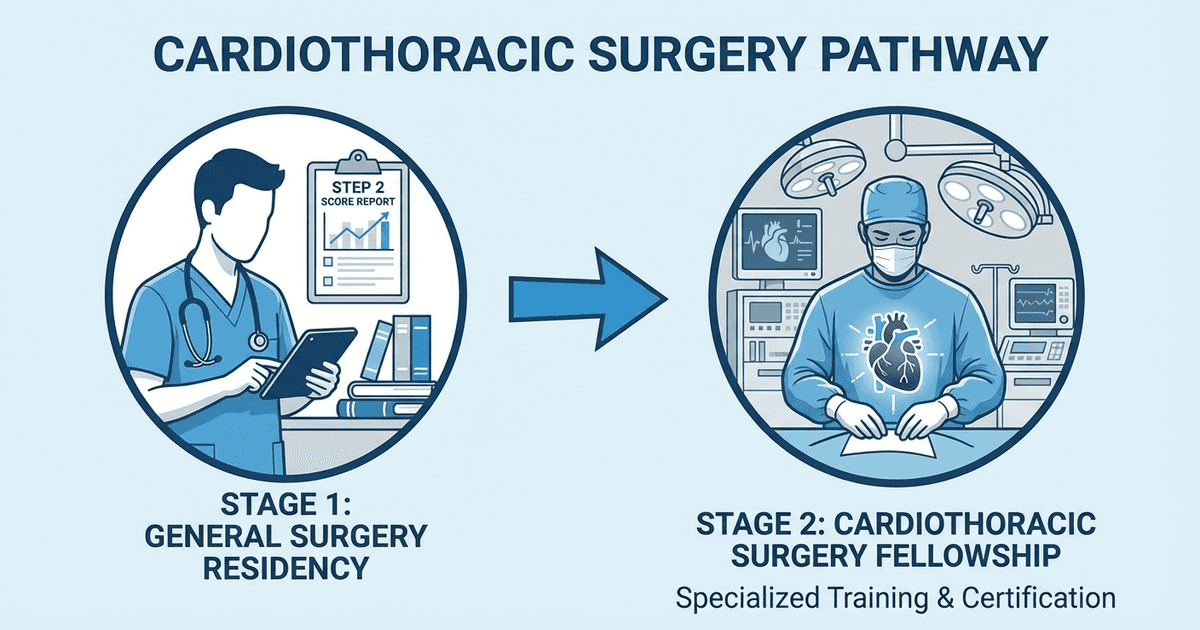
You are probably wondering why cardiothoracic surgery "residency" applications aren't open on ERAS. Here is the reality: cardiothoracic surgery isnt a direct residency match. You cant apply straight out of medical school. The path requires completing general surgery residency first, then applying for a competitive CT surgery fellowship.
This two-stage pathway changes everything about your preparation strategy. Your Step 2 CK score needs to get you into general surgery residency, which then becomes your gateway to CT surgery fellowship. The minimum Step 2 score for general surgery is 245, but competitive CT surgery fellowship applicants typically scored 255+ on Step 2 during their residency applications.
Most students dont realize this pathway complexity until its too late. General surgery match rates hover around 80% for US medical graduates, but CT surgery fellowship acceptance rates drop to just 65-70% even for general surgery residents. The competition intensifies at every stage.
Understanding the Cardiothoracic Surgery Pathway
Cardiothoracic surgery requires a specific educational sequence that cant be bypassed. You must complete 5 years of general surgery residency before becoming eligible for CT surgery fellowship applications.
Stage 1: Medical School → General Surgery Residency
Your first milestone is matching into general surgery residency. This happens during your final year of medical school through the standard NRMP Match process. General surgery programs evaluate candidates based on:
Step 2 CK score: 245+ minimum, 255+ competitive
Step 1 score: Pass/fail since 2022, but prior numerical scores still matter
Research experience: 3-5 publications minimum
Clinical grades: Honors in surgery and medicine rotations
USCE experience: For international medical graduates
Stage 2: General Surgery Residency → CT Surgery Fellowship
After completing PGY-5 in general surgery, you can apply for CT surgery fellowship during your chief year. Fellowship programs look for:
Board eligibility: Must be eligible for general surgery boards
Research productivity: 10-15 publications during residency
Operative experience: Strong cardiac and thoracic case logs
Letters of recommendation: From CT surgery faculty
Geographic flexibility: Only 75 CT surgery fellowship spots nationwide
The timeline means you wont start practicing cardiothoracic surgery until 8-9 years after medical school graduation.
Step 2 CK Score Requirements for General Surgery
Your Step 2 CK score is crucial for the first stage of this pathway. Recent match data shows clear score thresholds for general surgery residency success.
Minimum Competitive Scores by Applicant Type
Applicant Category | Minimum Score | Competitive Score | Match Rate |
|---|---|---|---|
US MD | 245 | 255+ | 85% |
US DO | 250 | 260+ | 78% |
US IMG | 255 | 265+ | 65% |
Non-US IMG | 260 | 270+ | 45% |
These numbers reflect the reality that general surgery is becoming more competitive. Programs receive 3,000+ applications for 1,200 spots annually.
Score Distribution Among Matched Applicants
The Step 2 CK score distribution for matched general surgery residents shows the importance of high performance:
Top quartile (270+): 25% of matched applicants
Second quartile (255-269): 35% of matched applicants
Third quartile (240-254): 30% of matched applicants
Bottom quartile (<240): 10% of matched applicants
Scoring in the top two quartiles significantly improves your chances. When preparing cardiac pathophysiology cases, focus on the complex scenarios that differentiate high scorers from average performers.
CT Surgery Fellowship Competition in 2026
The second stage of competition occurs during your general surgery chief year. CT surgery fellowship is among the most competitive subspecialties in surgery.
Fellowship Match Statistics
Total positions: 75 fellowship spots across 50+ programs
Applications per position: 8-10 applicants per spot
Match rate: 65-70% of applicants match
Unmatched applicants: Often reapply after additional research years
What Fellowship Programs Want
CT surgery fellowship directors prioritize specific qualifications during selection:
Research Portfolio (40% of selection criteria)
First-author publications: 5+ papers minimum
Total publications: 15-20 papers during residency
Research focus: Cardiac surgery, thoracic surgery, or related fields
Conference presentations: National society meetings
Clinical Performance (35% of selection criteria)
General surgery board scores: Top quartile performance
Operative skills assessment: Excellent evaluations
Case variety: Cardiac and thoracic surgery exposure
Leadership roles: Chief resident experience
Professional Network (25% of selection criteria)
Letters from CT surgeons: 2-3 strong recommendations
Away rotations: 1-2 CT surgery rotations at target programs
Research mentorship: Established relationships with faculty
Geographic connections: Regional program familiarity
Success requires planning these elements throughout your general surgery residency, not just during fellowship application season. Many successful applicants start building relationships and research portfolios during their PGY-2 and PGY-3 years.
Building Your Competitive Profile Early
Since the pathway to CT surgery takes 8-9 years, early strategic planning makes the difference between matching and not matching.
Medical School Strategy (Years 1-4)
Your medical school years set the foundation for general surgery residency applications. Focus on these priorities:
Academic Performance
Target Step 2 CK scores of 260+ for maximum flexibility
Earn Honors grades in surgery and internal medicine rotations
Maintain top 25% class rank if your school provides rankings
Research Development
Start research during pre-clinical years
Target cardiac surgery or thoracic surgery labs
Aim for 2-3 publications before residency applications
Present at regional surgery meetings
Clinical Exposure
Complete surgery rotations at multiple institutions
Seek cardiothoracic surgery observerships
Build relationships with general surgery faculty
Document interest through consistent involvement
Residency Strategy (Years 5-9)
Your general surgery residency years require sustained focus on CT surgery fellowship preparation while excelling in general surgery training.
Research Productivity
Join established CT surgery research projects
Develop independent research interests
Target high-impact cardiothoracic surgery journals
Present at Society of Thoracic Surgeons meetings
Clinical Excellence
Rotate through CT surgery services early in residency
Request cardiac surgery cases during cardiac rotations
Master relevant procedures: chest tubes, central lines, cardiac catheterization
Build reputation for reliability and surgical skill
Professional Networking
Complete away rotations at target fellowship programs
Attend cardiothoracic surgery conferences
Join relevant professional societies early
Maintain mentor relationships from medical school
The key insight most residents miss: CT surgery fellowship preparation should start during PGY-1, not PGY-4. Programs want evidence of sustained interest and commitment, not last-minute career changes.
Study Strategies for Step 2 Success
Your Step 2 CK preparation should emphasize the cardiac and surgical pathophysiology that will serve you throughout the CT surgery pathway.
High-Yield Topics for Future CT Surgeons
Focus your Step 2 preparation on these areas that bridge into cardiothoracic surgery:
Cardiac Pathophysiology
Valvular disease presentations and hemodynamics
Heart failure pathophysiology and management
Coronary artery disease and acute coronary syndromes
Congenital heart disease in adults
Cardiac arrhythmias and electrophysiology basics
During Step 2 prep, dive deep into cardiac tamponade recognition — this knowledge transfers directly to post-cardiac surgery emergencies you will manage as a resident.
Thoracic Medicine
Pleural effusion evaluation and management
Pneumothorax recognition and treatment
Lung cancer staging and surgical indications
Pulmonary embolism diagnosis and management
Respiratory failure and mechanical ventilation
Perioperative Medicine
Preoperative cardiac risk assessment
Perioperative medication management
Postoperative complication recognition
Fluid and electrolyte management
Pain management strategies
Effective Study Methods
Use active learning methods that build the pattern recognition skills essential for both Step 2 success and future surgical training:
Case-Based Learning
Work through complex cardiac scenarios
Practice interpreting ECGs, echocardiograms, and chest imaging
Focus on emergency presentations requiring rapid diagnosis
Master hemodynamic calculations and interpretation
The cardiothoracic surgery question bank includes vignettes spanning cardiac surgery emergencies and perioperative care scenarios that appear frequently on Step 2. Spaced Repetition
Review cardiac pathophysiology daily using flashcards
Space cardiac surgery knowledge over weeks and months
Connect basic science concepts to clinical presentations
Reinforce procedural indications and contraindications
Use cardiology flashcards to master high-yield cardiac pathophysiology facts that form the foundation for advanced CT surgery knowledge. Long-Term Planning
Create study schedules that extend beyond Step 2
Connect Step 2 topics to future residency learning
Build knowledge frameworks for continued expansion
Track progress across multiple timeframes
Consider using structured study plans designed for the extended pathway from Step 2 through general surgery residency to CT surgery fellowship preparation.
Alternative Pathways and Timing Considerations
While the traditional 5-year general surgery pathway is most common, several alternative routes exist for cardiothoracic surgery training.
Integrated CT Surgery Residency
A few programs offer 6-year integrated CT surgery residency that combines general surgery and CT surgery training:
Program Characteristics
Total spots: 8-10 positions annually across 4 programs
Application timing: Directly from medical school
Competition level: Extremely high (300+ applicants per spot)
Requirements: 270+ Step 2 scores, extensive research
Integrated Programs (2026)
Harvard/Brigham and Women's Hospital
Johns Hopkins University
University of Pennsylvania
Stanford University
These programs are exceptionally competitive and require Step 2 CK scores in the 270+ range with extensive research portfolios during medical school.
Thoracic Surgery vs Cardiac Surgery
Some programs offer separate fellowships in cardiac surgery or thoracic surgery rather than combined cardiothoracic training:
Cardiac Surgery Fellowship
Focus: Adult cardiac surgery, congenital heart surgery
Length: 2-3 years post-general surgery
Case volume: 150-200 major cardiac cases
Thoracic Surgery Fellowship
Focus: Lung surgery, esophageal surgery, mediastinal surgery
Length: 1-2 years post-general surgery
Case volume: 100-150 major thoracic cases
Combined CT Surgery Fellowship
Focus: Full spectrum cardiac and thoracic surgery
Length: 2-3 years post-general surgery
Case volume: 200+ combined cardiac and thoracic cases
International Training Options
Some US medical graduates pursue cardiothoracic surgery training abroad before returning for US practice:
Common International Programs
United Kingdom: 6-year cardiothoracic surgery training
Australia: 6-year cardiothoracic surgery training
Canada: 5+2 pathway similar to US system
Considerations for International Training
ECFMG certification requirements for return to US
Board certification pathway complications
Extended timeline (8-10 years total)
Limited US job opportunities without US training
Most international training routes require additional US fellowship or board certification processes for US practice eligibility.
Timeline Planning and Key Milestones
Success in the CT surgery pathway requires hitting specific milestones at predetermined timepoints. Missing these targets significantly reduces your competitiveness.
Medical School Timeline (Years 1-4)
Year 1-2: Foundation Building
Establish research relationships in cardiac/thoracic surgery
Excel in basic science courses, especially physiology and anatomy
Begin shadowing cardiothoracic surgeons
Join relevant student organizations
Year 3: Clinical Performance
Target Honors in surgery and internal medicine rotations
Complete cardiothoracic surgery observership
Publish first research abstracts or case reports
Build relationships with surgery faculty
Year 4: Application Preparation
Take Step 2 CK by June (target 260+ scores)
Complete away rotations in general surgery
Finalize research publications (target 2-3 papers)
Submit general surgery residency applications
Residency Timeline (Years 5-9)
PGY-1: Research Foundation
Join cardiothoracic surgery research lab
Complete basic surgery rotations with excellence
Begin long-term research projects
Attend cardiothoracic surgery conferences
PGY-2: Clinical Development
Complete cardiothoracic surgery rotation
Publish research from PGY-1 projects
Present at regional surgery meetings
Build mentor relationships with CT surgery faculty
PGY-3: Leadership Development
Take on research leadership roles
Complete additional CT surgery rotations
Begin fellowship program research
Publish 3-5 papers annually
PGY-4: Fellowship Preparation
Complete away rotations at target programs
Finalize research portfolio (10-15 publications)
Secure letters of recommendation
Submit fellowship applications
PGY-5: Chief Year and Matching
Complete fellowship interviews
Match into CT surgery fellowship
Begin advanced cardiac and thoracic surgery training
Prepare for board certification
This timeline requires sustained effort across 8-9 years. Students who succeed treat CT surgery preparation as a long-term commitment rather than a series of short-term goals.
Red Flags That Hurt Your Application
Certain patterns in your application can significantly reduce your competitiveness for general surgery residency and subsequent CT surgery fellowship.
Academic Red Flags
Step Score Inconsistency
Large gaps between Step 1 (if numerical) and Step 2 scores
Multiple attempts on any Step exam
Scores below specialty minimums without compelling explanations
Clinical Performance Issues
Repeated comments about professionalism or reliability
Below-expectations grades in surgery rotations
Lack of surgical exposure during clinical years
Research Red Flags
Quantity Without Quality
High publication numbers with minimal first-author papers
Research unrelated to surgery or cardiothoracic surgery
Lack of presentations at relevant conferences
Timing Issues
All research completed during final year of medical school
No sustained research relationships
Publications in predatory journals
Professional Red Flags
Geographic Inflexibility
Applying only to programs in desirable locations
Unwillingness to complete away rotations
Limited geographic diversity in application list
Commitment Questions
Late decision to pursue surgery
Frequent career interest changes
Lack of sustained involvement in surgical activities
Communication Issues
Poor interview performance
Inappropriate social media presence
Negative references from clinical faculty
These red flags compound over time. Address them early rather than hoping they wont impact your applications.
Financial Planning for Extended Training
The 8-9 year pathway to cardiothoracic surgery requires careful financial planning due to extended training periods and delayed attending income.
Training Phase Income
Medical School (4 years)
Average debt accumulation: $200,000-300,000
Living expenses: $20,000-40,000 annually
Board exam costs: $3,000-5,000 total
General Surgery Residency (5 years)
Resident salary: $55,000-65,000 annually
Debt interest accumulation during deferment
Living expenses in expensive residency locations
CT Surgery Fellowship (2-3 years)
Fellowship salary: $65,000-75,000 annually
Continued debt interest accumulation
Potential relocation costs for fellowship
Post-Training Financial Outlook
Cardiothoracic Surgery Attending Salary
Starting salary: $450,000-600,000 annually
Mid-career salary: $600,000-800,000 annually
Geographic variation: 20-30% salary differences
Private practice vs academic differences: 15-25%
Debt-to-Income Considerations
Total debt at attending start: $300,000-400,000
Debt-to-income ratio: 50-70% initially
Loan forgiveness programs: Limited for specialists
Typical payoff timeline: 5-10 years as attending
Plan for extended debt accumulation and delayed income compared to other medical specialties. Consider geographic location costs during training when evaluating program choices.
Frequently Asked Questions
Can you apply directly to cardiothoracic surgery residency from medical school?
No, with very rare exceptions. Only 4 programs in the US offer integrated 6-year cardiothoracic surgery residency that accepts medical students directly. These programs accept 8-10 residents total annually and are extremely competitive (300+ applicants per spot). The standard pathway requires completing 5 years of general surgery residency first.
What Step 2 CK score do you need for general surgery residency?
The minimum competitive Step 2 CK score for general surgery is 245 for US medical graduates, 250 for US DOs, and 255+ for international medical graduates. However, successful CT surgery fellowship applicants typically scored 255+ on Step 2 during their original residency applications. Higher scores provide more program options and better fellowship preparation.
How many CT surgery fellowship spots are available each year?
Approximately 75 cardiothoracic surgery fellowship positions are available annually across 50+ programs nationwide. With 8-10 applicants per position, only 65-70% of applicants successfully match. Unmatched applicants often take additional research years and reapply.
When should you start preparing for CT surgery fellowship during residency?
Begin fellowship preparation during PGY-1, not PGY-4. Successful applicants start research projects, build faculty relationships, and complete CT surgery rotations early in residency. Programs want evidence of sustained interest, not last-minute career changes. Target 3-5 publications annually during residency years.
Are there alternative pathways to cardiothoracic surgery?
Yes, several alternatives exist: integrated 6-year programs (extremely competitive), separate cardiac surgery or thoracic surgery fellowships (rather than combined CT surgery), and international training programs. Some programs offer 1-year focused fellowships in specific areas like congenital heart surgery or lung transplantation after completing general CT surgery training.
How long does it take to become a practicing cardiothoracic surgeon?
The total timeline is 8-9 years after medical school graduation: 5 years of general surgery residency plus 2-3 years of CT surgery fellowship. Integrated programs reduce this to 6 years but are extremely rare. Additional subspecialty fellowships can extend training to 10+ years for highly specialized areas like pediatric cardiac surgery.
---
Prepare smarter with Oncourse AI — adaptive MCQs, spaced repetition, and AI explanations built for USMLE Step 2. Download free on Android and iOS.