Average Step 2 Score: How Rezzy Tutor + Explanation Chat Changes USMLE Prep
Discover how USMLE Step 2 CK average scores have shifted in 2026 and how Rezzy AI tutor with explanation chat transforms weak area remediation for 20-40 point improvements.
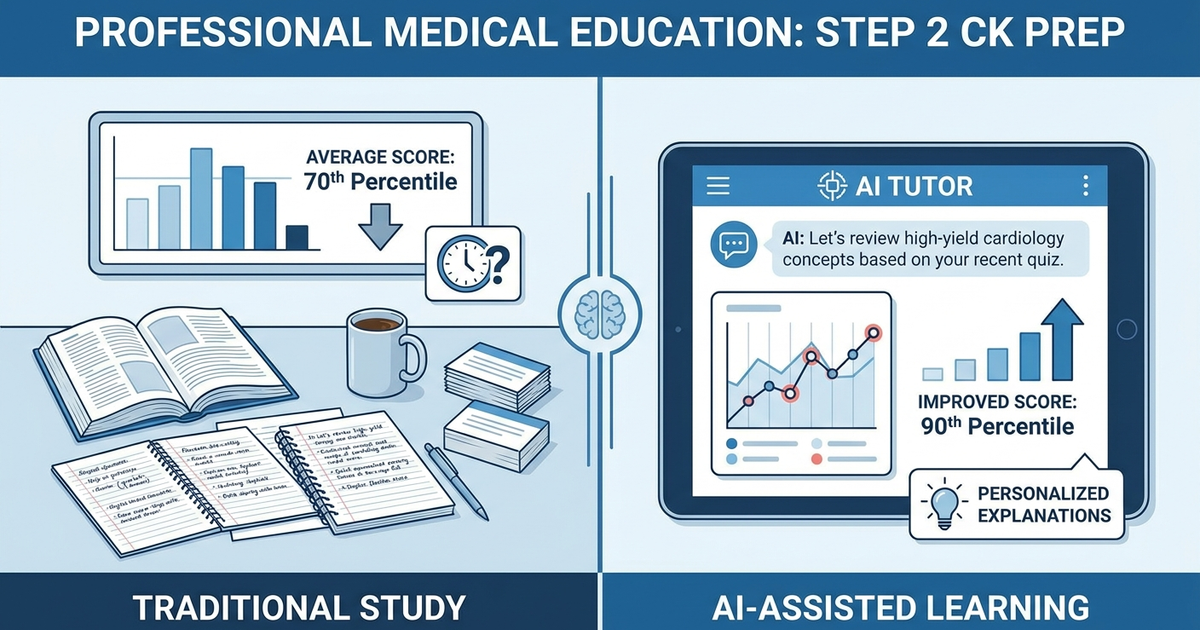
Average Step 2 Score: How Rezzy Tutor + Explanation Chat Changes USMLE Prep
You are staring at your latest NBME score. 237. Not bad, but not the 255+ you need for your target specialty. You know the drill — more UWorld blocks, more content review, more late nights grinding through explanations that dont quite stick. But here's what you probably havent considered: the average Step 2 score isnt moving because students are studying harder. It's moving because the smart ones are studying differently.
The 2026 data is clear. Average Step 2 CK scores for first-time US medical graduates hover around 250, with matched applicants in competitive specialties averaging 255-260+. But here's the kicker — scores arent just higher. The gap between average and excellent is getting narrower, which means every point counts more than ever.
This is where Rezzy tutor and explanation chat change everything. Not because they give you more content (you already have enough), but because they give you the right content at the right moment, personalized to exactly what you're missing.
Understanding Average Step 2 CK Scores in 2026
The landscape has shifted dramatically since Step 1 went pass/fail. Your Step 2 CK score is now the primary numeric benchmark residency programs use for initial screening, and the stakes couldnt be higher.
Current Score Benchmarks
Overall Statistics:- Average first-time taker (US MD): 250 (SD ~15)
- Passing score: 218 (increased from 214 in July 2025)
- 50th percentile: ~249
- 75th percentile: ~256
- 90th percentile: ~265
- 218-224: 3rd-6th percentile
- 230: 12th-17th percentile
- 240: 26th-36th percentile
- 245: 37th-49th percentile
- 250: 50th-62nd percentile
- 255: 63rd-75th percentile
- 260: 76th-86th percentile
Specialty-Specific Requirements
The data shows stark differences in what constitutes a competitive Step 2 score depending on your target specialty.
Ultra-Competitive (255-265+ expected):- Dermatology: 257 average for matched MDs
- Orthopedic Surgery: 258 average
- Plastic Surgery: 256 average
- Neurosurgery: 255 average
- Radiation Oncology: 256 average
- Internal Medicine: 250 average
- Emergency Medicine: 248 average
- Radiology: 252 average
- Anesthesiology: 249 average
- Family Medicine: 244 average
- Psychiatry: 246 average
- Pediatrics: 247 average
- Pathology: 242 average
Why Traditional Study Methods Hit a Ceiling
Most students plateau around their second pass of major question banks. They've seen the high-yield topics, memorized the classic presentations, and can recite treatment algorithms. Yet their scores stagnate in the 240-250 range.
The problem isnt knowledge volume — it's knowledge application. Step 2 CK doesnt test what you know. It tests how you think through what you know when the case doesnt fit the textbook exactly.
The Three Types of Errors That Keep Scores Average
Based on performance analysis of thousands of Step 2 test-takers, missed questions fall into three categories:
1. Knowledge gaps (20-30% of errors): You legitimately dont know the content
2. Reasoning errors (50-60% of errors): You know the facts but cant synthesize them correctly
3. Timing/careless errors (10-20% of errors): You know the answer but make preventable mistakes
Most students treat everything like a knowledge gap. They read more, review more, and add more Anki cards. But if 70% of your errors are reasoning-based, more content review is like bringing a hammer to a chess match.
This is exactly where clinical reasoning lessons become crucial — you need to understand not just what the answer is, but why you're thinking about it wrong.
How Rezzy Tutor Transforms Your Step 2 Prep
Rezzy isnt another chatbot giving you textbook explanations. It's an AI tutor trained specifically on USMLE patterns, high-yield topics, and the reasoning frameworks that distinguish 250+ scorers from everyone else.Real-Time Error Analysis
When you miss a question about heart failure management, Rezzy doesnt just explain ACE inhibitors. It identifies exactly where your reasoning went wrong:
- Did you miss the clinical context clues?
- Are you confusing acute vs chronic management?
- Is this a knowledge gap or a pattern recognition issue?
Personalized Clinical Algorithms
Generic study resources give you the same decision trees everyone else gets. Rezzy builds algorithms based on your specific error patterns.
If you keep missing "next best step" questions in emergency scenarios, Rezzy creates a personalized decision tree emphasizing the clinical pivots you're missing:
- Stable vs unstable patient
- Rule-out vs rule-in testing
- Diagnostic vs therapeutic interventions
These become your personal shortcuts during the exam — not generic algorithms, but ones tailored to how your brain actually processes clinical scenarios.
Adaptive Explanation Depth
Here's where Rezzy gets sophisticated. It adjusts explanation complexity based on your demonstrated understanding level.
Early in your prep: detailed mechanism explanations with multiple examples
Mid-prep: pattern recognition with key differentiating features
Pre-exam: rapid recall triggers and test-taking strategies
Most importantly, when you miss something you previously understood, Rezzy flags potential knowledge decay and automatically schedules targeted review.
The Power of Explanation Chat for Weak Area Remediation
The explanation chat feature turns every missed question into a personalized tutoring session. But unlike passive reading of pre-written explanations, you can dig deeper into exactly what you dont understand.
Interactive Problem-Solving
Standard explanation: "The answer is C because patients with suspected PE and low pretest probability should get a D-dimer first."
Rezzy explanation chat conversation:
You: "Why not CT-PA directly?"
Rezzy: "Good question. Cost and radiation exposure. But here's the real test-taking insight — NBME loves efficiency algorithms. Low pretest probability + negative D-dimer rules out PE in their world. What would make you go straight to CT-PA?"
You: "High pretest probability?"
Rezzy: "Exactly. Now let me show you how they signal high vs low pretest probability in vignettes..."
This type of interactive drilling builds the pattern recognition that separates good test-takers from great ones.
Personalized Mnemonics and Memory Hooks
Rezzy creates memory devices tailored to your learning style and the specific details you tend to forget. If you keep confusing the cardiac enzymes timeline, Rezzy might create:
"CK-MB peaks at 2 days (Step 2 CK)"
"Troponin stays elevated 2 weeks (Trop-two-nin)"
These arent random mnemonics — they're generated based on your actual error patterns and what's stuck before.
Concept Connections Across Systems
One of Rezzy's most powerful features is connecting concepts across different organ systems and question types. When you miss a nephrology question about electrolytes, Rezzy shows you how the same principle applies to:
- Cardiology (arrhythmias from electrolyte imbalances)
- Endocrinology (DKA and electrolyte shifts)
- ICU management (post-op electrolyte monitoring)
The 30-Point Score Improvement Framework
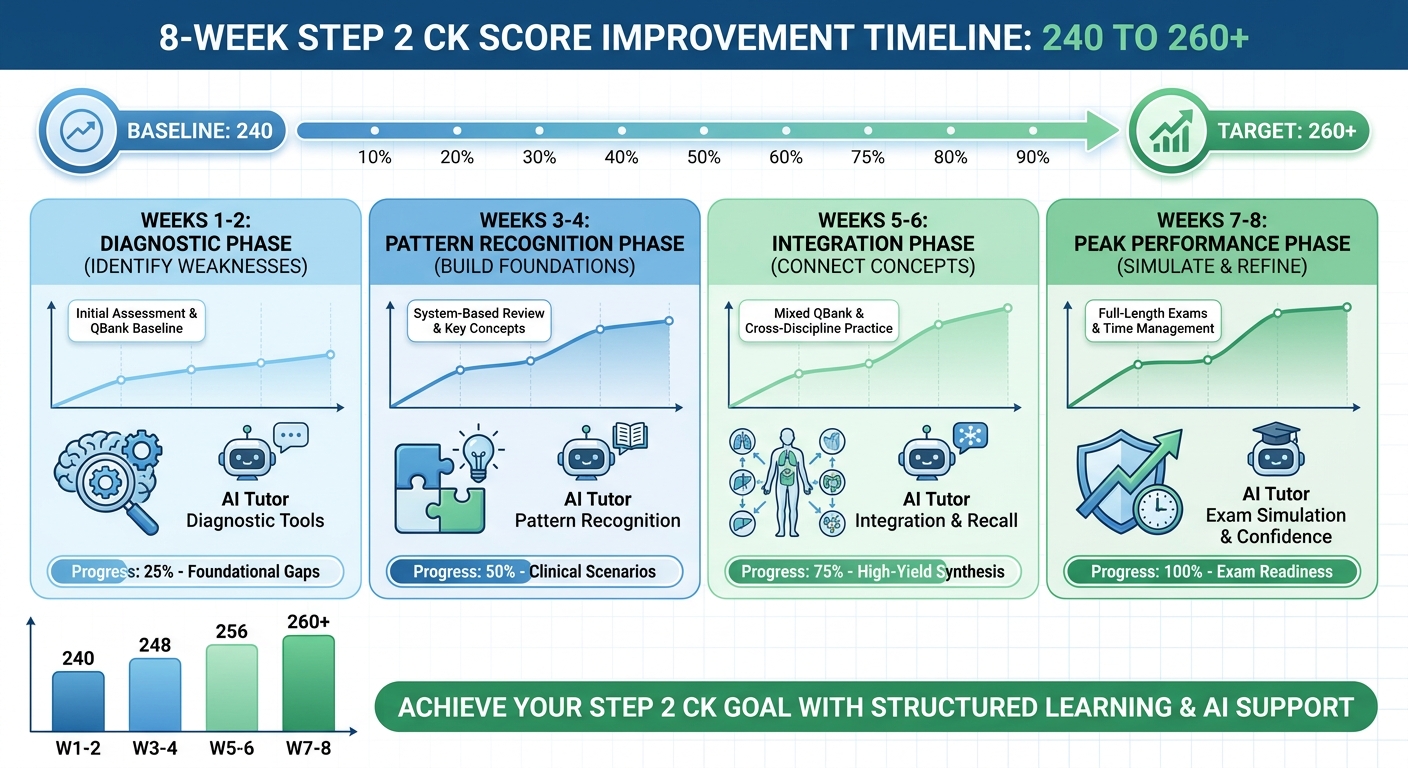
Students using Rezzy tutor with systematic weak area remediation typically see 20-40 point score improvements. Here's the framework that drives those results:
Week 1-2: Diagnostic Phase
- Take baseline NBME with Rezzy analysis
- Identify top 5 weak areas by frequency and impact
- Begin targeted Step 2 CK question practice in those areas
- Use explanation chat to understand error patterns, not just correct answers
Week 3-4: Pattern Recognition Phase
- Focus on clinical reasoning algorithms for your weak systems
- Build personalized decision trees with Rezzy
- Practice mixed blocks with real-time error categorization
- Develop shortcuts for recurring question types
Week 5-6: Integration Phase
- Shift to timed, mixed blocks that simulate exam conditions
- Use Rezzy for immediate post-block analysis
- Refine algorithms based on persistent error patterns
- Build confidence with targeted weak area drills
Week 7-8: Peak Performance Phase
- Final NBME assessment with score prediction
- Address any remaining knowledge gaps
- Perfect timing and test-taking strategies
- Use Rezzy for confidence-building review of mastered concepts
Specialty-Specific Score Strategies
Different specialties require different approaches to Step 2 prep, and Rezzy adapts its teaching style accordingly.
For Competitive Specialties (Target 255+)
If you're aiming for dermatology, orthopedics, or other ultra-competitive fields, every point matters. Rezzy focuses on:
- Advanced clinical reasoning scenarios that test higher-order thinking
- Rare but testable presentations that separate top scorers
- Precision in management decisions where multiple answers seem correct
- Speed optimization for complex multi-step vignettes
For Primary Care Specialties (Target 245+)
For family medicine, internal medicine, or pediatrics, the approach shifts to:
- Bread-and-butter clinical scenarios with focus on common presentations
- Strong foundation in outpatient management and preventive care
- Efficiency in recognizing classic patterns quickly
- Solid performance across all systems without need for expertise in rare conditions
For IMG Candidates
International medical graduates face unique challenges, typically needing scores 5-10 points higher than US graduates for equivalent competitiveness. Rezzy adapts by:
- Emphasizing US practice patterns and standard-of-care differences
- Extra focus on ethics, healthcare systems, and medico-legal scenarios
- Cultural context for patient-physician interactions
- Intensive practice with NBME-style question formatting and expectations
Real Student Success Stories
Sarah, MS4 targeting Internal Medicine: "Started with a 241 baseline. After 6 weeks with Rezzy, scored 256 on the real exam. The explanation chat was a game-changer — instead of reading the same canned explanations, I could ask exactly what I didnt understand about each question." Marcus, IMG targeting Emergency Medicine: "My weakness was clinical reasoning, not knowledge. Rezzy helped me build decision trees for common EM scenarios. Went from 238 to 251, which was enough to match at my target program." Priya, MS4 targeting Dermatology: "I was already scoring well (252 range) but needed those extra points for derm. Rezzy's advanced clinical scenarios and nuanced explanations pushed me to 261. Got 8 dermatology interviews."The pattern is consistent: students dont just memorize more facts. They develop better clinical reasoning frameworks that translate directly to higher scores.
Common Pitfalls and How to Avoid Them
Pitfall 1: Treating All Errors as Knowledge Gaps
Most students see a missed question and immediately think they need to study that topic more. But if you understood the physiology and still got it wrong, more physiology review wont help. Solution: Use Rezzy's error categorization to identify whether you missed due to knowledge gaps, reasoning errors, or timing issues. Address the actual problem, not the assumed one.Pitfall 2: Passive Review of Explanations
Reading through explanations without active engagement is one of the least effective study methods. Yet most students do exactly that. Solution: Use explanation chat to actively question and explore each missed item. Ask follow-up questions, request similar examples, and test your understanding with generated scenarios.Pitfall 3: Over-Studying Low-Yield Topics
Step 2 CK has a finite number of testable concepts. Spending hours on rare diseases that show up once per form is inefficient. Solution: Rezzy knows NBME patterns and will steer you toward high-yield topics and away from zebras. Trust the data-driven approach over your intuition about what's important.Pitfall 4: Ignoring Timing and Test-Taking Skills
A student who knows 95% of the content but runs out of time will score lower than one who knows 85% but manages time efficiently. Solution: Practice with Rezzy's timed scenarios and develop consistent approaches for different question types. Speed comes from pattern recognition, not rushing.The Science Behind Personalized Learning
Rezzy's effectiveness isn't magic — it's based on established learning science principles optimized for medical education.
Adaptive Retrieval Practice
Instead of reviewing everything equally, Rezzy uses spaced repetition algorithms to bring back your specific weak areas at optimal intervals. You'll see more cardiology if that's your weakness, more pediatrics if you're strong there but haven't seen it recently.Interleaved Practice
Rather than blocking questions by system (all cardiology, then all pulm, then all GI), Rezzy mixes topics the way the real exam does. This builds the flexible thinking Step 2 CK actually tests.Elaborative Interrogation
The explanation chat feature implements this proven technique by encouraging you to explain why answers are correct or incorrect. The act of generating explanations strengthens understanding more than passive reading.Metacognitive Awareness
Rezzy helps you understand not just what you know, but how you think about clinical problems. This "thinking about thinking" is what allows 250+ scorers to recognize when they're going down the wrong path and self-correct.Building Your Personalized Study Plan
The key to maximizing Rezzy's impact is integration with a systematic study schedule. Here's how to structure your weeks:
Daily Structure (6-8 weeks out)
- Morning: 40 questions timed block + Rezzy analysis
- Afternoon: Targeted weak area review with explanation chat
- Evening: Spaced repetition flashcards for long-term retention
Weekly Structure
- Monday-Wednesday: Focus on your two weakest systems
- Thursday-Friday: Mixed practice with all systems
- Saturday: Full-length simulated exam
- Sunday: Review and plan adjustments based on performance data
Assessment Schedule
- Baseline NBME (Week 1)
- Progress NBME (Week 4)
- Final NBME (Week 7)
- Real exam (Week 8)
Frequently Asked Questions
How much can I realistically improve my Step 2 score?
Most students see 20-40 point improvements with systematic preparation. However, this depends on your baseline score, study time available, and how efficiently you address your specific weaknesses. Students starting below 220 often see larger absolute gains than those starting above 240.Is 6 weeks enough time to see significant score improvement?
Yes, if you study efficiently. Unlike Step 1, which requires building foundational knowledge, Step 2 CK tests clinical reasoning patterns that can improve rapidly with focused practice. Many students see meaningful gains in 4-6 weeks of dedicated study.How does Rezzy compare to traditional tutoring?
Rezzy offers 24/7 availability, instant feedback, and personalized content generation that adapts to your exact learning needs. Unlike human tutors, Rezzy never gets tired, never forgets your weak areas, and has access to comprehensive NBME pattern data.Can I use Rezzy alongside other prep resources?
Absolutely. Rezzy works best when integrated with question banks like UWorld. Use UWorld for volume and variety, then use Rezzy to deeply understand your missed questions and build clinical reasoning frameworks.What if my target specialty requires a very high score?
For ultra-competitive specialties requiring 255+, Rezzy focuses on advanced clinical reasoning scenarios and nuanced case presentations that separate top scorers. The explanation chat feature is particularly valuable for mastering the subtle distinctions that matter at the highest score levels.How long should I spend in explanation chat per question?
For questions you missed due to knowledge gaps: 2-3 minutes to understand the core concept. For reasoning errors: 5-10 minutes to build decision-making frameworks and practice similar scenarios. For careless mistakes: 30 seconds to identify the pattern and move on.---
Your Step 2 CK score will largely determine which residency programs consider your application. With average scores climbing and specialty competition intensifying, you cant afford to study the same way everyone else does.
Rezzy tutor plus explanation chat gives you the personalized, data-driven approach that turns your specific weaknesses into strengths. Not through more content — you already have enough. But through better understanding of how to think through clinical scenarios the way Step 2 CK actually tests them.
The students scoring 255+ arent necessarily smarter. Theyre studying smarter. And in 2026, that means studying with AI that adapts to exactly what you need, when you need it.
Prepare smarter with Oncourse AI — adaptive MCQs, spaced repetition, and AI explanations built for USMLE success. Download free on Android and iOS.