Daniel and Lena Arden, both age 58, engage a private wealth adviser after deciding to reduce their dependence on Arden Technologies, a privately controlled software company founded by Daniel. Their current balance sheet is shown in Exhibit 1. Daniel remains chief executive and expects to receive after-tax salary of USD 300,000 during the next year. The couple has no other reliable employment income.
The Ardens spend USD 600,000 annually after tax. They also signed an agreement to purchase an adjacent property for USD 1.20 million in cash at the end of the next year. Their current cash and short-term government securities can be used for either spending or the property purchase. They want the adviser to calculate the minimum amount that must remain in liquid, low-risk assets for these two needs. No additional contingency reserve is required for this calculation.
Arden Technologies pays no dividend and is expected to be sold to a strategic buyer in approximately two years, although neither the timing nor the sale price is assured. The shares have an aggregate tax basis of USD 2.0 million. Daniel and Lena are subject to a 40% marginal tax rate on interest income and a 25% tax rate on realized long-term capital gains. They want at least half of the current company position diversified within two years, but they also want to manage the timing of taxable gains. They are unwilling to use derivatives because the company shareholders' agreement restricts hedging transactions.
Daniel tells the adviser, 'Selling shares before the transaction seems unnecessary. I understand this company better than any public investment, so I regard it as one of our safer assets.' Lena is more concerned about the position because Daniel's salary and much of their financial wealth depend on the same company. The adviser concludes that the family's willingness to accept risk is above average but that its risk capacity is moderated by the concentrated holding, correlated employment income, planned property purchase, and uncertainty surrounding the sale.
For the diversified portfolio, the Ardens are comparing the fixed-income alternatives in Exhibit 2. Both alternatives have comparable duration, credit quality after considering the municipal portfolio's insurance, and expected transaction costs. The yields are stated on the same annual basis. The Ardens reside in the jurisdiction granting the municipal portfolio's stated tax exemption.
Arden Family Balance Sheet
| Asset or liability | Current value |
|---|---:|
| Arden Technologies shares | USD 10.5 million |
| Diversified taxable portfolio | USD 5.0 million |
| Cash and short-term government securities | USD 2.5 million |
| Residence | USD 3.0 million |
| Mortgage | USD 1.0 million |
Fixed-Income Alternatives
| Investment | Yield | Tax treatment |
|---|---:|---|
| Municipal bond portfolio | 3.60% | Exempt from income tax |
| Corporate bond portfolio | 5.70% | Fully taxable |
Q1.1
The minimum one-year liquidity reserve for spending and the property purchase is closest to:
AUSD 1.20 million
BUSD 1.50 million
CUSD 1.80 million
Show answer and rationale
Answer: B. USD 1.50 million
Rationale
USD 1.50 million
Annual after-tax spending of USD 600,000 less Daniel’s USD 300,000 after-tax salary leaves a USD 300,000 funding shortfall.
Adding the USD 1.20 million property purchase gives a minimum one-year reserve of USD 300,000 + USD 1.20 million = USD 1.50 million in liquid, low-risk assets.
USD 1.20 million
This covers the property purchase but omits the USD 300,000 spending shortfall after Daniel’s salary.
With no additional contingency reserve required, the reserve must still cover both stated needs.
USD 1.80 million
Adding the full USD 600,000 of annual spending to the USD 1.20 million property payment produces USD 1.80 million.
That calculation overlooks Daniel’s USD 300,000 after-tax salary, which is available to fund part of the spending.
Q1.2
Based on Exhibit 2, the municipal portfolio's tax-equivalent yield is closest to:
A5.70%
B4.80%
C6.00%
Show answer and rationale
Answer: C. 6.00%
Rationale
6.00%
Exhibit 2 gives the municipal portfolio a 3.60% tax-exempt yield, and the Ardens’ marginal tax rate on interest income is 40%.
Its taxable-equivalent yield is 3.60% ÷ (1 − 0.40) = 6.00%.
5.70%
5.70% is the corporate bond portfolio’s stated yield in Exhibit 2, not the municipal portfolio’s tax-equivalent yield.
Taking the quoted corporate yield as the answer skips the adjustment needed to compare taxable interest with the municipal portfolio’s tax-exempt income.
4.80%
Dividing 3.60% by (1 − 0.25) gives 4.80%.
That calculation mistakenly uses the Ardens’ 25% capital gains tax rate rather than their 40% marginal tax rate on interest income.
Q1.3
The most appropriate initial strategy for the concentrated company holding is to:
AImplement staged, tax-aware sales of company shares
BRetain the shares until the planned business sale
CBorrow against the shares to purchase diversified assets
Show answer and rationale
Answer: A. Implement staged, tax-aware sales of company shares
Rationale
Implement staged, tax-aware sales of company shares
Staged sales reduce exposure to Arden Technologies while managing realized capital gains and meeting the Ardens’ goal of diversifying at least half the position within two years.
The strategy addresses the risk that both Daniel’s salary and much of the family’s wealth depend on a company that pays no dividend.
Retain the shares until the planned business sale
The expected sale in approximately two years has uncertain timing and price, so waiting does not reliably meet the Ardens’ diversification goal.
Daniel’s familiarity with Arden Technologies does not make its shares low-risk when his employment income is tied to the same company.
Borrow against the shares to purchase diversified assets
Borrowing adds leverage while leaving the Arden Technologies shares—and their company-specific risk—in place.
It is less appropriate as an initial strategy given the Ardens’ moderated risk capacity and USD 1.20 million cash property purchase next year.
Q1.4
Daniel's belief that Arden Technologies is less risky because he knows the business best reflects:
ALoss-aversion bias
BFamiliarity bias
CStatus-quo bias
Show answer and rationale
Answer: B. Familiarity bias
Rationale
Familiarity bias
Daniel regards Arden Technologies as safer because he knows the business, treating familiarity as evidence of low risk.
That judgment overlooks the concentration of family wealth in the company and Daniel’s salary dependence on it.
Loss-aversion bias
Loss aversion concerns the pain of losses relative to equivalent gains, not a belief that a familiar company is safer.
Daniel does not cite a potential loss from selling shares; he cites his knowledge of Arden Technologies.
Status-quo bias
Status-quo bias is a preference for leaving an existing position unchanged, which could help explain reluctance to sell.
It does not as directly explain Daniel’s stated belief that understanding Arden Technologies makes its shares less risky.
Q1.5Select all that apply
Which of the following statements about the Ardens' risk exposure are correct? (Select all that apply)
ADaniel's after-tax salary is correlated with the value of Arden Technologies shares.
BThe shareholders' agreement's restriction on hedging limits the ability to reduce company-specific risk using derivatives.
CThe couple's risk capacity is unaffected by the uncertain timing and price of the anticipated sale.
DLena's greater concern about the concentrated position reflects the correlation between employment income and financial wealth.
EThe municipal bond portfolio's tax exemption applies regardless of the Ardens' state of residence.
Show answer and rationale
Answer: A. Daniel's after-tax salary is correlated with the value of Arden Technologies shares.; B. The shareholders' agreement's restriction on hedging limits the ability to reduce company-specific risk using derivatives.; D. Lena's greater concern about the concentrated position reflects the correlation between employment income and financial wealth.
Rationale
Select
Daniel's after-tax salary is correlated with the value of Arden Technologies shares.
Daniel expects USD 300,000 in after-tax salary from Arden Technologies next year, and the couple has no other reliable employment income.
A setback at the company could threaten both that salary and the value of their USD 10.5 million shareholding.
The shareholders' agreement's restriction on hedging limits the ability to reduce company-specific risk using derivatives.
The shareholders' agreement restricts hedging transactions, so derivatives are not an available way to offset exposure to Arden Technologies.
That restriction matters because the shares are a concentrated position and the company pays no dividend.
Lena's greater concern about the concentrated position reflects the correlation between employment income and financial wealth.
Lena recognizes that Daniel's salary and much of their financial wealth depend on the same company.
Her concern accounts for a shared source of risk that Daniel overlooks when he calls the shares one of their safer assets.
Do not select
The couple's risk capacity is unaffected by the uncertain timing and price of the anticipated sale.
The sale is expected in approximately two years, but neither its timing nor price is assured.
That uncertainty moderates risk capacity because the Ardens cannot rely on receiving a particular amount from the sale when needed.
The municipal bond portfolio's tax exemption applies regardless of the Ardens' state of residence.
The case says the Ardens reside in the jurisdiction granting the municipal portfolio's tax exemption.
Their residence is relevant to the stated exemption; the case does not establish that it would apply wherever they lived.
Q1.6Fill in the blank
If the Ardens sell USD 3.0 million of Arden Technologies shares, with the tax basis allocated pro rata based on the total position's basis, the capital gains tax owed on the sale is closest to (state your answer in USD millions, rounded to two decimals):
Answer:
Show answer and rationale
Answer: 0.61
Rationale
0.61
The Arden Family Balance Sheet values the shares at USD 10.5 million, so the basis allocated to a USD 3.0 million sale is USD 3.0 million × (USD 2.0 million ÷ USD 10.5 million) = USD 0.57143 million.
The taxable gain is USD 3.0 million − USD 0.57143 million = USD 2.42857 million; at the 25% capital gains rate, tax is USD 0.60714 million, or USD 0.61 million.
Common wrong answers
0.75
Taxing the full USD 3.0 million sale proceeds at 25% produces USD 0.75 million, but incorrectly assigns no tax basis to the shares sold.
0.97
Applying the 40% interest-income rate to the USD 2.42857 million capital gain produces USD 0.97143 million, or USD 0.97 million; realized long-term gains instead use 25%.
Show case rationale
Rationale
The Ardens need near-term liquidity while reducing a concentrated, taxable company holding.
The minimum one-year reserve is USD 1.50 million: USD 600,000 of spending plus the USD 1.20 million property purchase, less Daniel’s USD 300,000 after-tax salary.
A USD 3.0 million share sale has a pro rata basis of USD 3.0 million × (USD 2.0 million ÷ USD 10.5 million); the resulting gain × 25% produces USD 0.61 million of tax, rounded to two decimals.
Company-specific risk links the Ardens’ financial wealth to Daniel’s employment income.
Staged, tax-aware sales address their diversification goal without relying on an uncertain business sale; borrowing to buy other assets would leave the company exposure in place.
Daniel’s view that the shares are safer because he knows the business reflects familiarity bias, while Lena recognizes the correlation between his salary and their wealth.
Traps in this case
Ignoring next year’s salary
Reserving USD 1.80 million for spending and the property overlooks the USD 300,000 of after-tax income available during that year.
Comparing bond yields before tax
The municipal portfolio’s tax-equivalent yield is 3.60% ÷ (1 − 40%) = 6.00%, above the corporate portfolio’s 5.70% taxable yield.
Treating the planned sale as assured
Uncertain timing and price moderate risk capacity, and the shareholders’ agreement restricts derivative hedging; the municipal exemption also depends on the Ardens’ jurisdiction.
Q2Unfolding case study
Elena Marquez, age 55, founded Arcadia Robotics and holds shares representing 62% of its voting power. The shares are publicly traded but have limited daily trading volume. Elena plans to remain chief executive for five years. Her salary and annual bonus constitute nearly all household employment income, and the bonus varies directly with Arcadia's profitability.
Elena tells her private wealth adviser that maintaining majority voting control is important until her retirement. She nevertheless wants protection against a material decline in the share price and is willing to surrender some upside appreciation to obtain that protection. She prefers to defer capital gains taxes where practical. She will not enter a strategy that requires transferring all her Arcadia shares or prevents access to the contributed assets for several years.
The remainder of the household portfolio is diversified across global public equities and investment-grade bonds. Elena has no debt, and her primary residence is not available to fund ordinary spending. She describes the residence as a legacy asset for her children. The household has a known tax payment due in six months and no other unusual cash needs during the next year.
The investment policy requires cash or short-term government securities sufficient to meet the tax payment and one full year of household spending. Assets allocated to that reserve are not included in the long-term return-seeking portfolio. Elena is comfortable with public-market volatility but recognizes that a decline in Arcadia could simultaneously reduce her portfolio value, salary security, and annual bonus.
The adviser considers an outright sale, an exchange fund, and an options-based hedging program. An exchange fund under the applicable jurisdiction permits a tax-deferred contribution of concentrated shares in exchange for an interest in a diversified pool, but contributed assets cannot be withdrawn for seven years and voting rights pass to the fund. A zero-cost collar would purchase a put and sell a call on the same number of shares, thereby establishing a downside floor and an upside cap while Elena retains legal ownership and voting rights. The adviser uses the financial information and assumptions in Exhibits 1 and 2.
Marquez Household Balance Sheet
| Item | Current value | Tax basis or liability |
|---|---:|---:|
| Arcadia Robotics shares | USD 32.0 million | USD 2.0 million basis |
| Diversified public securities | USD 8.0 million | USD 7.0 million basis |
| Primary residence | USD 4.0 million | No mortgage |
| Cash | USD 1.0 million | Not applicable |
| Tax payment due in six months | Not applicable | USD 2.0 million liability |
Applicable Planning Assumptions
A sale of Arcadia shares incurs transaction costs equal to 1% of gross proceeds. Capital gains are taxed at 25%, with transaction costs not deductible in calculating the taxable gain. Elena's annual household spending is USD 600,000, paid evenly throughout the year. Short-term government securities are treated as cash equivalents.
Q2.1
The minimum one-year liquidity reserve consistent with Elena's stated policy is closest to:
AUSD 0.6 million
BUSD 2.6 million
CUSD 3.2 million
Show answer and rationale
Answer: B. USD 2.6 million
Rationale
USD 2.6 million
The investment policy requires USD 2.0 million for the tax payment due in six months plus USD 0.6 million for one full year of spending, totaling USD 2.6 million.
The USD 1.0 million already held in cash counts toward the reserve, so Elena must allocate another USD 1.6 million to cash or short-term government securities.
USD 0.6 million
This covers one year of household spending but omits the USD 2.0 million tax payment required by the policy.
The six-month timing of the tax payment does not remove it from the one-year liquidity reserve.
USD 3.2 million
This results from adding the USD 2.0 million tax payment to two years of spending (2 × USD 0.6 million), rather than one.
The policy specifies one full year of spending, so a second year’s USD 0.6 million is not part of the minimum reserve.
Q2.2Fill in the blank
Based on Exhibits 1–2, the minimum gross proceeds from selling Arcadia shares required so that the after-tax, after-transaction-cost proceeds equal the USD 2.6 million liquidity reserve identified in Question 1 is closest to:
Answer:
Show answer and rationale
Answer: USD 3.44 million
Rationale
USD 3.44 million
Exhibit 1 gives Arcadia shares a basis of USD 2.0 million on USD 32.0 million of value, so 93.75% of gross sale proceeds is taxable gain.
Under Exhibit 2, each dollar sold nets (1-(0.25\times0.9375)-0.01=0.755625) dollars; the required gross proceeds are (USD\ 2.6\text{ million}\div0.755625\approx\mathbf{USD\ 3.44\text{ million}}).
Given Elena's five-year retention horizon as CEO and her stated desire to retain majority voting control while limiting downside risk, the strategy most appropriate for her control and risk-management objectives is to:
AEstablish a zero-cost collar on part of the position
BContribute the entire position to an exchange fund
CSell the shares and purchase a diversified portfolio
Show answer and rationale
Answer: A. Establish a zero-cost collar on part of the position
Rationale
Establish a zero-cost collar on part of the position
The purchased put limits downside on the covered shares, while the sold call finances that protection by capping their upside, which Elena is willing to surrender.
Elena retains ownership and voting rights over her shares, preserving her 62% voting position during her planned five years as CEO.
Contribute the entire position to an exchange fund
The fund offers tax-deferred diversification, but voting rights on contributed shares pass to the fund, defeating Elena’s objective of retaining majority control.
Its seven-year withdrawal restriction also conflicts with her refusal to lock up contributed assets for several years.
Sell the shares and purchase a diversified portfolio
Selling the Arcadia shares would diversify Elena’s investments but surrender the voting control she wants to keep until retirement.
A full sale would also trigger tax on the USD 30.0 million gain and transaction costs of 1% of gross proceeds, rather than deferring those costs where practical.
Q2.4
Elena's continued employment at Arcadia most likely has which effect on her capacity to hold its shares?
AIncreases risk capacity because salary is bond-like
BDecreases risk capacity because human capital is company-linked
CLeaves risk capacity unchanged because salary is not investable
Show answer and rationale
Answer: B. Decreases risk capacity because human capital is company-linked
Rationale
Decreases risk capacity because human capital is company-linked
Elena’s salary and bonus provide nearly all household employment income, and her bonus varies directly with Arcadia’s profitability.
A decline in Arcadia could therefore reduce both her share value and employment income, lowering her capacity to bear additional Arcadia share risk.
Increases risk capacity because salary is bond-like
Salary can resemble a bond-like income stream when it is stable and independent of an investor’s concentrated holdings.
Elena’s compensation depends on Arcadia, so it does not diversify the risk of holding its shares.
Leaves risk capacity unchanged because salary is not investable
Human capital matters to household risk capacity even though future earnings cannot be traded like shares.
Elena’s continued employment adds company-linked exposure through salary security and her profitability-linked bonus.
Q2.5
If, instead of selling Arcadia shares, Elena sells the entire diversified public securities portfolio in Exhibit 1 to fund the USD 2.6 million liquidity reserve, the after-tax proceeds available are closest to:
AUSD 7.67 million
BUSD 7.75 million
CUSD 8.00 million
Show answer and rationale
Answer: B. USD 7.75 million
Rationale
USD 7.75 million
The Marquez Household Balance Sheet shows an USD 8.0 million value and USD 7.0 million basis, so the USD 1.0 million gain incurs USD 0.25 million tax at the 25% rate.
After-tax sale proceeds are USD 8.0 million − USD 0.25 million = USD 7.75 million; the 1% transaction cost in Applicable Planning Assumptions applies only to Arcadia shares.
USD 7.67 million
This results from incorrectly applying the Arcadia-specific 1% transaction cost to diversified securities: USD 8.0 million − USD 0.25 million tax − USD 0.08 million cost = USD 7.67 million.
Applicable Planning Assumptions specify that cost for a sale of Arcadia shares, not for this portfolio sale.
USD 8.00 million
This is the diversified securities’ gross value in the Marquez Household Balance Sheet, before tax on the realized gain.
Ignoring the USD 0.25 million tax on the USD 1.0 million gain leaves USD 8.00 million rather than the after-tax proceeds.
Q2.6Select all that apply
Which of the following statements about Elena's total economic balance sheet are most accurate? (Select all that apply.)
AElena's salary and bonus should be modeled as a bond-like asset uncorrelated with Arcadia's share price.
BElena's human capital exposure to Arcadia amplifies the equity risk already reflected in her Arcadia shares.
CThe primary residence should be included in the one-year liquidity reserve because it is unencumbered.
DElena's total economic exposure to Arcadia includes both her financial capital and her human capital.
Show answer and rationale
Answer: B. Elena's human capital exposure to Arcadia amplifies the equity risk already reflected in her Arcadia shares.; D. Elena's total economic exposure to Arcadia includes both her financial capital and her human capital.
Rationale
Select
Elena's human capital exposure to Arcadia amplifies the equity risk already reflected in her Arcadia shares.
Elena’s bonus varies directly with Arcadia’s profitability, while her salary security also depends on the company she leads.
A decline in Arcadia could therefore reduce both the value of her USD 32.0 million shareholding and her employment income.
Elena's total economic exposure to Arcadia includes both her financial capital and her human capital.
The Marquez Household Balance Sheet records Elena’s Arcadia shares as financial capital.
Her expected salary and bonus over her remaining five years as chief executive are human capital exposed to the same company.
Do not select
Elena's salary and bonus should be modeled as a bond-like asset uncorrelated with Arcadia's share price.
Elena’s bonus varies with Arcadia’s profitability, so her compensation is not uncorrelated with the company’s fortunes.
Her salary security could also weaken if Arcadia declines, making her employment income more equity-like than bond-like.
The primary residence should be included in the one-year liquidity reserve because it is unencumbered.
Although the Marquez Household Balance Sheet shows no mortgage, Elena says the residence is a legacy asset unavailable for ordinary spending.
The required reserve must instead hold cash or short-term government securities for the tax payment and one year of household spending.
Show case rationale
Rationale
Elena’s plan turns on funding near-term needs while managing Arcadia risk without surrendering voting control.
The liquidity reserve is USD 2.6 million: the USD 2.0 million tax payment plus USD 0.6 million of annual spending; her residence is a legacy asset, not reserve cash.
A zero-cost collar limits downside and caps upside while preserving ownership and voting rights, although Elena’s Arcadia-linked salary and bonus amplify her exposure to the company.
Traps in this case
Confusing the reserve with the amount of new cash needed
Existing cash reduces the reserve shortfall to USD 1.6 million, but the Arcadia sale question asks for proceeds equal to the full USD 2.6 million, requiring USD 2.6 million ÷ [0.99 − 0.25 × (1 − 2 ÷ 32)] ≈ USD 3.44 million in gross proceeds.
Treating all sales as having the same tax cost
Selling the entire diversified securities portfolio yields USD 7.75 million after tax: USD 8.0 million less 25% of its USD 1.0 million gain.
Overlooking control and employment exposure
The exchange fund transfers voting rights and locks up assets for seven years, while a share sale sacrifices control; neither removes the additional risk from Elena’s company-linked employment income.
Q3Unfolding case study
Rina and Samuel Arden own Arden Foods, a privately held business representing 70% of their net worth. They have two adult children. Maya has worked in the company for eight years and currently manages its largest division. An independent assessment concludes that she is qualified to become chief executive after additional board-level experience. Leo is a successful physician, does not want an operating role, and prefers diversified financial assets. Both children want fair treatment, but neither has stated that fairness requires identical assets.
The parents want to retain voting control during their lifetimes and then transfer control to the child best qualified to operate the company. They also want both children to receive comparable economic value. The company's charter permits separate voting and nonvoting share classes. The jurisdiction recognizes binding shareholder agreements that can restrict transfers, establish purchase rights, and define permitted shareholders. The jurisdiction also recognizes gift and estate tax planning techniques, including grantor retained annuity trusts (GRATs), which allow a grantor to retain an annuity for a term of years before the remaining trust assets transfer to a designated beneficiary at reduced gift tax cost.
Family communication has become strained. Samuel discusses succession only with Maya because she works in the company, while Rina privately assures Leo that he will receive half of every family asset. Maya interprets her parents' silence about leadership as a lack of confidence. Leo worries that receiving company shares would expose him to an illiquid asset over which he has little practical influence. The family's adviser recommends facilitated family meetings, written employment qualifications, defined decision rights, and an independent board member.
The Ardens also want to donate appreciated publicly traded shares worth USD 5 million this year. The shares have a tax basis of USD 1 million. Under the stated tax assumptions, a contribution to either a qualifying public charity or a donor-advised fund produces the same current deduction and avoids recognition of the embedded capital gain. Contributions are irrevocable. A donor-advised fund legally controls contributed assets, although the family may recommend eligible grants. A private foundation would require annual administration, regulatory filings, and investment oversight that the family does not want.
Exhibit 1 summarizes the family's objectives. The adviser must distinguish instruments that are legally enforceable from governance practices that facilitate communication but do not independently bind shareholders.
Family Transfer Objectives
- Preserve family voting control over Arden Foods.
- Give Maya a management role based on competence, not birth order.
- Provide Leo with comparable economic value without requiring employment.
- Donate USD 5 million of appreciated public shares this year.
- Obtain a current charitable deduction while retaining advisory privileges over future grants.
Q3.1
According to Exhibit 1, the most appropriate charitable strategy is to:
AEstablish a private foundation employing family members
BContribute the shares to a donor-advised fund
CRetain the shares and make annual cash donations
Show answer and rationale
Answer: B. Contribute the shares to a donor-advised fund
Rationale
Contribute the shares to a donor-advised fund
Donating the USD 5 million of appreciated public shares this year provides the stated current deduction and avoids recognition of the gain on their USD 4 million of appreciation.
The Ardens can recommend future grants, although the contribution is irrevocable and the fund legally controls the assets.
Establish a private foundation employing family members
A private foundation would require the annual administration, regulatory filings, and investment oversight that the Ardens do not want.
Employing family members does not advance Exhibit 1’s charitable objective of retaining advisory privileges over grants.
Retain the shares and make annual cash donations
Retaining the shares does not make the planned USD 5 million contribution this year, so it does not provide the requested current deduction for that contribution.
Annual cash gifts would not use the stated opportunity to donate appreciated shares without recognizing their embedded gain.
Q3.2
The mechanism most appropriate for legally restricting transfers of voting shares is:
AA family mission statement
BA periodic family assembly
CA binding shareholder agreement
Show answer and rationale
Answer: C. A binding shareholder agreement
Rationale
A binding shareholder agreement
The jurisdiction recognizes binding shareholder agreements that restrict transfers, establish purchase rights, and define permitted shareholders of Arden Foods.
Those enforceable provisions can help preserve the Ardens’ intended voting control as ownership passes to the next generation.
A family mission statement
A family mission statement can express the Ardens’ shared values and succession goals, but it does not independently restrict voting-share transfers.
Preserving voting control requires an enforceable ownership provision rather than a statement of family intentions.
A periodic family assembly
A periodic family assembly could improve the strained communication among Rina, Samuel, Maya, and Leo, but its discussions do not bind shareholders.
Meetings can support decisions about succession and fairness, while a shareholder agreement supplies the legal transfer restriction.
Q3.3
Given the parents' desire to retain control and income during their lifetimes while eventually transferring the business to Maya at reduced gift tax cost, the most appropriate technique is to:
ATransfer shares to a grantor retained annuity trust (GRAT) that pays the parents an annuity for a term of years, with any remaining value passing to Maya
BGift all shares to Maya immediately using the full lifetime gift tax exemption
CSell the shares to Leo at fair market value in exchange for a cash lump sum
Show answer and rationale
Answer: A. Transfer shares to a grantor retained annuity trust (GRAT) that pays the parents an annuity for a term of years, with any remaining value passing to Maya
Rationale
Transfer shares to a grantor retained annuity trust (GRAT) that pays the parents an annuity for a term of years, with any remaining value passing to Maya
A GRAT gives the parents annuity payments during its term and transfers any remaining trust value to Maya at reduced gift tax cost.
The annuity does not itself preserve voting control; the Ardens must structure the transfer so they retain voting shares during their lifetimes.
Gift all shares to Maya immediately using the full lifetime gift tax exemption
An immediate gift gives up the parents’ shares now, conflicting with their wish to retain voting control and income.
Using the full lifetime exemption also misses the GRAT’s opportunity to transfer remaining value to Maya at reduced gift tax cost.
Sell the shares to Leo at fair market value in exchange for a cash lump sum
A sale to Leo directs the business toward the child who does not want an operating role, rather than Maya, who is being prepared for leadership.
A cash lump sum does not provide the parents with the GRAT’s term annuity or accomplish their planned reduced-gift-tax transfer to Maya.
Q3.4
The most appropriate next step for addressing the family's communication problem is to:
ALimit succession discussions to the parents and their attorney
BHold facilitated meetings with defined decision responsibilities
CDefer governance planning until ownership has been transferred
Show answer and rationale
Answer: B. Hold facilitated meetings with defined decision responsibilities
Rationale
Hold facilitated meetings with defined decision responsibilities
Facilitated family meetings give Maya and Leo a shared forum to discuss leadership, economic value, and their different preferences rather than relying on conflicting private assurances.
Defined decision responsibilities clarify who decides succession and governance matters while the parents retain voting control; the meetings improve communication but do not themselves bind shareholders.
Limit succession discussions to the parents and their attorney
Excluding Maya and Leo leaves Maya’s uncertainty about leadership and Leo’s concern about receiving illiquid company shares unaddressed.
Samuel’s private discussions with Maya and Rina’s assurances to Leo have already produced conflicting expectations that a parents-only discussion would not resolve.
Defer governance planning until ownership has been transferred
The Ardens need to clarify leadership qualifications and decision rights before transferring control to the child best qualified to operate Arden Foods.
Waiting would leave Maya’s and Leo’s concerns unresolved while the parents still have the voting control needed to plan the transition.
Q3.5Select all that apply
Which of the following actions are consistent with the family's objectives in Exhibit 1? (Select all that apply.)
ARestrict transfer of voting shares to family members through a binding shareholder agreement
BPromote Maya to CEO based on tenure rather than an independent competence assessment
CContribute appreciated public shares to a donor-advised fund this year
DGrant Leo an equal number of voting shares as Maya
Show answer and rationale
Answer: A. Restrict transfer of voting shares to family members through a binding shareholder agreement; C. Contribute appreciated public shares to a donor-advised fund this year
Rationale
Select
Restrict transfer of voting shares to family members through a binding shareholder agreement
Exhibit 1 calls for preserving family voting control over Arden Foods.
The jurisdiction recognizes binding shareholder agreements that restrict transfers and define permitted shareholders, making this restriction enforceable.
Contribute appreciated public shares to a donor-advised fund this year
Contributing the USD 5 million of public shares this year meets Exhibit 1’s donation objective and, under the stated assumptions, provides a current deduction without recognizing the USD 4 million embedded gain.
The family may recommend future grants, as Exhibit 1 seeks, although the contribution is irrevocable and the donor-advised fund legally controls the assets.
Do not select
Promote Maya to CEO based on tenure rather than an independent competence assessment
Exhibit 1 requires a management role based on competence, not tenure or birth order.
The independent assessment finds Maya qualified to become chief executive after additional board-level experience, so her eight years at Arden Foods alone do not justify promotion.
Grant Leo an equal number of voting shares as Maya
Equal voting shares would divide control rather than direct it to the child best qualified to operate Arden Foods after the parents’ lifetimes.
Leo wants diversified assets and no operating role; comparable economic value does not require him to receive identical voting shares.
Q3.6Ordered response
Order the following steps the Arden family should take to implement the recommended succession and governance plan, from first to last.
Conduct facilitated family meetings to define decision rights and expectations
Formalize the binding shareholder agreement restricting share transfers
Complete the transfer of voting control to the qualified child
Show answer and rationale
Answer: 1. Conduct facilitated family meetings to define decision rights and expectations; 2. Formalize the binding shareholder agreement restricting share transfers; 3. Complete the transfer of voting control to the qualified child
Rationale
Conduct facilitated family meetings to define decision rights and expectations → Formalize the binding shareholder agreement restricting share transfers → Complete the transfer of voting control to the qualified child
Facilitated meetings address the Ardens’ conflicting private assurances and clarify how leadership, voting power, and economic value will be handled.
A binding shareholder agreement should protect the agreed ownership structure before voting control passes to the qualified successor, consistent with the parents retaining control during their lifetimes.
1. Conduct facilitated family meetings to define decision rights and expectations
Samuel’s discussions with Maya and Rina’s assurances to Leo have created different expectations that need to be addressed before legal terms are set.
2. Formalize the binding shareholder agreement restricting share transfers
The jurisdiction recognizes agreements that restrict transfers and define permitted shareholders, making this the enforceable step after expectations are clarified.
3. Complete the transfer of voting control to the qualified child
Maya is the identified prospective successor, but she needs additional board-level experience, and the parents intend to retain voting control during their lifetimes.
Common wrong orders
Transfer control before agreeing on governance
Doing so would act on Maya’s prospective qualification before resolving Leo’s concerns and the family’s decision rights.
Restrict transfers before the family meetings
A binding restriction set before the discussions could lock in terms without addressing the family’s conflicting expectations.
Show case rationale
Rationale
The plan separates voting control, economic value, and management responsibility.
The parents can retain voting control during their lifetimes and ultimately transfer it to the qualified operator, while providing Leo comparable value through assets that do not require him to manage an illiquid business.
The sequence is to hold facilitated family meetings to clarify expectations and decision rights, formalize transfer restrictions in a binding shareholder agreement, and then complete the transfer of voting control.
The charitable choice depends on advisory privileges, not continued ownership.
Contributing the USD 5 million of appreciated public shares to a donor-advised fund meets the current-deduction and grant-advisory objectives while avoiding recognition of the USD 4 million embedded gain.
The contribution is irrevocable: the fund legally controls the shares, and the family may recommend, but not direct, eligible grants.
Traps in this case
Treating equal treatment as identical voting shares
Leo wants diversified assets rather than an operating role, and Maya’s eight years at Arden Foods do not replace the independent assessment or her need for additional board-level experience.
Confusing family governance with enforceable restrictions
Meetings and a mission statement can improve strained communication, but only a binding shareholder agreement can impose the contemplated share-transfer restrictions.
Choosing an instrument that defeats another objective
An immediate gift to Maya would not preserve the parents’ present control, whereas a GRAT retains an annuity for a term before remaining value passes to her at reduced gift tax cost; a private foundation adds administration the family does not want.
Q4Unfolding case study
Eleanor Morgan, age 72, owns Morgan Foods, a privately held regional food producer. Her daughter, Lena, manages the company and is expected to succeed Morgan as chief executive. Her son, James, is not involved in the business. Morgan's estate assets are presented in Exhibit 1. She has no debt and has made no prior taxable gifts.
Morgan's will transfers her assets to her children after making the charitable bequest described in Exhibit 2. She wants Lena eventually to control Morgan Foods, but she does not want family disagreements about distributions, employment, or ownership to interfere with the operating board. The existing board consists of Lena, two senior executives, and two independent directors. Morgan is considering adding all adult descendants to the board so that every family branch is represented. Her adviser instead raises the possibility of creating a separate family-governance body responsible for family education, communication, and owner-policy matters.
Morgan is also deciding whether to transfer her marketable securities during life or retain them until death. Her children intend to sell those securities shortly after receiving them. For this decision, Morgan's sole stated objective is to minimize capital gains tax attributable to the securities' existing appreciation. Ignore subsequent changes in market value and any potential estate-tax effect of post-transfer appreciation.
Morgan intends to formalize the family's charitable activity this year. She wants an immediate charitable deduction, a single account from which the family can recommend grants over many years, minimal administrative responsibility, and the option to make grants anonymously. She does not need legally binding control over the recipient organizations and does not intend to employ staff to operate a charitable entity.
The jurisdiction follows all tax and legal assumptions in Exhibit 2. The estate-tax calculation is based on current fair market values, with no valuation discounts for the business interest. Morgan's estate has sufficient liquidity to pay any tax calculated, so the tax calculation does not depend on selling a specific asset. The governance, basis-planning, charitable-planning, and estate-tax questions are independent.
Morgan Estate Assets
| Estate asset | Fair market value | Income-tax basis |
|---|---:|---:|
| Morgan Foods shares | USD 18.0 million | USD 2.0 million |
| Marketable securities | USD 12.0 million | USD 3.0 million |
| Residence and other property | USD 8.0 million | USD 6.0 million |
| **Gross estate** | **USD 38.0 million** | |
Estate and Charitable Planning Assumptions
The estate-tax exemption is USD 15.0 million, and the estate-tax rate is 40%. A USD 3.0 million charitable bequest qualifies for an unlimited estate-tax charitable deduction. Ignore debts, administration expenses, and state taxes. Assets included in the estate receive a basis equal to fair market value at death. Lifetime gifts retain the donor's basis. A donor-advised fund provides an immediate charitable deduction, permits nonbinding grant recommendations, allows anonymous grants, and is administered by the sponsoring charity.
Q4.1
Based on Exhibits 1–2, the calculated federal estate-tax liability is closest to:
AUSD 6.00 million
BUSD 8.00 million
CUSD 9.20 million
Show answer and rationale
Answer: B. USD 8.00 million
Rationale
USD 8.00 million
Exhibit 1 gives a USD 38.0 million gross estate; subtracting Exhibit 2’s USD 3.0 million charitable deduction and USD 15.0 million exemption leaves USD 20.0 million taxable.
Applying Exhibit 2’s 40% estate-tax rate to USD 20.0 million produces USD 8.0 million.
USD 6.00 million
This results from applying 30% instead of Exhibit 2’s 40% rate to the correct USD 20.0 million taxable amount.
At the stated 40% rate, USD 20.0 million produces USD 8.0 million, not USD 6.0 million.
USD 9.20 million
This results from omitting the USD 3.0 million charitable deduction: (USD 38.0 million − USD 15.0 million) × 40% = USD 9.2 million.
Exhibit 2 states that the charitable bequest qualifies for an estate-tax deduction, reducing the liability to USD 8.0 million.
Q4.2
Assuming Morgan's sole objective is minimizing capital gains tax on the marketable securities, the most appropriate action is to:
AGift the securities now to increase the children's basis
BSell the securities now and gift the after-tax proceeds
CRetain the securities for transfer at death
Show answer and rationale
Answer: C. Retain the securities for transfer at death
Rationale
Retain the securities for transfer at death
Under Estate and Charitable Planning Assumptions, securities included in Morgan’s estate receive a basis equal to their fair market value at death.
At the stated USD 12.0 million value, that basis eliminates the USD 9.0 million of existing appreciation (USD 12.0 million − USD 3.0 million) when the children sell.
Gift the securities now to increase the children's basis
Estate and Charitable Planning Assumptions specify that a lifetime gift retains the donor’s basis, so the children would receive Morgan’s USD 3.0 million basis.
Selling at the stated USD 12.0 million value would therefore leave the existing USD 9.0 million gain subject to capital gains tax.
Sell the securities now and gift the after-tax proceeds
Morgan’s sale at the stated USD 12.0 million value would realize a USD 9.0 million gain over her USD 3.0 million basis.
Gifting the proceeds afterward would not undo the capital gains tax triggered by her sale.
Q4.3
Based on Exhibit 2, the charitable vehicle most appropriate for Morgan's stated preferences is to:
AEstablish a donor-advised fund
BEstablish a private foundation
CMake separate unrestricted donations
Show answer and rationale
Answer: A. Establish a donor-advised fund
Rationale
Establish a donor-advised fund
Under Estate and Charitable Planning Assumptions, a donor-advised fund provides an immediate charitable deduction and lets Morgan recommend grants over many years from one account.
The sponsoring charity handles administration, grants may be anonymous, and Morgan does not require binding control over recipients.
Establish a private foundation
A private foundation generally entails more administration and reporting than Morgan wants, particularly when she does not intend to employ staff.
Its greater control over grantmaking offers little benefit because Morgan is content to make nonbinding recommendations.
Make separate unrestricted donations
Separate donations may qualify for charitable deductions but would not establish the single account Morgan wants for multiyear family giving.
Making donations individually also lacks the donor-advised fund’s combination of sponsor administration and an option for anonymous grants.
Q4.4
The most appropriate governance response to Morgan's concern about mixing family and business decisions is to:
AExpand the operating board to include all descendants
BAssign family disputes to the company's chief executive
CEstablish a family council separate from the operating board
Show answer and rationale
Answer: C. Establish a family council separate from the operating board
Rationale
Establish a family council separate from the operating board
A family council gives Morgan’s descendants a forum for communication, education, and policies on distributions, employment, and ownership.
Keeping it separate lets the existing operating board focus on Morgan Foods’ business oversight rather than family disagreements.
Expand the operating board to include all descendants
Morgan’s proposed expansion would bring family disagreements onto the very board she wants to protect from them.
Family membership alone does not establish the business expertise needed for board oversight.
Assign family disputes to the company's chief executive
Making Lena, the expected chief executive, responsible for family disputes would mix family governance with operating management.
A separate family council can address those disputes without diverting the chief executive from running Morgan Foods.
Q4.5Fill in the blank
Based on Exhibit 1, calculate the total step-up in income-tax basis (in USD millions) for the Morgan Foods shares and marketable securities if both assets are included in the estate at death and receive a basis adjustment to fair market value.
Answer:
Show answer and rationale
Answer: USD 25.0 million
Rationale
USD 25.0 million
Morgan Foods shares step up by USD 16.0 million: USD 18.0 million fair market value minus USD 2.0 million basis.
Marketable securities step up by USD 9.0 million: USD 12.0 million minus USD 3.0 million, bringing the total to USD 25.0 million.
Common wrong answers
USD 16.0 million
This includes the step-up for Morgan Foods shares but omits the securities’ USD 9.0 million step-up.
USD 9.0 million
This includes the securities’ step-up but omits the shares’ USD 16.0 million step-up.
USD 30.0 million
This adds the two fair market values, USD 18.0 million + USD 12.0 million, without subtracting their USD 5.0 million combined basis.
Q4.6Matrix
Match each description (1–3) to the corresponding entity (A–C) described in the case.
Finding
Donor-advised fund
Operating board
Family council
1. Provides an immediate charitable deduction and permits anonymous grants
○
○
○
2. Oversees day-to-day business operations and includes independent directors
○
○
○
3. Addresses family education, communication, and owner-policy matters separate from business oversight
○
○
○
Show answer and rationale
1. Provides an immediate charitable deduction and permits anonymous grants: Donor-advised fund
2. Oversees day-to-day business operations and includes independent directors: Operating board
3. Addresses family education, communication, and owner-policy matters separate from business oversight: Family council
Rationale
1. Provides an immediate charitable deduction and permits anonymous grants
Donor-advised fund
Under Estate and Charitable Planning Assumptions, a donor-advised fund provides an immediate charitable deduction and permits anonymous grants.
Its sponsoring charity handles administration, while Morgan’s family can recommend grants over many years without controlling the recipients.
Operating board
Morgan Foods’ operating board oversees the business, not charitable deductions or grants.
Family council
A family council handles family-governance matters, not the charitable account Morgan wants.
2. Oversees day-to-day business operations and includes independent directors
Operating board
Morgan Foods’ existing operating board includes Lena, two senior executives, and two independent directors.
It oversees business operations, which Morgan wants to keep separate from family disagreements about distributions, employment, and ownership.
Donor-advised fund
A donor-advised fund is a charitable-granting arrangement, not Morgan Foods’ business oversight body.
Family council
A family council addresses family and owner-policy matters separately from the operating board.
3. Addresses family education, communication, and owner-policy matters separate from business oversight
Family council
The proposed family-governance body would address family education, communication, and owner-policy matters.
Keeping those matters in a family council would help prevent family disagreements from interfering with Morgan Foods’ operating board.
Donor-advised fund
A donor-advised fund supports charitable grants, not family education or ownership policy.
Operating board
The operating board oversees Morgan Foods rather than serving as a forum for every family branch’s concerns.
Show case rationale
Rationale
The estate-tax calculation deducts the charitable bequest and exemption; assets retained until death receive a fair-market-value basis.
Morgan Estate Assets and Estate and Charitable Planning Assumptions give an estate tax of USD 8.00 million: (USD 38.0 million − USD 3.0 million charitable bequest − USD 15.0 million exemption) × 40%.
Including both Morgan Foods shares and marketable securities in the estate produces a USD 25.0 million total basis step-up: (18.0 − 2.0) + (12.0 − 3.0) million; retaining the securities eliminates capital gains tax on their existing USD 9.0 million appreciation when the children sell shortly after death.
A donor-advised fund serves Morgan’s charitable preferences, while a family council separates family matters from business oversight.
Under Estate and Charitable Planning Assumptions, a donor-advised fund provides an immediate deduction, nonbinding grant recommendations, anonymous grants, and sponsor administration; separate unrestricted donations lack the requested continuing account, while a private foundation conflicts with her wish for minimal administration.
A family council can handle education, communication, and owner-policy matters, leaving the operating board—including its independent directors—to oversee the business rather than adding all descendants or assigning family disputes to Lena as chief executive.
Traps in this case
Ignoring the charitable bequest
Taxing USD 38.0 million less only the USD 15.0 million exemption produces USD 9.20 million, not the liability after the qualifying USD 3.0 million bequest.
Transferring the securities during life
A gift retains Morgan’s USD 3.0 million basis rather than increasing it, while selling now realizes the securities’ existing USD 9.0 million gain before she gifts the proceeds.
Treating family representation as operating-board oversight
Adding every adult descendant to the board would bring the distribution, employment, and ownership disagreements Morgan wants kept separate into business oversight.
Q5Medium
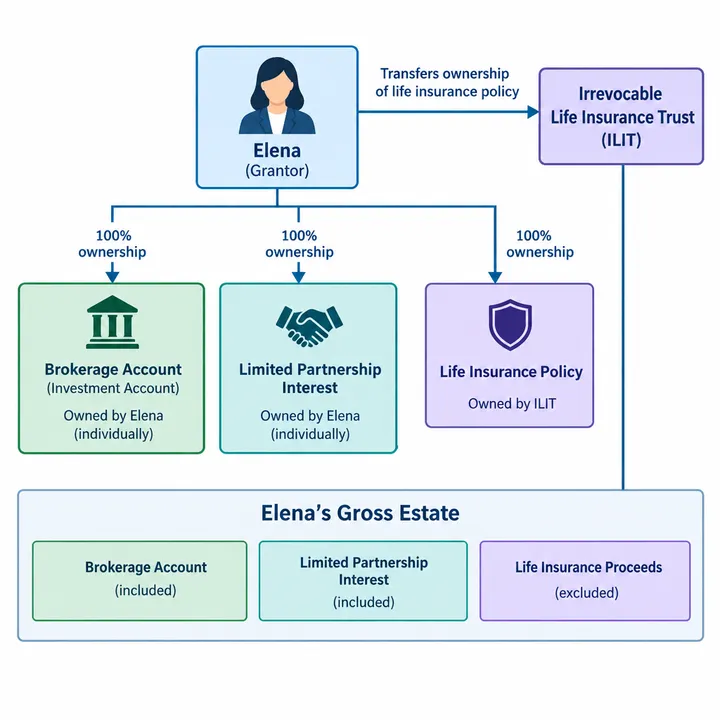
Under the stated jurisdictional assumptions, which asset in the ownership diagram is most likely excluded from Elena's gross estate?
Answer: B. The life insurance proceeds
***The life insurance proceeds***
- The irrevocable life insurance trust (ILIT) owns the policy and is its beneficiary.
- Because Elena retains **no incidents of ownership**, the proceeds are most likely excluded from her gross estate under the stated assumptions.
*The brokerage account*
- Elena owns the brokerage account **individually**, so its value is included in her gross estate.
- The ownership diagram shows the insurance policy, not the brokerage account, held by the ILIT.
*The limited partnership interest*
- Elena **directly owns** the limited partnership interest, so the interest is included in her gross estate.
- The partnership’s ownership of the underlying rental property does not exclude Elena’s interest from her estate.
Explanation locked
Q6Medium
A client's death would create USD 3.0 million of immediate obligations plus 15 year-end payments of USD 120,000. At a 4% discount rate, existing liquid assets are USD 1.0 million and insurance is USD 0.5 million. Required additional coverage is closest to:
Answer: A. USD 2.83 million
***USD 2.83 million***
- The 15 year-end payments have a present value of **USD 1.334 million**: USD 120,000 × [1 − (1.04)^−15] ÷ 0.04.
- Adding USD 3.0 million of immediate obligations and subtracting USD 1.0 million of liquid assets and USD 0.5 million of existing insurance gives **USD 2.834 million**, closest to USD 2.83 million.
*USD 3.33 million*
- USD 3.0 million + USD 1.334 million − USD 1.0 million = **USD 3.334 million**.
- This deducts liquid assets but overlooks the **USD 0.5 million of existing insurance**.
*USD 4.33 million*
- USD 3.0 million + USD 1.334 million = **USD 4.334 million**, the total present value of the obligations.
- This reports total needs without deducting either **USD 1.0 million of liquid assets** or USD 0.5 million of existing insurance.
Explanation locked
Q7Easy
A single wealthy family already employs a small family office for planning and consolidated reporting, but the family wants to delegate full discretionary authority over manager selection and portfolio construction to a professional external party, retaining only oversight of investment policy rather than day-to-day investment decisions. The most appropriate service model is:
Answer: A. An outsourced chief investment officer (OCIO)
***An outsourced chief investment officer (OCIO)***
- An **OCIO** takes discretionary responsibility for manager selection and portfolio construction, which are the decisions the family wants to delegate.
- The family can retain oversight of **investment policy** while its existing family office continues planning and consolidated reporting.
*A trust company acting as corporate trustee*
- A corporate trustee’s primary responsibility is administering assets held in **trust** under its fiduciary duties, not serving as the family’s external discretionary investment lead.
- Trust companies may offer investment management, but the question specifies delegation of portfolio construction and manager selection across the family’s investments.
*A dedicated single-family office*
- The family **already has** a family office for planning and reporting, so establishing another does not address the requested delegation.
- A single-family office could hire investment staff, but that would build an **in-house** capability rather than appoint the external discretionary party the family seeks.
Explanation locked
Want unlimited practice?
Get full access to all questions, explanations, and performance tracking.