Bellweather University maintains a USD 500 million endowment supporting scholarships, faculty positions, and academic programs. Its investment objective is to preserve the real value of assets after spending and investment expenses while providing a stable annual distribution. The endowment is tax exempt and has a perpetual horizon, but the university depends heavily on distributions because tuition revenue is insufficient to fund existing programs.
The current policy spending rate is 5% of beginning market value, paid in equal quarterly installments. University administrators strongly prefer stable distributions and may reduce planned spending by no more than 5% without trustee approval. The investment committee is considering alternative spending rules after recent market volatility caused large changes in projected distributions.
Private-market investments have generated strong long-term performance, but commitments made in prior years have increased illiquid exposure above its policy target. Capital calls are contractual and cannot be deferred. Expected private-market distributions are based on written notices from general partners; unrestricted gifts shown in Exhibit 1 have already been received and can be used for spending. The investment office wants liquid assets sufficient to cover identified 12-month net cash requirements without assuming asset sales at distressed prices.
The two-person investment office currently monitors 42 external managers, conducts asset-allocation analysis, and prepares quarterly committee reporting. Committee members are experienced professionals but do not participate in daily implementation. The chair proposes either expanding direct investing, hiring several specialist analysts, or delegating manager selection and rebalancing to an outsourced chief investment officer under a board-approved investment policy.
To reduce private-market exposure gradually, the staff expects to suspend new commitments and use future distributions to rebalance. Liquid public equity is available for near-term cash needs. A broad equity futures contract can maintain market exposure during the transition and is permitted under the endowment's derivatives policy, provided the overlay does not create leverage.
Endowment Liquidity Forecast for the Next 12 Months
| Item | USD millions |
|---|---:|
| Beginning market value | 500 |
| Policy spending distribution | 25 |
| Expected private-market capital calls | 20 |
| Expected private-market distributions | 8 |
| Unrestricted gifts available for spending | 5 |
Governance and Investment Constraints
The investment office has two professionals, and the investment committee meets quarterly. The endowment is tax exempt, has a perpetual horizon, and cannot reduce annual university distributions by more than 5% without trustee approval. Private-market investments represent 38% of assets, compared with a policy target of 30%. Derivatives may be used only for hedging and efficient exposure management.
Spending Rule Alternatives
| Alternative | Rule |
|---|---|
| 1 | Spend 5% of each year-end market value |
| 2 | Spend 80% of the prior year's distribution adjusted for inflation plus 20% of 5% of current market value |
| 3 | Spend a fixed USD 25 million annually without inflation adjustment |
Q1.1
Based on Exhibit 1, the minimum net liquidity requirement is closest to:
AUSD 32 million
BUSD 40 million
CUSD 45 million
Show answer and rationale
Answer: A. USD 32 million
Rationale
USD 32 million
Exhibit 1 identifies USD 45 million of required outflows: USD 25 million of policy spending plus USD 20 million of contractual capital calls.
Subtracting USD 8 million of expected private-market distributions and USD 5 million of unrestricted gifts gives a minimum net liquidity requirement of USD 32 million.
USD 40 million
USD 25 million of spending plus USD 20 million of capital calls minus USD 5 million of gifts equals USD 40 million.
This omits the USD 8 million of expected private-market distributions in Exhibit 1.
USD 45 million
USD 25 million of spending plus USD 20 million of capital calls equals USD 45 million.
That is gross outflow, not net liquidity required, because it ignores both the USD 8 million of distributions and USD 5 million of available gifts.
Q1.2
Based on Exhibit 3, the spending rule that best balances distribution stability and intergenerational equity is:
AAlternative 1
BAlternative 3
CAlternative 2
Show answer and rationale
Answer: C. Alternative 2
Rationale
Alternative 2
Exhibit 3’s 80% prior distribution adjusted for inflation component limits abrupt changes in funding for university programs.
Its 20% market-value component adjusts spending toward the endowment’s capacity, helping preserve real value for future generations.
Alternative 1
Spending 5% of each year-end market value passes market volatility directly into distributions rather than smoothing them.
A sharp decline could force a spending reduction beyond the university’s 5% limit without trustee approval.
Alternative 3
A fixed USD 25 million distribution provides nominal stability but loses purchasing power as inflation rises.
Because it never adjusts to market value, the fixed amount can also become unsustainable after investment losses, weakening intergenerational equity.
Q1.3
According to Exhibit 2, the most appropriate governance response is:
AExpand internal security-selection coverage
BUse an outsourced chief investment officer
CIncrease direct private-market sourcing
Show answer and rationale
Answer: B. Use an outsourced chief investment officer
Rationale
Use an outsourced chief investment officer
The two-person investment office already monitors 42 external managers, conducts asset-allocation analysis, and prepares quarterly reports, leaving limited capacity for more daily implementation.
An outsourced chief investment officer can take on manager selection and rebalancing under a board-approved investment policy, while the quarterly committee retains oversight.
Expand internal security-selection coverage
Hiring specialist analysts would add security-selection work rather than address the office’s existing responsibility for 42 external managers.
Because the committee meets only quarterly and does not implement decisions daily, expanded internal coverage is less appropriate than delegated implementation.
Increase direct private-market sourcing
Direct sourcing would add due-diligence and liquidity-management demands when private markets already represent 38% of assets against a 30% policy target.
The staff instead plans to suspend new commitments and use future distributions to reduce that exposure gradually.
Q1.4
The most appropriate first step toward the policy allocation is:
ARedeem liquid public equity and use futures temporarily
BCommit additional capital to private-market funds
CSell public equity and retain the proceeds in cash permanently
Show answer and rationale
Answer: A. Redeem liquid public equity and use futures temporarily
Rationale
Redeem liquid public equity and use futures temporarily
The endowment needs USD 32 million in liquid assets over the next 12 months: USD 25 million of spending plus USD 20 million of capital calls, less USD 8 million of expected distributions and USD 5 million of available gifts.
Redeeming liquid public equity can fund that need, while a nonleveraged futures overlay maintains equity exposure temporarily as private-market distributions gradually reduce the allocation toward its 30% target.
Commit additional capital to private-market funds
Private markets already represent 38% of assets against a 30% policy target, so new commitments would move the endowment farther from its target.
Additional commitments could increase future contractual capital calls when the endowment needs liquid assets to support distributions.
Sell public equity and retain the proceeds in cash permanently
Selling public equity can address the near-term liquidity need, but permanently holding the proceeds in cash would not maintain the intended market exposure.
A lasting cash allocation could hinder the endowment’s objective of preserving real value after spending and investment expenses; permitted futures provide a temporary transition instead.
Q1.5Select all that apply
Which of the following statements about Bellweather's private-market exposure and governance constraints, based on Exhibit 2, are correct? (Select all that apply)
APrivate-market allocation exceeds its policy target by 8 percentage points
BCapital calls can be deferred if liquidity is insufficient
CReducing distributions by more than 5% requires trustee approval
DThe investment committee can independently expand direct investing without additional staff
Show answer and rationale
Answer: A. Private-market allocation exceeds its policy target by 8 percentage points; C. Reducing distributions by more than 5% requires trustee approval
Rationale
Select
Private-market allocation exceeds its policy target by 8 percentage points
Exhibit 2 reports private-market investments at 38% of assets against a 30% policy target.
The allocation therefore exceeds its target by 8 percentage points.
Reducing distributions by more than 5% requires trustee approval
Exhibit 2 states that annual university distributions cannot be reduced by more than 5% without trustee approval.
Administrators can make a reduction of up to 5%, but a larger reduction requires the trustees’ consent.
Do not select
Capital calls can be deferred if liquidity is insufficient
The case states that private-market capital calls are contractual and cannot be deferred.
The expected USD 20 million in calls must therefore be included in the next 12 months’ liquidity planning.
The investment committee can independently expand direct investing without additional staff
The two-person investment office already monitors 42 external managers and handles asset-allocation analysis and quarterly reporting.
Committee members do not participate in daily implementation, so their experience does not supply the staff capacity needed to expand direct investing.
Q1.6Fill in the blank
Using Exhibit 1, if expected private-market distributions increase by USD 4 million and unrestricted gifts available for spending increase by USD 2 million, the revised minimum net liquidity requirement (in USD millions) would be:
Answer:
Show answer and rationale
Answer: 26
Rationale
26
Exhibit 1 shows an original net requirement of USD 32 million: USD 25 million of policy spending plus USD 20 million of capital calls, less USD 8 million of private-market distributions and USD 5 million of unrestricted gifts.
The additional USD 4 million of distributions and USD 2 million of gifts both reduce cash needed, so the revised requirement is 32 − 4 − 2 = USD 26 million.
Common wrong answers
30
USD 30 million subtracts the additional gifts but overlooks the USD 4 million increase in private-market distributions.
28
USD 28 million subtracts the additional private-market distributions but overlooks the USD 2 million increase in unrestricted gifts.
Show case rationale
Rationale
Bellweather’s decisions turn on funding near-term cash needs while preserving stable spending and reducing excess illiquid exposure.
Exhibit 1’s minimum net liquidity requirement is USD 32 million: USD 25 million of spending plus USD 20 million of capital calls, less USD 8 million of expected private-market distributions and USD 5 million of unrestricted gifts.
If distributions rise by USD 4 million and gifts by USD 2 million, the revised requirement is USD 26 million: 25 + 20 − 12 − 7.
A smoothed spending rule and delegated implementation fit Bellweather’s institutional constraints.
Exhibit 3’s Alternative 2 blends inflation-adjusted prior spending with a current-market-value component, balancing distribution stability and intergenerational equity better than Alternative 1’s market-driven spending or Alternative 3’s fixed nominal amount.
With two professionals monitoring 42 managers, an outsourced chief investment officer can handle manager selection and rebalancing under board policy; expanding internal coverage or direct sourcing would add to the office’s workload.
Traps in this case
Confusing gross outflows with net liquidity needs
USD 40 million omits the USD 8 million in expected distributions, while USD 45 million uses gross outflows without netting either available inflow.
Treating private-market commitments or university spending as optional
Exhibit 2 shows private markets at 38% versus a 30% target, contractual capital calls that cannot be deferred, and a requirement for trustee approval to cut annual distributions by more than 5%.
Selling public equity without maintaining exposure
Bellweather can use liquid public equity for near-term cash and a temporary, nonleveraged futures overlay to maintain market exposure while it suspends new private-market commitments and awaits distributions; additional commitments or permanent cash holdings would not serve that transition.
Q2Medium
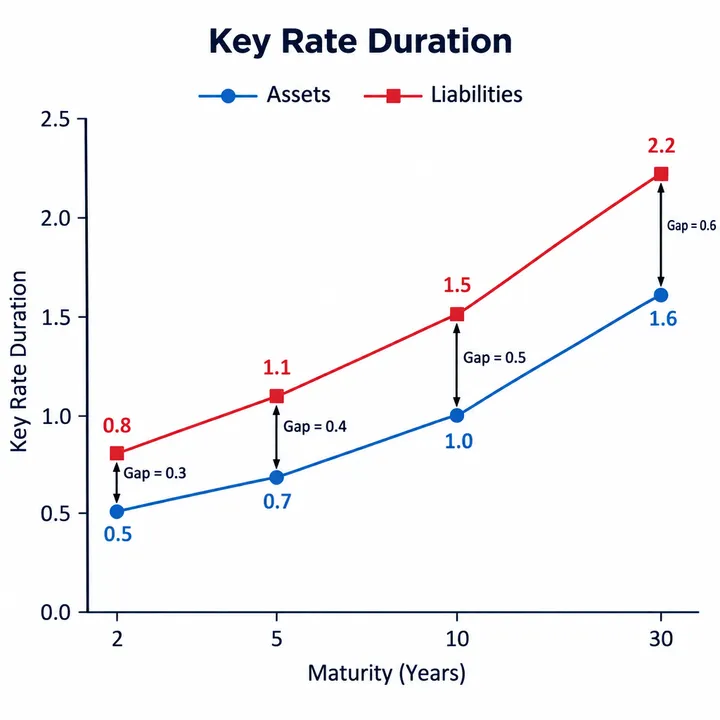
The figure shows liability key-rate duration exceeding asset key-rate duration only at 30 years. The most appropriate hedge is to:
Answer: B. Receive fixed in a thirty-year swap
***Receive fixed in a thirty-year swap***
- The figure shows that liability key-rate duration exceeds asset key-rate duration only at **30 years**.
- Receiving fixed in a thirty-year swap adds positive duration at that maturity, reducing the shortfall.
*Receive fixed in a five-year swap*
- Receiving fixed would add positive duration near **five years**, not at the 30-year maturity where the shortfall occurs.
- Because the figure shows no five-year shortfall, this swap would introduce an unnecessary mismatch.
*Pay fixed in a thirty-year swap*
- Paying fixed in a thirty-year swap adds **negative duration** at the relevant maturity.
- That would widen, rather than hedge, the existing 30-year shortfall in asset key-rate duration.
Explanation locked
Q3Medium
A corporate bond has an option-adjusted spread duration of 4.5. If credit spreads widen by 30 basis points, the price decline attributable to the spread widening is closest to:
Answer: A. −1.35%
***−1.35%***
- The approximate price change from spread widening is **−spread duration × change in spread**.
- A 30-basis-point widening is 0.30%, so −4.5 × 0.30% = **−1.35%**.
*−0.30%*
- This uses the **0.30% spread change** as the price change without applying the bond’s spread duration.
- The 4.5 spread duration means the estimated price change is 4.5 times the spread change, with the opposite sign.
*−4.50%*
- This results from using **4.5 as the percentage decline** without multiplying by the 0.30% spread widening.
- Spread duration measures price sensitivity; it is not itself the price change for this 30-basis-point move.
Explanation locked
Q4Unfolding case study
Crestline Asset Management manages diversified equity portfolios for institutional clients. Its trading desk measures implementation shortfall relative to the portfolio manager's decision price. For purchase orders, costs are recorded as positive when execution prices exceed the decision price. The desk includes explicit costs, execution costs, and opportunity costs on unexecuted shares. Exhibit 1 presents a completed order with no commissions, fees, cancellations, or shares remaining at the close.
The head trader is also selecting an execution strategy for a USD 12 million purchase of a thinly traded small-cap stock ahead of a scheduled corporate announcement. The order represents nearly 30% of expected daily volume. The portfolio manager's alpha signal has an estimated half-life of less than one day, intraday volatility is elevated, and a client redemption requires the position to be established before the market close. The trader's objective is to achieve rapid, certain execution despite the higher market-impact cost this entails.
Crestline compares execution quality across trading venues. Exhibit 2 provides information for a representative buy execution. The firm's transaction-cost policy measures effective spread and realized spread using the full-spread convention stated in the exhibit. It defines price impact as effective spread minus realized spread. The five-minute post-trade midquote is used to separate the dealer or venue's realized compensation from the subsequent movement in the security's midpoint.
Crestline's chief operating officer proposes an internal crossing network for orders generated by different portfolio teams. The network would execute only when compatible buy and sell orders arrive in the same security at the same time and would cross them at the prevailing midpoint. Unmatched orders would be routed to external venues under the existing execution policy. The compliance department would monitor allocation fairness and information barriers. Management recognizes that crossing cannot guarantee completion, but it expects a cost advantage when natural counterparties are available.
Completed Purchase Order
| Item | Data |
|---|---:|
| Decision price | USD 50.00 |
| Shares ordered | 100,000 |
| First execution | 60,000 shares at USD 50.10 |
| Second execution | 40,000 shares at USD 50.25 |
| Closing price | USD 50.30 |
| Commissions and fees | USD 0 |
The order was completed on the decision date.
Venue Execution Observation
| Measure | Price |
|---|---:|
| Midquote at order submission | USD 25.00 |
| Buy execution price | USD 25.04 |
| Midquote five minutes after execution | USD 25.03 |
Use the full-spread convention: effective spread equals twice the buy price minus the submission midquote; realized spread equals twice the buy price minus the subsequent midquote.
Q4.1
Based on Exhibit 1, the total implementation shortfall is closest to:
Dividing by the decision value of 100,000 × USD 50.00 = USD 5,000,000 gives 32 basis points; the completed order has no opportunity cost.
46 basis points
This is the average of the actual 32-basis-point shortfall and the 60-basis-point change from decision price to closing price.
Averaging in the closing-price change incorrectly treats it as a cost even though all 100,000 shares were executed.
60 basis points
The closing price exceeds the decision price by USD 0.30, and USD 0.30 ÷ USD 50.00 equals 60 basis points.
That calculation substitutes the closing price for the execution prices, although no shares remained unexecuted.
Q4.2
For the small-cap order described in the vignette, the most appropriate execution strategy is to:
ASubmit an immediate market order
BUse a patient volume-participation algorithm
CExecute an aggressive liquidity-taking algorithm
Show answer and rationale
Answer: C. Execute an aggressive liquidity-taking algorithm
Rationale
Execute an aggressive liquidity-taking algorithm
The USD 12 million purchase is nearly 30% of expected daily volume, while the alpha signal has a half-life of less than one day.
Aggressive liquidity taking prioritizes execution before the required market-close deadline, accepting higher market impact to meet the trader’s objective of rapid, certain execution.
Submit an immediate market order
An immediate market order would seek speed but could cause substantial slippage in this thinly traded small-cap stock.
An aggressive algorithm can seek liquidity across venues and manage how the large order is submitted while still prioritizing completion.
Use a patient volume-participation algorithm
A patient strategy limits market impact by trading gradually, but this order must be completed before the market close.
With the order near 30% of expected daily volume and the alpha signal decaying within a day, waiting risks both noncompletion and loss of the expected benefit.
Q4.3
Based on Exhibit 2, the estimated price-impact component under the full-spread convention is:
AUSD 0.01 per share
BUSD 0.02 per share
CUSD 0.06 per share
Show answer and rationale
Answer: C. USD 0.06 per share
Rationale
USD 0.06 per share
Under Exhibit 2’s full-spread convention, the effective spread is 2 × (USD 25.04 − USD 25.00) = USD 0.08 per share.
The realized spread is 2 × (USD 25.04 − USD 25.03) = USD 0.02, so price impact is USD 0.08 − USD 0.02 = USD 0.06 per share.
USD 0.01 per share
USD 25.04 − USD 25.03 = USD 0.01, the unscaled difference between the buy price and the five-minute midquote.
This omits the required doubling and measures realized compensation rather than price impact.
USD 0.02 per share
Doubling that difference gives USD 0.02, the realized spread under Exhibit 2.
Price impact instead subtracts the realized spread from the USD 0.08 effective spread.
Q4.4
The principal expected benefit of Crestline's proposed internal crossing network is:
ALower market impact when compatible orders can be matched
BGreater execution certainty for every submitted order
CFaster incorporation of information into market prices
Show answer and rationale
Answer: A. Lower market impact when compatible orders can be matched
Rationale
Lower market impact when compatible orders can be matched
Crossing compatible buy and sell orders at the prevailing midpoint lets Crestline execute without sending those shares to an external venue.
Using a natural counterparty can reduce market impact, but the benefit applies only when matching orders arrive in the same security at the same time.
Greater execution certainty for every submitted order
The network executes only when a compatible opposite-side order is available, so it cannot guarantee a fill.
Crestline routes unmatched orders to external venues under its existing policy; the network itself does not make every order certain to execute.
Faster incorporation of information into market prices
Midpoint crossing is designed to lower trading costs, not to make public prices reflect information faster.
Because matched orders trade internally rather than on an external venue, faster price discovery is not the principal expected benefit.
Q4.5Fill in the blank
Based on Exhibit 1, the volume-weighted average execution price for the order, in USD per share, is closest to:
Using Exhibit 1’s closing price instead of the prices at which shares executed gives USD 50.30.
Q4.6Select all that apply
Which of the following statements about Crestline's proposed internal crossing network are true? (Select all that apply.)
AThe network can execute even without a compatible contra order
BMatched orders are crossed at the prevailing midpoint
CInternal crossing eliminates a portion of the bid–ask spread cost when natural counterparties exist
DUnmatched orders are routed to external venues under Crestline's existing execution policy
EThe network guarantees full completion of every submitted order
Show answer and rationale
Answer: B. Matched orders are crossed at the prevailing midpoint; C. Internal crossing eliminates a portion of the bid–ask spread cost when natural counterparties exist; D. Unmatched orders are routed to external venues under Crestline's existing execution policy
Rationale
Select
Matched orders are crossed at the prevailing midpoint
Crestline’s network crosses compatible buy and sell orders in the same security at the same time at the prevailing midpoint.
That price lies between the quoted bid and ask rather than requiring the buyer to pay the ask or the seller to receive the bid.
Internal crossing eliminates a portion of the bid–ask spread cost when natural counterparties exist
When Crestline’s portfolio teams supply natural counterparties, midpoint crossing avoids a portion of the bid–ask spread cost.
The cost advantage depends on compatible orders being available; it is not a promise that every order will cross.
Unmatched orders are routed to external venues under Crestline's existing execution policy
Crestline’s proposal explicitly sends unmatched orders to external venues.
Those orders remain subject to the firm’s existing execution policy rather than being executed within the network.
Do not select
The network can execute even without a compatible contra order
An internal cross requires a compatible buy and sell order in the same security at the same time.
Without a contra order, no internal execution occurs; the unmatched order is routed externally.
The network guarantees full completion of every submitted order
Management explicitly recognizes that internal crossing cannot guarantee completion.
Completion depends on compatible contra orders arriving, while unmatched orders must seek execution at external venues.
Show case rationale
Rationale
Crestline measures purchase-order costs against the decision price and separates spread costs from price impact.
In the Completed Purchase Order, the volume-weighted execution price is USD 50.16: (60,000 × 50.10 + 40,000 × 50.25) ÷ 100,000; implementation shortfall is (50.16 − 50.00) ÷ 50.00 × 10,000 = 32 basis points.
In the Venue Execution Observation, effective spread is 2 × (25.04 − 25.00) = USD 0.08, realized spread is 2 × (25.04 − 25.03) = USD 0.02, and price impact is USD 0.06 per share.
Urgency favors aggressive execution, while internal crossing saves costs only when orders match.
An aggressive liquidity-taking algorithm suits the thinly traded small-cap purchase because the signal decays within a day and the position must be established before the close, despite higher market impact.
Compatible internal buy and sell orders cross at the prevailing midpoint, avoiding part of the bid–ask spread and reducing market impact; unmatched orders go to external venues.
Traps in this case
Using the closing price for completed shares
The USD 50.30 close applies to unexecuted shares, but every share in the Completed Purchase Order was executed.
Confusing spread components
USD 0.02 is realized spread, not price impact; USD 0.01 is the execution price minus the later midpoint without the required full-spread adjustment.
Assuming speed or internal matching guarantees execution
A patient algorithm risks missing the short-lived signal, an immediate market order lacks the aggressive algorithm’s execution controls, and internal crossing requires a compatible contra order.
Q5Medium
A beta-neutral equity portfolio is 100% long stocks expected to outperform by 3% and 100% short stocks expected to underperform by 2%. Before costs, its expected active return is closest to:
Answer: B. 5.0%
***5.0%***
- The 100% long position contributes **3%** from expected outperformance.
- The 100% short position gains **2%** when its stocks underperform, giving an expected active return of **3% + 2% = 5%** before costs.
*1.0%*
- Subtracting the forecasts gives **3% − 2% = 1%**.
- That treats the shorted stocks’ underperformance as a loss, although it benefits the short position.
*10.0%*
- Multiplying the **5%** combined contribution by the portfolio’s **200% gross exposure** gives **10%**.
- That double-counts exposure: the 3% and 2% contributions already reflect the respective 100% long and short positions.
Explanation locked
Q6Unfolding case study
Meridian Asset Management is redesigning an enhanced index equity portfolio for an institutional client. The investment committee wants modest benchmark-relative outperformance but places greater importance on controlling unintended factor exposures, trading costs, and tracking error. The portfolio team must select an implementation method, measure the extent of active positioning, evaluate a proposed trade after implementation costs, classify the team's investment approach, identify the constraints applied to the optimizer, and recall the mandate's tracking-error limit. All expected returns and costs are annual unless an exhibit states otherwise. Active weights are defined as portfolio weights minus benchmark weights, and active share is calculated using absolute active weights. Exhibits 1–3 contain the mandate, portfolio construction data, and investment team statements required for each question. The questions are independent; no result calculated for one question is needed to answer another.
Equity Mandate and Proposed Implementation
The USD 2.4 billion portfolio is benchmarked to a broad index containing 1,500 securities. The smallest 900 constituents collectively represent 7% of benchmark capitalization but include securities with wide bid–ask spreads and limited trading volume. The mandate permits optimization and derivatives, requires annualized ex ante tracking error below 0.40%, and does not require ownership of every benchmark constituent. The manager proposes holding a representative sample that matches the benchmark's sector, capitalization, style, and country exposures.
Portfolio Construction Statistics
| Statistic | Value |
|---|---:|
| Sum of absolute portfolio-minus-benchmark weights | 36.0% |
| Proposed increase in Stock R portfolio weight | 1.0% |
| Forecast annual alpha for Stock R | 3.0% |
| One-way transaction cost for Stock R | 0.40% of value traded |
The proposed Stock R trade is executed immediately, and transaction cost is charged once at initiation.
Investment Team Statements
**Statement 1:** The team's signals exploit recurring underreaction to analyst revisions across approximately 800 stocks. Securities are ranked using standardized data, and positions are generated consistently through a rules-based model.
**Statement 2:** The optimizer will maximize expected active return subject to the tracking-error limit, sector exposure bands, position limits, liquidity constraints, and estimated transaction costs. An unconstrained portfolio would produce excessive exposure to the technology sector.
Q6.1
Based on Exhibit 1, the most appropriate index implementation approach is:
AStratified sampling
BFull replication
CEqual-weighted replication
Show answer and rationale
Answer: A. Stratified sampling
Rationale
Stratified sampling
Exhibit 1 proposes a representative sample matched to the benchmark’s sector, capitalization, style, and country exposures, rather than ownership of every constituent.
Sampling can avoid trading the 900 smallest securities, which together represent only 7% of benchmark capitalization but have wide bid–ask spreads and limited volume, while supporting the low tracking-error objective.
Full replication
Buying all 1,500 securities would require trading the 900 small, less liquid constituents despite their combined 7% benchmark weight.
Their wide bid–ask spreads and limited volume make full replication less appropriate when the mandate prioritizes trading costs and does not require every constituent to be held.
Equal-weighted replication
Giving each of the 1,500 securities the same weight would depart from the capitalization-weighted benchmark rather than match its weights.
That departure would create unintended exposures and tracking error, conflicting with the mandate’s 0.40% ex ante tracking-error limit.
Q6.2
Based on Exhibit 2, the portfolio's active share is closest to:
A9.0%
B18.0%
C36.0%
Show answer and rationale
Answer: B. 18.0%
Rationale
18.0%
Active share is one-half the sum of absolute portfolio-minus-benchmark weights.
Using Exhibit 2, active share is ½ × 36.0% = 18.0%.
9.0%
This results from halving twice: 36.0% ÷ 2 ÷ 2 = 9.0%.
Active share requires only one division by two because Exhibit 2 already gives the sum of absolute active weights.
36.0%
This is Exhibit 2’s sum of absolute active weights, not active share.
Omitting the required one-half factor gives 36.0% instead of ½ × 36.0% = 18.0%.
Q6.3
Based on Exhibit 2, Stock R's first-year net contribution to portfolio active return is closest to:
A2.0 basis points
B2.6 basis points
C3.0 basis points
Show answer and rationale
Answer: B. 2.6 basis points
Rationale
2.6 basis points
Exhibit 2 gives a gross active-return contribution of 3.0 basis points: 1.0% added weight × 3.0% forecast alpha.
Subtracting 1.0 basis point from the 3.0-basis-point gross contribution produces 2.0 basis points.
That slip treats the 1.0% trade weight as the cost deduction; Exhibit 2 instead specifies a 0.40% cost on the value traded, producing a 0.4-basis-point deduction.
3.0 basis points
The 1.0% added weight × 3.0% forecast alpha produces 3.0 basis points before costs.
This choice omits Exhibit 2’s transaction cost, which is charged once at initiation and reduces the first-year contribution by 0.4 basis points.
Q6.4
The investment approach described in Exhibit 3, Statement 1, is best classified as:
ASystematic active investing
BFundamental bottom-up investing
CTop-down thematic investing
Show answer and rationale
Answer: A. Systematic active investing
Rationale
Systematic active investing
Exhibit 3, Statement 1 describes standardized signals applied across approximately 800 stocks to exploit recurring underreaction to analyst revisions.
Ranking securities and generating positions consistently through a rules-based model makes the approach systematic and active.
Fundamental bottom-up investing
Statement 1 does not describe company-by-company valuation or analyst judgment as the basis for selecting securities.
Analyst revisions are inputs to a standardized signal, not evidence that the team conducts fundamental research on each stock.
Top-down thematic investing
Statement 1 ranks individual securities rather than starting with a macroeconomic or industry theme.
Its positions follow a rules-based security model, not allocations driven by a top-down view.
Q6.5Select all that apply
Based on Exhibit 3, Statement 2, select all of the following that are explicitly identified as constraints imposed on the optimizer.
ATracking-error limit
BSector exposure bands
CPosition limits
DLiquidity constraints
EEstimated transaction costs
FMinimum dividend yield requirement
Show answer and rationale
Answer: A. Tracking-error limit; B. Sector exposure bands; C. Position limits; D. Liquidity constraints; E. Estimated transaction costs
Rationale
Select
Tracking-error limit
Exhibit 3, Statement 2 explicitly makes the tracking-error limit a constraint on maximizing expected active return.
The mandate sets that limit at below 0.40% annualized ex ante tracking error.
Sector exposure bands
Exhibit 3, Statement 2 explicitly lists sector exposure bands among the optimizer’s constraints.
These bands address the excessive technology-sector exposure that Statement 2 says an unconstrained portfolio would produce.
Position limits
Exhibit 3, Statement 2 explicitly lists position limits as constraints on the optimizer.
Position limits restrict individual holdings while the optimizer seeks expected active return.
They are pertinent because the mandate describes many smaller index constituents as having limited trading volume.
Estimated transaction costs
Exhibit 3, Statement 2 explicitly includes estimated transaction costs among the constraints.
The portfolio team therefore accounts for trading costs when optimizing expected active return.
Do not select
Minimum dividend yield requirement
Exhibit 3, Statement 2 does not identify a minimum dividend yield requirement.
The stated optimizer constraints concern tracking error, sector exposures, positions, liquidity, and transaction costs, not dividend yield.
Q6.6Fill in the blank
Fill in the blank: Based on Exhibit 1, the mandate requires the portfolio's annualized ex ante tracking error to remain below ____%.
Answer:
Show answer and rationale
Answer: 0.40
Rationale
0.40
Exhibit 1 states that the portfolio’s annualized ex ante tracking error must remain below 0.40%.
The blank asks for the number before the percent sign, so enter 0.40, not a decimal conversion.
Common wrong answers
0.004
Dividing 0.40 by 100 converts 0.40% to a decimal, but the blank already supplies the percent sign.
40
Multiplying 0.40 by 100 treats the stated 0.40% as though it were already a decimal.
Show case rationale
Rationale
Meridian’s mandate favors representative sampling and disciplined control of active risk.
The Equity Mandate and Proposed Implementation permits stratified sampling to match sector, capitalization, style, and country exposures without trading every constituent, including the smallest 900 securities with limited liquidity.
Statement 1 describes systematic active investing: standardized signals rank approximately 800 stocks, and a rules-based model generates positions rather than relying on company-by-company fundamental judgment or top-down themes.
Active positioning and trade costs must be measured at the portfolio level.
Active share is 18.0%: one-half of the 36.0% sum of absolute active weights in Portfolio Construction Statistics.
Stock R’s first-year net active-return contribution is 2.6 basis points: 1.0% × 3.0% = 3.0 basis points gross, less the once-at-initiation cost of 1.0% × 0.40% = 0.4 basis points.
Traps in this case
Replicating or weighting every constituent
Full replication incurs trading in illiquid small constituents, while equal-weighted replication would depart from the broad capitalization-weighted benchmark that the proposed sample seeks to represent.
Confusing gross figures with net or halved figures
36.0% omits active share’s one-half factor, 3.0 basis points omits Stock R’s transaction cost, and 16.0% and 2.0 basis points do not follow from any single standard error.
Overlooking the stated optimizer controls
Statement 2 explicitly lists tracking-error, sector, position, liquidity, and estimated-transaction-cost constraints—not a minimum dividend yield—and the mandate requires annualized ex ante tracking error below 0.40%.
Q7Unfolding case study
Daniel Morgan manages Ardent Credit Fund against an investment-grade corporate bond benchmark. The mandate permits active sector allocation, issuer selection, and spread-duration positioning, subject to a tracking-error limit. Morgan evaluates expected holding-period returns by adding carry, the price effect of forecast spread changes, and any expected rating-migration effect. Interest-rate duration is fully hedged for the candidate positions, so the analysis isolates credit-spread effects.
Exhibit 1 presents three candidate bonds. A positive expected spread change denotes spread widening, and a negative change denotes spread tightening. The approximate spread-related price return is calculated as negative spread duration multiplied by the spread change expressed in decimal form. One basis point equals 0.0001. Carry and migration effects are stated as percentages of market value over the same horizon, and no default loss or currency effect is expected beyond the migration effects shown.
Morgan also reviews equity trades made by a diversified multi-asset portfolio managed by his firm. Exhibit 2 presents a completed purchase order. Implementation shortfall is measured relative to the portfolio manager's decision price and includes explicit commissions. Because the full order was executed on the same day, there is no opportunity-cost component for unexecuted shares. The denominator is the order's market value at the decision price. The closing price is supplied for monitoring but is not used as the benchmark for this implementation-shortfall calculation.
Finally, Morgan must sell a USD 12 million position in a thinly traded corporate bond. The investment thesis has weakened, but the information is expected to decay slowly over several weeks. The fund has no immediate cash requirement, and the bond's credit outlook is stable. A dealer has identified another institutional investor interested in purchasing a substantial block near the current mid-market price. Morgan expects that immediately displaying the entire order would move the market materially. He therefore compares an aggressive market order, complete delay, and a strategy combining a block cross with patient execution of any residual amount. The objective is to control market impact without accepting unnecessary timing risk.
| Item | Data |
|---|---:|
| Order size | 100,000 shares |
| Decision price | USD 50.00 |
| First execution | 60,000 shares at USD 50.10 |
| Second execution | 40,000 shares at USD 50.25 |
| Commission | USD 0.02 per share |
| Closing price | USD 50.30 |
Q7.1Select all that apply
Based on Exhibit 1, which bond(s) are expected to experience a price decline from the spread-change effect alone, before considering carry or migration? (Select all that apply.)
ABond A
BBond B
CBond C
Show answer and rationale
Answer: A. Bond A; C. Bond C
Rationale
Select
Bond A
Exhibit 1 forecasts 30 bps of spread widening for Bond A, which lowers its price before carry or migration.
Its spread-change price return is −4.5 × 0.0030 = −1.35%.
Bond C
Exhibit 1 forecasts 10 bps of spread widening for Bond C, which also lowers its price before carry or migration.
Its spread-change price return is −5.0 × 0.0010 = −0.50%.
Do not select
Bond B
Exhibit 1 forecasts 20 bps of spread tightening for Bond B, so its spread-change effect increases rather than decreases its price.
Its spread-change price return is −3.0 × (−0.0020) = +0.60%, before carry or migration.
Q7.2
Including carry, spread change, and migration, the highest expected return is offered by:
ABond B
BBond C
CBond A
Show answer and rationale
Answer: A. Bond B
Rationale
Bond B
Bond B’s 20 bp tightening produces a spread-price gain of (3.0 \times 0.0020 = 0.60%).
Adding 3.20% carry and the +0.25% migration effect gives the highest expected return: 4.05%.
Bond C
Bond C’s 10 bp widening produces a (5.0 \times 0.0010 = 0.50%) spread-price loss.
Its 4.50% carry less that loss and the 0.40% migration loss yields 3.60%, below Bond B.
Bond A
Bond A’s 30 bp widening produces a (4.5 \times 0.0030 = 1.35%) spread-price loss.
With no migration effect, its 4.00% carry yields 2.65%, below both other bonds.
Q7.3Select all that apply
Which of the following are correctly included in the implementation-shortfall calculation for the order in Exhibit 2? (Select all that apply.)
ACommissions
BExecution price versus decision price impact
COpportunity cost for unexecuted shares
DMark-to-market versus the closing price
Show answer and rationale
Answer: A. Commissions; B. Execution price versus decision price impact
Rationale
Select
Commissions
The Completed Purchase Order charges USD 0.02 per share on all 100,000 executed shares, so commissions are USD 2,000.
Implementation shortfall includes this explicit trading cost along with the cost of buying above the decision price.
Execution price versus decision price impact
Relative to the USD 50.00 decision price, the executions cost (60,000 × USD 0.10) + (40,000 × USD 0.25) = USD 16,000.
Adding USD 2,000 in commissions gives USD 18,000 of implementation shortfall, or 0.36% of the USD 5,000,000 order value at the decision price.
Do not select
Opportunity cost for unexecuted shares
The full 100,000-share purchase order was executed, leaving no unexecuted shares.
Opportunity cost can arise when an order is not filled, but its component here is zero.
Mark-to-market versus the closing price
The USD 50.30 closing price is supplied for monitoring, not as the implementation-shortfall benchmark.
For this completed purchase, execution prices are compared with the USD 50.00 decision price, not the closing price.
Q7.4
For the proposed sale, Morgan's most appropriate execution strategy is to:
ASeek a block cross, then trade residual shares patiently
BSubmit the entire order as an immediate market order
CDelay all trading until daily volume increases materially
Show answer and rationale
Answer: A. Seek a block cross, then trade residual shares patiently
Rationale
Seek a block cross, then trade residual shares patiently
The interested institutional buyer offers a way to cross a substantial part of the USD 12 million position near the current mid-market price, limiting market impact.
With no immediate cash need, a stable credit outlook, and information expected to decay slowly, Morgan can execute any residual shares patiently without unnecessary urgency.
Submit the entire order as an immediate market order
Immediately exposing the full position in a thinly traded bond is expected to move its price materially.
The fund has no immediate cash requirement that would justify accepting that avoidable market impact.
Delay all trading until daily volume increases materially
Waiting to sell the entire position creates timing risk even though Morgan has decided to sell after the investment thesis weakened.
Complete delay also forgoes the institutional buyer’s current interest in a substantial block near the mid-market price.
Q7.5Ordered response
Order the following steps in the sequence Morgan should follow when executing the bond sale, from first to last.
Determine whether displaying the full order would move the market materially
Negotiate the block cross with the identified institutional buyer
Execute any residual shares patiently to minimize market impact
Assess urgency, information decay, and liquidity conditions
Show answer and rationale
Answer: 1. Assess urgency, information decay, and liquidity conditions; 2. Determine whether displaying the full order would move the market materially; 3. Negotiate the block cross with the identified institutional buyer; 4. Execute any residual shares patiently to minimize market impact
Rationale
Assess urgency, information decay, and liquidity conditions → Determine whether displaying the full order would move the market materially → Negotiate the block cross with the identified institutional buyer → Execute any residual shares patiently to minimize market impact
Morgan should choose an execution strategy only after weighing timing risk against market impact for the USD 12 million bond sale.
Slowly decaying information and no immediate cash need permit patient execution, while the identified buyer offers a way to sell a substantial block.
1. Assess urgency, information decay, and liquidity conditions
The weakened thesis creates a reason to sell, but its slow information decay and the fund’s lack of an immediate cash requirement reduce urgency.
2. Determine whether displaying the full order would move the market materially
Morgan expects that displaying the entire order in this thinly traded bond would move the market materially.
3. Negotiate the block cross with the identified institutional buyer
The buyer’s interest in a substantial block near the current mid-market price offers an alternative to displaying the full order.
4. Execute any residual shares patiently to minimize market impact
After the block cross, Morgan can work any remaining bond position patiently rather than expose it all at once.
Common wrong orders
Negotiate the cross before assessing urgency
A willing buyer does not eliminate the need to consider how quickly the weakened investment thesis requires Morgan to sell.
Display the full order before seeking the cross
That sequence risks the material market movement Morgan expects from revealing the USD 12 million order.
Delay the entire sale instead of working the residual
Complete delay accepts unnecessary timing risk when Morgan can cross a substantial block and execute the remainder patiently.
Q7.6
True or False: Because interest-rate duration is fully hedged for the candidate bonds in Exhibit 1, changes in the level of risk-free interest rates are expected to affect their expected holding-period returns.
ATrue
BFalse
Show answer and rationale
Answer: B. False
Rationale
False
Morgan has fully hedged interest-rate duration for the candidate bonds in Exhibit 1, so changes in risk-free rate levels are not expected to affect their holding-period returns.
His expected-return analysis instead combines carry, the price effect of forecast credit-spread changes, and expected rating-migration effects.
True
This would apply to an unhedged bond position, whose price could change when risk-free rates change.
Exhibit 1’s spread durations measure sensitivity to credit-spread changes, not an interest-rate exposure left in Morgan’s hedged positions.
Show case rationale
Rationale
Credit returns depend on carry, spread-price effects, and migration—not risk-free rate changes that have been fully hedged.
In Credit Portfolio Candidates, widening lowers the prices of Bond A by 1.35% and Bond C by 0.50%, while tightening raises Bond B’s price by 0.60%.
Including carry and migration, expected returns are 2.65% for A, 4.05% for B, and 3.60% for C, making B highest.
Trading costs and execution strategy depend on the decision price, urgency, and market impact.
Completed Purchase Order shortfall includes USD 6,000 + USD 10,000 of execution-price impact and USD 2,000 of commissions: USD 18,000 / USD 5,000,000 = 0.36%.
For the bond sale, assess urgency and liquidity, determine the impact of displaying the full order, negotiate the available block cross, then execute any residual patiently.
Traps in this case
Treating a price decline as a negative total return
Bond A and Bond C lose value from spread widening alone, but their carry leaves both with positive expected total returns.
Using the closing price or unexecuted-share costs
The purchase was fully executed, so there is no opportunity cost; its shortfall uses the USD 50.00 decision price, not the USD 50.30 close.
Trading the entire bond position immediately or delaying it all
An immediate market order risks material impact, while complete delay accepts unnecessary timing risk despite the identified buyer and slowly decaying information.
Q8Unfolding case study
Solstice Asset Management operates an index mandate benchmarked to a capitalization-weighted global equity index. The benchmark contains 1,800 securities, including thinly traded small-cap stocks and securities in markets with relatively high transaction costs. The mandate permits optimization and sampling but requires annualized ex ante tracking error below 1.00%. Country and sector exposures must remain close to benchmark weights, and expected annual turnover should not exceed 20%.
Portfolio manager Lena Clarke proposes holding a representative subset of the benchmark. Her process selects liquid securities within each country, sector, capitalization, and style segment and then minimizes forecast tracking error. She states that full replication would eliminate security-level sampling risk but could increase market impact, custody expenses, and rebalancing costs. The proposed portfolio characteristics are presented in Exhibit 1.
Clarke also manages an enhanced-index sleeve. The sleeve uses 144 independent security-selection decisions each year. Historical validation indicates an information coefficient of 0.04. Portfolio constraints and implementation frictions produce a transfer coefficient of 0.75. Clarke uses the transfer-adjusted fundamental law of active management, with breadth defined as the number of independent decisions, to estimate the sleeve's information ratio.
During a risk review, Clarke examines selected positions shown in Exhibit 2. The risk system reports each security's active weight and marginal contribution to active risk using a common scale. For this review, a security's contribution to active risk is evaluated as its active weight multiplied by its marginal contribution; the committee compares absolute contributions when identifying concentration.
A separate unconstrained optimizer generates a portfolio with forecast tracking error of 0.72% and expected turnover of 43%. Clarke argues that the portfolio should be implemented because its forecast alpha is higher than that of the portfolio in Exhibit 1. The trading desk estimates that market impact rises sharply above 20% annual turnover, particularly among small-cap constituents. The investment policy does not permit a temporary waiver of the turnover limit. Clarke must therefore decide whether to alter the optimization process before presenting a final portfolio to the investment committee.
Proposed Index Portfolio Characteristics
| Characteristic | Benchmark | Proposed portfolio |
|---|---:|---:|
| Number of securities | 1,800 | 425 |
| Ex ante tracking error | 0.00% | 0.85% |
| Expected annual turnover | 8% | 19% |
| Small-cap weight | 14% | 14% |
| Sector weights | Benchmark weights | Within ±0.25% |
| Country weights | Benchmark weights | Within ±0.20% |
Based on Exhibit 1, the most appropriate benchmark-tracking approach is:
AStratified sampling
BFull replication
CFundamental indexing
Show answer and rationale
Answer: A. Stratified sampling
Rationale
Stratified sampling
The proposed portfolio holds 425 of 1,800 benchmark securities while matching the benchmark’s 14% small-cap weight and keeping country and sector weights close.
Exhibit 1 shows 0.85% ex ante tracking error and 19% expected turnover, both within the mandate’s limits, while avoiding costly trades in thinly traded constituents.
Full replication
Holding all 1,800 securities would eliminate security-level sampling risk, but it would require trading thinly traded small-cap stocks and securities in high-cost markets.
Because the sampled portfolio already meets the tracking-error and turnover limits, the additional market impact, custody expenses, and rebalancing costs make full replication less appropriate.
Fundamental indexing
Fundamental indexing weights securities by measures other than market capitalization, so it would change the weighting approach used by this capitalization-weighted benchmark.
The mandate calls for close benchmark tracking; Exhibit 1 instead supports a representative subset that preserves benchmark exposures within its risk and turnover limits.
Q8.2
Using Clarke's assumptions, the sleeve's expected information ratio is closest to:
A0.24
B0.27
C0.36
Show answer and rationale
Answer: C. 0.36
Rationale
0.36
The transfer-adjusted fundamental law gives information ratio = IC × √breadth × transfer coefficient.
This results from using a 0.50 transfer coefficient: 0.04 × 12 × 0.50 = 0.24.
Clarke’s stated transfer coefficient is 0.75, not 0.50.
0.27
This results from applying the 0.75 transfer coefficient twice: 0.04 × 12 × 0.75 × 0.75 = 0.27.
The transfer-adjusted fundamental law applies that coefficient only once.
Q8.3
Based on Exhibit 2, which security has the greatest absolute contribution to active risk?
AAltair
BBellatrix
CCygnus
Show answer and rationale
Answer: B. Bellatrix
Rationale
Bellatrix
Exhibit 2 defines each security’s active-risk contribution as its active weight multiplied by its marginal contribution: Bellatrix’s is 0.80 × 1.50 = 1.20 on the common scale.
Its absolute contribution of 1.20 exceeds Altair’s 0.80 and Cygnus’s 0.60.
Its 2.00 marginal contribution is the highest in Exhibit 2, but marginal contribution alone omits the active weight.
Cygnus
Cygnus’s contribution is −0.60 × 1.00 = −0.60, giving an absolute contribution of 0.60.
The committee compares absolute contributions, so Cygnus’s negative active weight does not make its contribution larger than Bellatrix’s 1.20.
Q8.4
The most appropriate modification to Clarke's optimization process is to:
AAdd a turnover constraint and transaction-cost penalty
BIncrease the number of independent alpha signals
CReplace active weights with total portfolio weights
Show answer and rationale
Answer: A. Add a turnover constraint and transaction-cost penalty
Rationale
Add a turnover constraint and transaction-cost penalty
The unconstrained portfolio’s 43% expected turnover exceeds the mandate’s 20% limit, even though its 0.72% forecast tracking error is below the 1.00% ceiling.
A turnover constraint enforces the mandate, while a transaction-cost penalty accounts for the market impact that the trading desk expects to rise sharply above 20% turnover.
Increase the number of independent alpha signals
More independent signals could improve the enhanced-index sleeve’s potential information ratio, but they would not make the unconstrained portfolio’s 43% turnover permissible.
The decision before the committee concerns implementing the optimized portfolio within trading limits, not increasing the sleeve’s breadth.
Replace active weights with total portfolio weights
Tracking error measures risk relative to the benchmark, so optimization must account for active weights rather than substitute total portfolio weights.
Changing the weight measure would neither enforce the 20% turnover limit nor capture the small-cap trading costs identified by the trading desk.
Q8.5Select all that apply
Which of the following actions would help align the unconstrained optimizer's output with the mandate's turnover limit? (Select all that apply.)
AImpose an explicit turnover constraint within the optimization
BIncorporate estimated transaction costs into the optimizer's objective function
CIncrease the forecast-alpha weighting in the objective function
DRequest a temporary waiver of the turnover limit
Show answer and rationale
Answer: A. Impose an explicit turnover constraint within the optimization; B. Incorporate estimated transaction costs into the optimizer's objective function
Rationale
Select
Impose an explicit turnover constraint within the optimization
A 20% turnover constraint would prevent the optimizer from selecting its current 43%-turnover portfolio.
The portfolio’s 0.72% forecast tracking error meets the risk limit, but that does not excuse breaching the separate turnover limit.
Incorporate estimated transaction costs into the optimizer's objective function
Penalizing expected trading costs makes the optimizer account for the market impact that rises sharply above 20% turnover, particularly in small-cap stocks.
This could reduce turnover, although a cost penalty alone does not guarantee compliance with the mandate’s 20% limit.
Do not select
Increase the forecast-alpha weighting in the objective function
Giving forecast alpha more weight favors the aggressive repositioning that produced the optimizer’s 43% expected turnover.
Higher forecast alpha does not override the mandate’s turnover limit, even when forecast tracking error is below 1.00%.
Request a temporary waiver of the turnover limit
The investment policy does not permit a temporary waiver, so the 43%-turnover portfolio cannot be approved on that basis.
Clarke must alter the optimization process rather than seek an exception to the 20% limit.
Q8.6Fill in the blank
The unconstrained optimizer's expected turnover of 43% exceeds the mandate's 20% turnover limit by _____ percentage points.
Answer:
Show answer and rationale
Answer: 23
Rationale
23
The unconstrained optimizer’s expected turnover exceeds the mandate’s limit by 43% − 20% = 23 percentage points.
Its 0.72% forecast tracking error is below the 1.00% limit, but that does not waive the separate 20% turnover limit.
Common wrong answers
24
Subtracting the proposed portfolio’s 19% turnover instead of the mandate’s 20% limit gives 43% − 19% = 24 percentage points.
35
Subtracting the benchmark’s 8% turnover instead of the mandate’s 20% limit gives 43% − 8% = 35 percentage points.
Show case rationale
Rationale
A representative sample can track the capitalization-weighted benchmark while meeting the mandate’s implementation limits.
Clarke’s 425-security portfolio samples liquid stocks across benchmark segments; Exhibit 1 shows 0.85% tracking error, 19% turnover, and country and sector weights close to the benchmark.
Full replication would trade thinly traded constituents and increase costs, while fundamental indexing would depart from the benchmark’s capitalization weighting.
Research skill and active-risk concentration require different calculations.
The sleeve’s transfer-adjusted information ratio is 0.36: 0.04 × √144 × 0.75; using all three stated inputs rules out 0.24 and 0.27.
Exhibit 2 gives absolute active-risk contributions of 1.20 for Bellatrix, 0.80 for Altair, and 0.60 for Cygnus, multiplying each active weight by its marginal contribution on the common scale.
Traps in this case
Treating acceptable tracking error as permission to trade
The unconstrained portfolio’s 0.72% tracking error meets its limit, but 43% − 20% = 23 percentage points of excess turnover requires an explicit turnover constraint and a transaction-cost penalty.
Trying to solve an implementation constraint with more alpha
Increasing forecast-alpha weight or adding independent signals does not enforce the 20% turnover limit and could encourage more costly trades.
Changing the risk measure or seeking an unavailable exception
Total weights do not replace the specified active-weight calculation, and the investment policy expressly prohibits a temporary turnover waiver.
Q9Unfolding case study
Westbridge University has a USD 1.0 billion endowment intended to support current university operations while preserving purchasing power for future generations. The investment policy has a perpetual horizon and a long-run objective of earning the spending rate plus inflation and investment expenses. The portfolio includes public equity, fixed income, hedge funds, private equity, and private infrastructure. The private-market program creates uncertain long-term cash flows, but capital calls already contractually scheduled for the next 12 months are known.
The finance office prepares the liquidity schedule in Exhibit 1. The beginning liquid reserve and committed donations are available to meet both the policy spending distribution and scheduled capital calls. The endowment does not plan to borrow, and the committee wants to raise only the minimum additional amount required from marketable investments. It treats neither expected market appreciation nor uncommitted future gifts as available liquidity.
To raise the required liquidity, the trading desk plans to sell a position in a highly liquid large-capitalization stock. The sale represents less than 5% of the security's expected daily volume, no adverse information is pending, and the cash is not required for five business days. The security is eligible for an institutional crossing session scheduled for the next morning. The desk expects the crossing session to provide natural counterparties at the prevailing midpoint, although execution is not guaranteed.
The committee also reviews a recently completed purchase order using implementation shortfall. Exhibit 2 provides the decision price, executions, closing price, and commissions. The benchmark paper portfolio assumes all 500,000 shares could have been purchased at the USD 50.00 decision price. For a purchase, higher execution or closing prices represent costs. The opportunity cost of shares remaining unexecuted is measured using the market close because the order remained active.
Twelve-Month Liquidity Sources and Uses
| Item | Amount |
|---|---:|
| Beginning liquid reserve | USD 80 million |
| Contractually committed donations | USD 15 million |
| Policy spending distribution | USD 45 million |
| Private-market capital calls | USD 100 million |
Equity Purchase Execution
| Item | Shares | Price per share |
|---|---:|---:|
| Portfolio-manager decision | 500,000 | USD 50.00 |
| First execution | 300,000 | USD 50.10 |
| Second execution | 150,000 | USD 50.30 |
| Unexecuted shares at market close | 50,000 | USD 50.40 |
Total commissions were USD 10,000. The order was not cancelled, and the closing price is used for opportunity cost.
Q9.1
Based on Exhibit 1, the minimum additional liquidity that must be raised is closest to:
AUSD 30 million
BUSD 40 million
CUSD 50 million
Show answer and rationale
Answer: C. USD 50 million
Rationale
USD 50 million
Exhibit 1 shows USD 145 million in uses: USD 45 million of policy spending plus USD 100 million of scheduled capital calls.
Available liquidity is USD 80 million of reserves plus USD 15 million of committed donations, so the minimum to raise is USD 145 million − USD 95 million = USD 50 million.
USD 30 million
USD 45 million − USD 15 million = USD 30 million covers spending after donations but omits the capital calls still unfunded after applying the reserve.
The USD 80 million reserve falls USD 20 million short of the USD 100 million calls, bringing the amount to raise to USD 50 million.
USD 40 million
USD 45 million − (USD 100 million − USD 80 million − USD 15 million) = USD 40 million results from subtracting, rather than adding, the remaining capital-call shortfall.
That shortfall is USD 5 million; adding it to USD 45 million of spending gives the required USD 50 million.
Q9.2
The committee's decision to exclude expected market appreciation and uncommitted future gifts from the twelve-month liquidity calculation is best explained by which principle?
ALiquidity should be measured using only resources that are contractually available or already realized
BLiquidity should be measured using the endowment's expected total portfolio return
CLiquidity should be measured using the endowment's long-run spending rate
Show answer and rationale
Answer: A. Liquidity should be measured using only resources that are contractually available or already realized
Rationale
Liquidity should be measured using only resources that are contractually available or already realized
The twelve-month schedule can rely on the USD 80 million liquid reserve and USD 15 million in contractually committed donations.
Expected market appreciation and uncommitted gifts are uncertain, so counting them could leave the USD 45 million spending distribution and USD 100 million in scheduled capital calls unfunded.
Liquidity should be measured using the endowment's expected total portfolio return
Expected return supports the endowment’s long-run investment objective but does not provide cash that is reliably available within twelve months.
The committee therefore excludes expected market appreciation when determining how much to raise from marketable investments.
Liquidity should be measured using the endowment's long-run spending rate
The spending rate helps determine the endowment’s distribution, represented here by a USD 45 million liquidity use.
It is not a source of cash for meeting that distribution or the scheduled capital calls.
Q9.3
Given the trade characteristics, the most appropriate initial execution method is to:
ASubmit the order to tomorrow's crossing session
BExecute immediately using market orders
CDivide the order among high-participation algorithms
Show answer and rationale
Answer: A. Submit the order to tomorrow's crossing session
Rationale
Submit the order to tomorrow's crossing session
The cash is not needed for five business days, so the desk can first seek natural counterparties in the next morning’s crossing session.
A midpoint cross may reduce spread and market-impact costs for this liquid stock, though execution is not guaranteed.
Execute immediately using market orders
Market orders pay for immediacy that the five-business-day deadline does not require.
They also give up price control when a midpoint crossing opportunity is available the next morning.
Divide the order among high-participation algorithms
High participation is unnecessary for a sale representing less than 5% of expected daily volume with no pending adverse information.
Aggressive trading could increase market impact and signaling costs before the desk tries the available crossing session.
Q9.4Fill in the blank
Based on Exhibit 2, calculate the purchase order's implementation shortfall in basis points (round to the nearest whole basis point). Enter your answer as a number of basis points.
Adding USD 20,000 for the 50,000 unexecuted shares at the USD 50.40 close and USD 10,000 in commissions gives USD 105,000; divided by the USD 25,000,000 paper portfolio value, this is 42 basis points.
Which of the following characteristics of the equity sale support using the crossing session as the initial execution method? (Select all that apply.)
AThe order size is less than 5% of the security's expected daily volume
BNo adverse information is pending on the security
CThe cash is needed within one business day
DA known crossing session is scheduled for the next morning
Show answer and rationale
Answer: A. The order size is less than 5% of the security's expected daily volume; B. No adverse information is pending on the security; D. A known crossing session is scheduled for the next morning
Rationale
Select
The order size is less than 5% of the security's expected daily volume
The sale’s low participation rate makes it reasonable to seek a midpoint execution in the crossing session rather than demand immediate liquidity.
Because cash is not needed for five business days, the desk can try the crossing session first even though execution is not guaranteed.
No adverse information is pending on the security
With no pending adverse information, the case gives the desk no information-driven reason to sell immediately.
The desk can therefore wait for the next morning’s crossing session and seek natural counterparties at the prevailing midpoint.
A known crossing session is scheduled for the next morning
The scheduled session gives the desk a specific near-term opportunity to trade with natural counterparties at the prevailing midpoint.
Its uncertain execution is acceptable as an initial attempt because the cash is not required for five business days.
Do not select
The cash is needed within one business day
The case says cash is needed in five business days, not within one.
A one-day deadline would increase the cost of nonexecution and weaken the case for relying first on a crossing session that does not guarantee a trade.
Q9.6Ordered response
Based on Exhibit 2, rank the components of the implementation shortfall from the largest dollar amount to the smallest dollar amount.
First execution cost
Second execution cost
Opportunity cost
Commissions
Show answer and rationale
Answer: 1. Second execution cost; 2. First execution cost; 3. Opportunity cost; 4. Commissions
Rationale
Second execution cost → First execution cost → Opportunity cost → Commissions
Exhibit 2 measures each purchase execution cost as shares purchased multiplied by the difference between its execution price and the USD 50.00 decision price.
Because the order remained active, the 50,000 unexecuted shares use the USD 50.40 closing price for opportunity cost; commissions are a separate cost.
1. Second execution cost
USD 45,000 = 150,000 × (USD 50.30 − USD 50.00), the largest component.
2. First execution cost
USD 30,000 = 300,000 × (USD 50.10 − USD 50.00).
3. Opportunity cost
USD 20,000 = 50,000 × (USD 50.40 − USD 50.00).
4. Commissions
Exhibit 2 states total commissions of USD 10,000, the smallest component.
Common wrong orders
Putting first execution ahead of second execution
The first execution involved more shares, but its USD 30,000 cost is below the second execution’s USD 45,000 cost.
Putting opportunity cost ahead of an execution cost
The closing-price increase applies to only 50,000 unexecuted shares, producing USD 20,000 rather than USD 30,000 or USD 45,000.
Show case rationale
Rationale
Westbridge must fund known twelve-month obligations without relying on uncertain future resources.
Twelve-Month Liquidity Sources and Uses shows USD 145 million of spending and capital calls against USD 95 million of liquid reserve and committed donations, requiring USD 50 million from marketable investments.
Expected appreciation and uncommitted gifts cannot reduce that requirement because neither is available liquidity for the scheduled obligations.
Execution depends on the sale’s urgency and the full cost of the purchase order.
The small, nonurgent equity sale has no pending adverse information, making tomorrow’s crossing session a suitable first attempt despite uncertain execution.
Equity Purchase Execution gives costs of USD 45,000 for the second execution, USD 30,000 for the first, USD 20,000 for unexecuted shares, and USD 10,000 in commissions; USD 105,000 ÷ USD 25 million equals 42 basis points.
Traps in this case
Treating long-run returns as twelve-month cash
The endowment’s perpetual return objective does not make expected appreciation or uncommitted gifts available to pay scheduled capital calls.
Trading as though the cash were needed immediately
Cash is not required for five business days, so an immediate market order sacrifices the chance to meet natural counterparties at the crossing session’s midpoint.
Ranking execution costs by share count
The second execution costs USD 45,000 (150,000 × USD 0.30), exceeding the first execution’s USD 30,000 (300,000 × USD 0.10).