
Interest Rate Risk and Return — MCQs

On this page
A bond has modified duration of 6.2 and convexity of 48. If its yield declines by 40 basis points, its estimated percentage price change is closest to:
Answer: B. +2.52%
An issuer must retire 20% of a bond issue annually at par, with the specific bonds selected by lot. This feature is most likely:
Answer: C. A sinking fund provision
An issuer may satisfy each coupon obligation by delivering additional bonds instead of cash. The instrument is most likely:
Answer: B. A payment-in-kind bond
An issuer compares an otherwise identical bond with a make-whole call to one with a conventional par call. For investors, the make-whole provision most likely:
Answer: B. It generally preserves more value when rates fall
An issuer's sinking-fund provision permits annual retirement of part of a bond issue by lottery. An affected investor is most likely to conclude that:
Answer: C. Selected bonds may be redeemed before maturity
An issuer wants redemption flexibility while minimizing the investor's exposure to below-market reinvestment rates. Which bond structure is most appropriate?
Answer: B. A make-whole callable bond
Market yields rise sharply after an investor purchases a putable bond. The embedded provision most likely permits the investor to:
Answer: A. Exercise the put and receive the contractual put price
An issuer replaces a fixed-price call with a make-whole call based on a government yield plus a stated spread. Compared with the fixed-price call, the investor's reinvestment risk is most likely:
Answer: B. Lower because the call price reflects foregone coupons
A bond has modified duration of 4.8 and convexity of 32. If its yield rises 50 basis points, its estimated percentage price change is closest to:
Answer: A. −2.36%
An analyst observes that Curve II flattens as yields decline. Curve II most likely represents:
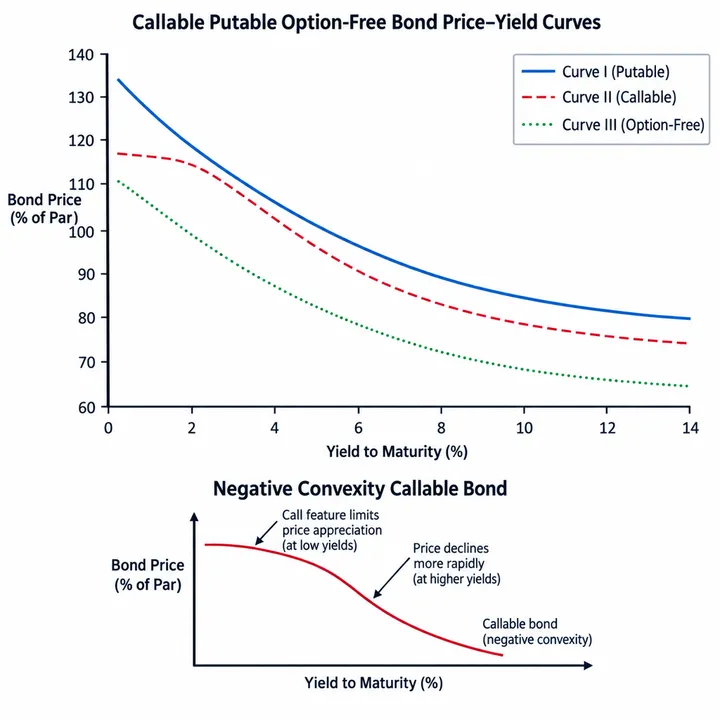
Answer: C. A callable bond
Practice by Chapter
Want unlimited practice?
Get full access to all questions, explanations, and performance tracking.
Scan to download app