
Breakeven, shutdown points and economies of scale — MCQs

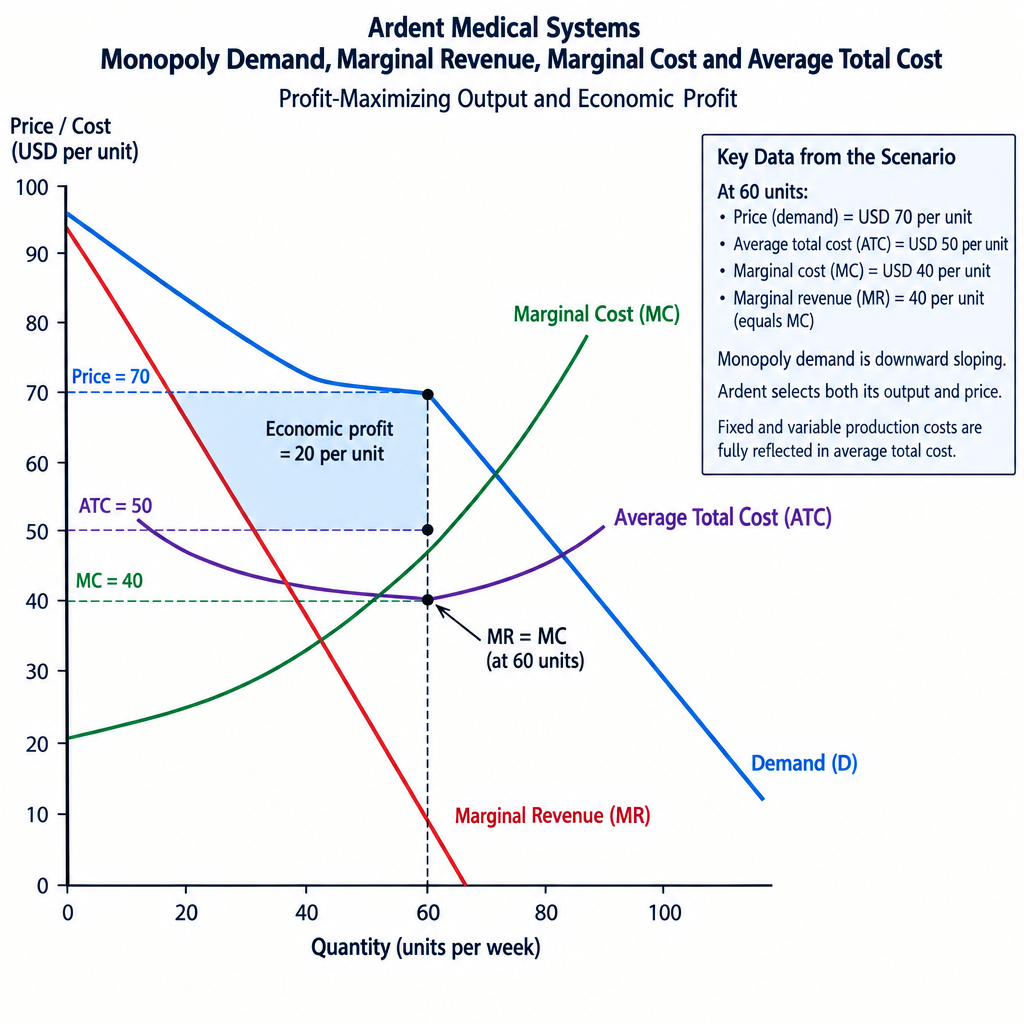
Ardent Medical Systems produces specialized diagnostic units protected by patents and regulatory approvals. Its product has no close substitute for certain hospital procedures, although hospitals can defer replacement purchases when prices rise. Ardent therefore faces a downward-sloping demand curve and selects both its output and price rather than accepting a market price. An equity analyst, Elena Ruiz, evaluates Ardent's current pricing decision using the weekly cost and revenue curves in Figure 1. All monetary amounts in the figure are measured in USD per unit, and quantity is measured in units per week. At 60 units, marginal revenue equals marginal cost. The demand curve indicates a price of USD 70 per unit at that output, average total cost is USD 50 per unit, and marginal cost is USD 40 per unit. Fixed and variable production costs are fully reflected in average total cost. Ruiz notes that Ardent is considering separate prices for two identifiable customer groups. Emergency-care hospitals have relatively inelastic demand because they must maintain immediate diagnostic capacity. Elective-care clinics have more elastic demand because they can delay purchases or use external laboratories. Ardent can verify each purchaser's facility type but currently permits unrestricted resale between licensed facilities. Management is considering contractual restrictions that would make resale impractical. A second analyst, Dev Patel, expects the patents to expire. He forecasts that differentiated competitors will enter with products that perform the same core function but vary in software, service agreements, and operating features. Entry will be legally unrestricted, and customers will continue to perceive meaningful product differences. Patel expects each producer to retain a downward-sloping demand curve, although entry will eliminate persistent economic profit. He also expects each producer's long-run output to remain below the quantity that minimizes average total cost. Ruiz emphasizes that the firm's profit-maximizing output must be identified from the marginal curves rather than from the intersection of demand and marginal cost. She also cautions that total revenue, accounting profit, and economic profit are distinct measures. The analysts assume that Ardent maximizes economic profit, does not engage in strategic limit pricing, and faces no capacity constraint over the output range displayed.
Armitage Foods produces differentiated packaged meals in Selvara and competes with several domestic and foreign brands. Product differentiation gives each producer some pricing power, although consumers can switch brands when relative prices change. Armitage faces the downward-sloping demand schedule shown in Exhibit 1. Its management assumes that fixed costs do not affect the current output decision and that the relevant objective is to maximize economic profit using marginal revenue and marginal cost. The company can select only one of the output levels shown. Selvara is a small country in the global market for packaged food and cannot influence the world price. Its government proposes a tariff on imported packaged meals to support domestic producers. Imports are expected to continue after the tariff is imposed. The tariff will raise the domestic price by the full amount of the tariff, increase domestic production, and reduce domestic consumption. The government will collect revenue on post-tariff imports. Armitage's economist explains that the policy redistributes surplus and creates production and consumption efficiency losses. Armitage also relies on an imported critical mineral used in temperature-control components for its production facilities. The exporting country has announced quantitative restrictions on mineral exports to pressure Selvara into changing its foreign policy. Alternative suppliers exist but require at least 18 months to qualify. During that period, mineral prices are expected to increase sharply and some Selvaran manufacturers may be unable to obtain sufficient quantities. Armitage's economist characterizes the restriction as economic statecraft and analyzes its immediate macroeconomic transmission through firms' input costs and productive capacity. The board additionally reviews Selvara's long-run growth prospects. Exhibit 2 provides the economy's expected capital growth, labor growth, total factor productivity growth, and factor shares. The economist applies a standard growth-accounting framework in which potential output growth equals the capital share multiplied by capital growth, plus the labor share multiplied by labor growth, plus total factor productivity growth. Factor shares sum to 100%, and no other growth adjustment is required. The board is cautioned not to confuse an increase in an economy's level of capital with permanently higher per-capita growth. Sustained increases in potential output per person ultimately require continuing technological progress or other persistent productivity improvements. All quantitative conclusions requested in the questions can be determined independently from the relevant exhibit.
An economy has capital and labor shares of 35% and 65%. Capital grows 4%, labor grows 2%, and total factor productivity grows 1.5%. The calculated growth rate of real output is closest to:
Atlas Global Strategy advises multinational companies on currency exposure and long-term country allocation. An analyst is asked to calculate several exchange rates using the quotations in Exhibit 1. Each quotation is stated as units of the price currency per one unit of the base currency. Transaction costs, taxes, and bid–ask spreads are ignored. For a cross-rate calculation, the analyst must determine the number of USD required to purchase one GBP using the USD-per-EUR and EUR-per-GBP spot quotations. The analyst is instructed to arrange the multiplication so that the intermediate EUR units cancel. Atlas is also evaluating a one-year forward contract. EUR and USD risk-free securities have identical default risk and liquidity, and borrowing and lending can occur at the stated annual rates. The forward contract is initiated at zero value, has no interim cash flows, and is priced using covered interest parity. For this calculation, the requested quotation is EUR per USD, so EUR is the price currency and USD is the base currency. A currency strategist estimates an equilibrium USD-per-EUR rate using relative purchasing power parity. The strategist compares the current market exchange rate with that equilibrium estimate and measures EUR overvaluation or undervaluation relative to the equilibrium rate. A higher USD-per-EUR rate means that one EUR purchases more USD and therefore indicates a stronger EUR relative to the USD. Finally, Atlas assesses the monetary policy stances of the Eurozone and the United States by comparing each central bank's current policy rate with its estimated neutral policy rate. A current policy rate above the neutral rate indicates a contractionary, or restrictive, stance intended to slow economic activity, while a current policy rate below the neutral rate indicates an expansionary, or accommodative, stance intended to stimulate activity. Atlas also considers how the resulting interest rate differential relates to cross-border capital flows and to the pricing of forward contracts under covered interest rate parity.
Northland Asset Management is preparing its quarterly economic outlook. The firm's economists are assessing a domestic telecommunications provider and the broader economy because both affect the earnings forecasts used by the equity team. The provider is the sole supplier of a specialized network service. Government licensing rules prevent entry for at least five years, resale is prohibited, and the provider charges one price to all customers. Its analysts assume that the demand and cost relationships in Exhibit 1 apply over the relevant output range and that the firm maximizes current-period economic profit. The macroeconomic committee separately reviews national data. Real output has declined for two consecutive quarters, unemployment is rising, inflation is below the central bank's target, and the estimated output gap is negative. Tax collections have declined under the existing tax code, while payments under the existing unemployment-benefit system have increased. Parliament has not enacted a stimulus package, changed tax rates, or modified eligibility for transfer programs. The committee also notes that the estimated marginal propensity to consume in the economy is 0.80 and that the foreign central bank's policy interest rate currently stands at 2.00%. The central bank operates under an inflation-targeting mandate and allows the currency to float. International capital can move freely, and domestic government securities are actively traded. Because conventional policy rates remain above zero, the central bank is considering purchasing government securities in the open market. The committee expects the standard short-run monetary transmission mechanism to operate and assumes no simultaneous foreign policy change. One committee member argues that the larger fiscal deficit proves the economy is above potential and that the government has adopted discretionary fiscal stimulus. Another member responds that the deficit can vary over the business cycle even without a legislative policy change. The portfolio managers must determine which interpretation is consistent with the observations and assess the likely initial interest-rate and exchange-rate consequences of the proposed monetary action. All conclusions are to be made using the data and statements in Exhibits 1 and 2.
A sovereign-strategy team at an asset manager is reviewing Norland, a developed economy whose government and central bank have separate policy mandates. The team must assess the economy's cyclical position and determine which policy instruments are most likely to be effective over the next year. Exhibit 1 presents recently released indicators, all calculated consistently over time. The government has not yet announced a new fiscal package. An economist on the team notes that real consumption growth has slowed as households rebuild savings. Export demand has also weakened, and manufacturers have responded by reducing production more slowly than sales have fallen. Wage growth remains positive but is decelerating. The economist expects unemployment to rise during the next two quarters because changes in employment tend to follow changes in production and new orders. Norland has a progressive personal income tax system and an unemployment-insurance program under existing law. As household income and employment change, tax collections and unemployment payments adjust without additional legislative approval. Parliament could also authorize a temporary infrastructure program, but procurement rules mean that approved construction spending would not begin for at least nine months. The government has sufficient fiscal capacity to undertake temporary countercyclical measures without breaching its medium-term debt ceiling. The central bank defines price stability as 2.0% inflation and estimates the neutral real policy rate at 1.5%. Although inflation has declined, the policy committee has maintained its nominal policy rate at 5.0% because it previously focused on preventing inflation expectations from becoming unanchored. The committee now recognizes that monetary policy affects output and inflation with a lag. Norland maintains a fixed exchange rate against a trade-weighted basket and permits capital to move freely across its borders. The central bank intervenes as necessary to maintain the exchange-rate commitment. A strategist argues that the authorities can independently reduce interest rates substantially below foreign rates while preserving the fixed exchange rate indefinitely. Another strategist responds that the exchange-rate regime limits monetary independence and that temporary fiscal support would be more effective if aggregate demand continues to weaken. The team uses Exhibits 1 and 2 to evaluate these conclusions.
The spot rate is USD1.1111/CHF. One-year risk-free rates are 5.0% in the United States and 2.0% in Switzerland. The calculated one-year forward rate is closest to:
Elena Ruiz, an economist at Meridian Asset Management, is preparing a quarterly outlook for the firm's equity and fixed-income teams. She first evaluates Vectra Components, the only domestic producer of a specialized semiconductor input protected by a long-lived patent. Vectra sells into a market represented by the linear inverse demand curve in Exhibit 1. Its manufacturing facilities have sufficient capacity to meet the profit-maximizing level of demand, and its marginal cost is constant. Ruiz assumes Vectra maximizes operating profit and cannot price-discriminate. Ruiz next reviews national activity data. Consumer spending growth has slowed, manufacturing firms have reduced overtime, and lenders have tightened approval standards. The data in Exhibit 1 summarize three indicators she considers particularly useful for determining the current business-cycle phase. There have been no supply disruptions or labor strikes that would independently explain the movements in these indicators. The national central bank operates under an inflation-targeting framework and permits the currency to float. With inflation below target and economic activity weakening, the policy committee is considering an open-market purchase of government securities. Ruiz expects commercial banks to retain normal reserve buffers and assumes that financial markets are functioning without unusual stress. She evaluates the initial directional effects of the action on domestic short-term interest rates and the currency, holding foreign monetary policy constant. The finance ministry is separately considering a discretionary fiscal package consisting of the spending and net tax changes reported in Exhibit 1. For estimating the package's demand effect, Ruiz uses a simple closed-economy Keynesian model with a constant price level, no crowding out, no induced imports, and no change in private investment. Government purchases enter aggregate expenditure directly, while the tax change affects consumption through the marginal propensity to consume. Ruiz emphasizes that the monetary and fiscal proposals have not yet been implemented. Consequently, the business-cycle classification must be based on the reported economic indicators rather than on assumed future policy effects. She also treats the company pricing analysis independently of the macroeconomic outlook.
An economy's labor force grows 1.5%, capital stock grows 4.0%, and total factor productivity grows 2.0%. With capital and labor shares of 40% and 60%, potential output growth is closest to:
Want unlimited practice?
Get full access to all questions, explanations, and performance tracking.
Scan to download app