
Pricing and Valuation of Forward Commitments — MCQs

On this page
Lydon Securities is reviewing option positions for its proprietary portfolio and for a private client who already owns Lydon common stock. The firm's policy requires analysts to use no-arbitrage valuation methods and to distinguish an option's expiration payoff from its current value. Unless otherwise stated, options are European, transaction costs and taxes are ignored, and borrowing and lending occur at the stated risk-free rate. The first analysis concerns six-month European calls and puts on a non-dividend-paying stock. Exhibit 1 provides the stock price, exercise price, risk-free rate, and observed call price. The call and put have identical exercise prices and expiration dates. Analyst Priya Shah plans to infer the put price using a position in the stock and a risk-free zero-coupon bond rather than relying on a directional forecast for the stock. The risk-free rate is continuously compounded. Shah next values a different European call using the one-period binomial model. Exhibit 2 provides the current stock price, the two possible expiration-date stock prices, the exercise price, and the risk-free gross return for the period. The model assumes the stock has only the stated up and down outcomes, no dividends are paid, and there are no arbitrage opportunities. Shah will first determine the call's state-contingent payoffs and then identify the stock position and risk-free borrowing or lending position that reproduce those payoffs. She will also verify the result using risk-neutral valuation. The risk-neutral probability must be inferred from the stock prices and the risk-free gross return; it is not an estimate of the stock's actual probability of increasing. The private client owns 10,000 Lydon shares and expects the price to remain close to its current level during the next three months. The client's objective and constraints are summarized in Exhibit 3. The client wants to retain legal ownership unless the shares rise to a predetermined sale price and is comfortable delivering the shares at that price. The client does not want a strategy that creates an obligation to acquire additional shares if the stock price declines. The adviser is considering calls and puts with three months to expiration and recognizes that option premiums received at initiation affect strategy profit even though they are not part of the option's expiration payoff. Each analysis is independent. The data in Exhibit 1 apply only to the parity analysis, the data in Exhibit 2 apply only to the binomial analysis, and Exhibit 3 governs the strategy recommendation.
Northbridge Asset Management holds a concentrated position in the shares of a non-dividend-paying company. Portfolio manager Elena Ruiz is considering European options both to manage the position's risk and to create synthetic exposures. All options under review can be exercised only at expiration. Markets are assumed to be frictionless, borrowing and lending are available at the risk-free rate, and there are no taxes or transaction costs. Ruiz first asks analyst Mark Feld to verify the quoted value of a one-year European put by applying put–call parity. A European call with the same underlying stock, exercise price, and expiration is actively traded. Feld is instructed to distinguish the present value of the exercise price from the exercise price payable at expiration. He is also reminded that the current values of the call and put, rather than their expiration profits, must be used in the parity relationship. The relevant data are presented in the parity analysis column of Exhibit 1. Feld then examines a separate stock and call using a one-period binomial model. At the end of the year, the stock will have one of two stated values. The call's terminal payoff is the greater of the stock price minus the exercise price or zero. Feld initially proposes using Northbridge's forecast probability of an economic expansion, but Ruiz directs him to use the risk-neutral probability implied by the stock-price outcomes and the risk-free growth factor. The binomial analysis assumes no interim distributions and no arbitrage opportunities. Ruiz also evaluates strategies for Northbridge's concentrated equity holding. The investment committee wants protection against a substantial decline below a specified share price but does not want to dispose of the shares or surrender gains if the shares appreciate. The committee accepts the payment of an option premium in exchange for this protection. It does not have an income-generation objective and does not want to increase the number of shares it may be required to own. Finally, Feld must determine the number of shares in the replicating portfolio for the binomial call. The replicating position combines shares with borrowing or lending so that its terminal values match the call's payoffs in both states. Each question can be answered directly from the stated objectives and the independently supplied data.
Meridian Advisory manages option overlays for private and institutional clients. Analyst Elena Park is reviewing European options on non-dividend-paying shares. All options in the analysis can be exercised only at expiration, and contracts used in a replication have identical strikes and expiration dates. Markets are assumed to be frictionless, borrowing and lending are available at the stated risk-free rate, and no arbitrage opportunities can persist. Park first evaluates a quoted European call and determines the corresponding no-arbitrage put value. She applies put–call parity using the present value of the strike price because the exercise payment occurs at expiration. The market information required for this calculation appears in Exhibit 1. A second assignment requires Park to construct a synthetic forward position. She recalls that the combination must reproduce the forward's linear expiration payoff rather than merely provide exposure to volatility. The options used for this position have the same strike and expiration. Client 1's required direction of exposure is stated in Exhibit 3. Park next values a European call using a one-period binomial model. The stock has only two possible prices at the end of the period, and the up and down factors are obtained directly from the terminal prices relative to the current stock price. She calculates a risk-neutral probability using the one-period risk-free gross return and discounts the risk-neutral expected option payoff at the risk-free rate. The stock pays no dividends during the period. Exhibit 2 contains all required model inputs. Finally, Park advises Client 2, who already owns the underlying shares. The client is concerned about a material decline but does not want to surrender gains if the share price appreciates. The client accepts the payment of an option premium to obtain asymmetric protection. Park considers a protective put, a covered call, and liquidation of the shares. The client's objective, rather than Park's directional market forecast, governs the strategy recommendation.
Northbridge Opportunities Fund holds concentrated positions in publicly traded equities and uses European options for valuation-consistent hedging and return modification. Portfolio manager Elena Park asks an analyst to assess option values and strategies under no-arbitrage assumptions. All contracts cover one share, the underlying shares pay no dividends during the stated periods, and there are no transaction costs, taxes, or exercise restrictions beyond the European exercise terms. For the first analysis, Park provides prices for a European call and the associated underlying share. A European put has the same exercise price and expiration date, but its market price is temporarily unavailable. The analyst is instructed to infer the put price from put–call parity using simple-interest discounting. The annual risk-free rate and six-month maturity are specified in Exhibit 1. Park then considers a separate one-period European call. At the end of the period, the share will be worth either USD 120 or USD 90. The exercise price is USD 100, and the risk-free gross return over the period is 1.02. The analyst may use either a replicating portfolio or risk-neutral valuation. The physical probabilities of the two share-price outcomes are unknown and are not required for no-arbitrage valuation. Short selling and borrowing are permitted. In addition to valuation, Park evaluates three strategies shown in Exhibit 2. For one existing share position, the fund wishes to establish a minimum expiration-date sale price but remain able to participate in appreciation above the current share price. For a second position, the fund would accept limited upside in exchange for current premium income. Park also identifies a possible volatility trade for a security expected to experience a substantial price movement, although the direction of that movement is uncertain. The options are assumed to remain outstanding until expiration. References to a strategy's expiration payoff exclude initial premiums unless the question explicitly requests profit. The covered-call premium is received when the strategy is established, whereas premiums for purchased options are paid at initiation.
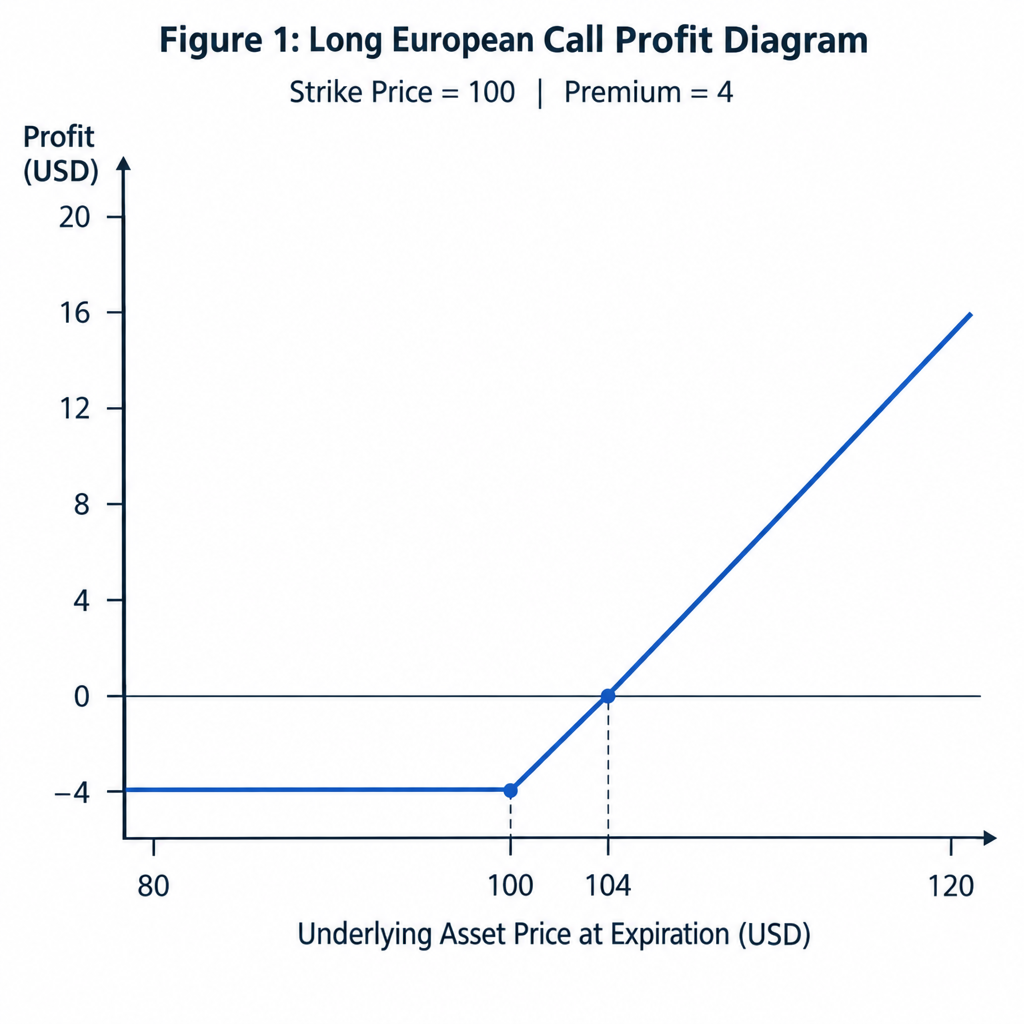
Elena Morris manages the Northbridge Options Fund. She is preparing three independent analyses for the investment committee and uses European options throughout. All options can be exercised only at expiration, underlying assets make no distributions during the relevant periods, and markets are free of taxes, transaction costs, and arbitrage opportunities. Morris first reviews the expiration profit diagram in Figure 1. The horizontal axis shows the underlying asset price at expiration, and the vertical axis shows the option position's profit after including the premium. Profit remains constant at negative USD 4 when the underlying price is at or below USD 100. Above USD 100, profit rises dollar-for-dollar with the underlying price and crosses zero at USD 104. The committee asks Morris to identify the position represented by the diagram rather than merely describe its payoff. For Market 1, Morris observes a stock price of USD 100, a one-year European call price of USD 12, and a call and put exercise price of USD 95. The one-year risk-free rate is 5.00% using annual simple compounding. The put and call have the same exercise price and expiration date. Morris applies European put–call parity using the present value of the exercise price. For Market 2, a non-dividend-paying stock currently trades at USD 100. At the end of one year, the stock will be worth either USD 120 or USD 80. A European call expiring at that time has an exercise price of USD 100. The annual risk-free rate is 5.00%, and borrowing and lending are available at that rate. Morris uses a one-period binomial model and risk-neutral valuation; no real-world state probabilities are required. Separately, Northbridge advises a taxable shareholder with a concentrated listed-equity holding. The shareholder intends to retain the shares for one year, requires protection against a large decline, and wants to preserve all potential appreciation above the current share price. The shareholder can pay an option premium from existing cash and has no objective to generate current income. Morris considers a covered call, an equity collar, and a protective put. Each proposed option has a one-year expiration aligned with the shareholder's investment horizon.
Practice by Chapter
Pricing and valuing equity forwards and futures
Practice Questions
Carry arbitrage model with and without underlying cash flows
Practice Questions
Pricing and valuing interest rate forwards and futures
Practice Questions
Pricing and valuing fixed-income forwards and futures
Practice Questions
Pricing and valuing interest rate swaps
Practice Questions
Pricing and valuing currency swaps
Practice Questions
Pricing and valuing equity swaps
Practice Questions
Want unlimited practice?
Get full access to all questions, explanations, and performance tracking.
Scan to download app