
Swap as a series of forward contracts — MCQs

Meridian Derivatives Fund uses forwards, futures, and swaps to obtain market exposure and manage financing risk. A portfolio manager entered a nine-month long forward on a non-tradable equity index. The contract requires cash settlement at maturity, and the index's dividends are represented by a continuous dividend yield. Relevant initiation and current data are presented in Exhibit 1. The counterparty has not defaulted, no collateral has been transferred, and the current value is measured from Meridian's perspective. The manager is also comparing the index forward with an otherwise equivalent exchange-traded futures contract. The two contracts have the same underlying index and maturity. The futures contract is marked to market daily through a central clearinghouse, whereas the forward settles only at maturity. The manager expects index values and short-term interest rates to be positively correlated during the remaining contract period. Transaction costs, taxes, and initial margin financing costs are ignored for the pricing comparison. Meridian is evaluating a newly initiated three-year interest rate swap with annual settlements. Under the proposed swap, Meridian would pay a fixed rate and receive a one-year floating reference rate. The first floating payment is set at initiation, subsequent floating payments reset annually, and the notional principal is not exchanged. Exhibit 2 reports the discount factors applicable to the three annual payment dates. The fixed rate must make the swap's initial value equal to zero. Finally, the fund is considering a six-month forward purchase of an investment commodity. The commodity's spot price is USD 50.00 per unit. The continuously compounded annual risk-free rate is 4%, proportional storage costs are 2% annually, and the commodity provides a 1% annual convenience yield. All rates remain constant through maturity. Storage costs and convenience yield are incorporated into the continuous cost-of-carry relationship, and there are no other benefits, financing costs, or restrictions on short selling.
Northbridge Manufacturing is reviewing several derivative transactions with its treasury adviser. The company uses derivatives only for identifiable financing or operating exposures and measures all derivative values from Northbridge's position. Transaction costs and taxes are ignored, and all counterparties are assumed able to perform. The first transaction is a six-month equity forward considered by the corporate pension plan. The plan would take the long position and receive one share at maturity in exchange for the delivery price. The underlying share pays no dividends or other income during the contract term. At initiation, the share price and annual effective risk-free rate are those reported in Exhibit 1. The dealer quoted a delivery price of USD 126.00, although the pension analyst wants to calculate the no-arbitrage price independently. Three months after initiation, the share price has risen, and the risk-free rate is unchanged. The contract has not been reset, so its delivery price remains USD 126.00. The analyst must distinguish the forward price of a new contract from the value of the existing contract. The treasury adviser also proposes using exchange-traded futures instead of new OTC forwards for some shorter-term exposures. A treasury associate states: 'Because a futures contract is marked to market, Northbridge does not need to provide funds until the contract expires.' The adviser responds that an initial margin deposit and subsequent variation margin may be required. The adviser further explains that the daily settlement of gains and losses affects both counterparty exposure and the timing of cash flows. When interest rates are uncertain, the ability to reinvest interim gains or finance interim losses may cause a futures price to differ from the price of an otherwise comparable forward. Finally, Northbridge has USD 80 million of floating-rate debt. Interest is paid quarterly at the three-month reference rate plus 120 basis points, where 1 basis point equals 0.0001 in decimal rate terms. Management expects reference rates to rise and wants to stabilize interest expense for the next three years without refinancing the debt. The available swap has quarterly settlements, a USD 80 million notional principal, and a fixed rate of 4.60%. The floating leg is based on the same three-month reference rate as the debt. No principal is exchanged under the swap.
Meridian Capital manages a diversified multi-asset fund and uses derivatives both to obtain market exposure and to alter the fund's interest-rate profile. The derivatives committee requires all positions to be priced using no-arbitrage relationships and values to be reported from the fund's perspective. Unless stated otherwise, quoted rates are annual rates, and there are no transaction costs, taxes, or restrictions on short selling. An analyst first considers establishing a six-month long forward on a broad equity index. The index pays dividends continuously, so the analyst treats the dividend yield as an economic benefit forgone by holding the forward instead of the underlying index portfolio. The analyst notes that a forward's delivery price is set so that the contract has zero value at initiation, but its value can subsequently become positive or negative as market conditions change. The fund already holds a long equity index forward with a delivery price of 2,480 and three months remaining. To value this contract, the analyst obtains current spot, financing-rate, and dividend-yield data. The counterparty has posted collateral, but the contract is not settled daily. The analyst is instructed to calculate the current value rather than the current forward price or the expiration payoff. Meridian also holds a receive-fixed, pay-floating interest rate swap with a semiannual settlement convention. The floating payment for each period is determined using six-month SOFR observed at the beginning of that period and is paid at the end. The fixed and floating amounts are netted at settlement. The most recent SOFR reset has already occurred, making the next floating payment known even though later payments remain uncertain. Finally, the committee is comparing OTC forwards with exchange-traded futures. One member states that identical forward and futures prices are not guaranteed when interest rates are stochastic because futures gains and losses are realised daily and can be reinvested or financed at prevailing rates. For the operational comparison, the committee focuses on the daily settlement mechanism rather than on potential price differences arising from the correlation between interest rates and the underlying asset.
A copper producer locks in a customized future selling price through a privately negotiated contract requiring both parties to transact at maturity. The contract is best described as:
A portfolio manager trades an exchange-listed contract that requires both parties to transact at maturity and is marked to market daily. The contract is best described as:
A portfolio manager buys a listed contract that grants the right, but not the obligation, to buy an equity index at a fixed price. The contract is best described as:
A dealer replaces an uncleared bilateral forward with an exchange-traded futures contract. The change most likely will:
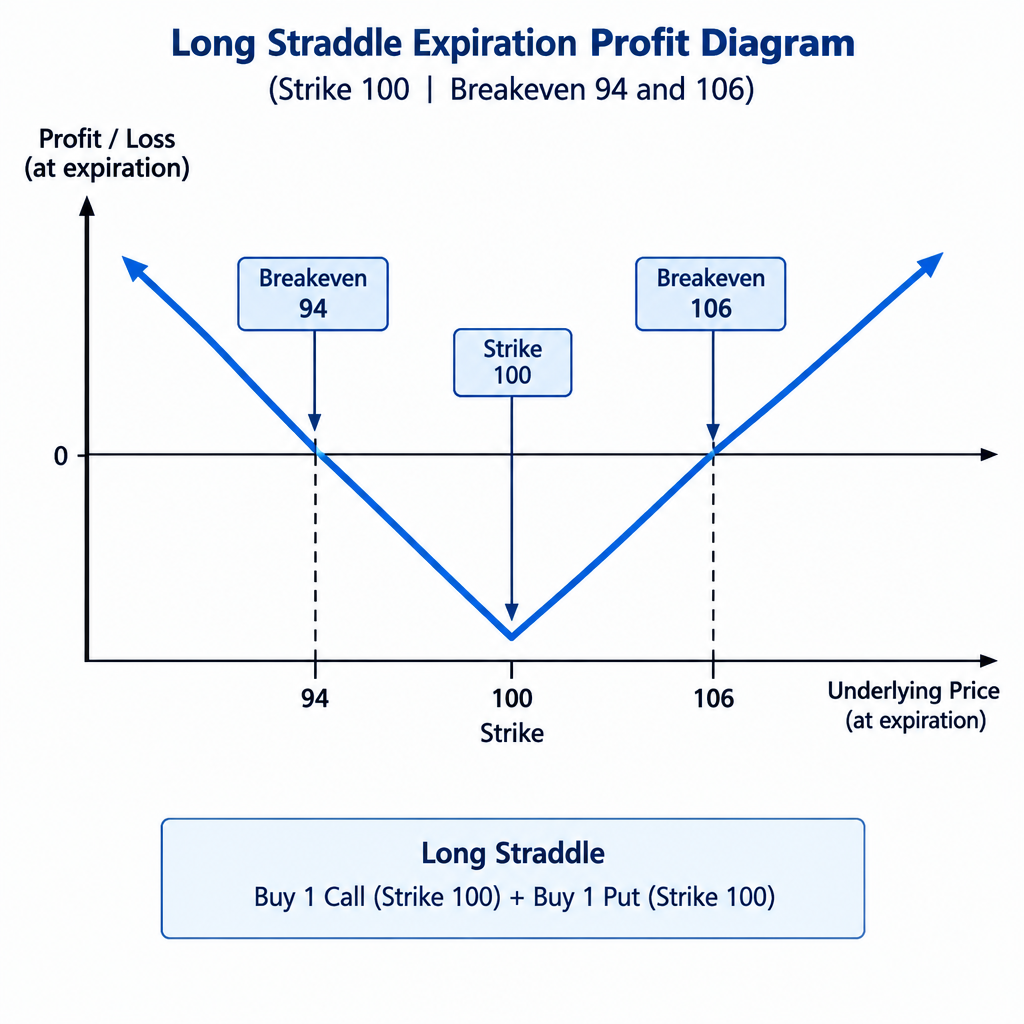
The option position represented by Figure 1 is best described as a:
Want unlimited practice?
Get full access to all questions, explanations, and performance tracking.
Scan to download app