
Put-call forward parity — MCQs

Northbridge Global Fund reports performance in USD and owns a European equity portfolio denominated in EUR. The portfolio's current market value and relevant currency data are presented in Exhibit 1. The exchange-rate quotation is USD per EUR, so an increase in the quoted rate represents EUR appreciation against USD. The fund's equity manager expects a positive local-market return but also expects EUR to depreciate against USD during the next six months. For performance estimation, the local-market and currency returns compound over the same period. The investment committee permits the use of deliverable currency forwards for strategic hedging. A full currency hedge would sell an amount of EUR equal to the portfolio's current EUR principal and buy USD for delivery in six months. The committee has instead selected an 80% hedge ratio because it wishes to reduce, but not eliminate, foreign-currency exposure. The hedge ratio applies to the current portfolio value; projected equity gains are not included in the forward notional. The committee ignores transaction costs, collateral costs, and any interim portfolio cash flows. A trustee asks whether the fund can protect against EUR depreciation while retaining gains if EUR instead appreciates. The fund may purchase European currency options expiring in six months. A EUR put gives its owner the right to sell EUR for USD at the exercise rate and is economically equivalent to a USD call when the currencies and notionals are matched. The committee is willing to pay an upfront premium but does not permit uncovered option writing. The risk manager reminds the committee that a forward is a bilateral forward commitment: both parties are obligated to transact at maturity, and its payoff varies linearly with the maturity spot rate. In contrast, a purchased currency option is a contingent claim that gives the fund a right without imposing an exercise obligation. The committee's choice must therefore reflect whether it wants to fix the exchange rate or establish downside protection while preserving favorable currency participation.
Arcadia Pension Plan reports its assets and liabilities in USD but invests in both domestic and international markets. The investment committee permits derivatives for hedging and efficient portfolio adjustment but prohibits uncovered speculative positions. Daniel Cho, the plan's risk manager, reviews a euro-denominated asset allocation and a domestic equity overlay. The euro asset creates a long exposure to EUR because its USD value falls if the EUR depreciates against the USD. Cho expects elevated exchange-rate volatility but has no reliable directional forecast. For one mandate, the committee wants to remove all exchange-rate uncertainty over the next three months using a forward contract. The applicable quotation is expressed as USD per EUR, so the EUR is the base currency and the USD is the price currency. Forward points are quoted in USD per EUR and must be algebraically added to the spot rate when positive. For a separate mandate, the committee wants protection against EUR depreciation but wishes to retain any increase in the USD value of the assets caused by EUR appreciation. Cho therefore considers a currency option rather than a forward commitment. The committee is willing to pay an upfront premium for an asymmetric payoff but will not write uncovered options. Cho also reviews the plan's domestic equity portfolio. The committee wants to reduce systematic equity exposure quickly without selling the underlying securities and incurring trading costs. Cho plans to use equity index futures and calculates the number of contracts from the required change in portfolio beta, the portfolio market value, and the value and beta of each futures contract. A negative result indicates a short futures position. Cho reminds the committee that forwards and futures impose obligations on both counterparties, whereas a purchased option gives the holder a right without an exercise obligation. Exhibit 1 contains all market values, quote conventions, and hedge objectives required for his analysis.
Glenhaven Global Fund reports performance in USD and invests in equities denominated in several currencies. The investment committee distinguishes the local-market return on each foreign asset from the currency return generated when that asset's value is translated into USD. Currency contracts are used solely to alter currency exposure; the underlying securities remain in the portfolio. The fund currently owns EUR-denominated equities and is therefore economically long EUR relative to USD. Portfolio manager Isaac Morgan is considering a full three-month currency hedge using forward contracts whose underlying contract size is stated in EUR. Under the market quote convention in Exhibit 1, EUR is the base currency and USD is the price currency. Morgan must choose the contract direction before determining the number of contracts. Glenhaven also has an existing long-EUR forward. At settlement, the fund will buy EUR at the contracted USD-per-EUR rate. The current value should be measured in USD from Glenhaven's perspective. Because the current three-month forward rate is above the existing contract rate, the contract has a gain to the party that is long EUR. The difference payable at maturity must be discounted using the USD effective risk-free rate for the remaining three-month period. The committee is also reviewing a proposed fixed-for-fixed cross-currency swap involving a US issuer and a European issuer. Each issuer wants funding in the other's domestic currency. Both can borrow directly in either currency, but their relative borrowing advantages differ across the two markets. A potential aggregate gain exists when the difference between their USD borrowing-cost spread and their EUR borrowing-cost spread is positive. Transaction costs and dealer compensation are ignored for purposes of identifying the comparative advantages. Finally, Morgan is considering whether a complete forward hedge is appropriate. The committee wants protection against EUR depreciation but also wants to retain gains if the EUR appreciates against the USD. The selected instrument must have a three-month maturity matching the exposure horizon. Options are European, the relevant EUR option notional equals the asset exposure, and the committee accepts paying an upfront premium for an asymmetric payoff. Exhibits 1 and 2 provide all market and borrowing data required for the analysis.
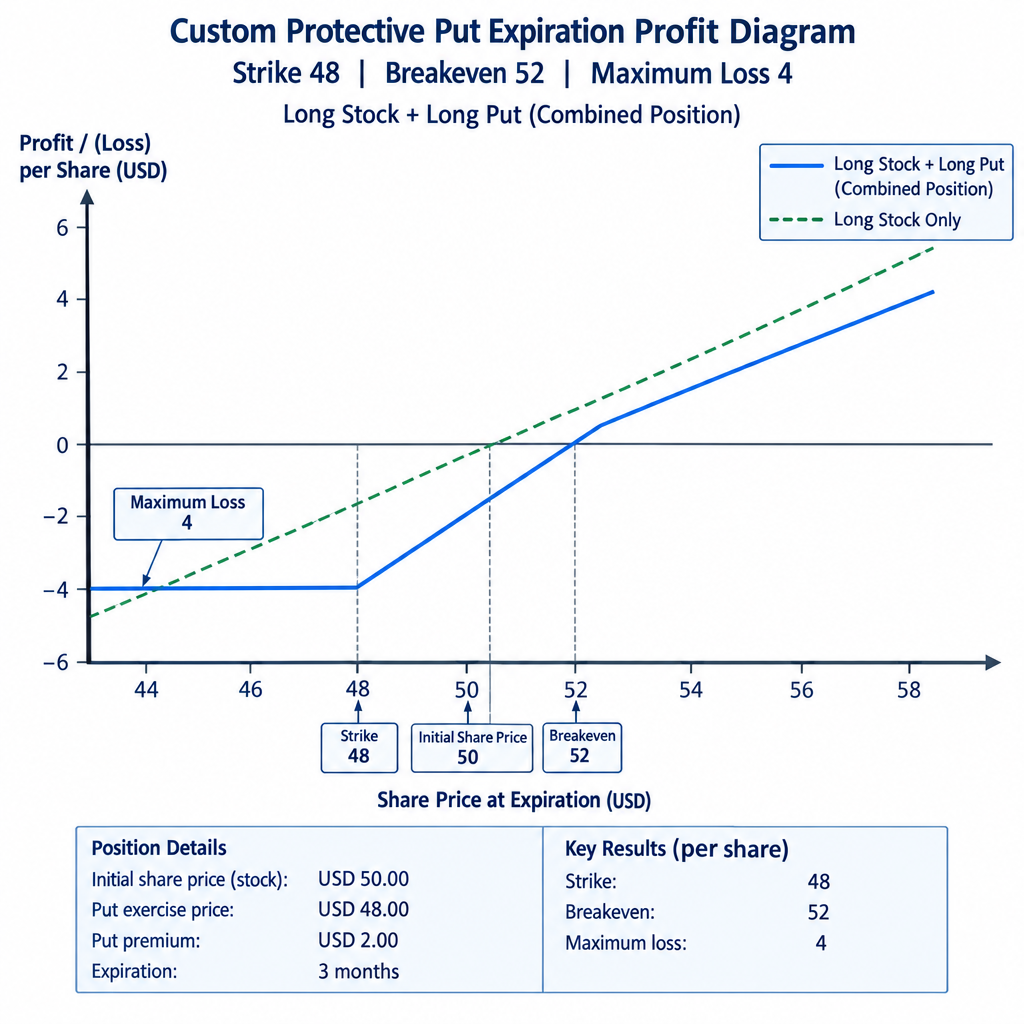
Hawthorne Global Fund holds domestic and foreign equities and uses derivatives to alter risk without immediately selling underlying investments. The investment committee requires each hedge to preserve an identified desirable exposure and to avoid introducing unnecessary leverage. The fund owns shares currently priced at USD 50.00. Concerned about a short-term decline, the manager considers purchasing a three-month put with an exercise price of USD 48.00 for a premium of USD 2.00 per share. Figure 1 shows the combined expiration profit per share from the existing long stock and the proposed option. The stock's initial purchase price is USD 50.00, and the figure incorporates the USD 2.00 option premium. Transaction costs and the time value of money are ignored. The manager wants a limited maximum loss while retaining gains if the share price rises. The fund also holds EUR-denominated assets whose current market value is EUR 20 million. Performance is measured in USD, and the relevant exchange-rate quote is USD per EUR, so EUR is the base currency and USD is the price currency. The manager expects the EUR to appreciate but wants protection against a material EUR depreciation over the next three months. The committee does not want to sell the EUR assets and is willing to pay an option premium to preserve favorable currency participation. The available European currency options expire at the end of the three-month hedging horizon. A smaller equity allocation is denominated in Swedish kronor (SEK). No sufficiently liquid SEK derivative is available for the required maturity, so the manager proposes using exchange-traded Norwegian krone (NOK) futures because SEK and NOK have historically moved together against USD. The futures are centrally cleared and marked to market daily. The compliance officer notes that historical correlation does not ensure that the currencies will move by equal percentages during the hedge period. The committee therefore asks the manager to identify the primary residual risk created by using NOK futures to hedge a SEK asset exposure. All positions are evaluated from the fund's perspective. Currency options are described in terms of the currency bought or sold, and no option is exercised before expiration.
Stratus Industries is a US-based manufacturer that reports its results in USD. Its treasury department manages contractual foreign-currency cash flows separately from longer-horizon economic exposures. Exchange rates are quoted as units of USD per unit of foreign currency unless explicitly stated otherwise. Stratus recently sold equipment to a European customer and will receive EUR 10 million in three months. The invoiced amount and payment date are fixed, and the customer presents no material credit concern. Treasury's objective is to eliminate uncertainty about the USD amount ultimately received. The treasurer is considering a deliverable forward contract matching both the amount and maturity of the receivable. The contract would not require an initial premium, but it would obligate Stratus to exchange the specified currencies at maturity regardless of the prevailing spot rate. Stratus also owns a CAD-denominated operating asset portfolio valued at CAD 20 million. Management expects to hold these assets for several years. For the next six months, however, it wants protection against a decline in the USD value of CAD while retaining any increase in value arising from CAD appreciation. Management is willing to pay an upfront option premium and does not want a hedge that creates an obligation to exchange currencies following a favourable movement. In a third market, Stratus expects to receive cash flows in an emerging-market currency for which neither liquid forwards nor exchange-traded futures are available. A dealer proposes a cross-hedge using liquid USD-settled futures on a different currency that has historically been positively correlated with the emerging-market currency. The treasurer recognises that the historical relationship may change during periods of market stress. The futures would also be marked to market daily, potentially generating interim liquidity requirements. The risk committee instructs treasury to distinguish the source of hedge ineffectiveness from the settlement mechanics of the selected instrument. It also notes that futures have symmetric obligations, whereas purchased options provide contingent rights. All hedges are evaluated from Stratus's perspective, and transaction costs, taxes, and counterparty defaults are ignored unless directly relevant to the identified risk.
Want unlimited practice?
Get full access to all questions, explanations, and performance tracking.
Scan to download app