
The economic balance sheet — MCQs

An institutional investor's asset allocation approach explicitly incorporates the value and duration of the investor's liabilities when setting target asset-class weights. This approach is best described as which of the following?
The Northbridge Investment Office develops ten-year strategic capital market expectations and twelve-month cyclical forecasts for a diversified pension plan. Its economists begin by estimating sustainable real output growth from expected labor-force growth and labor-productivity growth. They estimate long-run inflation using the central bank's target, fiscal conditions, and evidence concerning the credibility of monetary policy. Shorter-horizon forecasts incorporate the output gap, capacity utilization, corporate profitability, monetary policy, and current market prices. The economy has experienced three quarters of weak growth, declining corporate earnings, and below-average industrial utilization. Consumer demand has recently stabilized, new orders have increased, and bank lending standards have stopped tightening. Fiscal policy is expected to remain neutral. The central bank states that it will reduce its policy rate only if inflation continues moving toward target. The chief investment officer emphasizes that asset returns must be linked to economic forecasts through explicit transmission mechanisms. For government bonds, the office separately considers expected inflation, the expected path of real short-term rates, and the term premium. For equities, it considers earnings growth, dividend income, and possible valuation changes. The office also recognizes that economic and market relationships can change following regulatory reforms, technological developments, or shifts in monetary-policy credibility. The economists provide the forecasts in Exhibit 1 and the statements in Exhibit 2. The pension committee asks whether the central forecast should be treated as a precise outcome. The chief investment officer responds that estimation error, model uncertainty, and unexpected shocks can cause realized returns to differ materially from point forecasts. She therefore requests an approach that presents distinct but internally consistent economic paths, includes the asset-market implications of each path, and permits the committee to reflect its assessment of each path's likelihood.
Meridian University Endowment supports scholarships, faculty salaries, and research programs through annual distributions. Its investment committee is conducting a strategic asset allocation review after a period of rapid growth in private-market commitments. The endowment has a perpetual horizon, but the finance office requires dependable annual liquidity because operating units rely on distributions and cannot readily reduce spending during market downturns. The policy requires the portfolio to earn at least 7.0% nominally over the long term, reflecting the spending rate, expected inflation, and investment expenses. The committee accepts moderate market risk but has established a maximum expected volatility of 12.0%. Because capital calls and annual distributions may coincide, at least 70% of assets must remain in liquid public securities or cash. Private equity and infrastructure are considered illiquid, and their combined strategic weight may not exceed 25%. The consultant presents three candidate portfolios in Exhibit 1. Their expected returns and volatilities use consistent forward-looking assumptions. Public equity, investment-grade bonds, and cash are liquid; private equity and infrastructure are illiquid. The consultant confirms that no candidate portfolio uses leverage and that all reported weights sum to 100%. Several committee members focus on diversification. One member argues that a portfolio is well diversified whenever it contains many separately named asset classes. The consultant responds that public equity, private equity, and growth-oriented infrastructure can share substantial exposure to economic growth and equity-market risk. She recommends assessing the distribution of total portfolio risk across underlying return drivers rather than merely counting asset classes. The committee also considers implementation. A USD 40 million donation will be received next month, but the next scheduled private-market funding decision is six months away. The policy permits derivatives for hedging and efficient exposure management but prohibits portfolio leverage. The chief investment officer proposes temporarily obtaining equity exposure through fully collateralized index futures rather than leaving the donation uninvested or accelerating an illiquid commitment. Finally, the consultant recommends evaluating assets relative to the endowment's inflation-sensitive spending obligations. She explains that an asset-only optimization may select a mathematically efficient portfolio without considering whether its return pattern aligns with required distributions. The committee therefore wants an allocation that is not only efficient but also feasible under its liquidity, risk, illiquidity, and governance constraints.
Haven University has a USD 1.0 billion endowment with a perpetual time horizon. Its objective is to support current university spending while preserving purchasing power. The endowment distributes 4.5% of beginning-of-year market value and incurs investment and administrative expenses of 0.5% annually. Long-run expected inflation is 2.5%. The portfolio policy statement permits tactical deviations within approved ranges but requires each deviation to have a documented valuation or macroeconomic rationale, a maximum three-year horizon, and a predetermined review process. The investment office is considering a three-year overweight to emerging-market equities because their normalized valuation multiples are significantly below the office's fair-value estimates. Separately, the endowment's long-term strategic asset allocation includes a 55% target weight to global equities; a recent market rally has pushed the actual weight to 59%, and the investment office is evaluating whether to sell equities to restore the policy weight. The policy defines illiquidity exposure as private-market net asset value plus unfunded commitments. It limits this exposure to 30% of total endowment assets. The committee also requires a minimum two-percentage-point buffer below that limit when approving new commitments. Current private-market net asset value is USD 220 million, and existing unfunded commitments are USD 50 million. A private equity manager has requested a new USD 50 million commitment. The commitment would be included immediately in policy illiquidity exposure even though capital is expected to be called over several years. The endowment's small investment office can oversee diversified public-market funds and established private-market partnerships, but it cannot directly operate complex derivative overlays or manage concentrated direct investments. The committee therefore considers governance capacity when selecting a strategic portfolio. Separately, the office is evaluating whether to replace its capitalization-weighted domestic equity index fund with an ESG-screened index fund. The replacement would maintain the same policy equity weight and broad market exposure but would change security selection and create modest tracking error. Exhibit 1 presents three strategic portfolios produced by the consultant. All three meet the endowment's expected spending and purchasing-power return requirement before consideration of the stated constraints.
A foreign asset has an expected real local return of 4.0%, local inflation of 2.5%, and currency appreciation against USD of 1.5%. Using geometric compounding, its expected nominal USD return is closest to:
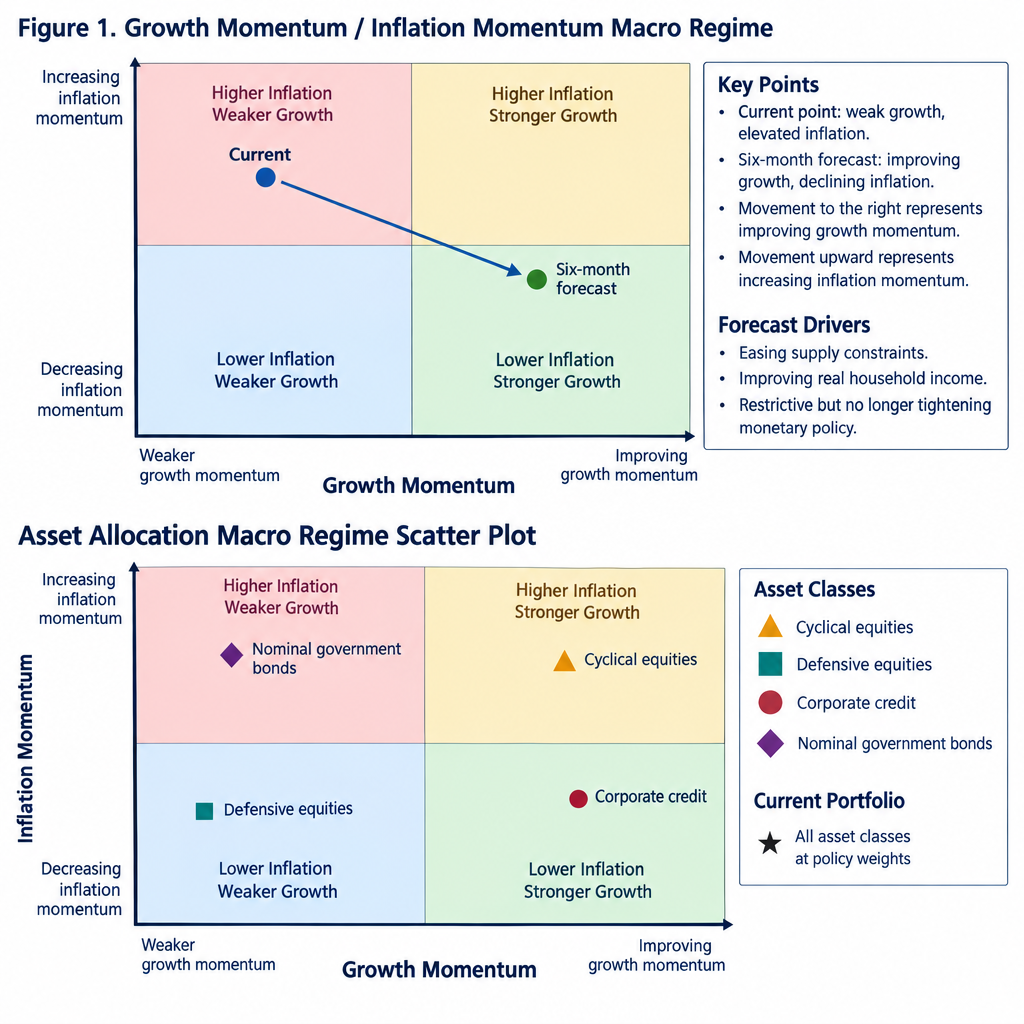
Northbridge Pension Plan reviews tactical asset allocation quarterly while retaining a long-term strategic policy portfolio. The plan's investment objective is to earn the liability discount rate over rolling five-year periods while avoiding unrewarded concentration risk. Tactical positions must remain within policy ranges and should reflect both the direction of a forecast and the investment team's confidence in that forecast. The macro team evaluates growth momentum and inflation momentum relative to consensus expectations. In Figure 1, movement to the right represents improving growth momentum, and movement upward represents increasing inflation momentum. The current point reflects weak growth and elevated inflation. The team's six-month forecast reflects improving growth and declining inflation. The forecast incorporates easing supply constraints, improving real household income, and restrictive but no longer tightening monetary policy. The equity manager states that cyclical companies generally have greater sensitivity to changes in economic activity than defensive companies. The credit manager notes that, holding other factors constant, improving economic growth tends to strengthen issuer cash flows and reduce expected default losses. The fixed-income manager expects declining inflation momentum to support nominal government bonds and reduce market-implied breakeven inflation, although stronger growth could partly offset the effect on real yields. The board permits tactical deviations of up to 4 percentage points above or below each liquid asset class's policy weight. The current portfolio is at policy weights. The tactical risk budget is not otherwise constrained, no near-term liquidity withdrawal is expected, and transaction costs for the proposed liquid exposures are immaterial. The chief investment officer describes confidence in the macro forecast as moderate rather than high. She therefore favors positions that express the forecast without moving directly to the maximum permitted deviation unless multiple independent signals strongly support doing so. The committee emphasizes that the forecast is conditional, not certain. If growth fails to improve or inflation rises instead of falling, the team must reassess the tactical positions rather than treat the forecast as a permanent change in the strategic asset allocation.
Want unlimited practice?
Get full access to all questions, explanations, and performance tracking.
Scan to download app