
Alternative Investment Performance and Returns — MCQs

On this page
Northbridge Advisory is conducting due diligence on Northbridge Fund I, a closed-end private capital partnership approaching the end of its third year. The fund invests in controlling equity positions and privately negotiated loans to middle-market companies. Its limited partners make legally binding capital commitments, and the general partner calls capital as investments and expenses arise. Limited partnership interests cannot be redeemed from the fund. Any transfer requires general partner approval and is normally completed through a negotiated secondary-market transaction. An analyst is reviewing the fund's reported performance. The analyst notes that private capital returns can be described using internal rates of return and investment multiples. Because the timing of capital calls and distributions can materially affect IRR, the analyst intends to use the actual dated cash flows rather than treating all contributions as if they occurred at inception. For investment multiples, the analyst will distinguish distributions already received from residual value that remains subject to manager valuation. Exhibit 1 presents the cash flows needed to calculate the relevant multiples; all amounts are measured from the limited partners' perspective, and the ending NAV is after the final listed distribution. The analyst also reviews the distribution waterfall. Northbridge applies its waterfall across the fund rather than separately to each portfolio company. Before carried interest is paid, limited partners must receive the capital attributable to the realised investment and the contractually specified preferred return. The preferred return compounds annually, and the agreement has no general-partner catch-up. Exhibit 2 provides the terms and cash flows for a fully realised investment. Assume that all proceeds are distributed immediately on the stated realisation date and that no management fees, taxes, or other expenses affect this calculation. Finally, the investment committee is considering expanding the fund's private credit allocation. One proposed loan combines exposures that would traditionally be divided between a senior secured lender and a subordinated lender. The investment committee expects the combined structure to reduce intercreditor negotiations but recognises that the lender will bear exposure across more than one level of the borrower's capital structure. A new institutional client asks whether becoming a limited partner provides both limited liability and ready access to invested capital. The analyst explains that the legal limitation on liability does not remove the liquidity, valuation, and capital-loss risks associated with a closed-end private fund.
Westbridge Pension Plan is reviewing its commitment to a ten-year private capital fund that invests in middle-market buyouts and growth equity. The fund is in year five of its life. Its limited partnership interests are not publicly traded, withdrawals are not permitted, and any secondary-market transfer requires general partner approval. The fund reports quarterly net asset values using valuation models because most portfolio companies have no quoted market prices. The pension plan's analyst notes that interim internal rates of return may be sensitive to the timing of capital calls and distributions. She therefore intends to supplement IRR with multiples that separately measure realized distributions and remaining value relative to contributed capital. She will use the information in Exhibit 1 without adjusting reported net asset value for the current annual management fee. The analyst also reviews the fund's fee terms in Exhibit 2. For purposes of a liquidation illustration, she assumes contributed capital of USD 80 million, total liquidation proceeds of USD 110 million after all management fees, and an 8% preferred return calculated once on contributed capital. No other expenses, taxes, or interim distributions apply. The general partner receives carried interest only from proceeds remaining after return of capital and payment of the preferred return. Finally, the fund proposes an investment in a privately held enterprise-software company. The company has commercially proven products and recurring customer revenue but remains cash-flow negative. New capital will finance expansion into additional markets, development of a larger sales organization, and increased server capacity. The company has no interest-bearing debt and does not own natural-resource reserves. Westbridge classifies the transaction as growth equity rather than venture capital or a leveraged buyout. The investment committee asks the analyst to identify the risk most directly increased by the company's expansion plan, rather than risks arising from fund illiquidity or model-based valuation.
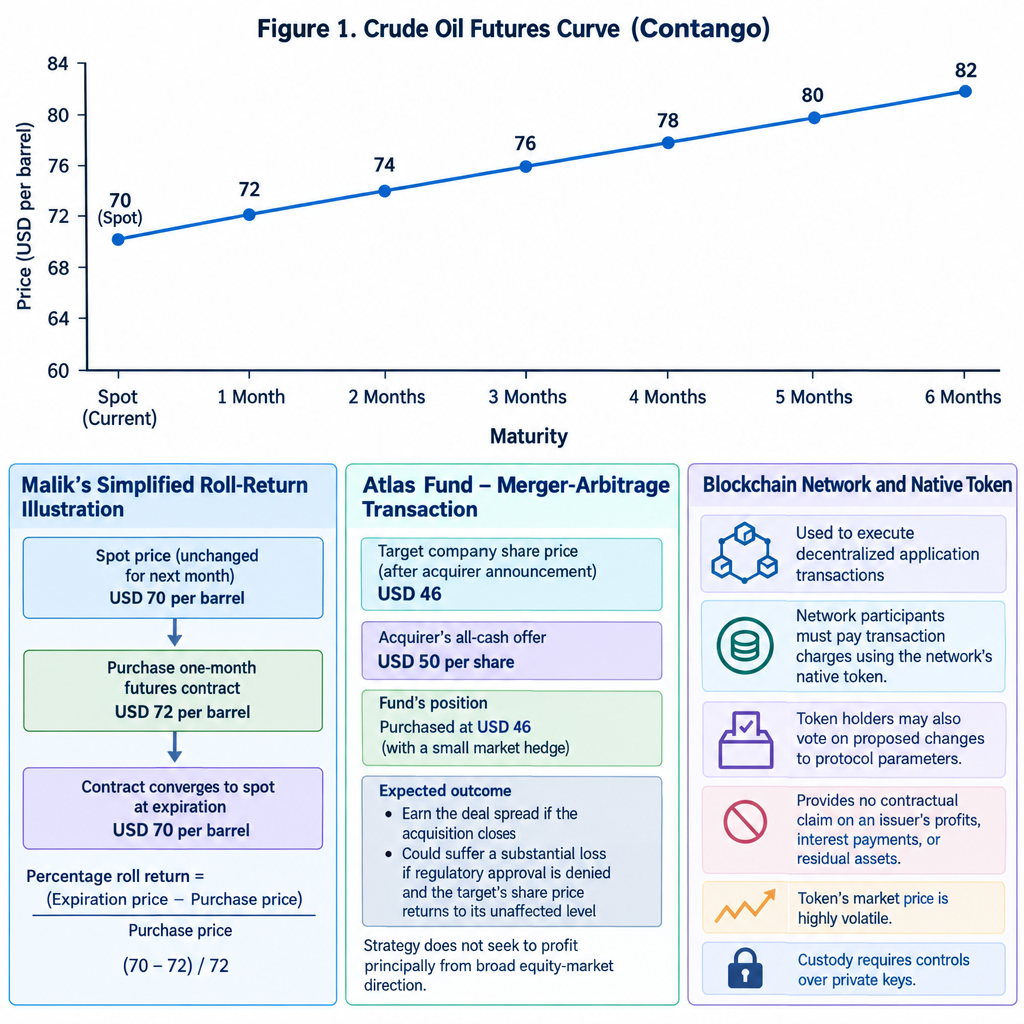
Meridian Alternatives advises a diversified endowment that is evaluating commodity, hedge fund, and digital asset exposures. Portfolio manager Tariq Malik reviews a crude oil market in which the current spot price and six monthly futures prices are displayed in Figure 1. Prices are quoted in USD per barrel. Storage, financing, convenience-yield, and transaction-cost effects are already reflected in the observed futures prices. For a simplified roll-return illustration, Malik assumes the spot price remains unchanged at USD 70 per barrel over the next month. A long-only index replaces an expiring contract with the one-month contract at USD 72. The newly purchased contract then converges to the unchanged USD 70 spot price at expiration. Malik defines the percentage roll return as the change from the purchase price of the replacement contract to its expiration price, divided by the replacement contract's purchase price. He analyzes this component separately from collateral income and changes in the spot price. Malik also evaluates Atlas Fund, which takes positions after binding corporate transactions are publicly announced. Atlas recently purchased shares of a target company at USD 46 after an acquirer announced an all-cash offer of USD 50 per share. Atlas simultaneously maintained only a small market hedge. The fund expects to earn the deal spread if the acquisition closes, but it could suffer a substantial loss if regulatory approval is denied and the target's share price returns to its unaffected level. The strategy does not seek to profit principally from broad equity-market direction. Finally, the endowment reviews a blockchain network used to execute decentralized application transactions. Network participants must pay transaction charges using the network's native token. Token holders may also vote on proposed changes to protocol parameters, but the token provides no contractual claim on an issuer's profits, interest payments, or residual assets. The token's market price is highly volatile, and custody requires controls over private keys. The endowment requires each proposed exposure to be classified according to its economic characteristics rather than its marketing label. It also directs Malik to distinguish commodity spot returns from roll returns, event-related hedge fund exposure from directional exposure, and token-based network utility from conventional debt or equity claims.
Meridian Foundation is considering a 10% allocation to diversifying alternative strategies. Chief investment officer Sofia Ortiz reviews hedge funds, commodity futures, and a digital asset fund. The foundation can tolerate moderate illiquidity but wants to understand sources of return, reporting limitations, and operational risks before approving the allocation. Ortiz begins with a commercially available hedge fund index. Participation in the database is voluntary, and managers may begin or stop reporting at their discretion. The index provider removes a fund from the historical database after the fund liquidates or ceases reporting. The provider does not restore the returns of removed funds and has not adjusted the published series for backfill or survivorship effects. Ortiz compares the index's historical return with the foundation's required return but questions whether the reported record is representative of the investable hedge fund universe. The investment staff then reviews the managers described in Exhibit 1. Apex selects securities using company-specific fundamental research and is permitted to vary its net equity exposure. Its gross exposure is the sum of the absolute long and short exposures, while its net exposure is long exposure minus short exposure. Beacon invests only after a proposed corporate acquisition has been publicly announced. Beacon's primary risk is that a transaction fails to close, causing the target's price to decline and the spread between the target price and offer price to widen. Corvus obtains commodity exposure through fully collateralized futures rather than physical inventories. The investment staff decomposes the expected return into spot return, roll return, and collateral return. The negative expected roll return reflects futures contracts being purchased above the expected spot price to which they converge. All three return components in Exhibit 1 refer to the same investment horizon and can be combined without annualization or currency adjustment. Finally, Ortiz reviews the custody incident summarized in Exhibit 2. The fund did not maintain the affected tokens directly; an external service provider controlled the private keys. Legal recovery is uncertain because blockchain transfers are generally irreversible once validated. An associate argues that the loss demonstrates a failure of the blockchain's consensus mechanism. Ortiz notes, however, that the transfer was submitted using a valid private key and that the distributed ledger continued operating according to its programmed rules.
Falcon Advisory is reviewing real estate allocations for an institutional client. The review covers a direct office property and shares of Metro REIT, a publicly traded real estate investment trust. Falcon's analysts use forecast stabilized net operating income when applying direct capitalization to the office property. They treat recurring property operating expenses as deductions in arriving at NOI but do not deduct financing costs, income taxes, depreciation, or capital expenditures from NOI. The office property is leased to multiple tenants. An analyst initially proposes capitalizing potential gross rental income directly, arguing that vacancy and operating costs are reflected in the capitalization rate. The senior analyst rejects that approach because the supplied capitalization rate is explicitly an NOI capitalization rate. A second analyst proposes subtracting planned capital expenditure when calculating NOI. The senior analyst notes that capital expenditure may be relevant to broader cash-flow analysis but is not included in the stated NOI calculation. Falcon also analyzes Metro REIT using funds from operations and net asset value. For this assignment, FFO is calculated from net income attributable to common shareholders by adding back real estate depreciation and amortization and subtracting gains on property sales. No impairment charges, non-controlling interests, preferred dividends, or unconsolidated affiliates affect the calculation. Falcon estimates NAV by replacing the accounting carrying values of properties with their current estimated market values and then subtracting interest-bearing debt. Other net assets and liabilities are zero. The institutional client wants real estate's income and diversification characteristics but has a binding liquidity requirement. Its governing board does not permit the investment staff to oversee tenants, maintenance, property-level financing, construction, or development partnerships. The board is willing to accept daily public-market price volatility and recognizes that listed real estate securities may exhibit greater short-term correlation with equities than directly appraised property. All values in the exhibits are denominated in USD. The capitalization analysis assumes the forecast NOI is stabilized and perpetual, with no separate near-term lease-up adjustment. The REIT calculation uses the number of common shares currently outstanding and assumes no options, convertibles, or other potentially dilutive securities.
Practice by Chapter
Want unlimited practice?
Get full access to all questions, explanations, and performance tracking.
Scan to download app