

Hypothermia & Basics - Frosty Fundamentals
-
Normal Thermoregulation: Hypothalamus (anterior preoptic area) maintains set point (~37°C). Heat gain (metabolism, shivering, vasoconstriction) balanced by heat loss (radiation, conduction, convection, evaporation, vasodilation).
-
Hypothermia: Core temperature < 35°C (95°F).
-
Causes:
- Environmental: Cold exposure (air/water).
- Metabolic: Hypothyroidism, hypoglycemia, adrenal insufficiency.
- CNS dysfunction: Stroke, head trauma, hypothalamic disorders.
- Drugs: Ethanol, sedatives, opioids.
- Other: Sepsis, extensive burns, iatrogenic.
-
Stages & Features:
Stage Core Temp (°C) Key Features Mild 32-35°C Shivering, tachycardia, tachypnea, confusion, ataxia. Moderate 28-32°C Shivering stops, bradycardia, hypotension, arrhythmias (AF), stupor. > ⭐ Paradoxical undressing may occur. Severe <28°C Coma, VF/asystole, areflexia, pulmonary edema. -
ECG: Osborn J wave (📌 camel hump at QRS-ST junction).
-
Management:
- ABCs; remove wet clothes.
- Rewarming:
- Passive external (mild): Warm blankets.
- Active external (mild-moderate): Forced warm air, heating pads.
- Active internal (moderate-severe, unstable): Warm IV fluids ($40-42°C$), peritoneal/pleural lavage, ECMO.

Heat Illnesses - Sizzling Syndromes
Caused by ↑ environmental heat. Key is core temperature & CNS status.
- Heat Cramps: Painful muscle spasms.
- Core Temp: Normal/Slightly ↑. Mental Status: Alert. Skin: Moist.
- Tx: Oral/IV fluids, rest.
- Heat Exhaustion: Systemic symptoms, but no significant CNS dysfunction.
- Core Temp: < 40°C (104°F). Mental Status: Fatigue, dizziness, headache. Skin: Cool, moist.
- Tx: Move to cool place, oral/IV fluids, active cooling.
- Heat Stroke: MEDICAL EMERGENCY!
- Core Temp: > 40°C (104°F) WITH CNS dysfunction (delirium, seizures, coma).
- Types:
- Classic (Non-exertional): Elderly, chronic illness; hot, dry skin.
- Exertional: Young athletes; skin often sweaty.
- Complications: Rhabdomyolysis, ARDS, DIC, AKI.
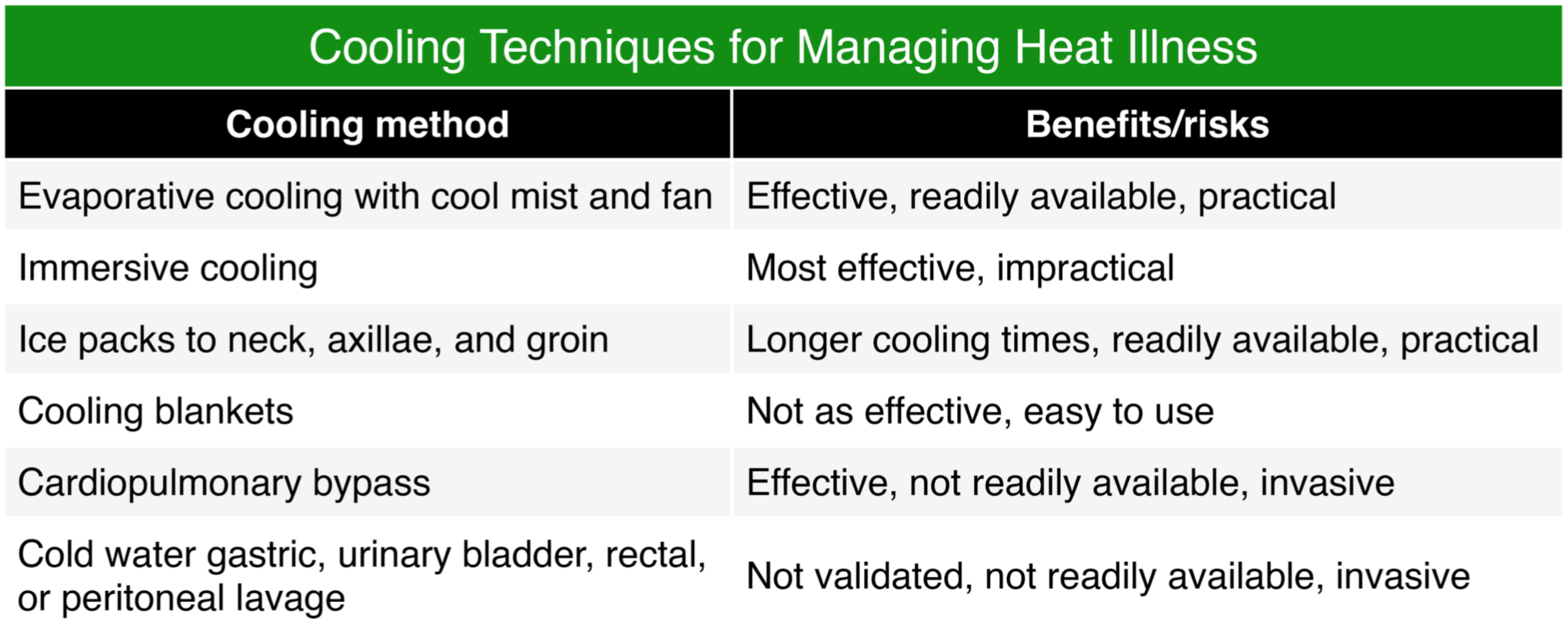
- Mgmt: ABCs, RAPID cooling (target 39°C; evaporative, immersion). Supportive. ⚠️ Avoid antipyretics.
| Feature | Heat Cramps | Heat Exhaustion | Heat Stroke |
|---|---|---|---|
| Core Temp | Normal/Slightly ↑ | < 40°C | > 40°C |
| Mental Status | Alert | Fatigue, dizzy (no major CNS) | Altered (coma, delirium) |
| Skin | Moist | Cool, moist | Hot, dry (Classic); Sweaty (Exertional) |
| Treatment | Fluids, rest | Cool, fluids | RAPID cooling!, ABCs |
| %%{init: {'flowchart': {'htmlLabels': true}}}%% | |||
| flowchart TD |
Start["☀️ Heat Exposure
• Presence of symptoms• Environmental risk"]
Assess["📋 Clinical Assessment
• Check core temp• Mental status exam"]
Cramps["🩺 Heat Cramps
• Normal/Slight ⬆️ temp• Hydrate and rest"]
Exhaustion["🩺 Heat Exhaustion
• Temp < 40 deg C• Cool and hydrate"]
Stroke["⚠️ Heat Stroke
• Temp > 40 deg C• Rapid cooling/ICU"]
Start --> Assess
Assess -->|"Alert/Cramps"| Cramps Assess -->|"No Major CNS"| Exhaustion Assess -->|"CNS Dysfunction"| Stroke
style Start fill:#FEF8EC, stroke:#FBECCA, stroke-width:1.5px, rx:12, ry:12, color:#854D0E style Assess fill:#FEF8EC, stroke:#FBECCA, stroke-width:1.5px, rx:12, ry:12, color:#854D0E style Cramps fill:#F7F5FD, stroke:#F0EDFA, stroke-width:1.5px, rx:12, ry:12, color:#6B21A8 style Exhaustion fill:#F7F5FD, stroke:#F0EDFA, stroke-width:1.5px, rx:12, ry:12, color:#6B21A8 style Stroke fill:#FDF4F3, stroke:#FCE6E4, stroke-width:1.5px, rx:12, ry:12, color:#B91C1C
> ⭐ Antipyretics (e.g., paracetamol) are ineffective and potentially harmful in heat stroke because the hypothalamic thermoregulatory set point is normal; the problem is overwhelming heat gain/impaired dissipation, not a changed set point.
## Hyperthermic Syndromes & Fever - Fiery Foes
**Malignant Hyperthermia (MH) vs. Neuroleptic Malignant Syndrome (NMS)**
| Feature | Malignant Hyperthermia (MH) | Neuroleptic Malignant Syndrome (NMS) |
|---------------------|-----------------------------------------------------------------|----------------------------------------------------------------------------|
| **Cause/Trigger** | Genetic (RYR1), succinylcholine, volatile anesthetics | Dopamine D2 antagonists (e.g., antipsychotics) |
| **Pathophysiology** | Uncontrolled sarcoplasmic $Ca^{2+}## Hyperthermic Syndromes & Fever - Fiery Foes
**Malignant Hyperthermia (MH) vs. Neuroleptic Malignant Syndrome (NMS)**
release | Central dopamine D2 receptor blockade |
| **Key Features** | Muscle rigidity, hyperthermia, acidosis, hyperkalemia | 📌 FEVER: Fever, Encephalopathy, Vitals unstable, Elevated enzymes (CK), Rigidity |
| **Treatment** | Dantrolene (**2.5 mg/kg** IV), stop trigger, supportive cooling | Stop agent, supportive, dantrolene, bromocriptine |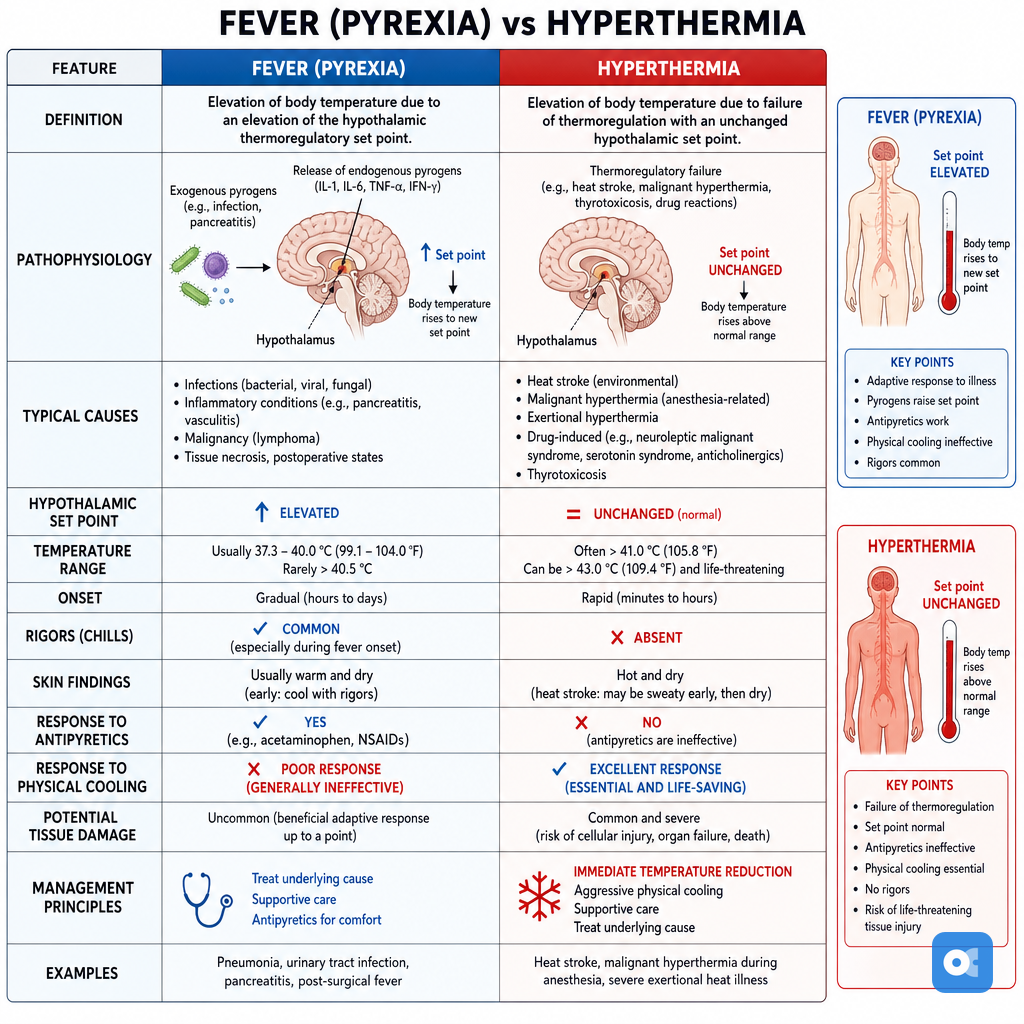
* **Fever Pathophysiology**: Pyrogens → IL-1, TNF-α, IL-6 → Hypothalamic COX-2 → ↑$PGE_2$ → ↑Hypothalamic set point.
* **Fever vs. Hyperthermia**:
- Fever: Elevated set point; body actively generates heat.
- Hyperthermia: Normal set point; overwhelmed heat dissipation.
> ⭐ Dantrolene, for Malignant Hyperthermia, blocks $Ca^{2+}$ release from sarcoplasmic reticulum.
## High‑Yield Points - ⚡ Biggest Takeaways
> * **Heat Stroke**: Core temp >**40°C** with **CNS dysfunction**; **exertional** type risks rhabdomyolysis.
> * **Heat Exhaustion**: Symptoms without **CNS dysfunction**; core temp <**40°C**.
> * **Malignant Hyperthermia**: **Autosomal dominant**; triggered by **succinylcholine/anesthetics**; treat with **dantrolene**.
> * **NMS**: Caused by **antipsychotics**; presents with fever, **\"lead-pipe\" rigidity**, autonomic instability.
> * **Hypothermia**: Core temp <**35°C**; look for **J waves (Osborn waves)** on ECG.
> * **Fever**: Elevated **hypothalamic set point** by **pyrogens** (IL-1, IL-6, TNF-α).
Unlock the full lesson and continue reading
Signup to continue reading this lesson and unlimited access questions, flashcards, AI notes, and more
