

SCN Anatomy & Role - Brain's Timekeeper
- Location: Suprachiasmatic Nucleus (SCN) in the anterior hypothalamus, directly superior to the optic chiasm. 📌 SCN - See C(Chiasm) Now!
- Master Pacemaker: The SCN is the brain's principal master circadian pacemaker, the central coordinator of daily biological timing.
- Hierarchy: It imposes hierarchical control, synchronizing numerous peripheral clocks located within organs and tissues throughout the body.
- Intrinsic Rhythmicity: Displays an endogenous, self-sustained rhythm of neuronal activity, with an approx. ~24-hour period, even without external time cues.
- Key Functions: Regulates sleep-wake cycles, hormone release (melatonin, cortisol), body temperature.
⭐ Lesions of the SCN abolish circadian rhythmicity.

Molecular Loop - Genetic Gears
The core mechanism is the Transcription-Translation Feedback Loop (TTFL).
- Positive Limb: CLOCK and BMAL1 proteins heterodimerize.
- This complex enters nucleus, binds E-box elements on Per and Cry gene promoters.
- This binding activates transcription of Per and Cry.
- Negative Limb: PER and CRY proteins are synthesized in cytoplasm and dimerize.
- Phosphorylation (e.g., by CK1δ/ε) regulates their stability, nuclear entry, and overall timing.
- The PER/CRY dimer translocates to the nucleus.
- Feedback Inhibition: In the nucleus, PER/CRY inhibits CLOCK-BMAL1 activity.
- This represses Per and Cry transcription, closing the loop.
- Degradation of phosphorylated PER/CRY proteins relieves inhibition, restarting cycle.
📌 Mnemonic: Can't Be Late, PERiodically CRY (CLOCK, BMAL1, PER, CRY).
⭐ CLOCK-BMAL1 heterodimer is the primary transcriptional activator in the TTFL.
Loading diagram…
Clock Synchronization - Sync & Set
- Zeitgebers: External cues synchronizing internal clocks.
- Primary: Light.
- Others: Food intake, temperature, social interactions.
- Photic Entrainment: Light-driven synchronization.
- Retinohypothalamic Tract (RHT): Pathway from retina to SCN. 📌 RHT: Retina Hits The Hypothalamus.
- Light activates intrinsically photosensitive retinal ganglion cells (ipRGCs) containing melanopsin.
- ipRGCs project via RHT to the Suprachiasmatic Nucleus (SCN).
- Release glutamate and PACAP in SCN, causing phase shifts (advances or delays).
⭐ Melanopsin-containing ipRGCs are crucial for non-image forming photoreception and entrainment to light.
- Retinohypothalamic Tract (RHT): Pathway from retina to SCN. 📌 RHT: Retina Hits The Hypothalamus.
Loading diagram…
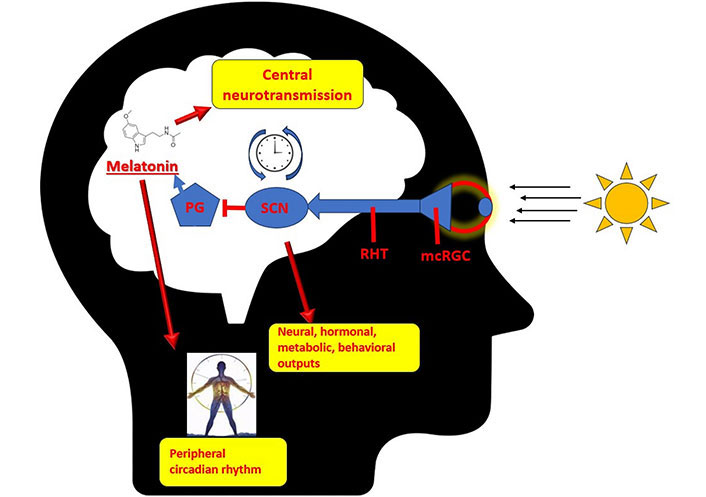
- Melatonin: "Hormone of darkness".
- Produced by pineal gland in response to darkness.
- Suppressed by light.
- Provides feedback to SCN via MT1/MT2 receptors, reinforcing circadian rhythms.
Physiological Rhythms & Issues - Rhythmic Regulation
- SCN Outputs & Peripheral Control:
- Neural (e.g., autonomic) & humoral (e.g., melatonin) signals from Suprachiasmatic Nucleus (SCN).
- SCN synchronizes peripheral clocks in organs (liver, heart, muscle).
- Examples of Rhythmic Regulation:
- Sleep-wake cycle.
- Cortisol: ↑ AM peak, ↓ PM nadir.
- Body temperature: ↓ early AM nadir, ↑ late afternoon peak.
- Hormone release: Growth Hormone (GH), prolactin (often nocturnal, pulsatile peaks).
- Common Circadian Rhythm Sleep-Wake Disorders (CRSWDs):
- Jet lag.
- Shift work disorder.
- Advanced Sleep Phase Disorder (ASPD).
- Delayed Sleep Phase Disorder (DSPD).
- Non-24-hour sleep-wake disorder.
⭐ Familial Advanced Sleep Phase Disorder (FASPD), a type of ASPD, is often linked to mutations in PER2 or CSNK1D genes. These genes are crucial clock components.
High‑Yield Points - ⚡ Biggest Takeaways
- The Suprachiasmatic Nucleus (SCN) in the hypothalamus is the master circadian pacemaker.
- SCN is entrained by light via retinohypothalamic tract from ipRGCs (melanopsin).
- Clock genes (PER, CRY, CLOCK, BMAL1) form feedback loops driving molecular rhythmicity.
- SCN orchestrates rhythms of melatonin (pineal), cortisol, and core body temperature.
- Melatonin promotes sleep; its secretion is suppressed by light.
- Light is the primary zeitgeber synchronizing the internal clock to the 24-hour day.
Unlock the full lesson and continue reading
Signup to continue reading this lesson and unlimited access questions, flashcards, AI notes, and more
