Pharmacogenomics

On this page

Pharmacogenomics: Foundations - Genes & Drugs Dance

  • Pharmacogenomics (PGx): How the entire genome influences drug response, guiding therapy.
  • Pharmacogenetics: How specific gene variations affect individual drug response.
  • Primary Goals:
    • Enhance therapeutic drug efficacy (↑).
    • Reduce adverse drug toxicity (↓).
  • Key Genetic Variations:
    • SNPs (Single Nucleotide Polymorphisms): Common single base-pair changes.
    • Indels (Insertions/Deletions): Small DNA base-pair additions/removals.
    • CNVs (Copy Number Variations): Altered number of copies of DNA segments.

⭐ Drug response traits can be Monogenic (e.g., TPMT variants and azathioprine toxicity) or Polygenic (e.g., warfarin dosing influenced by CYP2C9, VKORC1).

Pharmacogenomics: CYP Superstars - Metabolism Mavericks

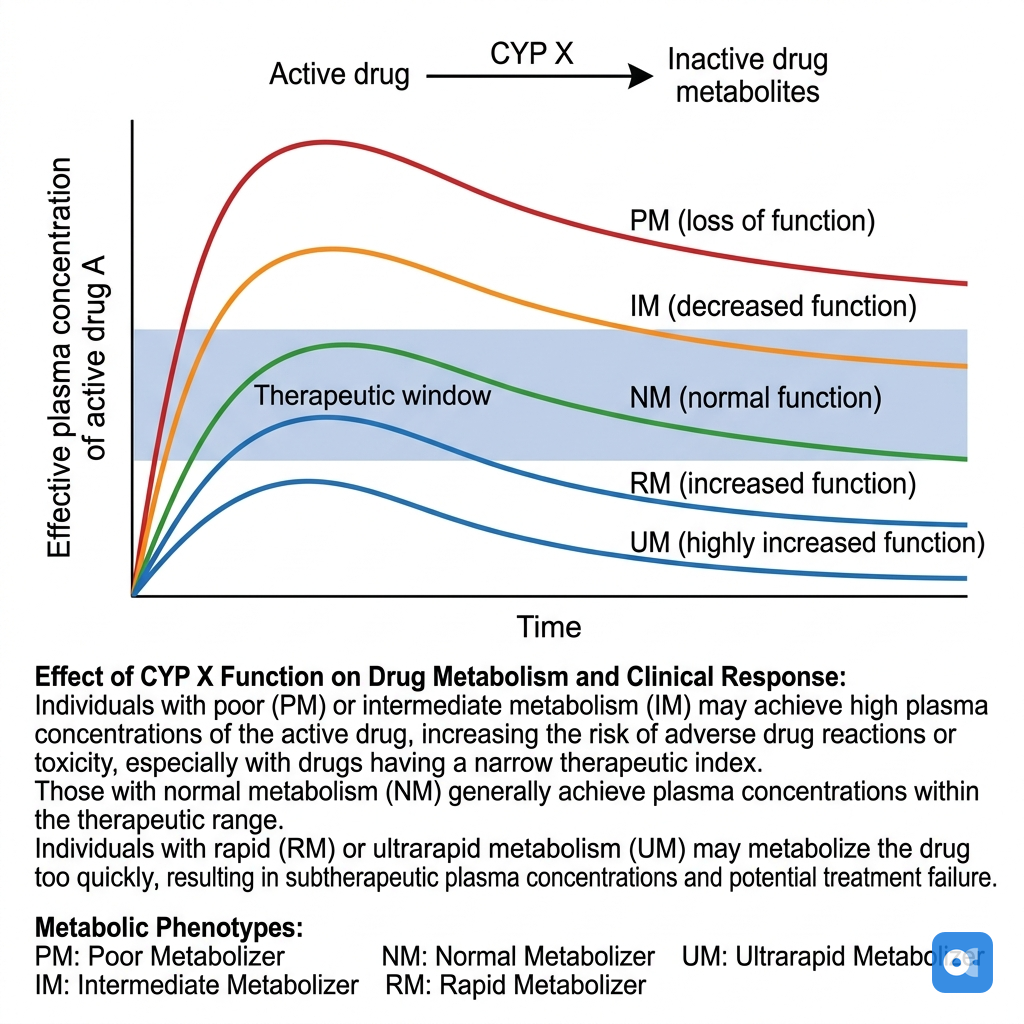
Cytochrome P450 (CYP) enzymes metabolize drugs. Genetic variants create phenotypes:

  • UM: Ultrarapid Metabolizer
  • EM: Extensive Metabolizer (normal)
  • IM: Intermediate Metabolizer
  • PM: Poor Metabolizer

Key CYP Enzymes:

EnzymeDrug ExamplesClinical Impact (Phenotype Dependent)
CYP2D6Codeine, TamoxifenUM: ↑ Codeine toxicity. PM: ↓ Codeine efficacy.
CYP2C19ClopidogrelPM: ↓ Clopidogrel efficacy (↑ thrombosis). UM: ↑ bleeding.
CYP2C9WarfarinPM: ↑ Warfarin sensitivity (↑ bleeding). Dose ↓ needed.
CYP3A4/5Tacrolimus, StatinsMetabolizes ~50% drugs. Variability impacts exposure.
%%{init: {'flowchart': {'htmlLabels': true}}}%%
flowchart TD

Start["💊 Drug
• Pharmacotherapy• Administration"]

Genotype["🧬 CYP Genotype
• Genetic testing• Allele analysis"]

UM["⚡ UM: Fast
• Ultra-metabolizer• High enzyme activity"]

EM["✅ EM: Normal
• Extensive metab• Standard dosing"]

IM["⚠️ IM: Reduced
• Intermediate metab• Lowered activity"]

PM["🐢 PM: Slow
• Poor metabolizer• Absent activity"]

UM_Res["🚨 UM Effects
• Prodrug: ⬆️ Toxicity• Drug: ⬇️ Efficacy"]

PM_Res["🚨 PM Effects
• Prodrug: ⬇️ Efficacy• Drug: ⬆️ Toxicity"]

Start --> Genotype Genotype --> UM Genotype --> EM Genotype --> IM Genotype --> PM UM --> UM_Res PM --> PM_Res

style Start fill:#F1FCF5, stroke:#BEF4D8, stroke-width:1.5px, rx:12, ry:12, color:#166534 style Genotype fill:#FFF7ED, stroke:#FFEED5, stroke-width:1.5px, rx:12, ry:12, color:#C2410C style UM fill:#FEF8EC, stroke:#FBECCA, stroke-width:1.5px, rx:12, ry:12, color:#854D0E style EM fill:#F6F5F5, stroke:#E7E6E6, stroke-width:1.5px, rx:12, ry:12, color:#525252 style IM fill:#FEF8EC, stroke:#FBECCA, stroke-width:1.5px, rx:12, ry:12, color:#854D0E style PM fill:#FEF8EC, stroke:#FBECCA, stroke-width:1.5px, rx:12, ry:12, color:#854D0E style UM_Res fill:#FDF4F3, stroke:#FCE6E4, stroke-width:1.5px, rx:12, ry:12, color:#B91C1C style PM_Res fill:#FDF4F3, stroke:#FCE6E4, stroke-width:1.5px, rx:12, ry:12, color:#B91C1C


> ⭐ **CYP2D6 & Codeine:** Ultrarapid metabolizers (UMs) rapidly convert codeine to morphine, risking overdose (e.g., respiratory depression). Poor metabolizers (PMs) get poor analgesia.
![CYP2D6 Phenotypes and Drug Metabolism](https://ylbwdadhbcjolwylidja.supabase.co/storage/v1/object/public/notes/clean-room-regen/prod/indian/molecular-pathology/05921c81-08a5-431b-b2cd-41b4774a3953-0e53450f.png)


## Pharmacogenomics: Beyond CYPs - Other Key Players

Many non-CYP genes also significantly impact drug response and adverse event profiles.

| Gene            | Drug(s)                               | Key Variant(s) / Allele          | Clinical Implication                                       |
|-----------------|---------------------------------------|----------------------------------|------------------------------------------------------------|
| TPMT          | Azathioprine, 6-MP, Thioguanine       | Low/no activity (e.g., *2, *3A) | ↑ Myelosuppression risk; **dose reduction crucial**        |
| UGT1A1        | Irinotecan                            | UGT1A1*28 (7 TA repeats)       | ↑ Neutropenia, diarrhea; **dose reduction if homozygous**  |
| SLCO1B1       | Statins (e.g., Simvastatin)           | c.521T>C (rs4149056)             | ↑ Statin concentration, ↑ myopathy risk                    |
| VKORC1        | Warfarin                              | -1639G>A                         | ↓ VKORC1 expression, **↓ warfarin dose needed**            |
| HLA-B         | Abacavir                              | HLA-B*57:01                     | ↑ Hypersensitivity (HSR); **contraindicated**              |
| HLA-B         | Allopurinol                           | HLA-B*58:01                     | ↑ SCARs; **test & avoid if positive**                      |
| HLA-B         | Carbamazepine, Oxcarbazepine          | HLA-B*15:02 (esp. Asian)        | ↑ SJS/TEN risk; **test & avoid if positive**               |> ⭐ TPMT deficiency significantly increases risk of myelosuppression with standard thiopurine doses.


## Pharmacogenomics: PGx in Practice - Clinical Hits

CPIC guidelines inform decisions. Pre-emptive/reactive testing optimizes drug choice/dose, minimizing adverse reactions, maximizing efficacy.

*   **Warfarin**: *CYP2C9, VKORC1* variants guide initial dosing.
*   **Clopidogrel**: *CYP2C19* LOF alleles ↓ active form; consider alternatives.
*   **Abacavir**: **HLA-B\*57:01** testing **mandatory** pre-therapy (prevents severe hypersensitivity).
*   **Statins**: *SLCO1B1* variants (OATP1B1) ↑ simvastatin myopathy risk.
*   **Irinotecan**: *UGT1A1\*28* allele ↑ risk of severe neutropenia/diarrhea.
*   **Thiopurines**: *TPMT* variants ↓ activity, ↑ myelosuppression risk (azathioprine/6-MP).


> ⭐ FDA: Carbamazepine & **HLA-B\*15:02** test in Asians (↑ SJS/TEN risk).

## High‑Yield Points - ⚡ Biggest Takeaways
>
> * **CYP2D6** variants affect **codeine** (ineffective/toxic) and **tamoxifen** efficacy.
> * **CYP2C19** loss-of-function alleles reduce **clopidogrel** activation, increasing thrombotic risk.
> * **TPMT** or **NUDT15** variants ↑ risk of **thiopurine** (azathioprine, 6-MP) toxicity.
> * **UGT1A1\*28** polymorphism (Gilbert's) ↑ **irinotecan** toxicity (neutropenia, diarrhea).
> * **HLA-B\*5701** screening is crucial before **abacavir** to prevent hypersensitivity.
> * **HLA-B\*1502** in Asians predicts **carbamazepine**-induced SJS/TEN.
> * **VKORC1** and **CYP2C9** genotypes guide **warfarin** dosing to minimize bleeding_risk_or_thrombosis_risk_if_dose_is_not_adjusted_appropriately_._

Unlock the full lesson and continue reading

Signup to continue reading this lesson and unlimited access questions, flashcards, AI notes, and more

Scan to download app

Scan to download
UNLOCK FREE ACCESS

Practice Questions: Pharmacogenomics

  1. 1. Which of the following agents requires the MOST caution when combined with spironolactone due to increased risk of hyperkalemia:

    • A. Captopril
    • B. Amlodipine
    • C. Propranolol
    • D. Chlorothiazide
    Show answer

    Answer: A. Captopril

    Captopril - Spironolactone is a potassium-sparing diuretic that blocks aldosterone effects in the collecting duct, reducing potassium excretion and increasing serum potassium. - Captopril is an ACE inhibitor that decreases aldosterone production, so combining it with spironolactone further reduces potassium excretion and creates a significant risk of severe hyperkalemia. Chlorothiazide - Chlorothiazide is a thiazide diuretic that promotes potassium excretion and is associated with hypokalemia rather than increased potassium levels. - When combined with spironolactone, its potassium-wasting effect can partially offset spironolactone-related potassium retention, making hyperkalemia less likely than with ACE inhibitors. Amlodipine - Amlodipine is a calcium channel blocker whose primary effect is vasodilation, without a substantial direct effect on potassium handling. - Because it does not significantly alter potassium balance, amlodipine does not markedly increase the hyperkalemia risk associated with spironolactone. Propranolol - Propranolol is a beta-blocker that can cause a slight increase in plasma potassium by inhibiting cellular potassium uptake, but this effect is generally modest. - Its more relevant combined effects with spironolactone concern blood pressure and heart rate, rather than a major additional impairment of potassium excretion.

  2. 2. Urinary alkalinisation does NOT enhance elimination of which drug?

    • A. Phenobarbitone sodium
    • B. Morphine sulphate
    • C. Acetylsalicylic acid
    • D. Methotrexate sodium
    Show answer

    Answer: B. Morphine sulphate

    Morphine sulphate - Morphine is an alkaline drug, so alkaline diuresis does not enhance its renal elimination. - Alkalinizing urine decreases morphine ionization, promoting tubular reabsorption rather than excretion; therefore, it is not used for morphine poisoning. Methotrexate sodium - Methotrexate is a weak organic acid, so increasing urine pH enhances its ionization and renal elimination. - Alkaline diuresis is useful in methotrexate toxicity because it reduces tubular reabsorption and helps prevent renal accumulation. Phenobarbitone sodium - Phenobarbitone is a weak acid, making its renal excretion more effective when urine is alkalinized. - Alkaline diuresis increases ionization and decreases tubular reabsorption, accelerating phenobarbitone elimination during overdose. Acetylsalicylic acid - Aspirin is an acidic drug, and alkaline diuresis increases its ionization within renal tubules. - This ion trapping reduces tubular reabsorption and promotes urinary clearance, making alkalinization useful in aspirin overdose.

  3. 3. Under identical experimental conditions, drugs A and B are administered separately and then together, using the same respective doses in each comparison and allowing BP to return to baseline between tests. The peak rise in BP above the common baseline is the measured response. Which interaction is demonstrated by the graph?

    • A. Summation
    • B. Potentiation
    • C. Tachyphylaxis
    • D. Antagonism
    Show answer

    Answer: A. Summation

    Summation is correct: from a baseline of 100 mmHg, A raises BP by approximately 20 mmHg and B by 15 mmHg, while A + B raises it by 35 mmHg, equalling their arithmetic sum. Potentiation, in the convention of an otherwise inactive drug enhancing another drug, is excluded because both drugs independently raise BP. Antagonism would reduce the combined response relative to the expected additive response. Tachyphylaxis is a rapidly diminishing response to repeated administration of the same drug, which this tracing does not show.

  4. 4. A malnourished patient with chronic alcohol dependence is about to receive intravenous glucose. Which vitamin should be administered before or concurrently with glucose?

    • A. Thiamine
    • B. Cyanocobalamin
    • C. Ascorbic acid
    • D. Folic acid
    Show answer

    Answer: A. Thiamine

    Thiamine - Chronic alcohol use commonly causes thiamine deficiency through poor intake, impaired absorption, and reduced hepatic storage; thiamine is required for pyruvate dehydrogenase and glucose metabolism. - Administering glucose before or without thiamine can precipitate Wernicke encephalopathy, characterized by confusion, ataxia, and ophthalmoplegia; therefore, thiamine should be given before or concurrently with glucose. Cyanocobalamin - Alcoholic patients may develop vitamin B12 deficiency, contributing to macrocytic anemia and neurological abnormalities, but it is not the immediate supplementation priority in this setting. - Cyanocobalamin does not prevent the acute glucose-related depletion of thiamine or the resulting Wernicke encephalopathy; it can be addressed after urgent thiamine replacement. Ascorbic acid - Alcohol dependence can be associated with poor nutrition and vitamin C deficiency, which may eventually cause scurvy, but this is not the critical acute risk addressed by the question. - Vitamin C does not support the glucose-metabolizing pathways that become vulnerable during thiamine depletion, so it is not supplemented first in a malnourished alcoholic patient. Folic acid - Folic acid deficiency is common in chronic alcohol use and may cause macrocytic anemia, but correcting it is less urgent than preventing acute neurological complications from thiamine deficiency. - Folic acid does not avert glucose-triggered Wernicke encephalopathy; thiamine must be administered first or concurrently with glucose, while folate replacement can follow.

  5. 5. Tadalafil should not be given with:

    • A. Amlodipine
    • B. Losartan potassium
    • C. Metoprolol
    • D. Nitroglycerin
    Show answer

    Answer: D. Nitroglycerin

    Nitroglycerin is contraindicated with tadalafil because nitrate-mediated cGMP production combined with PDE5 inhibition can cause profound hypotension. Amlodipine may add to blood-pressure lowering but does not carry the nitrate contraindication. Losartan potassium may also lower blood pressure but is not categorically contraindicated with tadalafil. Metoprolol is not contraindicated through the nitrate–cGMP interaction.

  6. 6. A 7-year-old child presents with poor wound healing, perifollicular hemorrhages, and sharp, painful swellings at the costochondral junctions of the ribs. Which of the following treatments is recommended?

    • A. Milk and curd
    • B. Liver and red meat
    • C. Oranges and amla
    • D. Rice and wheat
    Show answer

    Answer: C. Oranges and amla

    Oranges and amla are correct because they supply vitamin C, deficiency of which causes this child's scurvy. Liver and red meat are not reliable dietary sources of vitamin C. Milk and curd primarily provide calcium and protein rather than correcting vitamin C deficiency. Rice and wheat mainly supply carbohydrate and are not reliable sources of vitamin C.

  7. 7. Which drug class is NOT typically associated with a clinically significant interaction with warfarin?

    • A. Oral contraceptives
    • B. Barbiturates
    • C. Cephalosporins
    • D. Benzodiazepines
    Show answer

    Answer: D. Benzodiazepines

    Benzodiazepines - Benzodiazepines are generally considered safe with warfarin because they do not typically alter the cytochrome P450 enzymes responsible for warfarin metabolism. - They do not interfere significantly with vitamin K recycling or platelet function, distinguishing them from drugs that potentiate or reduce warfarin’s effect. Cephalosporins - Certain cephalosporins, particularly those with a methylthiotetrazole side chain, inhibit vitamin K-dependent clotting pathways and can potentiate warfarin’s anticoagulant effect. - This interaction may decrease vitamin K-dependent clotting factors, increasing the patient’s risk of bleeding rather than making cephalosporins compatible with warfarin. Oral contraceptives - Oral contraceptives can alter warfarin’s anticoagulant effect through effects on clotting factors or warfarin metabolism, so they are not considered interaction-free. - Reduced anticoagulation may increase the risk of thromboembolic events in patients taking warfarin, making this option unsuitable. Barbiturates - Barbiturates are potent hepatic enzyme inducers, particularly affecting CYP enzymes involved in warfarin metabolism. - Increased warfarin metabolism lowers its anticoagulant effect and may require higher warfarin doses, so barbiturates do interact.

  8. 8. In pseudocholinesterase deficiency, which drug should be used cautiously?

    • A. Suxamethonium
    • B. Thiopental
    • C. Gallamine triethiodide
    • D. Halothane
    Show answer

    Answer: A. Suxamethonium

    Suxamethonium - Suxamethonium (succinylcholine) is primarily metabolized by pseudocholinesterase, also called butyrylcholinesterase, in the plasma. - With pseudocholinesterase deficiency, succinylcholine metabolism is delayed, causing prolonged neuromuscular blockade and extended paralysis; therefore, it should be used cautiously. Halothane - Most halothane is exhaled unchanged, while approximately 15–20% undergoes hepatic metabolism; its elimination does not depend on pseudocholinesterase. - Because its clearance is unrelated to pseudocholinesterase activity, deficiency does not significantly prolong halothane’s effects, making it less appropriate than succinylcholine as the cautious-use choice. Thiopental - Thiopental is an intravenous barbiturate whose metabolism is predominantly hepatic. It is not a substrate of plasma pseudocholinesterase, so this deficiency does not cause the characteristic prolonged blockade seen with succinylcholine. Gallamine triethiodide - Gallamine triethiodide is a nondepolarizing neuromuscular blocker primarily eliminated by renal excretion as unchanged drug. - Because its elimination is independent of pseudocholinesterase, deficiency does not specifically delay its clearance, unlike the metabolism of succinylcholine.

  9. 9. ED50 is a measure of:

    • A. Potency
    • B. Safety
    • C. Efficacy
    • D. Toxicity
    Show answer

    Answer: A. Potency

    Potency - ED50 is the dose required to produce a specified therapeutic response in 50% of a population, making it a measure of potency. - A drug reaching its defined effect at a lower ED50 is more potent; potency is reflected by the dose-axis position of the dose–response curve. Toxicity - Toxicity concerns adverse or lethal effects rather than the intended therapeutic response produced by a drug. - Toxicity is assessed using measures such as TD50 or LD50, not ED50, which quantifies therapeutic effectiveness in a population. Safety - Safety describes the margin between therapeutic and harmful effects, rather than the dose producing a desired response. - Safety is commonly summarized by the therapeutic index, calculated as LD50/ED50; therefore ED50 alone does not measure safety. Efficacy - Efficacy is the maximum effect a drug can produce, regardless of the dose required to achieve it. - Efficacy is represented by Emax or the height of the dose–response curve, whereas ED50 indicates the dose needed for a specified effect.

  10. 10. Which combination increases atorvastatin-associated myotoxicity through strong CYP3A4 inhibition?

    • A. Phenytoin + atorvastatin
    • B. Itraconazole + atorvastatin
    • C. Amiodarone + atorvastatin
    • D. Carbamazepine + atorvastatin
    Show answer

    Answer: B. Itraconazole + atorvastatin

    Itraconazole + atorvastatin is the correct combination because itraconazole strongly inhibits CYP3A4 and increases atorvastatin exposure and myopathy risk. Phenytoin + atorvastatin instead involves enzyme induction, which can reduce atorvastatin exposure. Amiodarone + atorvastatin can increase exposure, but amiodarone is not a strong CYP3A4 inhibitor like itraconazole. Carbamazepine + atorvastatin involves CYP3A4 induction and can reduce atorvastatin exposure.

Flashcards: Pharmacogenomics

  1. 1. is the most commonly mutated gene in sporadic breast carcinomas

    Show answer

    TP53

  2. 2. The size of M-BCR ABL (Major BCR) protein in t(9;22) associated with chronic myeloid leukemia (CML) is  kDa.

    Show answer

    210

  3. 3. Alagille syndrome is associated with mutations in the gene in a small minority (<1%) of patients.

    Show answer

    NOTCH2

  4. 4. Activating mutation in  is responsible for bladder carcinoma.

    Show answer

    HRAS

  5. 5. is a molecular test in breast cancer that is a 21-gene assay

    Show answer

    Oncotype Dx

  6. 6. Best's disease is caused by a mutation on a gene.

    Show answer

    bestrophin-1 (BEST1 / VMD2)

  7. 7. In Array based Comparative Genomic Hybridization, if the test sample has amplification, then some spots on the array will fluoresce .

    Show answer

    green

  8. 8. Gain-of-function mutations in  gene has been linked with Pityriasis Rubra Pilaris (PRP)

    Show answer

    CARD14

  9. 9. _____ syndrome is a disease from abnormal biogenesis of lysosome-related organelles with impaired _____ maturation and absent _____ in thrombocytes.

    Show answer

    Hermansky Pudlak · melanosome · dense bodies

  10. 10. _____ syndrome is most commonly characterized by a _____,_____ karyotype

    Show answer

    Klinefelter · 47 · XXY

Everything you need for Indian Medical PG prep

Get full Oncourse access with lessons, practice questions, flashcards and AI study tools.

GET STARTED FOR FREE
75% OFFLimited time offer
GET 75% OFF