Corynebacterium and Listeria

Corynebacterium and Listeria

Corynebacterium and Listeria

On this page

Corynebacterium Details - The Club‑Shaped Culprit

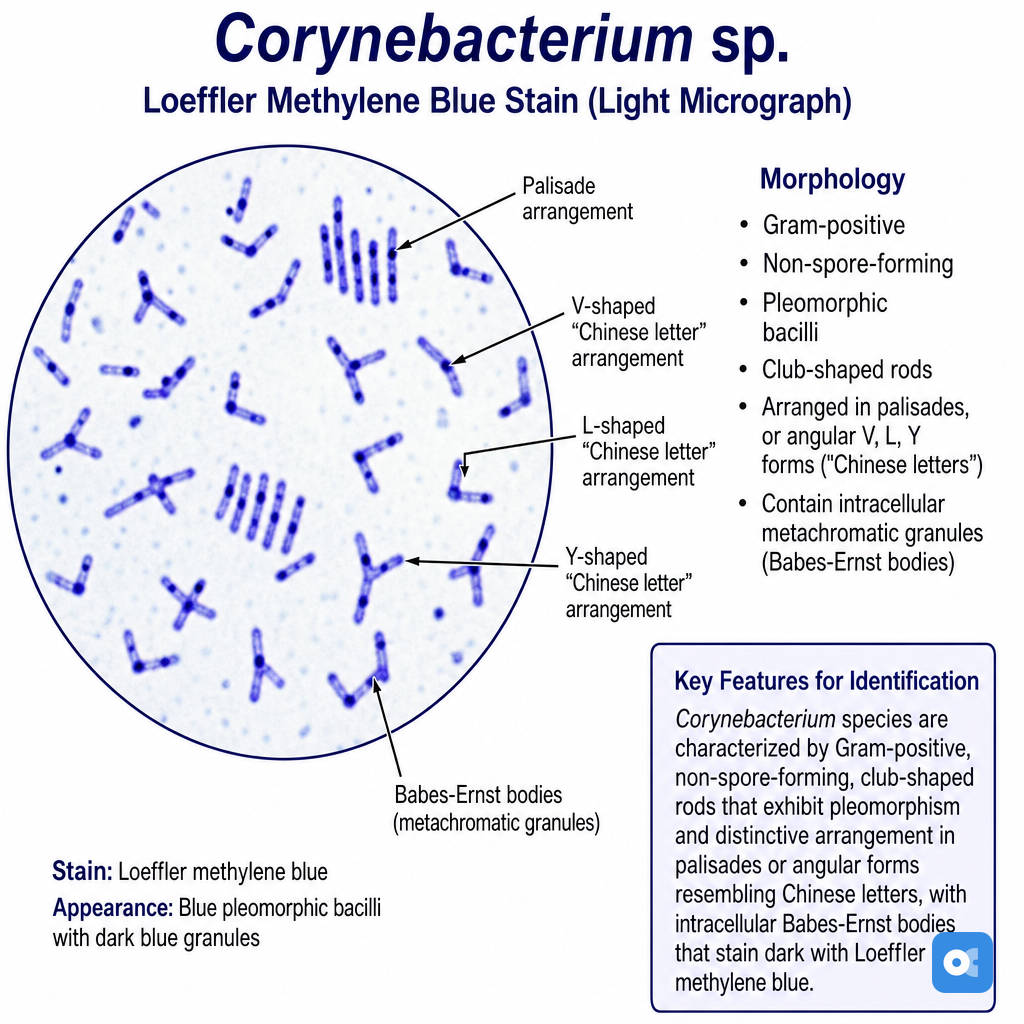
  • Morphology: Gram +ve, non-motile, non-sporing bacilli; club-shaped (V/L, Chinese letter, palisade arrangements).
    • Babes-Ernst granules (metachromatic, volutin; Albert's/Ponder's stain).
  • C. diphtheriae Strains: Gravis, Mitis, Intermedius.
  • Diphtheria Toxin:
    • A-B exotoxin (heat-labile); tox gene from β-phage (lysogenic conversion).
    • Mechanism: ADP-ribosylation of Elongation Factor 2 (EF-2) → inhibits protein synthesis.
  • Pathogenesis & Complications:
    • Local: Greyish-white adherent pseudomembrane (pharynx, larynx) → respiratory obstruction, "bull neck".
    • Systemic (toxin-mediated): Myocarditis, neuropathy (palatal palsy), acute tubular necrosis.
    • 📌 Mnemonic (ABCDEF): Airway obstruction, Bull neck, Cardiac, Deglutition, Eye, Facial/Peripheral neuropathy.
Loading diagram…
![Corynebacterium sp. Loeffler methylene blue stain](https://ylbwdadhbcjolwylidja.supabase.co/storage/v1/object/public/notes/clean-room-regen/prod/indian/bacteriology/d00b385c-6578-40cb-a52b-b2231e2a70d3-clean-164276ca.png)
  • Lab Diagnosis:
    • Specimen: Throat swab.
    • Stains: Albert's (granules green), Ponder's (blue-black granules). Gram stain.
    • Culture: Loeffler's serum slope, Potassium Tellurite agar (PTA; black colonies).
    • Toxigenicity: Elek's gel precipitation test. PCR for tox gene.

    ⭐ The Elek gel precipitation test is the gold standard for confirming toxigenicity of C. diphtheriae.

  • Treatment: Diphtheria Antitoxin (DAT) + Antibiotics (Penicillin/Erythromycin). Airway support.
  • Prevention: Active immunization with Toxoid vaccine (DPT, Tdap, Td).

Listeria Monocytogenes - The Tumbling Invader

  • Morphology: Gram-positive bacillus/coccobacillus. Non-spore-forming. Catalase-positive, Oxidase-negative.
  • Key Features:
    • Motility: Characteristic "tumbling" motility at 20-25°C. Intracellularly, uses actin rockets (via ActA protein) for direct cell-to-cell spread.
    • Growth: Facultative anaerobe. Grows at 4°C (refrigerator temp), enabling "cold enrichment" for isolation.
  • Virulence Factors:
    • Internalins (InlA, InlB): Mediate invasion into host cells.
    • Listeriolysin O (LLO): Pore-forming toxin (β-hemolysin); crucial for phagosomal escape.
    • ActA: Induces host actin polymerization for intracellular movement.
    • Phospholipases (PlcA, PlcB): Aid phagosomal escape and cell spread.
  • Pathogenesis (Facultative Intracellular):
Loading diagram…
  • Clinical Syndromes: 📌 Risk Groups: Pregnant, Elderly, Neonates, Immunocompromised (PENI).
    • Neonatal: Meningitis, sepsis (granulomatosis infantiseptica).
    • Immunocompromised/Elderly: Meningitis, meningoencephalitis, sepsis.
    • Pregnant: Flu-like illness, abortion, stillbirth.
    • Healthy: Usually self-limiting febrile gastroenteritis.

    ⭐ Listeria is a key foodborne pathogen; notably crosses placental barrier (fetal infections) and blood-brain barrier (meningitis).

  • Lab Diagnosis: Culture (blood/CSF); cold enrichment at 4°C. CAMP test positive (block-type hemolysis with S. aureus). Tumbling motility at 25°C.
  • Treatment: Ampicillin is drug of choice, often with Gentamicin for synergy.

Comparative Features - Differentiating Duo

FeatureCorynebacteriumListeria monocytogenes
MorphologyGPR, club-shaped, V/L forms ("Chinese letters")GPR, coccobacillary, short chains
GranulesMetachromatic (Babes-Ernst); Albert's stainAbsent
MotilityNon-motileTumbling at 22-28°C; actin "rocket tails"
Growth Temp (°C)3730-37; grows at 4 (cold enrichment)
Key Toxin & Mech.Diphtheria toxin (ADP-ribosylates EF-2)Listeriolysin O (LLO), ActA (actin polymerization)
Key DiseasesDiphtheria (pharyngeal, cutaneous), endocarditisListeriosis (meningitis, sepsis), neonatal infections, gastroenteritis
Lab Dx HighlightsAlbert's stain, Tellurite agar (black colonies)Cold enrichment, CAMP test (+), tumbling motility, umbrella motility
At-risk Pops.Unimmunized individualsPregnant women, neonates, elderly, immunocompromised
TreatmentAntitoxin + Penicillin/ErythromycinAmpicillin ± Gentamicin

High‑Yield Points - ⚡ Biggest Takeaways

  • C. diphtheriae causes diphtheria; its exotoxin ADP-ribosylates EF-2, halting protein synthesis.
  • Key signs: pharyngeal pseudomembrane, bull neck; diagnose with Albert's stain (metachromatic granules).
  • Culture on Loeffler's serum slope / tellurite agar; Elek's test for toxigenicity.
  • L. monocytogenes: characteristic tumbling motility (25°C) and actin rockets for intracellular spread.
  • Causes meningitis/sepsis in neonates, pregnant women, immunocompromised; grows at 4°C (cold enrichment).
  • Transmitted by contaminated food (e.g., unpasteurized dairy); treat with ampicillin.

Unlock the full lesson and continue reading

Signup to continue reading this lesson and unlimited access questions, flashcards, AI notes, and more

Scan to download app

Scan to download
UNLOCK FREE ACCESS

Practice Questions: Corynebacterium and Listeria

  1. 1. What is the most common carriage site of Staphylococcus aureus in healthy adults?

    • A. Anterior nares
    • B. Axillary skin
    • C. Perineal skin
    • D. Oropharyngeal mucosa
    Show answer

    Answer: A. Anterior nares

    Anterior nares - The anterior nares are the most common site of Staphylococcus aureus colonization in healthy individuals. - Nasal carriage increases the risk of subsequent self-acquired infection and transmission of S. aureus to others. Axillary skin: S. aureus can colonize the axilla, but the anterior nares are the standard most common carriage site in healthy adults. Perineal skin - The perineum can harbor Staphylococcus aureus, particularly in certain populations or with skin disorders, but it is not the usual primary site. - Perineal colonization is often secondary to nasal carriage or contact with contaminated surfaces rather than the most common carriage location. Oropharyngeal mucosa - The oropharynx may be colonized by Staphylococcus aureus, but it is not the primary or most common carriage site. - The oropharynx more commonly contains other colonizing bacteria, including Streptococcus species, distinguishing it from the anterior nares.

  2. 2. Which antibiotic is recommended for post-exposure chemoprophylaxis of close contacts of a confirmed diphtheria case?

    • A. Cloxacillin
    • B. Rifampicin
    • C. Ciprofloxacin
    • D. Erythromycin
    Show answer

    Answer: D. Erythromycin

    Erythromycin is a recommended antibiotic for post-exposure chemoprophylaxis of close contacts of a diphtheria case. Cloxacillin is mainly an antistaphylococcal penicillin and is not a recommended contact-prophylaxis regimen. Rifampicin has activity against Corynebacterium diphtheriae but is not the standard first-line contact-prophylaxis choice. Ciprofloxacin is not the recommended routine agent for diphtheria contact chemoprophylaxis.

  3. 3. In the context of diagnosing syphilis, which of the following is an example of a precipitation test?

    • A. Widal tube test
    • B. Rose waaler test
    • C. Latex bead test
    • D. Kahn tube test
    Show answer

    Answer: D. Kahn tube test

    Kahn tube test - The Kahn tube test is a flocculation test, a form of precipitation test used in the serological diagnosis of syphilis. - It detects reagin antibodies reacting with a non-treponemal cardiolipin antigen in the patient's serum. Rose waaler test - The Rose Waaler test is an agglutination test, not a precipitation test, and is used to detect rheumatoid factor in rheumatoid arthritis. - It uses sheep red blood cells sensitized with rabbit anti-sheep erythrocyte antibody, distinguishing it from syphilis flocculation tests. Widal tube test - The Widal tube test is an agglutination test used in diagnosing typhoid fever, rather than a precipitation test for syphilis. - It detects antibodies against Salmonella O and H antigens, not reagin antibodies reacting with cardiolipin. Latex bead test - Latex bead test is an agglutination method in which antigen or antibody is attached to latex particles to produce visible clumping. - Although useful in several diagnostic settings, it is not the classic syphilis precipitation test described here.

  4. 4. Griffith classification is based on

    • A. Type of hemolysis
    • B. Oxygen requirement
    • C. Protein antigen
    • D. 'C'-carbohydrate
    Show answer

    Answer: C. Protein antigen

    Protein antigen - Griffith classification is based on surface protein antigens designated M, T, and R antigens. - It is used for serotyping Group A Streptococcus, with M protein providing the principal basis for distinguishing strains. 'C'-carbohydrate - C-carbohydrate is the basis of Lancefield grouping, which classifies streptococci into serogroups such as A, B, and C. - It is a cell-wall polysaccharide antigen, whereas Griffith classification uses surface protein antigens for strain typing. Type of hemolysis - Hemolysis pattern describes alpha, beta, or gamma hemolysis observed on blood agar and assists preliminary identification. - Although Streptococcus pyogenes is typically beta-hemolytic, hemolysis does not provide Griffith serotyping or subdivide its strains. Oxygen requirement - Oxygen requirement describes whether an organism is aerobic, anaerobic, or facultatively anaerobic, reflecting its metabolism. - This characteristic is unrelated to serological classification; Streptococcus pyogenes is a facultative anaerobe.

  5. 5. All of the following are recognised causes of an appendicitis-like syndrome EXCEPT:

    • A. Yersinia pseudotuberculosis
    • B. Yersinia pestis
    • C. Yersinia enterocolitica
    • D. Campylobacter jejuni
    Show answer

    Answer: B. Yersinia pestis

    Yersinia pestis - Yersinia pestis primarily causes plague, including bubonic, pneumonic, and septicemic disease, rather than acute ileitis or mesenteric lymphadenitis. - Its typical presentation with fever, severe systemic illness, and buboes makes appendicitis-like syndrome less characteristic, so it is the least likely choice. Yersinia enterocolitica - Yersinia enterocolitica commonly causes acute ileitis and mesenteric lymphadenitis, producing right-lower-quadrant pain that can mimic appendicitis. - Its association with fever, abdominal pain, diarrhea, and vomiting makes it a plausible cause of an appendicitis-like syndrome rather than the least likely option. Yersinia pseudotuberculosis - Yersinia pseudotuberculosis causes terminal ileitis and mesenteric lymphadenitis, which can closely resemble acute appendicitis. - Right-lower-quadrant pain and fever, sometimes with erythema nodosum, support its inclusion among organisms causing an appendicitis-like presentation. Campylobacter jejuni - Campylobacter jejuni can cause acute ileitis and mesenteric adenitis, resulting in right-lower-quadrant pain that mimics appendicitis. - Although primarily a cause of gastroenteritis, associated bloody diarrhea, fever, and crampy abdominal pain make it more likely than Yersinia pestis to produce this syndrome.

  6. 6. A 30-year-old pregnant woman develops severe sepsis with headache and neck stiffness after eating coleslaw, soft cheese, and cantaloupes at a potluck dinner. Two other women who attended the event develop self-limiting abdominal cramps, nausea, and vomiting. Which infectious agent is most likely responsible?

    • A. Salmonella enterica
    • B. Campylobacter jejuni
    • C. Yersinia enterocolitica
    • D. Listeria monocytogenes
    Show answer

    Answer: D. Listeria monocytogenes

    Listeria monocytogenes - Listeria monocytogenes is a foodborne, facultative intracellular gram-positive bacillus associated with soft cheeses, coleslaw, and unwashed produce such as cantaloupes. - Pregnancy increases susceptibility through impaired cell-mediated immunity; listeriosis can cause maternal sepsis, meningitis, and neonatal infection, while healthy exposed individuals may develop self-limiting gastroenteritis. Salmonella enterica - Salmonella enterica can cause foodborne enteritis but lacks the characteristic association with pregnancy-associated invasive disease seen in listeriosis. Campylobacter jejuni - Campylobacter jejuni can cause foodborne enteritis but lacks the characteristic association with pregnancy-associated invasive disease seen in listeriosis. Yersinia enterocolitica - Yersinia enterocolitica can cause foodborne enteritis but lacks the characteristic association with pregnancy-associated invasive disease seen in listeriosis.

  7. 7. Mycoplasma is inherently resistant to which of the following antibiotic classes due to its lack of a peptidoglycan cell wall?

    • A. Cephalosporins
    • B. Macrolides
    • C. Aminoglycosides
    • D. Fluoroquinolones
    Show answer

    Answer: A. Cephalosporins

    Cephalosporins are ineffective against Mycoplasma because these organisms lack the peptidoglycan cell wall targeted by these drugs. Macrolides inhibit the 50S ribosomal subunit, so absence of a cell wall does not eliminate their target. Aminoglycosides act on the 30S ribosomal subunit, and their susceptibility limitations are not explained by absence of peptidoglycan. Fluoroquinolones inhibit DNA gyrase and topoisomerase IV, so the cell-wall deficiency does not confer the resistance described in the stem.

  8. 8. The Paul–Bunnell test detects heterophile antibodies in infectious mononucleosis caused by which organism?

    • A. Cytomegalovirus
    • B. Toxoplasma gondii
    • C. Human herpesvirus 6
    • D. Epstein–Barr virus
    Show answer

    Answer: D. Epstein–Barr virus

    Epstein–Barr virus causes infectious mononucleosis associated with heterophile antibodies detected by the Paul–Bunnell test. Human herpesvirus 6 is not the characteristic cause of Paul–Bunnell-positive mononucleosis. Toxoplasma gondii can cause a heterophile-negative mononucleosis-like illness. Cytomegalovirus also typically causes heterophile-negative mononucleosis.

  9. 9. A 25-year-old man admitted for pneumonia for 5 days develops gripping abdominal pain and loose stools. Stool culture grows Shigella flexneri susceptible to fluoroquinolones. Which oral drug is an appropriate first-line treatment?

    • A. Ciprofloxacin
    • B. Vancomycin
    • C. Loperamide
    • D. Diphenoxylate
    Show answer

    Answer: A. Ciprofloxacin

    Ciprofloxacin is an appropriate oral first-line treatment for the fluoroquinolone-susceptible Shigella flexneri infection confirmed by stool culture. Vancomycin does not treat Shigella infection because it lacks activity against this gram-negative pathogen. Loperamide is not an appropriate standalone treatment because it does not eradicate the infection, and antimotility treatment should be avoided in shigellosis. Diphenoxylate likewise does not treat the infection and should be avoided because slowing intestinal transit can worsen shigellosis.

  10. 10. A patient with a gray pharyngeal pseudomembrane has green bacilli containing bluish-black metachromatic granules on special staining. Which dyes and acid are present in the primary staining solution?

    • A. Toluidine blue, malachite green, acetic acid
    • B. Methylene blue, malachite green, acetic acid
    • C. Toluidine blue, carbol fuchsin, acetic acid
    • D. Toluidine blue, malachite green, hydrochloric acid
    Show answer

    Answer: A. Toluidine blue, malachite green, acetic acid

    Toluidine blue, malachite green, acetic acid - Albert’s stain uses toluidine blue, malachite green, and glacial acetic acid in its primary solution; it demonstrates metachromatic volutin granules in Corynebacterium diphtheriae. - Toluidine blue stains polyphosphate granules metachromatically, while malachite green stains the bacterial body, helping identify the organism in suspected diphtheria. Methylene blue, malachite green, acetic acid - This mixture incorrectly substitutes methylene blue for toluidine blue in Albert’s primary staining solution. Toluidine blue, carbol fuchsin, acetic acid - This mixture incorrectly substitutes carbol fuchsin for malachite green, which stains the green bacillary bodies described here. Toluidine blue, malachite green, hydrochloric acid - This mixture incorrectly substitutes hydrochloric acid for acetic acid in Albert’s primary staining solution.

Flashcards: Corynebacterium and Listeria

  1. 1. Corynebacterium is a gram _____ _____

    Show answer

    positive · rod

  2. 2. _____ are _____ secreted by gram positive and negative bacteria

    Show answer

    Exotoxin · proteins

  3. 3. Which subtype of diphtheria bacilli are long rods with prominent granules?

    Show answer

    mitis

  4. 4. Listeria monocytogenes is a Gram-_____ _____ that is a _____

    Show answer

    positive · rod · facultative anaerobe

  5. 5. _____, _____, and _____ are bacteria that all cause meningitis in neonates.

    Show answer

    Streptococcus agalactiae · Escherichia coli · Listeria monocytogenes

  6. 6. Which special culture media/agars (2) are used to isolate Corynebacterium diphtheriae? _____

    Show answer

    Loeffler serum slope and Tellurite agar

  7. 7. School of fish/railroad track appearance on Gram stain is suggestive of _____

    Show answer

    Hemophilus ducreyi

  8. 8. Which subtype of diphtheria bacilli shows 'poached egg' colonies (flat with central elevation)? _____

    Show answer

    mitis

  9. 9. Which subtype of diphtheria bacilli shows 'frog egg' colonies (dark centre, light margins)? _____

    Show answer

    intermedius

  10. 10. Miyagawa bodies are seen in _____

    Show answer

    lymphogranuloma venereum

Everything you need for Indian Medical PG prep

Get full Oncourse access with lessons, practice questions, flashcards and AI study tools.

GET STARTED FOR FREE
75% OFFLimited time offer
GET 75% OFF