Local Flaps and Soft Tissue Coverage

Local Flaps and Soft Tissue Coverage

Local Flaps and Soft Tissue Coverage

On this page

Local Flaps and Soft Tissue Coverage: Principles - Skin Deep Savvy

  • Local Flaps: Relocate skin & subcutaneous tissue with its native blood supply to an adjacent defect. Primary goal: "Replace like with like" for optimal function & aesthetics.
  • Key Principles:
    • Assess Defect: Size, depth, location, surrounding tissue quality.
    • Blood Supply: Crucial. Random pattern (dermal/subdermal plexus) vs. Axial pattern (known artery). 📌 Remember: Axial flaps are more robust.
    • Planning: Plan in reverse. Ensure tension-free closure. Minimize dog-ears.
    • Donor Site: Consider morbidity and closure options.
  • Reconstructive Ladder/Elevator: A hierarchical approach to soft tissue reconstruction.
Loading diagram…
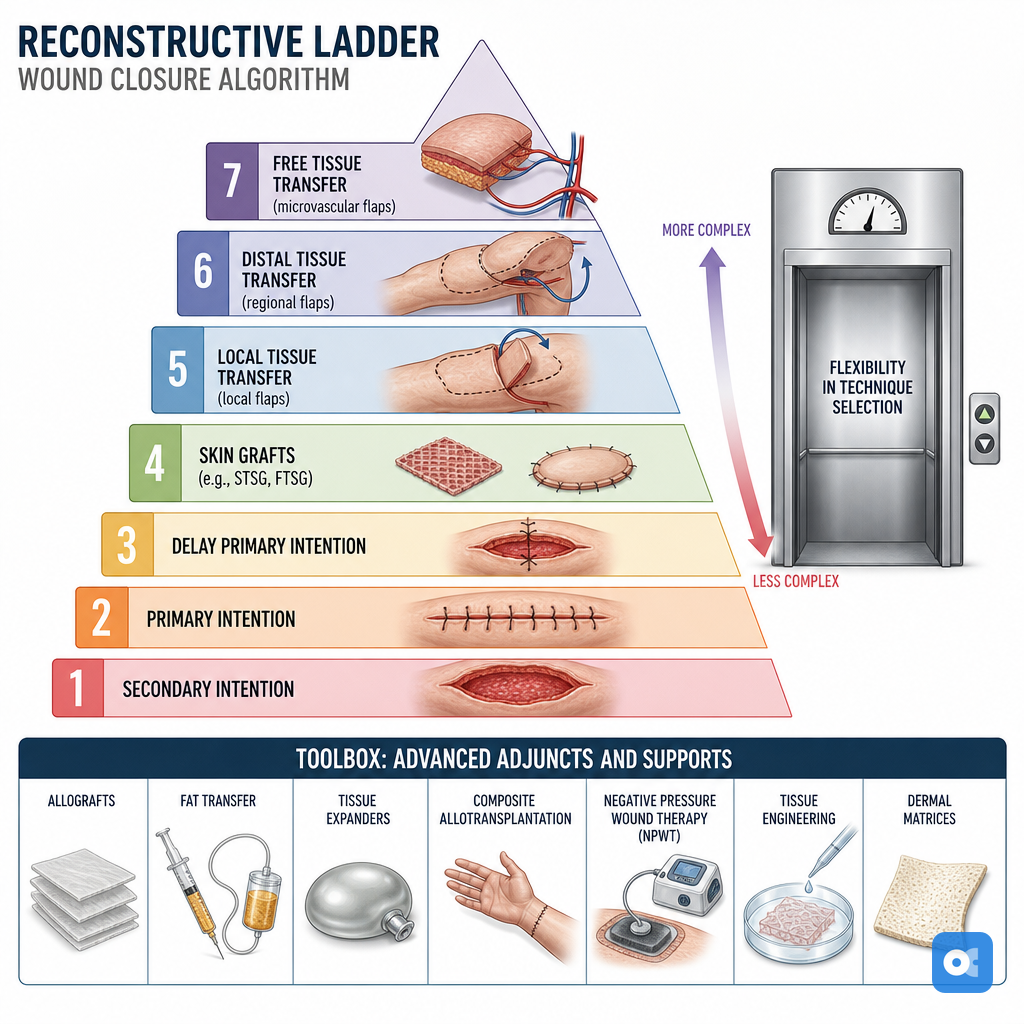
![Reconstructive Ladder/Elevator for Soft Tissue Coverage](https://ylbwdadhbcjolwylidja.supabase.co/storage/v1/object/public/notes/clean-room-regen/prod/indian/orthopaedic-techniques/a252c031-cf6d-4204-a4ba-3852fb6f0b61-1723eabc.png)

⭐ The Reconstructive Ladder advocates for using the simplest, most reliable method first, progressing to more complex options only as needed.

Local Flaps and Soft Tissue Coverage: Classification - Sorting Skins

Flaps are classified by blood supply, composition, and transfer method, guiding selection for defect coverage.

Classification of Flaps:

BasisTypes & Key Features
Blood Supply
Random Pattern: No specific vessel; dermal-subdermal plexus. Length:width ratio critical (≤ 2:1).
Axial Pattern: Named artery & vein. Greater survival. E.g., Groin flap.
Fasciocutaneous: Includes deep fascia; robust fascial plexus supply.
Musculocutaneous: Muscle carries blood to skin.
Composition
Cutaneous: Skin, subcutaneous tissue.
Fasciocutaneous: Skin, subcutaneous tissue, fascia.
Myocutaneous/Musculocutaneous: Skin, subcutaneous tissue, muscle.
Osteocutaneous: Includes bone with soft tissue.
Specialized: E.g., tendocutaneous, neurocutaneous.

Local Flaps and Soft Tissue Coverage: Common Types - Surgical Showpieces

  • Advancement Flaps:
    • Slide directly forward; rely on tissue elasticity.
    • Types: Single pedicle, bipedicle, V-Y plasty.
    • Use: Small defects, good skin laxity.
  • Rotation Flaps:
    • Semicircular flap pivots around a point into an adjacent defect.
    • Use: Triangular/wedge-shaped defects (e.g., scalp, cheek).
  • Transposition Flaps:
    • Rectangular/square flap lifted over intervening skin into a nearby defect.
    • Pedicle at one end.
    • Examples:
      • Z-Plasty: Interposes two triangular flaps. Used for scar contracture release, realigning scars.
      • Rhomboid (Limberg) Flap: For 60°/120° rhombic defects.
      • Bilobed Flap: Two lobes from a common pedicle.
Loading diagram…

⭐ A Z-plasty with 60° angles theoretically increases length along the central limb by 75%. Angles of 30°, 45°, 60°, and 90° give 25%, 50%, 75%, and 100% theoretical gain, respectively.

Local Flaps and Soft Tissue Coverage: Complications - Trouble Tidings

  • Early Complications:
    • Hematoma/Seroma: Collection of blood/serum under flap.
    • Flap Necrosis: Due to ischemia (venous > arterial).
      • Signs: Dusky discoloration, ↓ capillary refill, coolness.
    • Infection: Local or systemic signs.
  • Late Complications:
    • Flap Contracture: Scarring leading to reduced mobility.
    • Wound Dehiscence: Separation of wound edges.
    • Hypertrophic Scarring/Keloid Formation.
    • Altered Sensation: Numbness or hypersensitivity.

⭐ Most common cause of flap failure is venous congestion/thrombosis, not arterial insufficiency.

High‑Yield Points - ⚡ Biggest Takeaways

  • Reconstructive ladder: Guides soft tissue coverage choices, from simple closure to free flaps.
  • Random pattern flaps: Blood supply from subdermal plexus, limited length-to-width ratio (e.g., 1.5:1).
  • Axial pattern flaps: Incorporate a direct cutaneous artery; more reliable with greater length (e.g., groin flap).
  • Fasciocutaneous flaps: Include skin, subcutaneous tissue, and deep fascia; robust blood supply.
  • Muscle/musculocutaneous flaps: Provide bulk, good vascularity, and help control infection (e.g., latissimus dorsi).
  • Propeller flaps: Perforator-based island flaps that rotate around the perforator for versatile coverage.
  • Keystone flap: Perforator-based island flap, excellent for defects with moderate skin laxity nearby.

Unlock the full lesson and continue reading

Signup to continue reading this lesson and unlimited access questions, flashcards, AI notes, and more

Scan to download app

Scan to download
UNLOCK FREE ACCESS

Practice Questions: Local Flaps and Soft Tissue Coverage

  1. 1. Which of the following is the POOREST recipient bed for a skin graft?

    • A. Healthy deep fascia
    • B. Skull with intact periosteum
    • C. Healthy skeletal muscle
    • D. Healthy subcutaneous fat
    Show answer

    Answer: D. Healthy subcutaneous fat

    Healthy subcutaneous fat is the poorest recipient bed among these options because it supports graft take less reliably than muscle or fascia. Healthy deep fascia can support graft take through its vascular supply. Skull with intact periosteum can support graft take because the periosteum provides a vascular surface; denuded cortical bone lacks a suitable vascular surface. Healthy skeletal muscle is a favorable bed because it is richly vascularized.

  2. 2. Which of the following muscles does NOT contribute, through its overlying fascia or aponeurosis, to the usual anatomical bed of the breast?

    • A. Latissimus dorsi
    • B. Serratus anterior
    • C. External oblique
    • D. Pectoralis major
    Show answer

    Answer: A. Latissimus dorsi

    Latissimus dorsi does not contribute to the usual anatomical bed of the breast and is therefore the exception. Pectoralis major contributes through its covering fascia and forms the largest part of the bed. Serratus anterior contributes through its covering fascia laterally. External oblique contributes inferiorly through its aponeurosis.

  3. 3. The given instrument is used for harvesting the graft from a healthy area in split-thickness skin graft. What is this called?

    • A. Humby grafting knife
    • B. Catlin amputating knife
    • C. Padgett drum dermatome
    • D. Silver's grafting knife
    Show answer

    Answer: A. Humby grafting knife

    Humby grafting knife is identified by its long straight blade assembly, adjustable roller, and paired end handles. Catlin amputating knife is a double-edged amputation knife without this graft-thickness control assembly. Padgett drum dermatome uses a rotating drum rather than the illustrated straight blade-and-roller arrangement. Silver’s grafting knife is a smaller, single-handled razor-blade grafting knife, unlike the illustrated long, paired-handle assembly.

  4. 4. Which muscle flap is commonly used for autologous breast reconstruction after mastectomy?

    • A. Trapezius muscle flap
    • B. Pectoralis major muscle flap
    • C. Serratus anterior muscle flap
    • D. Latissimus dorsi muscle flap
    Show answer

    Answer: D. Latissimus dorsi muscle flap

    Latissimus dorsi muscle flap - The latissimus dorsi flap is commonly used for autologous breast reconstruction because its reliable blood supply permits transfer as a pedicled flap to the chest. - It can include muscle, skin, and subcutaneous fat, providing adequate tissue for an aesthetically acceptable breast mound after mastectomy. Trapezius muscle flap - The trapezius flap is more commonly used for head and neck reconstruction or coverage of posterior shoulder defects, rather than breast mound creation. - Although it has a good blood supply, its bulk and orientation are less suitable for achieving the anterior, hemispheric shape required in breast reconstruction. Pectoralis major muscle flap - The pectoralis major flap is primarily used for head and neck reconstruction, including oral cavity and pharyngeal defects, rather than breast reconstruction. - Its size and location make it less suitable for providing the comprehensive tissue volume needed to reconstruct a breast mound. Serratus anterior muscle flap - The serratus anterior can occasionally be used as a free flap for small soft-tissue defects, but it is not usually selected for large-volume breast reconstruction. - Its main role is in shoulder movement, and it generally lacks sufficient tissue bulk to create a complete breast mound.

  5. 5. Which of the following knives has an adjustable roller to help control graft thickness when harvesting a split-thickness skin graft?

    • A. Humby's knife
    • B. Langenbeck's knife
    • C. Bard-Parker scalpel
    • D. Liston's knife
    Show answer

    Answer: A. Humby's knife

    Humby’s knife has an adjustable roller that controls the blade-to-roller gap during split-thickness skin-graft harvesting. Langenbeck’s knife can be used for freehand graft harvesting but lacks this adjustable roller. Bard-Parker scalpel is a general cutting instrument and lacks an adjustable graft-thickness roller. Liston’s knife is principally an amputation knife and lacks an adjustable graft-thickness roller.

  6. 6. What type of graft or dressing is used to cover the post-burn wound shown in the image?

    • A. Split-thickness skin graft
    • B. Full-thickness skin graft
    • C. Negative-pressure dressing
    • D. Normal saline dressing
    Show answer

    Answer: A. Split-thickness skin graft

    Split-thickness skin graft is identified by the visible meshed skin covering the defect and contains epidermis with part of the dermis. Normal saline dressing is saline-soaked gauze rather than the meshed skin shown. Negative-pressure dressing uses a sealed negative-pressure system, which is not depicted. Full-thickness skin graft contains the entire dermis and is generally used unmeshed for smaller defects rather than providing this expanded meshed coverage.

  7. 7. With unilateral sternocleidomastoid contraction, which combination of head tilt and facial rotation occurs relative to the contracting side?

    • A. Ipsilateral tilt, contralateral rotation
    • B. Contralateral tilt, ipsilateral rotation
    • C. Contralateral tilt, contralateral rotation
    • D. Ipsilateral tilt, ipsilateral rotation
    Show answer

    Answer: A. Ipsilateral tilt, contralateral rotation

    Ipsilateral tilt, contralateral rotation is correct because unilateral sternocleidomastoid contraction tilts the head toward the contracting muscle and turns the face away. Ipsilateral tilt, ipsilateral rotation incorrectly reverses the direction of facial rotation. Contralateral tilt, ipsilateral rotation incorrectly reverses both movements. Contralateral tilt, contralateral rotation gives the correct rotation but the wrong direction of tilt.

  8. 8. Which local flap has a semicircular design and moves through an arc into a contiguous defect?

    • A. Interpolation flap
    • B. Rotation flap
    • C. Advancement flap
    • D. Transposition flap
    Show answer

    Answer: B. Rotation flap

    Rotation flap is the best answer because its semicircular design allows movement through an arc into a contiguous defect. Advancement flap moves primarily by linear sliding rather than this semicircular movement. Transposition flap is also pivotal but transfers adjacent tissue across an intervening area rather than using the described semicircular design. Interpolation flap transfers tissue across an intervening tissue bridge and commonly requires later pedicle division, rather than matching the described contiguous-defect design.

  9. 9. Which of the following best describes the location of Level II axillary lymph nodes?

    • A. Lateral to pectoralis major and minor
    • B. Superomedial to pectoralis major
    • C. Posterior to pectoralis minor
    • D. Medial to pectoralis minor
    Show answer

    Answer: C. Posterior to pectoralis minor

    Posterior to pectoralis minor - Level II axillary nodes are located posterior, or deep, to the pectoralis minor muscle in Berg’s classification. - This group also includes Rotter’s nodes, which lie between pectoralis major and minor; the pectoralis minor relationship is important for breast cancer staging and surgery. Medial to pectoralis minor - Level I nodes lie lateral and inferior to the pectoralis minor, so a medial location does not describe this group or the usual Level II position. - The pectoralis minor is the landmark for Berg classification; Level II nodes are posterior to it, whereas medial nodes correspond more closely to Level III. Lateral to pectoralis major and minor - Level II nodes are posterior to the pectoralis minor, not simply lateral to both pectoral muscles. - Nodes between pectoralis major and minor are Rotter’s interpectoral nodes, associated with Level II, but this option describes a lateral rather than posterior relationship. Superomedial to pectoralis major Superomedial to pectoralis major does not define an axillary level in Berg’s classification. Level III nodes lie medial to the medial border of pectoralis minor, which is the relevant landmark.

  10. 10. The Abbe flap is primarily used for the reconstruction of which anatomical structure?

    • A. Reconstruction of the lip
    • B. Reconstruction of the eyelid
    • C. Reconstruction of the tongue
    • D. Reconstruction of the ear
    Show answer

    Answer: A. Reconstruction of the lip

    Reconstruction of the lip - The Abbe flap is a classic technique used for lip reconstruction, particularly for defects involving the full thickness of the lip. - It involves transferring tissue from one lip to the other to restore oral competence, function, and aesthetics. Reconstruction of the eyelid - Eyelid reconstruction often uses techniques like Tenzel flaps or Hughes flaps, which are specifically designed for the periorbital area. - The Abbe flap is not typically used for eyelid reconstruction due to differences in tissue characteristics and functional requirements. Reconstruction of the tongue - Tongue reconstruction usually involves free flaps such as the radial forearm flap or anterolateral thigh flap, chosen for their bulk and vascularity. - These flaps provide the necessary tissue volume and mobility for tongue function, which the Abbe flap cannot adequately achieve. Reconstruction of the ear - Ear reconstruction commonly employs rib cartilage grafts or local skin flaps like the preauricular flap or postauricular flap to recreate ear contours. - The delicate structure and specific cartilage requirements of ear reconstruction make the Abbe flap unsuitable for this purpose.

Flashcards: Local Flaps and Soft Tissue Coverage

  1. 1. Plaster cast wedging is done by forcing open a cut on the  side of the angulation, at the same level as the # and the plaster is reinforced with extra bandages.

    Show answer

    concave

  2. 2. Cloverleaf shape of K-nail on the cross-section which provides good stability.

    Show answer

    rotational

  3. 3. can be used with Ilizarov technique and also for internal fixation of small bones

    Show answer

    K-wire (Kirschner wire)

  4. 4. Which structures are fixed first during reimplantation of an amputated limb?

    Show answer

    Bone

  5. 5. K-nail is based on the concept of point fixation

    Show answer

    three

  6. 6. Physiological limit for distraction osteogenesis is mm/day

    Show answer

    one

  7. 7. _____ screws have a smaller thread, low pitch, compression produced by over drilling proximal cortex

    Show answer

    Cortical

  8. 8. The following is a _____ fixator or LRS (limb reconstruction system)

    Show answer

    Rail

  9. 9. The following instrument is a _____

    Show answer

    osteotome

  10. 10. Name the following technique of reducing a dislocated shoulder: _____

    Show answer

    Stimson's hanging arm method

Everything you need for Indian Medical PG prep

Get full Oncourse access with lessons, practice questions, flashcards and AI study tools.

GET STARTED FOR FREE
75% OFFLimited time offer
GET 75% OFF