Mechanical Ventilation Principles

Mechanical Ventilation Principles

Mechanical Ventilation Principles

On this page

MV Fundamentals - Breath of Life

Goals of Mechanical Ventilation:

  • ↓ Work of Breathing (WOB), reduce muscle fatigue.
  • Support adequate gas exchange ($O_2$ uptake, $CO_2$ removal).
  • Reverse life-threatening hypoxemia (e.g., $P_aO_2$ < 60 mmHg).
  • Reverse acute respiratory acidosis (e.g., pH < 7.25 due to ↑$P_aCO_2$).

Key Indications:

  • Apnea or insufficient spontaneous ventilation.
  • Acute Respiratory Failure:
    • Type I (Hypoxemic): $P_aO_2$ < 60 mmHg despite high $F_iO_2$.
    • Type II (Hypercapnic): $P_aCO_2$ > 50 mmHg & pH < 7.25.
  • Airway protection (e.g., GCS < 8, risk of aspiration).
  • Impending respiratory collapse (e.g., severe distress, muscle fatigue).
  • Elective support (e.g., post-operative recovery, certain procedures).

⭐ PEEP (Positive End-Expiratory Pressure) is vital to prevent alveolar collapse (atelectrauma) and improve oxygenation by recruiting alveoli.

Ventilator Modes - Control Freaks & Helpers

  • Volume Control (VC): Delivers preset tidal volume ($V_T$); airway pressure ($P_{aw}$) varies. Guarantees minute ventilation. Risk: Barotrauma.
  • Pressure Control (PC): Delivers preset inspiratory pressure ($P_{insp}$); $V_T$ varies with lung mechanics. Limits $P_{aw}$. Risk: Hypoventilation.

Common Modes:

ModeTypeTriggerCycleGoalProCon
AC/CMVVC/PCPt/TimeVol/TimeFull support; Set $V_T$/$P_{insp}$$V_T$ assured (VC)/$P_{aw}$ limit (PC)Asynchrony, baro/volutrauma
SIMVVC/PCPt/Time (Mand); Pt (Spont)Vol/Time (Mand); Flow (Spont)Weaning, Pt sync↓Sedation, muscle use↑WOB if low
PSVPressurePtFlowSpont. support, weaningComfort, ↓WOBApnea risk, variable $V_T$
PRVCHybridPt/TimeTimeTarget $V_T$ @ low $P_{aw}$$V_T$ assured, $P_{aw}$ protectedSlow response
%%{init: {'flowchart': {'htmlLabels': true}}}%%
flowchart TD

FullControl["💨 Full Control
• AC/CMV mode• VC and PC modes"]

PartialSupport["🌬️ Partial Support
• SIMV plus PSV• Patient efforts"]

Spontaneous["🫁 Spontaneous
• PSV/CPAP setting• Trialing weaning"]

FullControl -->|Weaning| PartialSupport PartialSupport -->|Transition| Spontaneous

style FullControl fill:#FDF4F3,stroke:#FCE6E4,stroke-width:1.5px,rx:12,ry:12,color:#B91C1C style PartialSupport fill:#FEF8EC,stroke:#FBECCA,stroke-width:1.5px,rx:12,ry:12,color:#854D0E style Spontaneous fill:#F1FCF5,stroke:#BEF4D8,stroke-width:1.5px,rx:12,ry:12,color:#166534


> ⭐ In Pressure Support Ventilation (PSV), cycling from inspiration to expiration typically occurs when inspiratory flow decreases to **25%** of peak inspiratory flow. This is a common default setting.


## Parameters & Monitoring - Fine-Tuning Breaths

*   **Key Parameters & Targets:**
    -   Vt: **6-8** ml/kg IBW (ARDS: **4-6** ml/kg).
    -   RR: **12-20**/min (target PaCO2).
    -   FiO2: Start **1.0**, titrate for SpO2 >**92%**.
    -   PEEP: Start **5** cmH2O, titrate.
    -   I:E Ratio: **1:2** to **1:3** (longer for obstruction, e.g., **1:4**).
    -   PIP: <**35-40** cmH2O.
    -   Pplat: <**30** cmH2O.
        > ⭐ Driving Pressure ($P_{plat}$ - PEEP) should be <**15** cmH2O to minimize Ventilator-Induced Lung Injury (VILI).
*   **Essential Monitoring:**
    -   Gas Exchange: ABG, SpO2, EtCO2 (PaCO2-EtCO2 gradient **2-5** mmHg).
    -   Lung Mechanics:
        +   Static Compliance ($C_{L}$): $C_{L} = V_T / (P_{plat} - PEEP)$.
        +   Airway Resistance ($R_{aw}$): $R_{aw} = (P_{IP} - P_{plat}) / Flow$. 
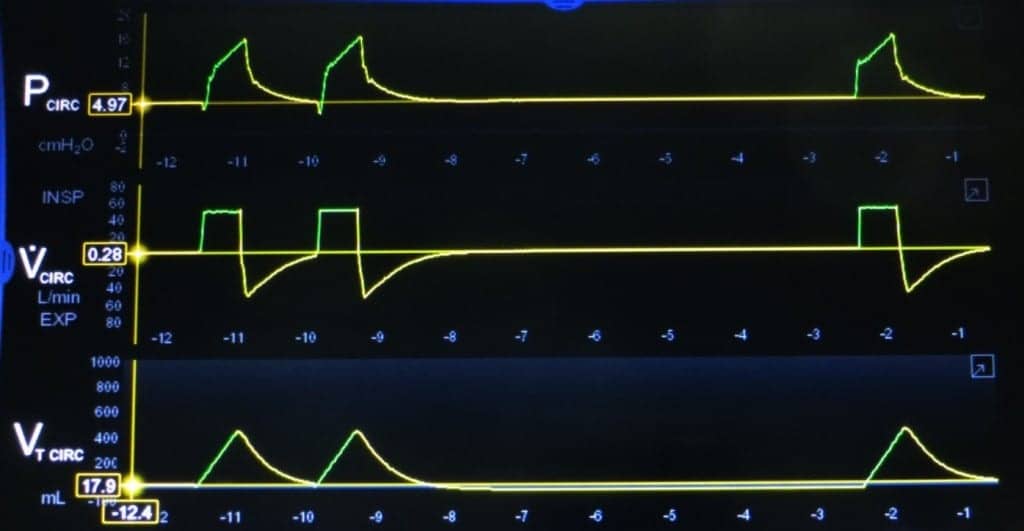
    -   Waveforms: Crucial for detecting asynchrony, auto-PEEP, leaks.
        ![Ventilator Pressure, Flow, and Volume Waveforms](https://ylbwdadhbcjolwylidja.supabase.co/storage/v1/object/public/notes/L1/Anesthesiology_Critical_Care_Medicine_Mechanical_Ventilation_Principles/125a24f2-92ff-41bc-a085-d98991e94c9a.jpg)


## Complications & Weaning - Escape from the Machine

**Complications:**
*   Ventilator-Associated Pneumonia (VAP):
    -   Prevention: 📌 **HOST** bundle (**H**OB elevation **30-45°**, **O**ral care, **S**ubglottic suction, **T**rials of spontaneous breathing).
*   Barotrauma/Volutrauma: Pneumothorax risk; monitor peak/plateau pressures.
*   Oxygen Toxicity: From prolonged FiO2 > **0.6**; aim SpO2 **92-96%**.
*   Cardiovascular: ↓Preload, hypotension from ↑intrathoracic pressure.
*   Auto-PEEP: Air trapping, ↑work of breathing.

**Weaning:**
*   Criteria: Improved underlying cause, stable hemodynamics, PaO2/FiO2 > **150-200**, PEEP ≤ **5-8** cmH2O, FiO2 ≤ **0.4**. Good cough. RSBI < **105** ($RSBI = RR / V_T$ in Liters).
*   Spontaneous Breathing Trial (SBT): **30-120** min on T-piece or low Pressure Support Ventilation (PSV).
*   Common Weaning Modes: PSV, T-piece trial.


```mermaid
%%{init: {'flowchart': {'htmlLabels': true}}}%%
flowchart TD

Start["<b>🫁 MV Patient</b><br><span style='display:block; text-align:left; color:#555'>• Mech ventilation</span><span style='display:block; text-align:left; color:#555'>• ICU admission</span>"]

Assess["<b>📋 Ready to Wean?</b><br><span style='display:block; text-align:left; color:#555'>• Assess criteria</span><span style='display:block; text-align:left; color:#555'>• Clinical screen</span>"]

ContinueMV["<b>👁️ Continue MV</b><br><span style='display:block; text-align:left; color:#555'>• Optimize support</span><span style='display:block; text-align:left; color:#555'>• Ongoing care</span>"]

RSBI["<b>📋 RSBI < 105?</b><br><span style='display:block; text-align:left; color:#555'>• Rapid shallow breathing</span><span style='display:block; text-align:left; color:#555'>• f/Vt ratio check</span>"]

SBT["<b>🔬 SBT</b><br><span style='display:block; text-align:left; color:#555'>• Spontaneous breath</span><span style='display:block; text-align:left; color:#555'>• Trial period</span>"]

Resume["<b>👁️ Resume Support</b><br><span style='display:block; text-align:left; color:#555'>• Resume settings</span><span style='display:block; text-align:left; color:#555'>• Further optimize</span>"]

Extubate["<b>💊 Extubate</b><br><span style='display:block; text-align:left; color:#555'>• Remove tube</span><span style='display:block; text-align:left; color:#555'>• Monitor airway</span>"]

Start --> Assess
Assess -->|Not Ready| ContinueMV
Assess -->|Criteria Met| RSBI
RSBI -->|Yes| SBT
RSBI -->|RSBI High| Resume
SBT -->|Tolerated| Extubate
SBT -->|Failed| Resume

style Start fill:#F7F5FD, stroke:#F0EDFA, stroke-width:1.5px, rx:12, ry:12, color:#6B21A8
style Assess fill:#FEF8EC, stroke:#FBECCA, stroke-width:1.5px, rx:12, ry:12, color:#854D0E
style ContinueMV fill:#EEFAFF, stroke:#DAF3FF, stroke-width:1.5px, rx:12, ry:12, color:#0369A1
style RSBI fill:#FEF8EC, stroke:#FBECCA, stroke-width:1.5px, rx:12, ry:12, color:#854D0E
style SBT fill:#FFF7ED, stroke:#FFEED5, stroke-width:1.5px, rx:12, ry:12, color:#C2410C
style Resume fill:#EEFAFF, stroke:#DAF3FF, stroke-width:1.5px, rx:12, ry:12, color:#0369A1
style Extubate fill:#F1FCF5, stroke:#BEF4D8, stroke-width:1.5px, rx:12, ry:12, color:#166534

⭐ The Rapid Shallow Breathing Index (RSBI) is a critical predictor for weaning success; a value < 105 indicates a high likelihood of successful extubation.

High‑Yield Points - ⚡ Biggest Takeaways

  • Tidal Volume (Vt): Target 6-8 mL/kg PBW, especially in ARDS, for lung protection.
  • PEEP: Optimizes oxygenation and prevents alveolar collapse; titrate for best compliance.
  • Plateau Pressure (Pplat): Keep <30 cmH2O to minimize barotrauma/volutrauma.
  • Driving Pressure (ΔP): Aim for <15 cmH2O (Pplat - PEEP), critical in ARDS.
  • Modes: Know ACVC, ACPC, SIMV, PSV indications and differences.
  • Weaning: Daily Spontaneous Breathing Trials (SBT) are crucial for liberation from ventilation.

Unlock the full lesson and continue reading

Signup to continue reading this lesson and unlimited access questions, flashcards, AI notes, and more

Scan to download app

Scan to download
UNLOCK FREE ACCESS

Practice Questions: Mechanical Ventilation Principles

  1. 1. Which mechanism accounts for the largest proportion of carbon dioxide transport in blood?

    • A. Bicarbonate formation by carbonic anhydrase
    • B. Binding to hemoglobin as carbaminohemoglobin
    • C. Direct dissolution in blood plasma
    • D. Transport as carbonic acid in red blood cells
    Show answer

    Answer: A. Bicarbonate formation by carbonic anhydrase

    Bicarbonate formation by carbonic anhydrase - Within red blood cells, carbonic anhydrase rapidly converts CO₂ and water into carbonic acid, which dissociates into bicarbonate ions and hydrogen ions. - Bicarbonate transport accounts for approximately 70% of blood CO₂ transport; its movement into plasma with the chloride shift makes it the major mechanism. Binding to hemoglobin as carbaminohemoglobin - Carbaminohemoglobin transports approximately 20–23% of blood CO₂ by binding CO₂ to amino groups on hemoglobin. - Although deoxygenated hemoglobin binds CO₂ more readily through the Haldane effect, this pathway is quantitatively less important than bicarbonate formation. Transport as carbonic acid in red blood cells - Carbonic acid is a transient intermediate formed during CO₂ hydration inside red blood cells, rather than the principal transported form. - It rapidly dissociates into hydrogen ions and bicarbonate, so CO₂ is transported mainly as bicarbonate rather than as carbonic acid. Direct dissolution in blood plasma - A small fraction, approximately 7–10%, of CO₂ is transported by direct dissolution in plasma. - Because plasma has limited CO₂ solubility, dissolved CO₂ is a minor pathway and is less important than bicarbonate transport.

  2. 2. In an adult receiving non-invasive ventilation for acute respiratory failure, which finding, by itself, mandates immediate endotracheal intubation and invasive ventilation?

    • A. Marked tachypnoea
    • B. Respiratory arrest
    • C. Respiratory acidosis
    • D. Marked hypercapnia
    Show answer

    Answer: B. Respiratory arrest

    Respiratory arrest is an indication for immediate intubation and invasive ventilation; continuing NIV is inappropriate. ISCCM guidelines distinguish such immediate indications from predictors of NIV failure. Marked tachypnoea indicates substantial distress but does not independently mandate intubation. Respiratory acidosis increases the risk of NIV failure, but selected patients—particularly those with an acute exacerbation of COPD—may still receive a closely monitored NIV trial where immediate intubation is available. Marked hypercapnia alone is not an intubation criterion and may represent compensated chronic hypercapnia. Persistent or worsening physiological abnormalities despite an adequate NIV trial require reassessment for escalation.

  3. 3. Which of the following parameters indicates the elimination of CO2 from the lungs?

    • A. PaCO2 level
    • B. pH level
    • C. HCO3− level
    • D. PaO2 level
    Show answer

    Answer: A. PaCO2 level

    PaCO2 level - PaCO2 directly reflects the adequacy of alveolar ventilation, the process responsible for eliminating CO2 from the lungs. - Adequate CO2 elimination generally maintains PaCO2 within 35–45 mmHg; elevated or reduced values suggest hypoventilation or hyperventilation, respectively. HCO3− level - HCO3− is the metabolic component of acid–base balance and is regulated primarily by the kidneys, rather than directly reflecting pulmonary CO2 elimination. - Although bicarbonate buffers CO2-derived acid, its concentration alone cannot determine how efficiently the lungs are removing CO2. PaO2 level - PaO2 measures the partial pressure of oxygen in arterial blood and primarily indicates pulmonary oxygenation, not CO2 elimination. - Although oxygenation and CO2 removal occur in the lungs, PaO2 does not directly assess the efficiency of alveolar ventilation. pH level - pH reflects the overall acidity or alkalinity of blood and is influenced by both respiratory CO2 and metabolic bicarbonate components. - CO2 retention can lower pH through the carbonic acid–bicarbonate buffer system, but pH is not a direct measure of pulmonary CO2 elimination.

  4. 4. A 28-year-old woman on postoperative day 3 after emergency LSCS has abdominal distension, vomiting, failure to pass flatus and absent bowel sounds. She is afebrile without guarding. Imaging shows diffuse small- and large-bowel dilatation without a transition point. What is the most likely diagnosis?

    • A. Postoperative paralytic ileus
    • B. Adhesive intestinal obstruction
    • C. Intra-abdominal abscess
    • D. Intestinal perforation
    Show answer

    Answer: A. Postoperative paralytic ileus

    Paralytic ileus best explains absent bowel sounds and diffuse small- and large-bowel dilatation without a transition point after abdominal surgery. Intra-abdominal abscess is less likely without fever or a described focal collection. Intestinal perforation is less likely without guarding or other supplied evidence of peritonitis. Adhesive intestinal obstruction can occur early after surgery, but it produces mechanical obstruction, typically with a transition point, rather than the generalized pattern described.

  5. 5. Which panel shows the correct rescuer posture for adult chest compressions?

    • A. Panel A with straight elbows
    • B. Panel A with flexed elbows
    • C. Panel C with straight elbows
    • D. Panel C with flexed elbows
    Show answer

    Answer: A. Panel A with straight elbows

    Panel A with straight elbows is correct: panel A shows extended elbows, whereas panel C shows flexed elbows. Panel A with flexed elbows misidentifies panel A. Panel C with straight elbows misidentifies panel C. Panel C with flexed elbows describes the incorrect posture shown in panel C. Extended elbows help transmit body weight through the arms during compressions.

  6. 6. Which of the following is typically decreased in restrictive lung disease and can be measured using spirometry alone?

    • A. Forced expiratory ratio (FEV1/FVC)
    • B. Total lung capacity (TLC)
    • C. Forced vital capacity (FVC)
    • D. Residual lung volume (RV)
    Show answer

    Answer: C. Forced vital capacity (FVC)

    Forced vital capacity (FVC) is typically reduced in restriction and is directly measurable by spirometry. Forced expiratory ratio (FEV1/FVC) is generally preserved or increased rather than decreased. Total lung capacity (TLC) is reduced and confirms restriction when below the lower limit of normal, but cannot be measured using spirometry alone. Residual lung volume (RV) may be reduced, but also cannot be measured using spirometry alone. Reduced FVC with a preserved ratio suggests restriction but does not establish it without TLC measurement.

  7. 7. Which of the following is NOT a risk factor for postoperative pulmonary complications?

    • A. BMI 18.5-24.9
    • B. Upper abdominal surgery
    • C. Age over 70 years
    • D. 20 pack years of smoking
    Show answer

    Answer: A. BMI 18.5-24.9

    BMI 18.5-24.9 is not itself a recognised postoperative pulmonary risk factor. Age over 70 years increases risk because advanced age reduces physiological reserve. Upper abdominal surgery promotes diaphragmatic dysfunction and reduced postoperative lung volumes. 20 pack years of smoking represents tobacco exposure associated with impaired mucociliary clearance and increased pulmonary complications.

  8. 8. Which of the following is NOT true about mechanical ventilation in ARDS?

    • A. Selective paralysis in severe ARDS
    • B. Low-volume ventilation with rate adjustment
    • C. Routine use of inverse-ratio ventilation
    • D. Lung protection with pressure or volume control
    Show answer

    Answer: C. Routine use of inverse-ratio ventilation

    Routine use of inverse-ratio ventilation is the incorrect statement because this is not a standard component of ARDS ventilation. Selective paralysis in severe ARDS can help when clinically indicated for substantial dyssynchrony. Low-volume ventilation with rate adjustment supports lung protection while managing ventilation. Lung protection with pressure or volume control is acceptable because achieving protective tidal volumes and plateau pressures matters more than selecting pressure control over volume control.

  9. 9. Which of the following statements about lung compliance is NOT true?

    • A. Based on alveolar pressure alone
    • B. Increased in emphysema
    • C. Reduced near total lung capacity
    • D. Increased by surfactant
    Show answer

    Answer: A. Based on alveolar pressure alone

    Based on alveolar pressure alone is the false statement because determining lung compliance requires the change in transpulmonary pressure, which is the difference between alveolar pressure and intrapleural pressure. At zero airflow with an open airway, alveolar pressure equals atmospheric pressure, so lung volume and intrapleural pressure measurements can be used to calculate static lung compliance. Increased in emphysema is true because destruction of elastic tissue reduces elastic recoil. Increased by surfactant is true because surfactant reduces alveolar surface tension. Reduced near total lung capacity is true because the pressure–volume curve becomes flatter at high lung volumes.

  10. 10. An asthmatic patient is posted for elective hernia repair. Which of the following inhalational anesthetic agents is preferred for induction?

    • A. Sevoflurane (Ultane)
    • B. Desflurane (Suprane)
    • C. Isoflurane (Forane)
    • D. Enflurane (Ethrane)
    Show answer

    Answer: A. Sevoflurane (Ultane)

    Sevoflurane (Ultane) - Sevoflurane provides potent bronchodilation, helping reduce airway hyper-reactivity and the risk of bronchospasm during induction in an asthmatic patient. - Its non-pungent odor causes minimal respiratory irritation, allowing smoother inhalational induction with less coughing, breath-holding, or laryngospasm. Desflurane (Suprane) - Desflurane is highly pungent and irritates the airway, potentially causing coughing and increased airway resistance during induction. - Because it can aggravate reactive airway disease, it is avoided for inhalational induction in asthmatic patients. Isoflurane (Forane) - Isoflurane has bronchodilatory properties, but its moderate pungency can irritate the airway during inhalational induction. - It may be suitable for maintenance anesthesia, but sevoflurane is preferred for induction because it is less irritating. Enflurane (Ethrane) - Enflurane is more irritating to the airway than sevoflurane, making it less suitable for smooth inhalational induction in asthma. - Its limited contemporary use and greater airway irritation distinguish it from the preferred non-pungent agent, sevoflurane.

Flashcards: Mechanical Ventilation Principles

  1. 1. In abdominal compartment syndrome, peak inspiratory pressure , leading to hypoxia

    Show answer

    increases

  2. 2. What is the target PEEP for lung protection in ARDS ventilation?

    Show answer

    5-15cm H2O

  3. 3. Patients who are dying, often in an intensive care unit are classified under Category of Modified Maastricht classification

    Show answer

    III

  4. 4. According to the Surviving Sepsis Campaign (EGDT), the mixed venous oxygen saturation (SvO2) target is

    Show answer

    >65%

  5. 5. Treatment of ARDS includes mechanical ventilation with _____ and most importantly _____ tidal volumes

    Show answer

    positive end-expiratory pressure (PEEP) · low

  6. 6. Patients who suffer unexpected cardiac arrest during intensive care are classified under Category of Modified Maastricht classification

    Show answer

    V

  7. 7. If after CPR initiation, the arterial relaxation phase (diastolic) pressure is < _____ mmHg, one should attempt to improve CPR quality.

    Show answer

    20 — If after CPR initiation, relaxation phase (diastolic) pressure is improve CPR quality

  8. 8. In the ACLS algorithm for VF/pVT, which medication is administered every 3-5 minutes starting after the second shock?

    Show answer

    Epinephrine

  9. 9. 2020 AHA guidelines recommendations:Parameters such as may be used to monitor and optimize CPR quality

    Show answer

    ETCO2

  10. 10. In a cardiac arrest patient, if an intravenous access cannot be made, is the next best way to administer epinephrine

    Show answer

    intraosseus

Everything you need for Indian Medical PG prep

Get full Oncourse access with lessons, practice questions, flashcards and AI study tools.

GET STARTED FOR FREE
75% OFFLimited time offer
GET 75% OFF