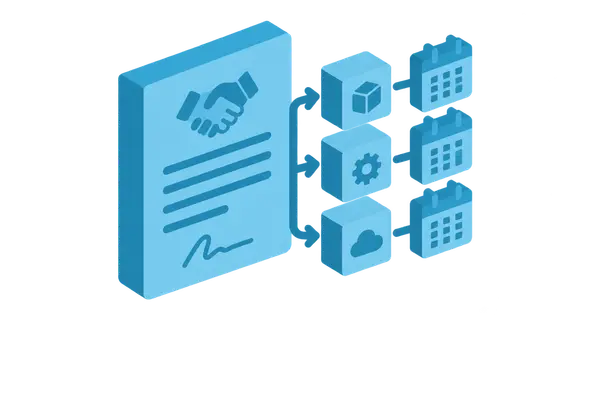

Separate promises have separate transfer dates
A customer signs a contract for a machine and routine installation for a fixed $108,000.
The machine's standalone selling price is $100,000, and the installation's standalone selling price is $20,000.
The machine is delivered on June 30, and installation is completed on July 31.
The common answer is to recognize the full $108,000 on June 30.
That answer is wrong because the contract contains separate promises, and consideration must be allocated to each promise's transfer date.
The first answer treats shipment as the only relevant event. The rule instead separates the promises, determines each amount, and tests when control transfers.
Contract, promises, price, allocation and timing
Each stage limits the next one. No contract means no revenue, no distinct promise means combination, and no allocation means no reliable amount for each transfer.
🔑 RULE: Apply the contract, distinctness, transaction price, allocation, and control-transfer stages in sequence. All five contract criteria must be met; either allocation or timing branches must then be applied as stated.
Contract existence: Under ASC 606-10-25-1, account for a contract only when:
- The parties have approved it and are committed to perform.
- Each party's rights regarding the goods or services can be identified.
- Payment terms can be identified.
- The contract has commercial substance.
- It is probable the entity will collect the consideration.
All five conditions must be met.
Performance obligations: A promised good or service is distinct only when it is capable of being distinct and is distinct within the context of the contract. Both conditions must be met.
Transaction price: Use the amount of consideration to which the entity expects to be entitled for transferring the promised goods or services. Exclude amounts collected for third parties.
Estimate variable consideration using the expected value or most likely amount. Include it only when it is probable that a significant reversal in cumulative revenue will not occur.
Do not adjust for a significant financing component when the period between transfer and payment is one year or less. This is the practical expedient.
Allocation: Allocate the transaction price to performance obligations based on relative standalone selling prices.
Allocate variable consideration entirely to one performance obligation only when the terms relate specifically to that obligation and the allocation is consistent with the allocation objective.
Timing: Recognize revenue over time when any one of these three ASC 606-10-25-27 conditions is met:
- The customer simultaneously receives and consumes the benefits.
- The entity's performance creates or enhances an asset the customer controls.
- The asset has no alternative use, and the entity has an enforceable right to payment for performance completed to date.
Otherwise, recognize revenue at the point in time when control transfers. Indicators include legal title, physical possession, risks and rewards, a present right to payment, and customer acceptance.
Probable is a judgment about likelihood, not a fixed percentage. Do not replace it with an invented cutoff.
The criteria combine in sequence. The allocation and timing rules then determine the amount and date for each promise.
Transaction price, allocation and transfer timing
The transaction-price stage includes the variable-consideration constraint and the financing practical expedient. The timing branch tests the three over-time conditions.
Loading diagram…
The worked contract follows the qualifying path, allocates the price, and uses separate transfer dates.
Machine and installation revenue allocation
The facts below apply each stage to the machine and installation. The final row gives the revenue amount and timing verdict.
| Fact | Criterion it touches | Met or not met |
|---|---|---|
| The parties approved and signed an enforceable contract; rights and payment terms are clear, the contract has commercial substance, and collection is probable. | ASC 606-10-25-1 contract criteria | Met |
| The machine and routine installation are each capable of being distinct and distinct within the contract's context. | Distinct performance obligations | Met |
| The contract price is fixed at $108,000, with no variable, noncash, or customer-payable consideration. | Transaction price | Met |
| Standalone selling prices are $100,000 and $20,000; total standalone selling prices are $120,000. | Relative standalone selling prices | Met |
| Allocation is $108,000 × $100,000 ÷ $120,000 = $90,000 to the machine. | Relative standalone selling prices | Met |
| Allocation is $108,000 × $20,000 ÷ $120,000 = $18,000 to installation. | Relative standalone selling prices | Met |
| Payment is due August 30, 30 days after installation and 61 days after machine delivery. | Significant financing practical expedient | Met; no financing adjustment |
| The machine is delivered and control transfers on June 30. | Point-in-time control transfer | Met; recognize $90,000 |
| Installation is completed and control transfers on July 31. | Point-in-time control transfer | Met; recognize $18,000 |
| Verdict | Recognize $90,000 on June 30 and $18,000 on July 31, for total revenue of $108,000. | The wrong answer came from skipping distinctness, relative allocation, and the separate installation transfer date. |
The contract qualifies, the promises are distinct, and the $108,000 is split between two transfer dates.
Constraining the installation bonus
The facts below add variable consideration and require the constraint to be applied before allocation.
| Fact | Rule check | Verdict |
|---|---|---|
| The contract has $120,000 fixed consideration plus a $20,000 installation bonus. | Transaction price and variable-consideration constraint | |
| The machine's standalone selling price is $100,000, and installation's is $20,000. | Relative standalone selling prices | |
| At signing on July 1, the bonus has a 50% chance and cannot be included without probable significant reversal protection. | Variable-consideration constraint | |
| The machine transfers August 1; installation is completed on time September 30. | Control transfer and bonus resolution | |
| Payment is due October 31. | Financing practical expedient | |
| Verdict | Determine the revenue recognized on August 1 and September 30. | ? |
Practice
Under the stated facts, what revenue should be recognized on August 1 and September 30?
The correct path keeps the bonus out initially, then assigns it to installation when the condition is met.
Allocation, financing and over-time recognition
These cases change one rule at a time. The wrong choices each misapply a specific allocation, financing, or timing criterion.
Practice
In the worked contract, how much revenue is recognized on June 30 when the machine is delivered?
A service transfers on January 1, and fixed consideration is due July 1 of the following year, 18 months later. Which treatment is required?
A customer receives a custom asset as the entity builds it, the asset has no alternative use to the entity, and the entity has an enforceable right to payment for performance completed to date. How should revenue be recognized?
Allocation, financing, and the over-time test each control a different part of the verdict.
When installation is not distinct
Was: An enforceable contract covered a $108,000 machine and routine installation, with standalone selling prices of $100,000 and $20,000, delivery June 30, completion July 31, and payment August 30.
Now: The customer cannot benefit from the machine without the seller's installation, and the seller provides no other service separately; does the verdict change?
Answer: Yes, the verdict changes. The distinct criterion is no longer met, so the machine and installation form one performance obligation, and $108,000 is recognized when the completed machine transfers on July 31.
The changed fact removes the separate-performance-obligation result. The earlier allocation and June 30 recognition no longer apply because distinctness changed.
Contract revenue amount and timing rules
Contract: All five ASC 606-10-25-1 conditions must be met.
Distinct promises: Both capable of being distinct and distinct within the contract's context must be met.
Transaction price: Include expected consideration, but constrain variable consideration when a significant reversal is probable.
Allocation: Use relative standalone selling prices, with a specific exception for qualifying variable consideration.
Timing: Recognize over time if any one of the three conditions is met; otherwise recognize at point-in-time control transfer.
Combining rule: Apply the criteria in sequence, then allocate the amount and place each amount at its transfer date.
Criterion people skip: The variable-consideration constraint.
The next chapter, Resolving revenue discrepancies with analytics, uses analytic results to find mismatches after contract-based amount and timing have been determined.
Unlock the full lesson and continue reading
Signup to continue reading this lesson and unlimited access questions, flashcards, AI notes, and more