
Revenue recognition

On this page
Revenue follows transferred goods and services
Revenue recognition records income when an entity transfers promised goods or services to a customer. It does not wait for an invoice or cash collection. Customers, lenders, management, investors, and auditors use revenue to see what the entity earned in each reporting period.
ASC 606 states the core principle. Revenue depicts the transfer of promised goods or services to customers. The amount reflects the money the entity expects to receive. ASC 606 calls that money consideration.
The process answers two linked questions. How much consideration belongs to each promise? When does the customer receive the good or service? Contract terms provide evidence for both answers. One contract can produce product revenue on one date, installation revenue on another date, and service revenue over a period. The five-step model in ASC 606-10-05-4 through 05-5 connects those decisions.
Contract evidence drives the revenue schedule
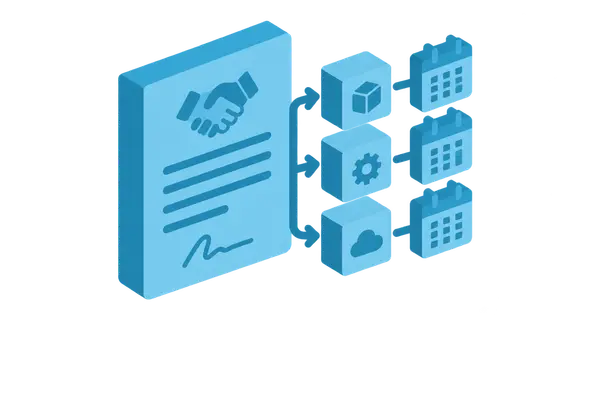
Read the flow from left to right. Contract evidence identifies the promises. The price stage measures fixed and variable consideration. Allocation assigns that price to each promise. Transfer timing determines the reporting period. The expected revenue schedule is then compared with the ledger. Exceptions are traced back to contract evidence and corrected.
Loading diagram…
The first four nodes create the amount and timing expected in the accounts. Analytics comes after that schedule because a ledger difference needs a contract-based expectation.
Promises, price, allocation and timing
Distinct promises come first
Under ASC 606-10-25-1, a contract must be approved and have identifiable rights and payment terms. It must have commercial substance and probable collectibility.
Probable is a judgment word. It means likely to occur, not a fixed percentage.
A promised good or service is distinct when the customer can benefit from it alone or with readily available resources. It must also be separately identifiable in the contract.
The customer can use the machine without the seller's installation. Installation does not significantly integrate or modify the machine. Support is a separate stand-ready service. These facts create three performance obligations.
The detailed promise analysis is in Reading contracts for revenue amount and timing.
Price must include only supportable consideration
The fixed contract price is $153,000. The possible installation bonus is $17,000. At January 1, significant reversal risk constrains the bonus to $0.
Transaction price includes fixed and variable consideration under ASC 606-10-32-2. Variable consideration is included only when a significant reversal is not probable.
Use the most likely amount for a single bonus. Use expected value when a range of outcomes better represents the consideration.
On April 30, the risk is gone. The $17,000 bonus is included. The contract terms relate the bonus specifically to installation. Therefore, the full amount is allocated to installation under ASC 606-10-32-36.
The constraint update appears in Reading contracts for revenue amount and timing.
Allocation follows standalone selling prices
The machine, installation, and support standalone selling prices are $120,000, $30,000, and $20,000. Total standalone selling prices are $170,000.
Allocate the $153,000 fixed price using relative standalone selling prices:
- The machine receives $108,000.
- Installation receives $27,000.
- Support receives $18,000.
The $17,000 bonus is added to installation. Final allocations are $108,000 for the machine, $44,000 for installation, and $18,000 for support.
Relative standalone selling price is the usual basis under ASC 606-10-32-28. A residual approach is permitted only when standalone selling price is highly variable or uncertain under ASC 606-10-32-34.
Payment 30 days after invoicing does not require a financing adjustment here. The practical expedient applies when the period between transfer and payment is one year or less. ASC 606-10-32-18 addresses significant financing.
The allocation schedule appears in Reading contracts for revenue amount and timing.
Transfer timing creates the schedule
Recognize a performance obligation at a point in time when control transfers. Recognize it over time when one of the ASC 606-10-25-27 and 25-30 criteria applies:
- The customer simultaneously receives and consumes the benefits.
- The customer controls the asset as it is created or enhanced.
- The asset has no alternative use, and the entity has an enforceable right to payment.
The machine transfers on March 31. Recognize its $108,000 then.
Installation transfers on April 30. Recognize its $44,000 then.
The 12-month support service begins May 1. Recognize $1,500 for the first month.
If installation were not distinct from the machine, there would be no separate installation allocation or transfer date.
The transfer schedule appears in Reading contracts for revenue amount and timing.
Analytics tests the expected schedule
Build expected revenue from the contract schedule. Compare it with ledger revenue by promise, amount, and period.
At May 31, expected cumulative revenue is:
- Machine revenue of $108,000.
- Installation revenue of $44,000.
- Support revenue of $1,500.
- Total revenue of $153,500.
The ledger shows:
- Machine revenue of $120,000.
- Installation revenue of $27,000.
- Support revenue of $0.
- Total revenue of $147,000.
The total difference is $6,500. More useful findings are the $12,000 machine overstatement, the $17,000 installation understatement, and the $1,500 support omission.
AU-C 520.05 through .07 requires analytical procedures to evaluate plausible relationships. Significant or inconsistent results must be investigated.
The evidence trail is in Resolving revenue discrepancies with analytics.
Promises, price, allocation and timing


The schedule carries amount and timing
The carried artifact is a revenue schedule with one row for each performance obligation. It includes contract evidence, standalone selling price, allocated transaction price, constraint status, transfer pattern, transfer date, cumulative revenue, and ledger revenue.
In the central case, the schedule carries $108,000 for the machine on March 31. It carries $44,000 for installation on April 30. It carries $1,500 of support through May 31.
Its expected total moves from $152,000 at April 30 to $153,500 at May 31. A net unbilled right is presented as a contract asset under ASC 606-10-45-1 through 45-4.
If price or allocation is wrong, every downstream amount is wrong. If a transfer date is wrong, revenue lands in the wrong period. If a bonus or support month is omitted, analytics may flag the ledger or miss an offsetting error.
Promise, price, allocation, transfer and analytics
The same contract produces different decisions, so keep their inputs separate. Promise identification asks what the customer receives. Price asks what consideration is supportable. Allocation assigns that consideration. Transfer and analytics determine when it appears and whether the ledger agrees.
| Decision | Trigger | What is received | What is recognized | Time limit or basis |
|---|---|---|---|---|
| Promise separation | Distinct test is met | Machine | Separate performance obligation | ASC 606-10-25-19 through 25-22 |
| Promise separation | Distinct test is met | Installation | Separate performance obligation | ASC 606-10-25-19 through 25-22 |
| Promise separation | Distinct test is met | Support | Separate stand-ready obligation | ASC 606-10-25-19 through 25-22 |
| Variable consideration | Bonus uncertainty exists | $17,000 installation bonus | $0 while constrained | Probable no significant reversal |
| Variable consideration | Reversal risk is gone | Installation bonus | $17,000 included | Update the constraint |
| Allocation | Fixed price covers promises | Machine | $108,000 | Relative standalone selling price |
| Allocation | Fixed price covers promises | Installation | $27,000 | Relative standalone selling price |
| Allocation | Fixed price covers promises | Support | $18,000 | Relative standalone selling price |
| Allocation | Bonus has a specific link | Installation | $17,000 additional | ASC 606-10-32-36 |
| Allocation | Final allocated amount | Installation | $44,000 | Fixed allocation plus bonus |
| Transfer | Control transfers March 31 | Machine | $108,000 | Point in time |
| Transfer | Control transfers April 30 | Installation | $44,000 | Point in time |
| Transfer | Support service begins May 1 | Support | $1,500 | Over time |
| Analytics | Expected schedule is complete | Cumulative revenue | $153,500 | By promise and period |
| Analytics | Ledger data is available | Ledger revenue | $147,000 | Investigate under AU-C 520 |
The fixed allocation amounts stay separate from the $17,000 bonus because the bonus has a specific installation link.
Machine, installation, support and bonus
On January 1, an approved contract includes one machine, installation, and 12-month support. The customer can use the machine without the seller's installation. Installation does not significantly integrate or modify the machine.
Standalone selling prices are machine $120,000, installation $30,000, and support $20,000. Total standalone selling prices are $170,000. The fixed contract price is $153,000.
A $17,000 installation bonus has significant reversal risk at January 1. On April 30, installation is complete. It is probable that no significant reversal will occur. The bonus relates specifically to installation.
Payment is due 30 days after each invoice. The machine transfers March 31. Installation finishes April 30. Support runs from May 1 through the next April 30.
At May 31, the ledger reports machine revenue of $120,000, installation revenue of $27,000, and support revenue of $0. Assume the net unbilled right is recorded as a contract asset.
Determine the performance obligations, transaction price, allocation, revenue through May 31, ledger variances, and correction.
The fixed-price allocations use relative standalone selling prices:
- Machine: $153,000 × $120,000 ÷ $170,000 = $108,000.
- Installation: $153,000 × $30,000 ÷ $170,000 = $27,000.
- Support: $153,000 × $20,000 ÷ $170,000 = $18,000.
Three changed facts test distinctness, financing, and bonus allocation.
Hook facts
- The machine cannot function without the seller's installation.
- The seller significantly integrates installation into the machine.
Determine whether installation is separate.
Your-turn facts
- The machine's allocated cash price is $108,000.
- Payment occurs exactly two years after March 31.
- The stated financing rate is 10% annually.
Determine revenue at transfer and the later finance income.
Change-one-thing facts
- The central dates remain unchanged.
- The bonus remains constrained until April 30.
- The $17,000 bonus applies to the overall arrangement.
Determine the allocation after the constraint is removed.
The transfer dates and ledger amounts produce the revenue records and correction below.
| Stage | Evidence or calculation | Line item | Amount | Timing | Chapter source |
|---|---|---|---|---|---|
| Identify promises | Each promise is distinct | Performance obligations | Three | January 1 | Reading contracts for revenue amount and timing |
| Set transaction price | Fixed contract price | Fixed consideration | $153,000 | January 1 | Reading contracts for revenue amount and timing |
| Set transaction price | Bonus has significant reversal risk | Constrained bonus | $0 | January 1 | Reading contracts for revenue amount and timing |
| Set transaction price | Reversal risk is gone | Installation bonus | $17,000 | April 30 | Reading contracts for revenue amount and timing |
| Set transaction price | Fixed price plus included bonus | Final transaction price | $170,000 | April 30 | Reading contracts for revenue amount and timing |
| Allocate consideration | Relative standalone selling price | Machine allocation | $108,000 | Contract allocation | Reading contracts for revenue amount and timing |
| Allocate consideration | Relative standalone selling price | Installation allocation | $27,000 | Contract allocation | Reading contracts for revenue amount and timing |
| Allocate consideration | Relative standalone selling price | Support allocation | $18,000 | Contract allocation | Reading contracts for revenue amount and timing |
| Allocate consideration | Bonus relates specifically to installation | Bonus allocation | $17,000 | April 30 | Reading contracts for revenue amount and timing |
| Allocate consideration | Fixed allocation plus specific bonus | Final machine allocation | $108,000 | Final schedule | Reading contracts for revenue amount and timing |
| Allocate consideration | Fixed allocation plus specific bonus | Final installation allocation | $44,000 | Final schedule | Reading contracts for revenue amount and timing |
| Allocate consideration | Fixed allocation plus specific bonus | Final support allocation | $18,000 | Final schedule | Reading contracts for revenue amount and timing |
| Recognize revenue | Machine control transfers | Machine revenue | $108,000 | March 31 | Reading contracts for revenue amount and timing |
| Recognize revenue | Installation transfers | Installation revenue | $44,000 | April 30 | Reading contracts for revenue amount and timing |
| Recognize revenue | Support is $18,000 over 12 months | May support revenue | $1,500 | May 1 through May 31 | Reading contracts for revenue amount and timing |
| Recognize revenue | Machine plus installation | Expected revenue | $152,000 | April 30 | Reading contracts for revenue amount and timing |
| Recognize revenue | Machine, installation, and May support | Expected revenue | $153,500 | May 31 | Reading contracts for revenue amount and timing |
| Compare ledger | Ledger machine amount | Machine ledger revenue | $120,000 | May 31 | Resolving revenue discrepancies with analytics |
| Compare ledger | Ledger installation amount | Installation ledger revenue | $27,000 | May 31 | Resolving revenue discrepancies with analytics |
| Compare ledger | Ledger support amount | Support ledger revenue | $0 | May 31 | Resolving revenue discrepancies with analytics |
| Compare ledger | Sum of ledger revenue | Ledger total revenue | $147,000 | May 31 | Resolving revenue discrepancies with analytics |
| Correct ledger | Expected revenue is lower | Machine revenue decrease | $12,000 | May 31 | Resolving revenue discrepancies with analytics |
| Correct ledger | Expected revenue is higher | Installation revenue increase | $17,000 | May 31 | Resolving revenue discrepancies with analytics |
| Correct ledger | Expected revenue is higher | Support revenue increase | $1,500 | May 31 | Resolving revenue discrepancies with analytics |
| Correct ledger | Net unbilled right is required | Contract asset increase | $6,500 | May 31 | Resolving revenue discrepancies with analytics |
The correction debits machine revenue $12,000 and the contract asset $6,500. It credits installation revenue $17,000 and support revenue $1,500.
Hook answer. Installation is not separate. The machine and installation are one combined performance obligation. There is no separate allocation. Recognize the combined obligation when transferred unless an over-time criterion applies.
Your-turn answer. The one-year practical expedient does not apply to a two-year delay. Revenue at transfer is $108,000. The payment is $130,680. Finance income over two years is $22,680, not revenue.
Change-one-thing answer. The bonus is allocated across the overall arrangement using relative standalone selling prices:
- Machine allocation is $120,000.
- Installation allocation is $30,000.
- Support allocation is $20,000.
Revenue decisions from promises through analytics
The items move from identifying promises to allocating constrained consideration. They then test service recognition over time and analytics correction. Each rationale names the contract evidence or analytic output that controls the answer.
Practice
Under the central contract, the customer can use the machine without the seller's installation, and the installation does not significantly integrate or modify the machine. How many performance obligations are identified?
At January 1, the $17,000 installation bonus has significant reversal risk. On April 30, the risk is gone, the installation is complete, and the contract says the bonus relates specifically to installation. What amount of bonus is added to installation revenue on April 30?
The support promise is allocated $18,000 and starts May 1 for 12 months. How much support revenue is recognized through May 31?
At May 31, expected cumulative revenue is machine $108,000, installation $44,000, and support $1,500. The ledger shows $120,000, $27,000, and $0. Which correction matches the evidence, assuming the net unbilled right is a contract asset?
Revenue amount and timing follow contract evidence
Distinct promises: separate a good or service when the customer can benefit from it and it is separately identifiable.
Price and allocation: constrain variable consideration until probable that no significant reversal will occur. Then allocate consideration using relative standalone selling prices unless a specific allocation rule applies.
Transfer timing: recognize each allocated amount when control transfers or as the customer receives the service over time.
Analytics: compare the contract-based expected schedule with ledger revenue by promise and period. Trace and correct every exception.
Revenue recognition as a whole: contract evidence determines the amount and timing. The schedule carries that answer into a reliable ledger.
Unlock the full lesson and continue reading
Signup to continue reading this lesson and unlimited access questions, flashcards, AI notes, and more

Practice Questions: Revenue recognition
1. A calendar-year public company reported net income of $1,200,000 and cumulative preferred dividends of $120,000. The company had 600,000 common shares outstanding through June 30 and issued 300,000 additional shares on July 1. On December 15, the company completed a 2-for-1 stock split. What basic earnings per share should the company report?
- A. $1.44
- B. $0.80
- C. $0.72
- D. $1.60
Show answer
Answer: C. $0.72
$0.72 - Income available to common shareholders is $1,080,000: $1,200,000 net income less $120,000 in cumulative preferred dividends. - Weighted-average shares are 1,500,000 after applying the 2-for-1 split retrospectively: (600,000 × 6/12 + 900,000 × 6/12) × 2, so basic EPS is $1,080,000 ÷ 1,500,000 = $0.72. $1.44 - This uses the correct $1,080,000 income available to common shareholders but divides by the 750,000 presplit weighted-average shares. - The December 15 stock split must be applied retrospectively to those shares, doubling the denominator and halving $1.44 to $0.72. $0.80 - This divides $1,200,000 net income by the correctly split-adjusted 1,500,000 weighted-average shares. - Cumulative preferred dividends of $120,000 must be deducted before calculating basic EPS for common shareholders. $1.60 - This divides $1,200,000 net income by the 750,000 presplit weighted-average shares. - It omits both the $120,000 preferred-dividend deduction and the retrospective 2-for-1 split adjustment.
2. A U.S. parent designates a derivative as a qualifying hedge of its net investment in a foreign operation. During the period, the derivative has an $80,000 gain that is entirely effective in offsetting the foreign-currency exposure. How should the parent report the gain in its consolidated financial statements?
- A. In current-period earnings as a foreign-currency transaction gain
- B. In other comprehensive income as a cash flow hedge reserve
- C. In other comprehensive income as part of the cumulative translation adjustment
- D. As a direct increase to the carrying amount of the foreign operation
Show answer
Answer: C. In other comprehensive income as part of the cumulative translation adjustment
In other comprehensive income as part of the cumulative translation adjustment - The derivative is a qualifying net investment hedge, and its $80,000 gain is entirely effective in offsetting the foreign-currency exposure. - The parent reports the effective gain in other comprehensive income as part of the cumulative translation adjustment. In current-period earnings as a foreign-currency transaction gain - Reporting the $80,000 in earnings would ignore the derivative’s qualifying net investment hedge designation. - Because the entire gain is effective, none of it is reported as a current-period foreign-currency transaction gain. In other comprehensive income as a cash flow hedge reserve - A cash flow hedge reserve applies to a cash flow hedge, not this hedge of a net investment in a foreign operation. - Although the $80,000 gain is reported in other comprehensive income, it belongs in the cumulative translation adjustment. As a direct increase to the carrying amount of the foreign operation - The $80,000 is a gain on the derivative, not a direct adjustment to the foreign operation’s carrying amount. - Its effective offset of the foreign-currency exposure determines its reporting in other comprehensive income, not as an increase in that carrying amount.
3. On January 1, Year 1, an entity grants employees equity-classified stock options with a grant-date fair value of $20,000 (assuming full vesting), vesting over two years of service. At grant, the entity estimates a 10% forfeiture rate, resulting in expected vested fair value of $18,000. At the end of Year 1, the entity revises its forfeiture estimate to 0%, as all employees are now expected to vest, and all awards do in fact vest at the end of Year 2. What compensation expense should be recognized in Year 2?
- A. $9,000
- B. $10,000
- C. $11,000
- D. $18,000
Show answer
Answer: B. $10,000
$10,000 - At the end of Year 1, the revised 0% forfeiture estimate makes cumulative expense $10,000: $20,000 grant-date fair value × one-half of the service period. - When all awards vest at the end of Year 2, total expense is $20,000, so Year 2 expense is $20,000 − $10,000 = $10,000. $9,000 - This is $18,000 × one-half, using the original 10% forfeiture estimate for Year 2. - The estimate changed to 0% at the end of Year 1, so the $18,000 expected vested amount no longer determines expense. $11,000 - This results from subtracting $9,000 from $20,000, as though the Year 1 expense remained unchanged after the revised estimate. - The end-of-Year-1 revision raises cumulative Year 1 expense to $10,000, leaving $10,000 for Year 2. $18,000 - This results from treating the original total expected vested fair value of $18,000 as expense solely in Year 2. - Compensation expense is allocated over the two years of service, and the final total reflects the $20,000 fair value of awards that vested.
4. A private company elected the accounting alternative for goodwill. On January 1, Year 1, the company recognized $5,000,000 of goodwill and determined that a 10-year amortization period was appropriate. No goodwill impairment triggering event occurred during Year 1. What goodwill balance should the company report at December 31, Year 1?
- A. $4,500,000, with no impairment test required
- B. $4,500,000, after completing a mandatory annual impairment test
- C. $5,000,000, with no impairment test required
- D. $5,000,000, after completing a mandatory annual impairment test
Show answer
Answer: A. $4,500,000, with no impairment test required
$4,500,000, with no impairment test required - Under the private-company goodwill alternative, Year 1 amortization is $500,000 ($5,000,000 ÷ 10 years). - The December 31, Year 1 balance is $4,500,000 ($5,000,000 − $500,000), and no impairment test is required because no triggering event occurred. $4,500,000, after completing a mandatory annual impairment test - The $4,500,000 balance correctly reflects Year 1 amortization of $500,000. - The elected alternative requires impairment testing only when a triggering event occurs, not annually, and none occurred during Year 1. $5,000,000, with no impairment test required - The absence of a triggering event correctly means no impairment test is required. - The $5,000,000 balance omits $500,000 of required Year 1 amortization ($5,000,000 ÷ 10), leaving $4,500,000. $5,000,000, after completing a mandatory annual impairment test - The $5,000,000 balance omits the required $500,000 of Year 1 amortization. - A mandatory annual impairment test also does not apply under the elected alternative when no triggering event occurred.
5. A U.S. parent designates a qualifying forward contract as a hedge of its net investment in a foreign operation. During the year, the forward contract has a $130,000 gain. The documented effectiveness assessment attributes $110,000 of the gain to the effective hedge relationship and $20,000 to an excluded component that the parent elected to recognize immediately in earnings. How should the gain be reported?
- A. $110,000 in the cumulative translation adjustment and $20,000 in earnings
- B. $130,000 in the cumulative translation adjustment and $0 in earnings
- C. $20,000 in the cumulative translation adjustment and $110,000 in earnings
- D. $0 in the cumulative translation adjustment and $130,000 in earnings
Show answer
Answer: A. $110,000 in the cumulative translation adjustment and $20,000 in earnings
$110,000 in the cumulative translation adjustment and $20,000 in earnings - The $110,000 effective gain on the qualifying net investment hedge is reported in the cumulative translation adjustment within other comprehensive income. - The parent elected to recognize the $20,000 excluded component immediately in earnings, accounting for the full $130,000 gain. $130,000 in the cumulative translation adjustment and $0 in earnings - Reporting the entire $130,000 in the cumulative translation adjustment would incorrectly include the $20,000 excluded component. - That allocation results from overlooking the parent’s election to recognize the excluded component immediately in earnings. $20,000 in the cumulative translation adjustment and $110,000 in earnings - This allocation reverses the treatment of the $110,000 effective hedge gain and the $20,000 excluded component. - The effective gain belongs in the cumulative translation adjustment, while the elected immediate recognition applies to the excluded component. $0 in the cumulative translation adjustment and $130,000 in earnings - Reporting the entire gain in earnings would disregard the forward contract’s qualifying net investment hedge designation. - Only the $20,000 excluded component is recognized immediately in earnings; the $110,000 effective gain is reported in the cumulative translation adjustment.
6. A newly formed 401(k) plan is a defined contribution employee benefit plan that prepares financial statements under U.S. GAAP. Which financial statements should the plan present as its basic financial statements?
- A. A statement of net assets available for benefits and a statement of changes in net assets available for benefits
- B. A statement of net assets available for benefits and a statement of cash flows
- C. A statement of accumulated plan benefits and a statement of changes in accumulated plan benefits
- D. A statement of financial position and a statement of comprehensive income
Show answer
Answer: A. A statement of net assets available for benefits and a statement of changes in net assets available for benefits
A statement of net assets available for benefits and a statement of changes in net assets available for benefits - Under U.S. GAAP, a defined contribution 401(k) plan reports the net assets available to pay participants’ benefits. - Its statement of changes shows how contributions, investment activity, benefit payments, and expenses changed those net assets during the period. A statement of net assets available for benefits and a statement of cash flows - The statement of net assets available for benefits is appropriate for this 401(k) plan. - A statement of cash flows does not replace the required statement of changes in net assets available for benefits. A statement of accumulated plan benefits and a statement of changes in accumulated plan benefits - Accumulated plan benefits concern promised benefits under defined benefit plan reporting, not the account balances of a defined contribution 401(k). - This choice omits the required statements of net assets available for benefits and changes in those net assets. A statement of financial position and a statement of comprehensive income - These are general-purpose corporate statement titles, rather than the basic financial statement titles prescribed for this employee benefit plan. - A statement of comprehensive income does not replace the 401(k) plan’s statement of changes in net assets available for benefits.
Flashcards: Revenue recognition
1. True or false: Under ASC 606, revenue is recognized only when, or as, an entity satisfies a performance obligation.
Show answer
True. Revenue is recognized when, or as, an entity satisfies a performance obligation, including progressively as the obligation is satisfied over time.
2. Under ASC 606, how is a construction-contract balance classified when the entity has transferred goods or services but its right to consideration remains conditional?
Show answer
It is a contract asset. If the right to consideration is unconditional, the balance is presented as a receivable instead.
3. Under ASC 606, when is revenue recognized over time rather than at a point in time?
Show answer
Revenue is recognized over time when at least one criterion is met: the customer simultaneously receives and consumes the benefits; the customer controls the asset as it is created or enhanced; or the asset has no alternative use to the entity and the entity has an enforceable right to payment for performance completed to date.
4. Under current revenue-recognition guidance, when revenue recognized to date on an over-time construction contract exceeds progress billings, what is the excess generally called?
Show answer
A contract asset. Historically, it was often described as costs and estimated earnings in excess of billings on an uncompleted contract.
Everything you need for CPA prep
Get full Oncourse access with lessons, practice questions, flashcards and AI study tools.
Scan to download app