
Public company reporting

On this page
SEC filing content and responsibility
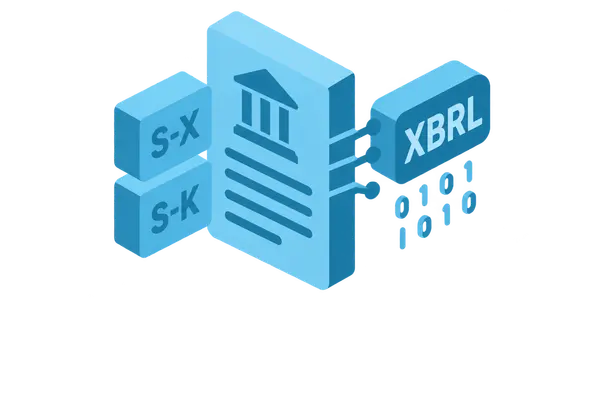
Public company reporting decides what an SEC registrant must include in a filing and how it must present that information. Financial statements and notes follow Regulation S-X. Business descriptions, legal proceedings, risk factors, and management's discussion follow Regulation S-K. XBRL adds machine-readable tags without changing the underlying accounting.
Management applies these rules to the issuer's facts and remains responsible for the filing. The SEC sets filing requirements. The auditor audits the required financial statements. Neither replaces management's responsibility.
For segment reporting, the chief operating decision maker's review helps determine which internal components are operating segments. These rules help investors compare companies, understand risks, and use reported amounts and structured data. Without them, an issuer could omit a key risk or hide weak operations among profitable ones.
Filing type, information type and segments
Start with the filing type. Then identify whether the information is financial, narrative, or structured data. Finally, evaluate the operating-segment facts and apply the quantitative tests.
Loading diagram…
The same filing can require Regulation S-X, Regulation S-K, and XBRL. ASC 280 adds a separate judgment about operating segments and disclosures.
Rules for financial, narrative and segment reporting
Financial statements and narrative information
Regulation S-X controls the form and content of SEC financial statements. It appears in 17 C.F.R. Part 210.
For a full annual filer, Rule 3-01 requires balance sheets for the two most recent fiscal years. Rule 3-02 requires three years of statements of comprehensive income, cash flows, and changes in stockholders' equity.
Rule 10-01 governs condensed interim statements in Form 10-Q. A smaller reporting company follows applicable Article 8 requirements, including Rule 8-03. Rule 3-12 addresses the age of financial statements.
Regulation S-K governs nonfinancial information in 17 C.F.R. Part 229. Item 101 covers the business description. Item 103 covers legal proceedings. Item 105 covers risk factors. Item 303 covers MD&A.
A Form 8-K follows item-specific current-reporting requirements. The filing type and information type decide the regulation, not the issuer's preference.
The filing-content detail is in SEC reporting requirements and XBRL.
Inline XBRL tags required facts
Regulation S-T appears in 17 C.F.R. Part 232. Rule 405 requires Inline XBRL for covered SEC filings.
Inline XBRL embeds tags in the human-readable filing. A computer can identify a fact's:
- Taxonomy concept.
- Entity.
- Reporting period.
- Unit, when the fact is numeric.
Required financial statement line items and note facts are tagged. Required nonfinancial facts specified by the SEC are also tagged.
An extension may be used when the standard taxonomy lacks a suitable concept. The tagged fact must still represent the issuer's reported information.
XBRL improves search, comparison, and analysis. It does not replace financial statements, change GAAP amounts, or make an estimate more precise.
The tagging detail is in SEC reporting requirements and XBRL.
Operating segments and the 10% tests
ASC 280-10-50-1 through 50-22 defines an operating segment through three conditions:
- The component engages in activities that may earn revenues and incur expenses.
- The chief operating decision maker regularly reviews its operating results.
- Discrete financial information is available.
Components with similar economic characteristics may be aggregated only when all five factors are similar:
- Nature of products or services.
- Production processes.
- Customer type or class.
- Distribution methods.
- Applicable regulatory environment.
A segment is initially reportable when any one test reaches at least 10%. The tests use:
- Revenue, including external and intersegment revenue.
- The absolute amount of profit or loss.
- Assets.
The profit-or-loss denominator is the greater absolute amount of combined profits from profitable segments or combined losses from loss segments.
Northstar's revenue total is $1,050 million. Its revenue threshold is $105 million. Its asset total is $980 million, creating a $98 million asset threshold. The greater profit-or-loss base is $115 million, creating an $11.5 million threshold.
Services has $100 million of revenue, a $15 million loss, and $150 million of assets. It passes the loss and asset tests.
“At least” and “10 percent or more” include equality. A failed revenue test does not end the analysis. Regular review and discrete financial information remain required.
The segment-identification detail is in Identifying and disclosing reportable segments.
Segment note and entity-wide disclosures
For each reportable segment, ASC 280 requires disclosure of:
- The factors used to identify reportable segments.
- The types of products and services.
- A measure of profit or loss.
- Total assets.
- Required revenue and other information.
Disclose external-customer revenue and intersegment revenue. Also disclose items such as interest, depreciation, depletion, amortization, equity-method income, unusual or material items, and additions to long-lived assets when applicable.
Reconcile segment revenue, profit or loss, assets, and other significant disclosed amounts to consolidated totals.
Entity-wide disclosures cover products and services, geographic information, and major customers providing 10% or more of consolidated revenue. Disclose the amount and the affected segment or segments.
The segment-disclosure detail is in Identifying and disclosing reportable segments.
Rules for financial, narrative and segment reporting


Facts that determine the reporting rule
The filing type, information type, tagging coverage, management review, economic similarity, quantitative tests, and revenue coverage each change the analysis.
| Fact in the situation | Sends you to | What changes |
|---|---|---|
| The document is an SEC filing by a registrant. | SEC filing rules | Identify whether it is annual, interim, or current. |
| The document is a full annual filing. | Regulation S-X Rules 3-01 and 3-02 | Use two balance sheets and three years of other required statements. |
| The document is an interim Form 10-Q. | Rule 10-01 or applicable Rule 8-03 | Use condensed interim statements and comparable interim information. |
| The item is business, legal, risk, or MD&A information. | Regulation S-K | Use the applicable narrative disclosure item. |
| Regulation S-T Rule 405 covers the filing. | Inline XBRL tagging | Tag required financial, note, and specified nonfinancial facts. |
| A component meets all three operating-segment conditions. | ASC 280 operating-segment analysis | Include the component in the operating-segment population. |
| Components share similar economics across all five factors. | ASC 280 aggregation | Qualifying components may be combined before testing. |
| A segment reaches at least 10% of one test. | Reportable-segment tests | The segment is initially reportable. |
| Initial reportable segments cover less than 75% of external revenue. | 75% coverage rule | Add operating segments until coverage reaches at least 75%. |
| A reportable segment or customer reaches 10% of revenue. | ASC 280 disclosures | Provide segment, reconciliation, product, geographic, and customer information. |
A failed test does not end the analysis when another test may still qualify. Coverage and disclosure requirements remain separate from filing and tagging decisions.
Northstar's filing and segment data
Northstar Public Products is a calendar-year SEC registrant and a full filer. It begins with an annual Form 10-K.
Northstar's filing contains financial statements, notes, business information, risk factors, and MD&A. Its segment ledger uses millions.
- Consumer has $350 million of external revenue, $20 million of intersegment revenue, $370 million of total revenue, $70 million of profit, and $400 million of assets.
- Industrial has $250 million of external revenue, $30 million of intersegment revenue, $280 million of total revenue, $30 million of profit, and $250 million of assets.
- Services has $100 million of external revenue, $0 of intersegment revenue, $100 million of total revenue, a $15 million loss, and $150 million of assets.
- Other A has $100 million of external revenue, $5 million of profit, and $70 million of assets.
- Other B has $100 million of external revenue, $4 million of profit, and $60 million of assets.
- Other C has $100 million of external revenue, $6 million of profit, and $50 million of assets.
- Total external revenue is $1,000 million.
- Total segment revenue is $1,050 million.
- Combined profits are $115 million.
- Combined losses are $15 million.
- Total assets are $980 million.
- The thresholds are $105 million for revenue, $11.5 million for profit or loss, and $98 million for assets.
Each row changes only the stated fact and keeps the earlier facts.
| Step and changed fact | Verdict | Pointer |
|---|---|---|
| Start: Northstar files an annual Form 10-K with statements, notes, and narrative information. | S-X governs statements, S-K governs narrative items, and Inline XBRL tags covered facts. | SEC reporting requirements and XBRL |
| Change A: The filing changes from Form 10-K to Form 10-Q. | Rule 10-01 applies to Northstar. Rule 8-03 applies when smaller reporting company requirements apply. | SEC reporting requirements and XBRL |
| Change B: A Form 10-Q note table contains untagged financial facts. | Required financial and note facts must be tagged in Inline XBRL. The table and amounts remain unchanged. | SEC reporting requirements and XBRL |
| Change C: The CODM receives separate results, reviews performance, and has discrete information for all six components. | Each component meets the operating-segment definition if it may earn revenue and incur expenses. | Identifying and disclosing reportable segments |
| Change D: Consumer and Industrial pass all three tests. Services passes the loss and asset tests. The three Other components fail all tests. | Three segments initially cover $700 million of $1,000 million, or 70%. Add Other A, reaching $800 million, or 80%. | Identifying and disclosing reportable segments |
| Change E: One customer provides $120 million of the $1,000 million external revenue. | Provide the ASC 280 major-customer disclosure, along with segment disclosures and reconciliations. | Identifying and disclosing reportable segments |
The decisive changes are filing type, tagging status, operating-segment evidence, revenue coverage, and customer concentration.
Applying the reporting rules to facts
These choices cover filing content, structured data, segment thresholds, coverage, and note disclosures. Each answer starts with the fact that selects the rule.
Practice
Northstar is a full SEC registrant filing an annual Form 10-K. Which statement is correct?
Which statement best describes Inline XBRL for Northstar's Form 10-Q?
Northstar's operating segments have total segment revenue of $1,050 million, total assets of $980 million, combined profit from profitable segments of $115 million, and combined loss from loss segments of $15 million. Services has external revenue of $100 million, no intersegment revenue, a $15 million loss, and assets of $150 million. What is the correct conclusion about Services?
Consumer, Industrial, and Services are initially reportable and together provide $700 million of Northstar's $1,000 million external revenue. Other A, Other B, and Other C each provide $100 million and fail all three 10 percent tests. One customer provides $120 million of Northstar's external revenue. Which action is required?
Facts that change the governing rule
- Financial statements and narrative information: Identify the information type and filing type, then apply Regulation S-X or Regulation S-K.
- Inline XBRL: If Rule 405 covers the filing, tag required financial, note, and specified nonfinancial facts without changing GAAP amounts.
- Operating segments: Require revenue-producing activities, regular CODM review, and discrete financial information. Aggregate only when all five similarity factors support aggregation.
- Reportability and disclosure: Apply the 10% tests, reach at least 75% external-revenue coverage, and provide ASC 280 disclosures.
- First question in every situation: What fact changed the governing rule, such as filing type, information type, XBRL coverage, CODM review, discrete information, economic similarity, a 10% test, 75% coverage, or a required note fact?
Unlock the full lesson and continue reading
Signup to continue reading this lesson and unlimited access questions, flashcards, AI notes, and more

Practice Questions: Public company reporting
1. A defined contribution employee benefit plan prepares financial statements under U.S. GAAP. Which of the following sets of basic financial statements should the plan present?
- A. A statement of net assets available for benefits and a statement of changes in net assets available for benefits
- B. A statement of financial position and a statement of accumulated plan benefits
- C. A statement of plan assets and a statement of projected benefit obligations
- D. A statement of fiduciary net position and a statement of cash flows
Show answer
Answer: A. A statement of net assets available for benefits and a statement of changes in net assets available for benefits
A statement of net assets available for benefits and a statement of changes in net assets available for benefits - Under U.S. GAAP, these are the two basic statements a defined contribution employee benefit plan presents. - The first reports resources available to pay participants; the second reports how those resources changed during the period. A statement of financial position and a statement of accumulated plan benefits - A statement of accumulated plan benefits is associated with defined benefit plan reporting, not the required defined contribution plan statements. - This pair omits the required statement of changes in net assets available for benefits. A statement of plan assets and a statement of projected benefit obligations - A projected benefit obligation is a sponsoring employer’s pension-accounting measure, not a basic statement of this plan. - These statements do not present the required changes in net assets available for benefits. A statement of fiduciary net position and a statement of cash flows - Fiduciary net position is governmental accounting terminology rather than the U.S. GAAP statement name for this plan. - A statement of cash flows is not one of the two required basic statements for a defined contribution employee benefit plan.
2. A defined contribution employee benefit plan prepares financial statements in accordance with U.S. GAAP. At what amount should plan investments be reported in the statement of net assets available for benefits?
- A. Fair value
- B. Historical cost
- C. Amortized cost
- D. Lower of cost or market
Show answer
Answer: A. Fair value
Fair value - Under U.S. GAAP, a defined contribution plan generally reports investments at fair value in its statement of net assets available for benefits. - Fair value reflects the investments’ current measurement rather than the amount the plan paid for them. Historical cost - Historical cost is the original amount paid, not the required measurement basis for the plan’s investments. - It would omit changes in investment value after purchase. Amortized cost - Amortized cost adjusts an initial amount for items such as interest and principal payments, rather than measuring investments at fair value. - It is not the general reporting basis for investments in this defined contribution plan’s statement of net assets available for benefits. Lower of cost or market - Lower of cost or market would recognize a decline below cost but not an increase above cost. - The plan’s investments are generally reported at fair value, even when fair value exceeds cost.
3. On January 1, Year 1, an acquirer provisionally recognized an assumed litigation liability of $120,000 in a business combination. On June 30, Year 1, before completing its acquisition accounting, the acquirer obtained evidence that conditions existing on the acquisition date required an acquisition-date fair value of $150,000. Which adjustment is appropriate?
- A. Debit litigation loss for $30,000 and credit the litigation liability for $30,000
- B. Debit retained earnings for $30,000 and credit the litigation liability for $30,000
- C. Debit goodwill for $30,000 and credit the litigation liability for $30,000
- D. Debit the litigation liability for $30,000 and credit goodwill for $30,000
Show answer
Answer: C. Debit goodwill for $30,000 and credit the litigation liability for $30,000
Debit goodwill for $30,000 and credit the litigation liability for $30,000 - The June 30 evidence concerns conditions existing on January 1 and was obtained before acquisition accounting was complete, so it is a measurement-period adjustment to the provisional liability. - Increasing the liability from $120,000 to $150,000 requires a $30,000 credit; the resulting decrease in identifiable net assets requires a $30,000 debit to goodwill. Debit litigation loss for $30,000 and credit the litigation liability for $30,000 - The liability must increase by $30,000, but the debit belongs to goodwill, not litigation loss. - A litigation loss would treat the evidence as a postcombination event rather than information about acquisition-date conditions. Debit retained earnings for $30,000 and credit the litigation liability for $30,000 - The $30,000 credit correctly increases the liability to $150,000, but retained earnings is not the offset. - Revising a provisional acquisition-date amount during the measurement period adjusts goodwill rather than correcting retained earnings. Debit the litigation liability for $30,000 and credit goodwill for $30,000 - Debiting the liability would reduce it from $120,000 to $90,000, contrary to the $150,000 acquisition-date fair value. - Increasing an assumed liability decreases identifiable net assets, so goodwill must increase, not decrease.
4. A public company reported net income of $4,000,000 and cumulative preferred dividends of $400,000 for 20X5. It had 1,000,000 weighted-average common shares outstanding and 200,000 dilutive options with a $20 exercise price. The average market price was $25. What was diluted earnings per share?
- A. $3.00
- B. $3.46
- C. $3.60
- D. $3.85
Show answer
Answer: B. $3.46
$3.46 - Income available to common shareholders is $4,000,000 − $400,000 in cumulative preferred dividends = $3,600,000. - The treasury stock method adds 200,000 − (200,000 × $20 ÷ $25) = 40,000 shares, so diluted EPS is $3,600,000 ÷ 1,040,000 = $3.46 rounded. $3.00 - Dividing $3,600,000 by 1,200,000 shares gives $3.00. - That calculation adds all 200,000 options but omits the 160,000 shares assumed repurchased with the exercise proceeds. $3.60 - Dividing $3,600,000 by the 1,000,000 weighted-average common shares gives $3.60. - This is basic EPS; diluted EPS also includes the 40,000 incremental shares from the options. $3.85 - Dividing the full $4,000,000 net income by 1,040,000 diluted shares gives $3.85 rounded. - That calculation fails to subtract the $400,000 in cumulative preferred dividends before computing earnings available to common shareholders.
5. A private company reporting under U.S. GAAP elects the accounting alternative for goodwill after completing a business combination. Which of the following treatments should the company apply to the recognized goodwill?
- A. Amortize goodwill over 10 years, or a shorter demonstrable useful life, and test it for impairment when a triggering event occurs.
- B. Do not amortize goodwill, and perform a quantitative impairment test at least annually regardless of triggering events.
- C. Write off goodwill directly to retained earnings on the acquisition date and reassess the acquired assets annually.
- D. Amortize goodwill over 40 years and perform an annual impairment test at the reporting-unit level.
Show answer
Answer: A. Amortize goodwill over 10 years, or a shorter demonstrable useful life, and test it for impairment when a triggering event occurs.
Amortize goodwill over 10 years, or a shorter demonstrable useful life, and test it for impairment when a triggering event occurs. - Under the elected private-company alternative, recognized goodwill is amortized over 10 years unless a shorter useful life is more appropriate. - The company tests goodwill for impairment when a triggering event indicates that its carrying amount may not be recoverable. Do not amortize goodwill, and perform a quantitative impairment test at least annually regardless of triggering events. - Nonamortization belongs to the general goodwill model, not the private-company alternative elected here. - The elected alternative calls for impairment testing upon a triggering event, rather than an annual test regardless of events. Write off goodwill directly to retained earnings on the acquisition date and reassess the acquired assets annually. - Goodwill from the business combination is recognized as an asset, not charged directly to retained earnings. - The alternative addresses amortization and event-driven impairment of goodwill; it does not require annual reassessment of the acquired assets. Amortize goodwill over 40 years and perform an annual impairment test at the reporting-unit level. - The alternative specifies 10 years, or a shorter appropriate useful life, not 40 years. - It does not require an annual impairment test when no triggering event occurs.
6. On December 31, 20X5, a company transferred a building with a carrying amount of $1,200,000 and a fair value of $1,800,000 to a financing entity for $1,800,000. The company simultaneously leased the building for five years and retained a substantive option to repurchase it for a fixed price. Immediately after the transfer, what amounts should the company report for the building and the related financial liability?
- A. Building of $0 and financial liability of $0
- B. Building of $0 and financial liability of $1,800,000
- C. Building of $1,800,000 and financial liability of $1,800,000
- D. Building of $1,200,000 and financial liability of $1,800,000
Show answer
Answer: D. Building of $1,200,000 and financial liability of $1,800,000
Building of $1,200,000 and financial liability of $1,800,000 - The substantive fixed-price repurchase option prevents the financing entity from obtaining control, so the transfer is not a sale. - The company keeps the building at its $1,200,000 carrying amount and records a $1,800,000 financial liability for the proceeds received. Building of $0 and financial liability of $0 - Reporting no building would incorrectly treat the transfer as a sale despite the substantive repurchase option. - Reporting no liability would also omit the $1,800,000 proceeds that the company must account for as financing. Building of $0 and financial liability of $1,800,000 - The $1,800,000 liability correctly reflects the proceeds received in a financing transaction. - Derecognizing the building is the slip: because the transfer is not a sale, its $1,200,000 carrying amount remains on the books. Building of $1,800,000 and financial liability of $1,800,000 - The $1,800,000 liability correctly reflects the financing proceeds. - Measuring the building at $1,800,000 incorrectly substitutes fair value for its existing $1,200,000 carrying amount in a transaction that is not a sale.
7. An online retailer processes customer orders totaling $500,000. The retailer sets customer prices, takes title to each product before delivery, and bears loss and return risk until customer acceptance. Suppliers receive $425,000 for the products, and the retailer retains the balance. How should the retailer present the transactions?
- A. Revenue of $500,000 and cost of goods sold of $425,000
- B. Revenue of $75,000 and no cost of goods sold
- C. Revenue of $425,000 and cost of goods sold of $350,000
- D. Revenue of $500,000 and no cost of goods sold
Show answer
Answer: A. Revenue of $500,000 and cost of goods sold of $425,000
Revenue of $500,000 and cost of goods sold of $425,000 - The retailer’s pricing discretion, title before delivery, and exposure to loss and returns show that it controls the products before customers receive them. - As principal, it reports the $500,000 charged to customers as revenue and the $425,000 paid to suppliers as cost of goods sold. Revenue of $75,000 and no cost of goods sold - The $75,000 is the difference between customer payments of $500,000 and supplier payments of $425,000. - Reporting only that difference as revenue would be appropriate for an agent, not this retailer, which controls the products before transfer. Revenue of $425,000 and cost of goods sold of $350,000 - The $425,000 is the amount paid to suppliers, not the consideration charged to customers. - The facts provide no $350,000 product cost; subtracting the $75,000 retained balance from the supplier payment incorrectly treats that balance as a cost adjustment. Revenue of $500,000 and no cost of goods sold - $500,000 correctly reflects the gross revenue earned by a retailer acting as principal. - Omitting cost of goods sold ignores the $425,000 paid to suppliers for the products sold.
8. A foreign subsidiary's functional currency is the peso, and its U.S. parent's reporting currency is the U.S. dollar. At year-end, the subsidiary reports equipment with a peso carrying amount of P2,000,000. The historical, weighted-average, and year-end exchange rates are $0.050, $0.055, and $0.060 per peso, respectively. At what amount should the equipment be included in the parent's consolidated financial statements?
- A. $120,000
- B. $100,000
- C. $110,000
- D. $20,000
Show answer
Answer: A. $120,000
$120,000 - Because the subsidiary’s functional currency is the peso, its equipment is translated at the year-end rate for the parent’s dollar-denominated consolidated statements. - P2,000,000 × $0.060 per peso = $120,000. $100,000 - P2,000,000 × the historical rate of $0.050 per peso = $100,000. - The historical rate is not used to translate this equipment when the subsidiary’s functional currency is the peso. $110,000 - P2,000,000 × the weighted-average rate of $0.055 per peso = $110,000. - The weighted-average rate generally applies to income statement items, not equipment reported at year-end. $20,000 - P2,000,000 × ($0.060 − $0.050) = $20,000. - That is the difference between the year-end-rate and historical-rate amounts, not the equipment balance included in consolidation.
Flashcards: Public company reporting
1. True or False: Companies subject to SEC periodic reporting requirements generally must include MD&A in their Forms 10-K and 10-Q.
Show answer
TRUE. SEC periodic reports generally require management’s discussion and analysis (MD&A), subject to applicable filing and scaled-reporting requirements.
2. What information is included for geographic areas in entity-wide disclosures?
Show answer
Revenues and long-lived assets.
3. What do factors used to identify an entity’s reportable segments help identify, including factors based on products and services, geographic areas, or regulatory environments?
Show answer
The entity’s reportable segments
4. What should be done with factors used to identify an entity’s reportable segments, including its basis of organization?
Show answer
They should be disclosed
5. Under the ASC 280 10% tests, when is an operating segment separately reportable?
Show answer
An operating segment is separately reportable if it meets any test at 10% or more: (1) total revenue, including intersegment revenue, is at least 10% of the combined revenue of all operating segments; (2) the absolute amount of its profit or loss is at least 10% of the greater of combined profits of profitable segments or combined losses of loss-making segments; or (3) its assets are at least 10% of combined operating-segment assets.
6. Which companies are subject to segment reporting?
Show answer
Public companies only.
7. Which disclosures cover products and services, geographic areas (including revenues and long-lived assets), and major customers?
Show answer
Entity-wide disclosures.
8. What categories are included in entity-wide disclosures?
Show answer
Products and services; geographic areas (include revenues and long-lived assets); major customers.
9. Under ASC 280, how is a reportable segment’s profit or loss measured?
Show answer
It is measured using the profit-or-loss measure reported to the chief operating decision maker (CODM) for purposes of allocating resources and assessing performance. The measure may be EBIT, but it is not universally required to be EBIT.
Everything you need for CPA prep
Get full Oncourse access with lessons, practice questions, flashcards and AI study tools.
Scan to download app