Audit data and evidence
On this page
Audit data must support the opinion
Audit data is the records and information used for a stated audit purpose. It can come from client systems, source documents, or outside parties.
The auditor uses audit data to obtain audit evidence. Management supplies much of the information. Those charged with governance and financial statement users rely on the resulting opinion.
The central question is whether recorded amounts and disclosures are supported, complete, accurate, and free from material misstatement. AU-C 200 describes reasonable assurance as a high level of assurance, but not absolute assurance. AU-C 500 requires sufficient appropriate audit evidence to provide a reasonable basis for the opinion.
Data is not automatically evidence that supports a conclusion. It must answer a defined assertion question, be made usable for the procedure, and then be judged for quality and quantity. The data request is the first link in that chain.
The path from assertion to evidence
Loading diagram…
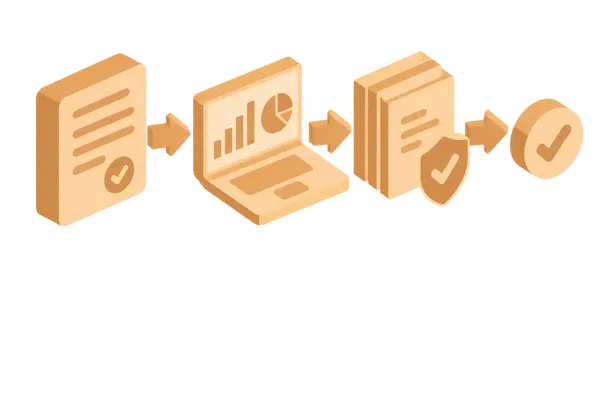
The assertion determines the requested fields. The requested fields determine the transformation and validation tests. Validated data makes analytics meaningful. Analytics identifies items needing direct or independent support. The auditor combines relevance, reliability, and quantity to decide whether the evidence supports the conclusion.
An incomplete file can hide an exception. A poor expectation can create a false exception. Evidence aimed at the wrong assertion cannot repair either problem.
Completeness and accuracy of extracted data
Start with the assertion. Request the transaction date, invoice or customer reference, amount, debit-credit sign, source status, shipping date, and source-system and general-ledger totals.
For April, the source report has 5 invoices totaling $1,260,000. The initial extract has 4 invoices totaling $1,200,000. The difference identifies a missing $60,000 invoice.
Transform revenue credits to positive amounts and debit memos to negative amounts. Standardize dates and field names. Preserve a record of each transformation.
Test completeness by comparing the source population, record count, sequences, required fields, and totals. Test accuracy by agreeing amounts, dates, customer references, and signs to source records and documents.
AU-C 500 requires evaluation of information produced by the entity. The evaluation includes accuracy, completeness, precision, and detail. A control total proves that the records in a file add to that total. It does not prove that the source population was complete or that offsetting errors do not exist.
The detailed request, transformation, completeness, and accuracy work is in Requesting, transforming and validating data.
A missing or mis-signed record changes every later result. The file must be tested before it is grouped or compared. Once the corrected file is reliable, its totals and fields can feed an analytical schedule.
Completeness and accuracy of extracted data

Analytics identifies unusual revenue differences
Use a spreadsheet query or similar automated tool to group validated revenue by month. Calculate variances, tie the schedule to the general ledger, and retain the source, formulas, output, and follow-up.
Validated monthly revenue is $900,000 for January, $1,000,000 for February, $1,100,000 for March, and $1,260,000 for April. A simple expectation based on a $100,000 monthly increase gives April expected revenue of $1,200,000.
The April difference is $1,260,000 minus $1,200,000, or $60,000. The four-month schedule totals $4,260,000 and must agree with the related general-ledger total.
Under AU-C 520, the auditor evaluates whether the data is reliable. The auditor develops an expectation precise enough to identify a misstatement. The auditor determines the difference acceptable without further investigation. Significant or inconsistent differences require inquiry and other procedures.
There is no universal variance percentage or dollar cutoff. The acceptable amount depends on engagement circumstances, materiality, risk, and the precision of the expectation.
The detailed schedule, variance follow-up, and analytics documentation are in Audit data analytics.
Analytics narrows the work by showing where the recorded amount differs from a supported expectation. It does not prove the reason for the difference. The exception directs the auditor to evidence that addresses the specific assertion.
Analytics identifies unusual revenue differences

Sufficiency, relevance and reliability
Use the AU-C 500 rule:
🔑 RULE: Sufficiency is the measure of the quantity of audit evidence. Appropriateness is the measure of its quality, including relevance and reliability.
Relevance means a logical connection to the audit purpose and assertion. Reliability is generally stronger when evidence comes from an independent outside source, is obtained directly by the auditor, is documentary, or is an original rather than a copy.
Twenty internally prepared invoices can be relevant, but their internal source affects their reliability. A customer confirmation received directly by the auditor is relevant and generally reliable for the existence of a $60,000 receivable.
A shipping document can support occurrence and cutoff. Neither item alone proves every revenue assertion or the completeness of the whole population.
A confirmation with no response requires alternative procedures under AU-C 505. A written representation is audit evidence, but it cannot provide sufficient appropriate evidence by itself under AU-C 580.
There is no fixed number of documents or population percentage that always satisfies sufficiency. Higher risk or weaker evidence generally requires more evidence.
The detailed evaluation of evidence quantity, quality, relevance, and reliability is in Sufficient appropriate evidence.
An analytics exception is only a pointer to the evidence needed next. The evidence must address the right assertion. Its quality and amount must support the conclusion rather than merely count documents.
Sufficiency, relevance and reliability

Traceability from source to conclusion
Carry the source-to-extract reconciliation, the transformed transaction file, the analytics schedule, and the exception log.
The corrected April file carries $1,260,000 from the source report into the schedule. The expectation remains $1,200,000, so the exception remains $60,000 and requires follow-up.
If the missing invoice remains out, the file shows $1,200,000 and the April difference disappears falsely. If a sign is reversed, the variance can be falsely enlarged or reduced.
If the source population is unreliable, every later total has the wrong scope. If the $60,000 exception lacks relevant and reliable support, the auditor has an explained number but not sufficient appropriate support for the full conclusion.
The same number must remain traceable from the validated file to the exception and then to the evidence request. Each handoff has a distinct purpose.
Data preparation, analytics and evidence evaluation
The shared columns show why the activities cannot replace one another. Preparation makes the input reliable, analytics identifies a difference, and evidence evaluation decides whether the difference and assertion are supported.
| Idea | Trigger | What is received | Main check or action | Output | What fails downstream if weak |
|---|---|---|---|---|---|
| Data preparation | An assertion requires usable transaction data | Source report, raw extract, required attributes, and source totals | Map signs and fields; compare 5 source records and $1,260,000 with 4 records and $1,200,000; test completeness and accuracy | Validated April file totaling $1,260,000 | An omitted or mis-signed record distorts every later result |
| Analytics | Validated data is ready for a pattern or expectation | Monthly validated revenue and the general-ledger tie-out | Calculate the $60,000 April difference from the $1,200,000 expectation and investigate it | Traceable exception and follow-up list | A false zero or false variance directs work to the wrong place |
| Evidence evaluation | An exception or assertion needs support | Customer confirmation, shipping document, internal records, and representations | Assess relevance, reliability, and quantity for the assertion | Supported conclusion or expanded procedures | A weak or irrelevant source leaves the conclusion unsupported |
Preparation, analytics, and evidence evaluation serve different purposes and must remain connected.
April revenue testing and evidence
The auditor must prepare the data, calculate and investigate the April difference, and decide what the available evidence supports.
Test the transformed amount
All 5 source records are present. A $300,000 source amount appears as $360,000 after transformation.
Answer. Test accuracy by agreeing the amount and sign to source records and documents. Matching record counts do not establish accuracy.
Case facts
- The April source report contains 4 invoices at $300,000 each.
- It contains 1 invoice at $60,000.
- The source total is $1,260,000.
- The extract contains only 4 invoices at $300,000 each.
- The extract total is $1,200,000.
- Revenue credits are positive.
- Validated January revenue is $900,000.
- Validated February revenue is $1,000,000.
- Validated March revenue is $1,100,000.
- The April expectation is $1,200,000 from a $100,000 monthly increase.
- The corrected April actual is $1,260,000.
- The resulting April difference is $60,000.
- The auditor receives 1 direct customer confirmation for the $60,000 receivable.
- The auditor has 1 shipping document agreeing to the amount.
- The shipping document is dated April 30.
The schedule carries each amount into the related procedure and keeps the conclusion limited to the assertions tested.
| Step | Source records | Source total | Extract records | Extract total | Expected April | Corrected April | Difference | General-ledger total | Work and arithmetic | Conclusion carried forward | Chapter |
|---|---|---|---|---|---|---|---|---|---|---|---|
| Prepare and validate | 5 | $1,260,000 | 4 | $1,200,000 | - | $1,260,000 | - | - | Identify the missing invoice, apply the positive-credit sign map, and test corrected fields. | The validated April file contains 5 records totaling $1,260,000. | Requesting, transforming and validating data |
| Analyze the corrected file | - | - | - | - | $1,200,000 | $1,260,000 | $60,000 | $4,260,000 | Subtract the expectation from corrected April revenue and tie the schedule to the general ledger. | The difference is real in corrected data and requires inquiry and other follow-up procedures. | Audit data analytics |
| Evaluate supporting evidence | - | - | - | - | - | - | $60,000 | - | Assess the confirmation for existence and the shipping document for occurrence and cutoff. | The items support the tested assertions, but not all April revenue assertions. | Sufficient appropriate evidence |
The procedures explain the identified difference but do not establish sufficient appropriate evidence for every April revenue assertion.
Confirmation nonresponse
The validated data and the $60,000 difference are unchanged. The customer does not reply to the confirmation.
Answer. Perform alternative procedures relevant to the assertion under AU-C 505. Do not assume that the balance is correct or wrong. A representation alone is not enough.
Changed shipping date
The customer confirms $60,000. The shipping document is dated May 2 rather than April 30.
Answer. Investigate cutoff and occurrence. The confirmation supports the balance or existence, but it does not by itself establish April recognition.
When changed facts affect evidence
Changed facts test whether the chain remains intact when a total agrees, a difference appears, a source is more or less reliable, or a confirmation receives no reply.
Practice
A revenue source report shows 5 records totaling $1,260,000. The extracted file also shows 5 records totaling $1,260,000. The source system is known to omit transactions that have no customer ID. Which conclusion is most appropriate?
Validated monthly revenue is January $900,000, February $1,000,000, March $1,100,000, and April $1,260,000. An expectation uses a $100,000 monthly increase. What is the appropriate response to the April result?
Which item is generally the strongest evidence of the existence of a $60,000 receivable, assuming the auditor selected the customer and controlled the confirmation request?
A confirmation request for the $60,000 receivable receives no reply. What is the appropriate next response?
From audit question to conclusion
- Usable data requires specified attributes, controlled transformations, and separate completeness and accuracy tests.
- Analytics requires validated inputs, a precise expectation, a tie-out, and investigation of differences.
- Evidence must be relevant and reliable, and its quantity must be sufficient for the risk and assertion. A representation cannot replace independent support.
- The full topic is a traceable path from a defined audit question through validated data and targeted evidence to a reasonable conclusion.
Unlock the full lesson and continue reading
Signup to continue reading this lesson and unlimited access questions, flashcards, AI notes, and more



Practice Questions: Audit data and evidence
1. An auditor plans to use a client-generated exception report as evidence that sales exceeding approved credit limits were reviewed. Before relying on the report, which procedure should the auditor perform?
- A. Inspect management's initials on a selection of the exceptions listed in the report
- B. Compare the current-year number of reported exceptions with the prior-year number
- C. Test the report parameters and reconcile selected report data to the underlying sales records
- D. Inquire of the credit manager whether all credit-limit exceptions appear in the report
Show answer
Answer: C. Test the report parameters and reconcile selected report data to the underlying sales records
> Key point: Before relying on a client-generated report, test whether its parameters capture relevant items and whether its data agree with underlying records. Why testing the report parameters and reconciling selected data is correct - Testing the parameters assesses whether the report captures sales exceeding approved credit limits; reconciling selected data to sales records tests accuracy. - Together, these procedures support the report’s completeness and accuracy before it is used as audit evidence. Why the other options are wrong - Inspect management's initials on listed exceptions: This may show review of listed items, but not that the report captured all qualifying sales. - Compare current-year and prior-year exception counts: A change in counts does not establish that the current-year report is complete or accurate. - Inquire whether all exceptions appear in the report: Inquiry alone does not test the report’s parameters or corroborate its data.
2. You are completing the audit of Summit Medical Devices, Inc., a nonissuer that prepares its December 31, 20X5 financial statements in accordance with U.S. GAAP. The audit is conducted under generally accepted auditing standards. Fieldwork is being completed on March 7, 20X6, the planned auditor's report date. Overall materiality is $300,000, performance materiality is $225,000, and the clearly trivial threshold is $15,000. Management has recorded no adjustments arising from the completion procedures summarized in the exhibits.
3. You are completing the audit of Apex Appliances, Inc., a nonissuer whose financial statements are prepared in accordance with U.S. GAAP for the year ended December 31, 2025. The audit is conducted under generally accepted auditing standards. The engagement team expects to date the auditor's report February 18, 2026. Use the exhibits to evaluate accounting estimates, litigation, subsequent events, accumulated misstatements, final analytical procedures, and engagement-completion documentation.
4. In planning a test of controls using attribute sampling, which of the following changes, considered independently with all other factors held constant, ordinarily increases the required sample size?
- A. Decreasing the expected population deviation rate from 3% to 1%
- B. Decreasing the tolerable deviation rate from 7% to 5%
- C. Increasing the acceptable risk of overreliance from 5% to 10%
- D. Reducing the planned degree of reliance on the tested control
Show answer
Answer: B. Decreasing the tolerable deviation rate from 7% to 5%
> Key point: A lower tolerable deviation rate ordinarily requires a larger attribute-sampling sample. Why decreasing the tolerable deviation rate from 7% to 5% is correct - A lower tolerable rate leaves less room for deviations, so the auditor needs a larger sample to support the planned reliance on the control. How they compare | Sampling change | Usual sample-size effect | |---|---| | Lower tolerable deviation rate | Increases | | Lower expected deviation rate | Decreases | | Higher acceptable risk of overreliance | Decreases | | Less planned reliance on the control | Does not increase | Why the other options are wrong - Decreasing the expected population deviation rate from 3% to 1%: A lower expected rate ordinarily reduces the sample needed. - Increasing the acceptable risk of overreliance from 5% to 10%: Accepting more risk requires less sampling assurance and ordinarily reduces the sample. - Reducing the planned degree of reliance on the tested control: Less reliance means less assurance is needed from the control test, not a larger sample.
5. During final analytical procedures for a December 31 audit, the auditor identifies an unexplained increase in gross margin from 28% to 37%. Test counts indicate that several January shipments may have been recorded as December sales. What should the auditor do before forming an audit conclusion?
- A. Test sales, shipping records, and related inventory entries immediately before and after year-end
- B. Increase the assessed control risk for the next year's revenue-cycle audit
- C. Obtain a representation that all sales were recorded in the proper accounting period
- D. Compare the current gross margin only with management's approved annual budget
Show answer
Answer: A. Test sales, shipping records, and related inventory entries immediately before and after year-end
> Key point: Suspected year-end cutoff errors require testing transactions and related records on both sides of year-end before concluding. Why cutoff testing is correct - The unexplained gross-margin increase and possible January shipments recorded as December sales point to a revenue cutoff risk. - Test sales, shipping records, and related inventory entries immediately before and after year-end to assess whether transactions were recorded in the proper period. How they compare | Action | Why it fits—or does not fit | |---|---| | Test sales, shipping records, and inventory entries around year-end | Directly investigates the suspected cutoff error in the current audit. | | Increase next year's control risk | Does not resolve whether this year's December sales are misstated. | | Obtain a management representation | Does not replace evidence from the underlying records. | | Compare gross margin only with budget | Does not establish when the January shipments were recorded. | Why the other options are wrong - Increase the assessed control risk for next year's audit: This does not investigate the possible misstatement in the current year's financial statements. - Obtain a representation about sales cutoff: A management assertion alone does not resolve the evidence suggesting a cutoff problem. - Compare gross margin only with the approved budget: Another analytical comparison cannot establish the recording period of the suspected shipments.
6. A nonissuer uses an outside appraiser to estimate the fair value of specialized property securing a material impaired loan. The appraiser has relevant credentials and experience, but the appraiser's fee increases if the estimated property value exceeds $8 million. What is the auditor's most appropriate response?
- A. Use the appraisal because the appraiser possesses the necessary competence
- B. Use the appraisal after obtaining management's representation about the appraiser
- C. Substitute the auditor's expected value for the appraiser's reported fair value
- D. Involve an auditor's valuation specialist and perform additional valuation procedures
Show answer
Answer: D. Involve an auditor's valuation specialist and perform additional valuation procedures
> Key point: An appraiser’s competence does not resolve a fee incentive that may impair objectivity. Why involving a valuation specialist and performing additional procedures is correct - The fee increase above $8 million creates an objectivity concern despite the appraiser’s relevant credentials and experience. - Because the appraisal concerns specialized property securing a material impaired loan, the auditor should use a valuation specialist and perform additional procedures to evaluate the appraisal’s methods, assumptions, and data. How they compare | Audit response | Addresses incentive? | Why it fits or fails | |---|---|---| | Involve a valuation specialist and perform additional procedures | Yes | Evaluates the appraisal and obtains further evidence | | Use the appraisal based on competence | No | Credentials do not resolve the fee incentive | | Use the appraisal with management’s representation | No | A representation does not remove the incentive or replace audit procedures | | Substitute the auditor’s expected value | No | An unsupported estimate does not evaluate the appraisal or provide a sound basis for fair value | Why the other options are wrong - Use the appraisal because the appraiser possesses the necessary competence: Competence does not establish objectivity when compensation rises above a value threshold. - Use the appraisal after obtaining management’s representation: Management’s representation does not remove the incentive or replace procedures to obtain evidence. - Substitute the auditor’s expected value for the reported fair value: An unsupported expected value is not a substitute for evaluating evidence using appropriate methods, assumptions, and data.
Flashcards: Audit data and evidence
1. What attributes should audit evidence possess?
Show answer
Audit evidence must be: - Sufficient in quantity. - Appropriate in quality, meaning relevant and reliable.
2. What is the main limitation regarding audit evidence?
Show answer
The primary constraint is the cost-versus-benefit analysis.
3. What is the primary task in forming an audit opinion?
Show answer
Gathering evidence to substantiate the audit opinion.
4. How does audit evidence affect detection risk?
Show answer
- Audit evidence and detection risk are inversely related. - Detection risk is the only audit risk factor the auditor can control through the nature, timing, and extent of audit procedures. - Inherent risk and control risk are beyond the auditor’s control.
5. What can audit evidence include?
Show answer
Audit evidence is information used by the auditor to reach conclusions. It includes accounting records underlying the financial statements and other corroborating information, such as supporting documents and information obtained from external sources.
Everything you need for CPA prep
Get full Oncourse access with lessons, practice questions, flashcards and AI study tools.
Scan to download app