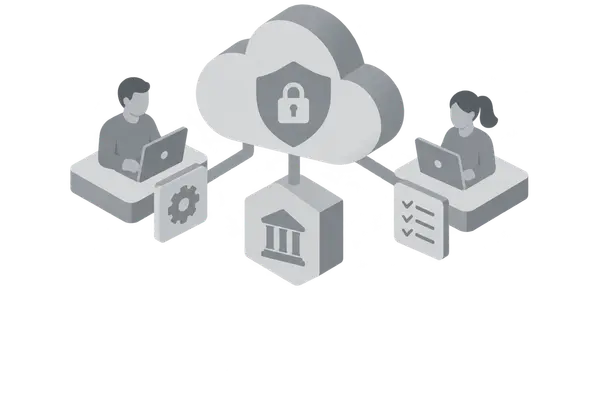
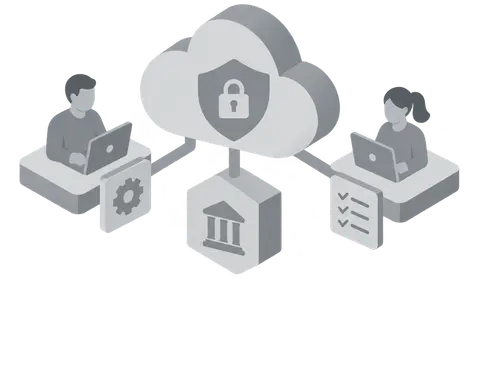
Accountability in cloud governance
Cloud computing moves systems, data, and controls into a service provider’s environment. You must know which party is accountable for each control.
This solves the governance problem of using a third party without losing responsibility for access, data, risk, and reporting. On the exam, an SLA, SOC report, outage, or incident can connect provider responsibilities with COSO’s control and enterprise-risk perspectives.
Cloud service models and governance frameworks
Use this diagram as a four-part map, not as a sequence or decision tree.
Loading diagram…
The shared-responsibility boundary changes across the 3 NIST SP 800-145 service models. In IaaS, the provider manages the underlying infrastructure and hypervisor. In PaaS, the provider also manages the operating system and runtime. In SaaS, the provider also manages the application.
You still control the data, identities, permissions, and settings available to you. The contract and control scope determine the exact boundary.
COSO Internal Control - Integrated Framework defines internal control as a process effected by an entity’s board, management, and other personnel. It provides reasonable assurance about objectives related to operations, reporting, and compliance. It has 5 components and 17 principles.
COSO Enterprise Risk Management - Integrating with Strategy and Performance links cloud risk with governance, strategy, performance, review, and reporting. It has 5 components and 20 principles.
Neither COSO framework is cloud architecture or a guarantee that provider controls work. Each is a governance and risk lens.
Cloud control responsibilities and assurance
Read the table as a responsibility map. A cloud provider is a service organization, but the service model, contract, and control scope set the boundary.
The AICPA Trust Services Criteria cover 5 categories: security, availability, processing integrity, confidentiality, and privacy. A SOC 2 report provides evidence about controls and the period within its scope. It does not remove customer responsibilities or prove every cloud control works.
COSO Internal Control applies its 5 components to the entity’s control system, including technology controls and provider oversight. COSO ERM connects cloud risks to risk appetite, strategy, performance, changing conditions, and enterprise reporting.
| Part | What it asks or covers in exam wording | Exam clue |
|---|---|---|
| Provider responsibilities | The provider operates the contracted cloud service as a service organization. In IaaS, it manages facilities, physical infrastructure, and the hypervisor. In PaaS, it also manages the operating system and runtime. In SaaS, it also manages the application. Within the agreed scope, it operates controls for security, availability, processing integrity, confidentiality, and privacy. It follows the SLA, monitors the service, and performs incident response or continuity activities promised by the contract. It may provide a SOC report or other control evidence. | service organization; cloud provider; SLA; SOC report; data center; hypervisor; provider-operated application; outage or incident response |
| Customer responsibilities | The customer remains accountable for data, users, identities, permissions, configurations, and workload controls available to it. In IaaS, this commonly includes the guest operating system and applications. In PaaS, it includes deployed applications and data. In SaaS, it includes user access, data, and service settings. The customer evaluates the contract, SOC scope, exceptions, and complementary user entity controls, and performs the controls assigned to it. | customer configuration; user access; identity; data classification; guest operating system; complementary user entity controls; customer must perform |
| COSO Internal Control - Integrated Framework | Apply the 5 components and 17 principles to cloud controls. Control Environment covers oversight, structure, competence, integrity, and accountability. Risk Assessment covers objectives, cloud and vendor risks, fraud risk, and significant change. Control Activities covers approvals, logical access, change management, encryption, and general controls over technology. Information and Communication covers relevant provider and incident information sent internally and externally. Monitoring Activities covers ongoing or separate evaluations, SOC review, testing of customer controls, and deficiency communication. | reasonable assurance; internal control; control deficiency; five components; general controls over technology; monitoring; operations, reporting, or compliance |
| COSO ERM - Integrating with Strategy and Performance | Apply the 5 components and 20 principles to enterprise cloud risk. Governance and Culture covers board oversight, operating structures, risk culture, values, and capable people. Strategy and Objective-Setting covers business context, risk appetite, alternative strategies, and objectives. Performance covers identifying, assessing, prioritizing, responding to, and viewing cloud risks as a portfolio. Review and Revision covers significant change, performance review, and improvement. Information, Communication, and Reporting covers technology-enabled information, risk communication, and reporting on risk, culture, and performance. | risk appetite; strategy; enterprise risk; risk response; portfolio view; significant change; board oversight; performance reporting |
The key distinction is simple: provider and customer responsibilities identify the control owner, while the COSO frameworks organize governance and risk over those controls.
Cloud roles and framework connections
Use only the four parts in the diagram as answer choices. These questions test recognition and understanding, not calculations or case walkthroughs.
Practice
A cloud contract says the provider will operate the data-center facilities and hypervisor, maintain the service’s security monitoring, and report outages. The customer configures its virtual machines and user permissions. Which part of the governance structure is primarily described?
An entity using SaaS assigns user roles, reviews access, classifies the data it uploads, and checks whether the provider’s SOC report covers the contracted service. Which part of the governance structure is primarily described?
Management assigns cloud-control accountability, assesses vendor and outage risks, approves least-privilege and change controls, receives provider reports, and evaluates control deficiencies. Which part of the governance structure is primarily described?
The board sets a risk appetite for cloud concentration, considers outage and privacy risks when setting strategy, prioritizes responses, reviews changed conditions, and receives portfolio-level risk reporting. Which part of the governance structure is primarily described?
Provider, customer, COSO and ERM
Provider: operates the contracted cloud service and controls the provider-side environment.
Customer: retains responsibility for its data, identities, configurations, and assigned controls.
COSO Internal Control: applies 5 components to provide reasonable assurance over cloud-related operations, reporting, and compliance.
COSO ERM: connects cloud risk with governance, strategy, appetite, performance, review, and reporting.
Unlock the full lesson and continue reading
Signup to continue reading this lesson and unlimited access questions, flashcards, AI notes, and more