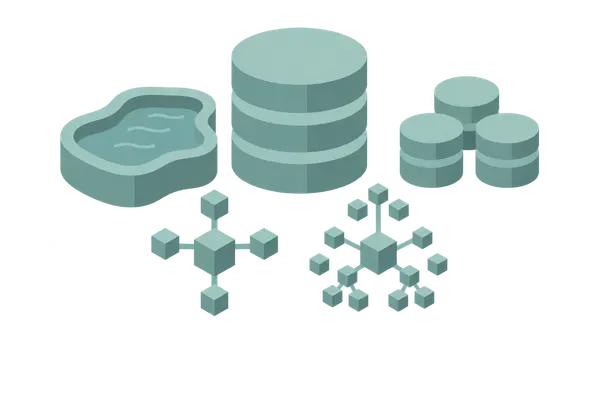
Warehouse, lake and mart roles
The data life cycle describes collection, storage, use, and retention. After data is created and collected, an organization chooses how to store and prepare it. The table compares the repository's role, not its size alone.
| Attribute | Data warehouse | Data lake | Data mart |
|---|---|---|---|
| Main purpose | Enterprise analysis, reporting, and decision support | Flexible storage and exploration of many kinds of data | Analysis and reporting for one department, function, or subject |
| Scope | Broad, organization-wide or cross-functional scope | Broad scope covering data from many sources and uses | Narrow, focused scope for a business unit or subject |
| Data form | Mostly structured, integrated business data | Structured, semi-structured, and unstructured data | Mostly structured data focused on its subject |
| Preparation | Cleansed, transformed, and organized before common use | Often kept in raw form; structure is applied when the data is used | Cleansed and organized for a specific reporting or analysis need |
| Typical content | Integrated sales, finance, customer, inventory, or operations history | Raw logs, files, sensor readings, text, images, audio, and source extracts | A sales mart, finance mart, marketing mart, or other focused subset |
| Common users | Managers, analysts, and reporting teams across the organization | Data engineers, data scientists, and analysts exploring varied data | A department's analysts and managers |
| Clue words | enterprise-wide, integrated, governed, historical reporting, curated | raw, any format, schema on read, exploratory, logs, files, sensor data | department, business function, focused subset, sales mart, marketing mart |
Notice the deciding contrast: a warehouse is broad and curated, a lake is broad and raw, and a mart is focused and curated. A mart may receive data from a warehouse or directly from source systems.
Star and snowflake table layouts
Relational database structure explains relational tables, integrity rules, the data dictionary, and normalization. Both designs use a central fact table and descriptive dimension tables. The comparison here concerns how those tables are arranged.
| Attribute | Star schema | Snowflake schema |
|---|---|---|
| Core layout | One central fact table connects directly to dimension tables | One central fact table connects to dimensions that may connect to other dimension tables |
| Dimension design | Dimensions are generally denormalized and kept wide | Dimensions are normalized and split into related tables |
| Number of joins | Usually fewer joins from a fact table to descriptive data | Usually more joins because descriptive data is split |
| Repeated values | More repeated descriptive values may be stored | Less repeated descriptive data is stored |
| Query use | Simpler queries and direct reporting paths | More complex queries but more structured dimension relationships |
| Maintenance | Easy for reporting users to understand; repeated values can require more storage or updates | More tables and joins to manage; shared dimension details can be maintained in one place |
| Clue words | directly linked, wide dimension, denormalized, fewer joins, simple reporting | normalized, split dimension, related dimension tables, more joins, less redundancy |
Notice that the fact table can hold the same business measures in either design. The deciding feature is the structure of the dimensions.
Scope, preparation and normalization
Storage cases turn on the repository's role. That role combines scope with preparation.
- Broad and raw data points to a data lake.
- Broad and curated data points to a data warehouse.
- Focused and curated data points to a data mart.
These are typical classifications, not a required data movement sequence. A mart may be fed by a warehouse or directly by source systems.
Schema cases turn on dimension normalization. One wide dimension directly connected to the fact table points to a star schema. Dimensions split into related normalized tables point to a snowflake schema. Both schemas can contain the same business facts.
Classifying warehouses, lakes and marts
The deciding line is direct: raw and broad supports a lake, curated and broad supports a warehouse, and curated and focused supports a mart.
Practice
A company combines cleaned sales, inventory, and customer data from many systems in a governed repository used for organization-wide reporting and analysis. Which description best identifies the repository?
An organization stores raw application logs, sensor readings, text files, images, and audio from many sources. Analysts decide how to structure each type when they use it. Which description best identifies the repository?
The marketing department receives a cleansed set of campaign, customer, and response data for its own reports. It does not contain the organization's full finance and operations data. Which description best identifies the repository?
Identifying star and snowflake schemas
A warehouse or mart can use either schema. Look at the dimensions rather than the repository name. Direct links and fewer joins indicate star, while split normalized dimensions indicate snowflake.
Practice
A sales fact table links directly to wide customer, product, and store dimension tables. Report writers use short queries with few joins, and some descriptive values repeat in the dimensions. Which schema is this?
A product dimension is divided into product, brand, and category tables. The tables reduce repeated descriptions, but a report must join through the related dimension tables to reach the fact table. Which schema is this?
A broader scope makes a warehouse
The classification moves because scope changed, not because the data became more structured.
Was: A company gives the sales department a cleansed repository containing sales, customer, and product data for sales reporting. Which one is this?
Answer: Data mart.
Now: The same cleansed repository is expanded to combine sales, finance, inventory, and operations data for reporting across the company.
Which one now?
Answer: Data warehouse. The changed fact is scope. The repository moved from one department to enterprise-wide coverage, while its curated preparation did not change.
Storage scope and dimension normalization
- Data warehouse: Broad, integrated, curated data for enterprise analysis.
- Data lake: Broad raw data in many formats, with structure applied when used.
- Data mart: Focused, curated data for one department or subject.
- Star schema: One fact table directly connected to wide dimensions.
- Snowflake schema: Normalized dimensions split into related tables.
The deciding axis is scope and preparation for storage, and dimension normalization for schemas. Warehouses, lakes, marts and schemas connects The data life cycle's storage stage with Relational database structure's tables and normalization.
Unlock the full lesson and continue reading
Signup to continue reading this lesson and unlimited access questions, flashcards, AI notes, and more