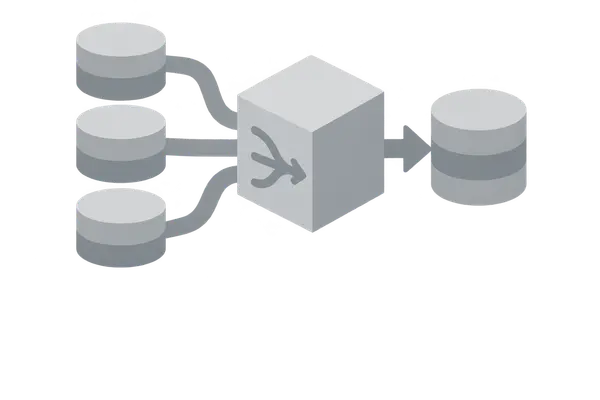
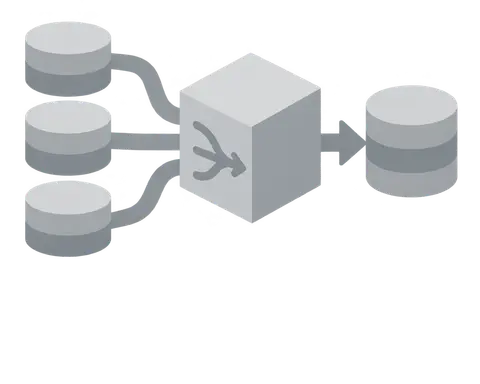
Extracting complete, correctly understood data
Business data sits in many systems, such as a CRM, an ERP, a payroll application, and shared files. These sources may use different field names, identifiers, formats, update times, and rules for missing values.
Extraction selects and obtains source data. Integration makes separate data sources usable together without changing meaning or losing important changes. Poor extraction can omit rows, repeat data, or miss deletions. Poor integration can match the wrong records, combine unlike values, or use an unauthorized path.
Source selection connects with Reviewing SQL queries. Data movement through business processes connects with Business process models and diagrams. This chapter supplies the extraction methods and integration patterns that connect those topics.
The problem is not simply moving a file or running a query. Source data must be complete, correctly understood, and allowed to move. The control rule comes first, then specific extraction and integration methods apply it.
Approved information flow and retention
These controls apply whether data is obtained by query, API, file, or change log. They also apply whether data uses ETL, ELT, or federation.
🔑 RULE: Enforce approved authorizations for controlling the flow of information within the system and between connected systems. - NIST SP 800-53 Rev. 5, AC-4
Manage and retain information within the system and information output from the system in accordance with applicable laws, executive orders, directives, regulations, policies, standards, guidelines, and operational requirements. - NIST SP 800-53 Rev. 5, SI-12
These controls set the boundary for the methods, matching work, transformations, and integration patterns that follow.
Extraction methods and integration patterns
Extraction choices answer what data is obtained, how it is accessed, and how changes are found. Integration choices align meaning, identify the same records, check quality, and determine where transformation occurs.
| Part | What it asks or covers | Clue words in a scenario |
|---|---|---|
| Query extraction | Selects specified rows and columns directly from a relational source by using a query. | SELECT, WHERE, source table, relational database, columns, filter |
| API or connector extraction | Requests data through a supported application interface or connector. | API endpoint, connector, JSON response, authentication, page, token |
| File export extraction | Reads a source-provided file and checks its structure and delivery timing. | scheduled file, CSV, JSON, XML, delimiter, encoding, export |
| Full extraction | Obtains the complete current source set for a run. | all rows, full snapshot, initial load, complete extract |
| Incremental extraction | Obtains records added or changed since the last successful extraction. | since last run, modified date, watermark, new rows, changed rows |
| Change data capture | Captures insert, update, and delete events from logs, change tables, or triggers. | CDC, transaction log, change table, trigger, insert, update, delete |
| Schema mapping | Maps source fields to target fields and aligns names, types, units, formats, and codes. | source field, target field, data type, code mapping, units, common schema |
| Record matching | Determines which records from different sources represent the same business entity. | customer ID, account key, same customer, duplicate, unmatched |
| Transformation and validation | Standardizes values, checks data, rejects invalid rows, and uses controls to check results. | clean, convert, validate, reject, quarantine, control total, lineage |
| ETL | Extracts data, transforms it before loading, and loads conforming results into the target. | ETL, transform before load, staging, conformed table |
| ELT | Extracts and loads source data first, then transforms it inside the target platform. | ELT, load raw, transform in warehouse, raw layer |
| Federation | Presents a combined virtual view while data remains in its source systems. | virtual view, live query, data stays in place, no central copy |
The extraction methods differ by access method and change scope, while the integration patterns differ by where data is aligned and stored.
Choosing extraction and integration methods
These scenarios move from source access to change capture, then to physical and virtual integration. Each answer uses one part from the same structure.
Practice
A reporting job asks a relational sales table for only posted invoices and the fields needed by the report, using a source-side SELECT with a WHERE condition. Which part is this?
A source system writes each insert, update, and delete to a change table, and the integration job reads those entries rather than scanning the full table. Which part is this?
An integration job converts source date and code values before writing only validated, common-format rows to warehouse tables. Which integration pattern describes where the conversion occurs?
CRM and ERP data stay in their own systems. A reporting tool presents a combined view by querying them when a user asks, with no central copy. Which part is this?
The labels connect source clues with the method used to extract, align, transform, or present the data.
Extraction, matching, transformation and integration
Query extraction selects source rows and columns directly.
API or connector extraction uses a supported application interface.
File export extraction reads a delivered file and checks its structure.
Full extraction takes the complete current source set.
Incremental extraction takes new or changed records after a reliable watermark.
Change data capture records inserts, updates, and deletes.
Schema mapping aligns fields, types, units, and codes.
Record matching identifies the same entity across sources.
Transformation and validation standardize, check, and trace the data.
ETL transforms before loading the target.
ELT loads first and transforms inside the target.
Federation provides a virtual view while source data stays in place.
Unlock the full lesson and continue reading
Signup to continue reading this lesson and unlimited access questions, flashcards, AI notes, and more